Lesson Plan August 4, 2026
Bold Promises to End Poverty
Country:
Grades:

This lesson was created by Rivanna Jihan, a high school teacher in Chicago, IL, as part of the Spring 2025 Pulitzer Center Teacher Fellowship program. It is designed for facilitation across approximately five days.
For more lessons created by Pulitzer Center Teacher Fellows in this cohort, click here.
Speaking to the topic of poverty, generally, it is important to stick with the information of the articles, to interrogate the systemic causes of poverty, and to challenge any thinking on the part of the students that if people just “work harder,” they can overcome the systematic oppressions of poverty as portrayed in these sets of articles. One overarching goal of this mini-unit is to derail the individualist thinking that supports the perpetuation of such systems.
Lesson Overview
This unit is designed to connect students with one another through shared experiences, regardless of geographic distance or area. In facilitating this connection, students will have the opportunity to see how their struggles exist in other regions, including regions that are different from their hometowns. Students will also have the opportunity to hear from and interact with journalists, to discuss how reporting on these issues impacts the ability of residents to get relief, and the ability of the wider world to gain understanding of communities that are often seen only in stereotypes.
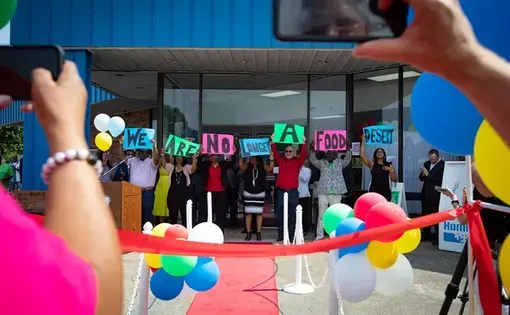
In 2020, the Illinois legislature made a bold promise to end poverty by 2036 in the state of Illinois. In this mini-unit, students will explore the impacts of poverty in Illinois following that promise. Students will examine a set of topics from two case studies, one from Chicago and the other from Alexander County, in the southern tip of the state. Each pair of students will be assigned one of the following topics, and will compare information from each location: housing, jobs, childcare, impact of incarceration, local politicians, and food deserts. Following their investigations on the topics, students will then connect online with students from another school — ideally, students in Chicago will connect with students from Southern Illinois, and vice versa, but any differences in geographically different regions (rural vs. urban, wealth vs. poor, etc.) will work. Then, all students will meet with journalists online to discuss the role of journalists and the media in telling accurate stories and sharing underreported news.
Essential Questions
- How does connecting with others impact and change our understanding of ourselves and the world?
- How are different aspects of society handling the impacts of poverty in Illinois (eg, housing, jobs, food deserts, childcare, impact of incarceration, and local politicians)?
- What role does the media play in our understanding of others and ourselves?
Performance Task
Option A (unit with school partnership)
On Day 5, students will return to the Essential Question and the Inquiry Questions they created on Day 1. In a 2-3 paragraph reflection, students will respond to the Essential Question and at least 1 Inquiry Question.
- They should cite evidence from at least two documents to support their position
- They should bring in information from the whole-class discussions with their classmates and the partner school
Option B (unit without school partnership)
- Once students have shared from each pair of articles, direct them back to their Inquiry Questions and the Essential Question.
- Spend 5-10 minutes supporting students as they bring their new information to bear on the questions. This can be done as a whole class on a screen or whiteboard, or it can be done in small groups, where each student shares information from their readings to respond to the questions.
- Finally, have students answer the essential question and at least one Inquiry Question. In a 2-3 paragraph reflection, students will respond to the questions they chose.
- They should cite evidence from at least 2 documents to support their position
- They should include information from the whole-class discussions with their classmates.
Assessment
Option A (unit with school partnership)
Create a rubric with the following criteria:
IL.SS.IS.1/3.9-12: Address essential questions that reflect an enduring issue; develop new supporting questions
- Day 1, activity 3
- Day 3, activity 3
- Day 5 activity
CCSS. RH.9-12.1-2: Determining central ideas and citing specific evidence
- Day 1, activities 1-2
- Day 2, activity 1
CCSS.RH.9-12.7: Integrating maps and charts into understanding
- Day 1, activity 2
CCSS. RH.9-12.6/9: Comparing and contrasting authors and information in more than 1 document
IL.SS.IS.4-5.9-12: Gather and evaluate information; identify evidence from multiple sources
- Day 1, activities 1-2
- Day 2, activity 2
- Day 3, activity 2
- Day 4, activity 2
CCSS.SL.9-12.1: Initiate and participate in a range of collaborative discussions
- Day 1, activity 3
- Day 3, activity 1-2
- Day 4, activity 3
CCSS.WHST.9-12.1/4: Write arguments focused on content, in a clear and concise fashion
- Day 5 activity
CCSS.WHST.9-12.8: Gather relevant information from multiple sources, integrate information, and avoid plagiarism
IL.SS.IS.6.9-12: Construct and evaluate explanations and arguments using multiple sources.
- Day 5 activity
Option B (unit without school partnership)
Create a rubric with the following criteria:
IL.SS.IS.1/3.9-12: Address essential questions that reflect an enduring issue; develop new supporting questions
- Day 1, activity 3
- Day 3 activities
CCSS. RH.9-12.1-2: Determining central ideas and citing specific evidence
- Day 1, activities 1-2
- Day 2, activity 1
CCSS.RH.9-12.7: Integrating maps and charts into understanding
- Day 1, activity 2
CCSS. RH.9-12.6/9: Comparing and contrasting authors and information in more than one document
IL.SS.IS.4-5.9-12: Gather and evaluate information; identify evidence from multiple sources
- Day 1, activities 1-2
- Day 2, activity 2
- Day 3, activity 1
CCSS.SL.9-12.1: Initiate and participate in a range of collaborative discussions
- Day 1, activity 3
- Day 3, activity 1-2
CCSS.WHST.9-12.1/4: Write arguments focused on content, in a clear and concise fashion
- Day 3, activity 3
CCSS.WHST.9-12.8: Gather relevant information from multiple sources, integrate information, and avoid plagiarism
IL.SS.IS.6.9-12: Construct and evaluate explanations and arguments using multiple sources.
- Day 3, activity 3
Notes on Context & Content Advisory
My students attend school on the South Side of Chicago and live on the South and West sides of the city. While they do not all live in poverty, their neighborhoods and our school are categorized by census tract and other demographic indicators as “poor.” Because suburbs surround Chicago, many of which are vastly wealthier than the South and West sides of Chicago, there is often an assumption that outside of Chicago, Illinois is wealthy. This unit is an exploration of the ways poverty traverses Illinois geographically, and an opportunity for students to see how people at the opposite end of the state struggle with many of the same issues that my students’ families and communities face.
Three or five-day lesson plan, including texts and graphic resources, discussion questions, and optional class activity involving an exchange with a partner school and local journalists. Download below to read the complete lesson plan.
Lesson Resources
| Pulitzer Reporting | "Illinois Made a Bold Promise To End Poverty. In Alexander County, It’s Hard To Tell." by Lylee Gibbs, Jamilah Lewis, Molly Parker and Julia Rendleman for Capitol News Illinois "Illinois Banned Life Sentences for Young Offenders—but Not for Those Already Behind Bars," by Ethan Holder, Molly Parker and Julia Rendleman for Capitol News Illinois “‘All Our Future Money Is Gone’: The Impossible Task of Providing Child Care in Rural Illinois,” by Molly Parker and Julia Rendleman for ProPublica “The Government Spends Millions To Open Grocery Stores in Food Deserts. The Real Test is Their Survival.” by Molly Parker and Julia Rendleman for Capitol News Illinois “Rice and River: A Family’s Approach to the Changing Agricultural Landscape,” by Lylee Gibbs for The Daily Egyptian “Shaped by Faith: A Young Cairo Councilman’s Coming of Age” by Lylee Gibbs and Ryan Grieser for Urban Voices |
| Teacher-created Resources | Day 1 - Press Release and Maps (.pdf) Strategic Plan Brief (.pdf) Extra Topic Articles (.pdf) (.docx) Day 2a-4a - Reading Guide & Journalist Prep (.pdf) (.docx) Day 2b - Reading Guide (.pdf) (.docx) Day 5a - Reflection (.pdf) (.docx) |
| Additional Reporting | Block Club Chicago - a parallel series of articles will be utilized from this newspaper Local broadcast and other news sources will also be investigated |
Illinois State Standards for Social Studies
IL.SS.IS.1.9-12: Address essential questions that reflect an enduring issue
IL.SS.IS.3.9-12: develop new supporting questions
IL.SS.IS.4.9-12: Gather and evaluate information from multiple sources
IL.SS.IS.5.9-12: Identify evidence from multiple sources
IL.SS.IS.6.9-12: Construct and evaluate explanations and arguments using multiple sources.
Common Core State Standards: Reading in History
CCSS. RH.11-12.1: Determining central ideas
CCSS.RH.11-12.2: Citing specific evidence
CCSS.RH.11-12.7: Integrating maps and charts into understanding
CCSS. RH.11-12.6: Comparing and contrasting authors in multiple sources.
CCSS.RH.11-12.9: Gather information from more than 1 document
Speaking and Listening
CCSS.SL.11-12.1: Initiate and participate in a range of collaborative discussions
Writing in History
CCSS.WHST.11-12.1: Write arguments focused on content.
CCSS.WHST.11-12.4: Write arguments in a clear and concise fashion
CCSS.WHST.11-12.8: Gather relevant information from multiple sources, integrate information, and avoid plagiarism
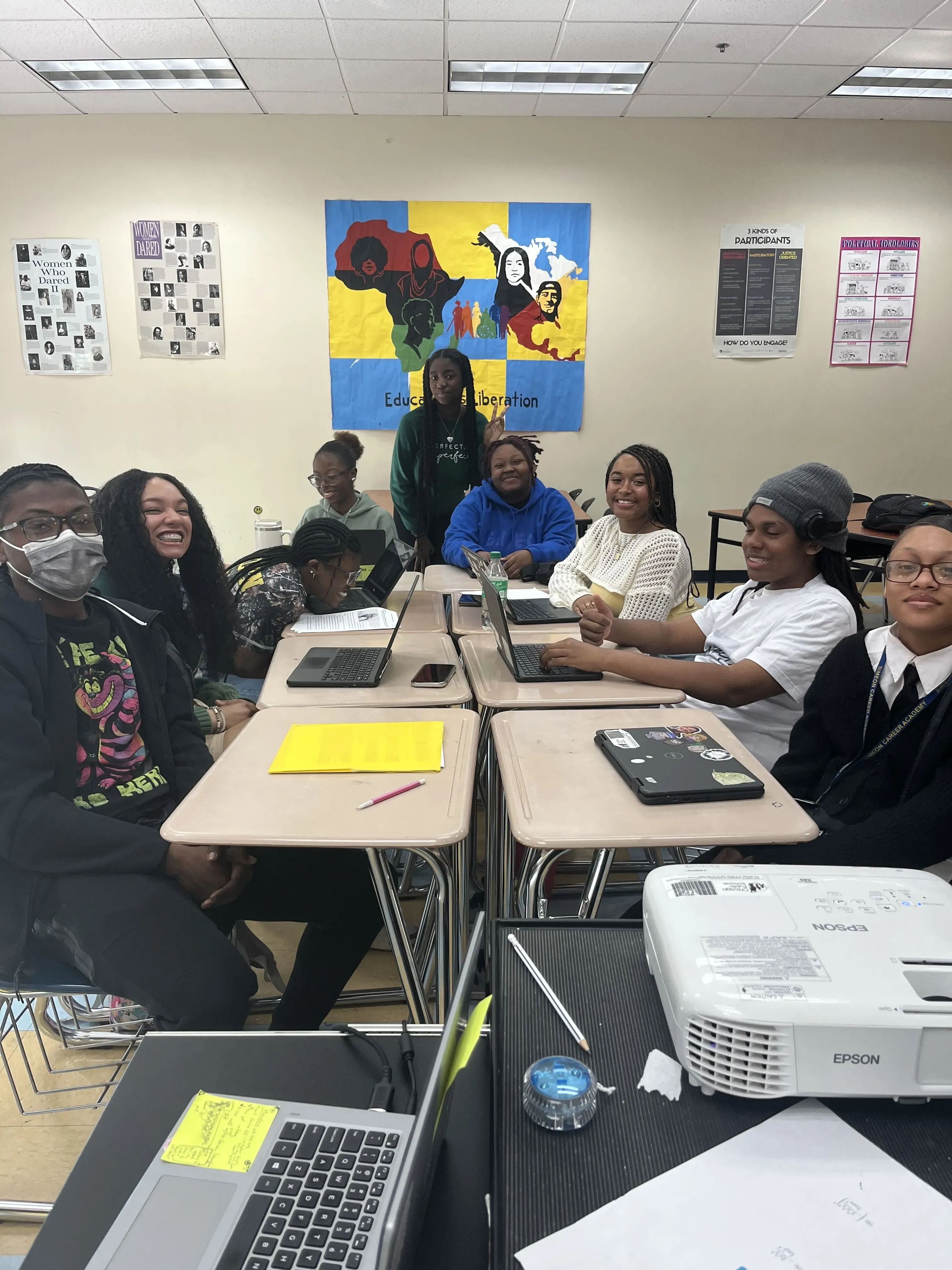
In this lesson, students examined poverty in their home city and compared it to the poverty in a geographically distant region of their state. After studying the issues, students participated in a virtual inter-school exchange with another school in Illinois, to compare how poverty impacts their community and to discuss the similarities/differences between the two regions.
Students reflected on the unit, writing:
The media plays a powerful role in shaping our understanding of others and ourselves . By sharing stories from our communities, local media helps us feel seen and heard. When we are able to see those who look like us and have the confidence to share their stories it makes a big impact on others. Local coverage of communities and people that look like me reminds us that our voice does matter. At the same time local media introduces us to the lives and experiences of others, helping to break down stereotypes and build empathy. When the media highlights diverse perspectives it can change the way we think about a lot of things like race, class, culture , and social issues.
Keytoia
In the times that we’re living in, poverty has become a national epidemic that has been plaguing the US rather rapidly. However, I will be concentrating on the State of Illinois–more specifically, the South Side of Chicago and Southern Illinois. The statistics in the ‘Illinois Commission on Poverty’ article discloses that before the pandemic, 1.6 million Illinoisians lived in poverty, with 739,000 of those living in deep poverty. That being said, many people in society ranging from local community leaders to big-time politicians decided to start doing something about the economic inequity that has been infecting their communities.
Endeyah
Connecting with others impacts and changes our understanding of ourselves and the world by opening our minds to things we never knew. Sharing information and connecting with one another allows us to take in different perspectives. Absorbing different perspectives helps us understand things in a different point of view, which unlocks new things for us to know or deepens our understanding. In Article 6: Chicago it says, “The railway company has “exceeded” the minimum percentage set in the agreement years prior, according to the company. Those statistics don’t reflect what’s happening in Englewood, Harris said. “I don’t understand it,” Harris said. “They displaced the Black community, but they only hire 50 people in a decade? They don’t care about the community. It’s about the bottom line for them.” This demonstrates the lack of understanding an outside point of view has on the job issue occurring in Englewood. By providing a different/insider perspective, this person was able to see a side to the story they could not have seen before. Connecting with others does not only provide us with new knowledge from different perspectives, but grants us the ability to mentally and emotionally understand problems transpiring outside of our own lives.
Deniah
Teacher Reflection
Through these lessons, students were able to examine efforts to end poverty, compare their own lived experiences to those of other young people elsewhere in the state, and to analyze the role that media plays in both reporting and shaping our perceptions of ourselves and others.
Rivanna Jihan, Social Studies Teacher and Teacher Fellow
How did you build this lesson with your community in mind?
I teach at an application-based career and technical high school on the South Side of Chicago, serving a student body of 1,100 students. The student body is 99% African-American and low-income. The class in which the unit was taught was a small 12th-grade dual credit U.S. history course, and seven of the nine students looped up with me from 11th-grade civics.
I partnered with a small high school in rural southern Illinois, with a student population of 200. In the partner school, 99% of the school is low-income, and 60% of the student body is African-American, 40% white. The class in which the unit was taught was an 11th-12th-grade current events course.
What is the focus of your lesson plan, and why did you write this lesson for your community?
I wrote a mini-unit that draws parallels between the struggles of poverty on the South Side of Chicago and the struggles with poverty in southern Illinois. I chose this topic because I wanted my students to see how they are connected to young people outside of the city, and how poverty impacts people in both similar and different ways.
Chicago is often portrayed in one of two ways to Illinoisans outside the city: either as wealthy and white, or as Black, poor, and dangerous. Meanwhile, Illinois outside Chicago and the collar counties are often portrayed as backward and white, but financially secure.
All of these stereotypes are grossly inaccurate, and they sow division between people who could be working together to solve the problems that impact the whole state. In addition to the details of how poverty impacts Illinois, the unit focused on how connecting with others can change our understanding of ourselves and the world, and the role that media plays in our understanding of others and the world.
What did your students learn while engaging with this lesson?
I took six articles from the Pulitzer Center written about Alexander County in southern Illinois, focused on housing, jobs, local politicians, child care, food deserts, and the impact of incarceration, and paired them with six articles on the same topics written by journalists here in Chicago. Then, each student read one pair of articles, drawing parallels between the two regions.
After virtually connecting with our partner classroom in southern Illinois, students discussed the six facets being impacted by poverty together. In many ways, these are two very different communities, and yet, the ways the two communities struggle with poverty are very similar.
Students had the opportunity to engage with journalists about the articles and discuss the impact of journalism on policy and perception. Four journalists joined virtually to speak with both classes of students, including three who were involved in the articles' reporting, and one who reports on the impacts of policy for Chicago public radio.
Through these lessons, students were able to examine efforts to end poverty, compare their own lived experiences to those of other young people elsewhere in the state, and to analyze the role that media plays in both reporting and shaping our perceptions of ourselves and others.
Students drew connections in the following ways via their questions to the journalists (quoted from virtual discussion):
- To past units: Is the Norfolk Railroad in Englewood a kind of redlining, given how they are taking over minority property?
- To discussions of bias and objectivity: How do you think your biases showed up in writing this story?
- To communication and the role media plays in society: What media platform do you think is best to spread information like what is presented in these articles?
Students also connected during discussions, asking things like (quoted from virtual discussion):
- Are young people in Chicago worried about being able to find housing after graduation?
- Do you expect to stay in Pulaski County after graduation and get a job where you are?
What did you learn by creating and teaching this lesson?
I created both a short, three-day version of the plan and a longer, five-day version. The three-day version doesn’t require the cross-school connection or the journalist visit, and it allows the class to focus more specifically on the articles and supporting information in order to write a reflection.
In creating both options, my biggest takeaway was the realization about the time commitment and front-loading it takes to bring in another school and to coordinate the journalists. At the same time, the depth of understanding, the questions and conversations, and the much more far-reaching impacts of the unit are only realized with outside people visiting the classroom. It is worth the extra time and effort to bring in the journalists, at the very least. But providing the opportunity for students to connect with other youth is the step that clinches the biggest leaps in empathetic learning and broadening of horizons.
Speaking to the topic of poverty, generally, it is important to stick with the articles' information, to interrogate the systemic causes of poverty, and to challenge any thinking on the part of the students that if people just “work harder,” they can overcome the systematic oppressions of poverty as portrayed in these sets of articles.
One overarching goal of this mini-unit is to derail the individualist thinking that supports the perpetuation of such systems.
About Rivanna Jihan
Rivanna has been teaching high school social studies since 2004, including US and World History, Human Geography, Government/Civics, Dual Credit US History, and Sociology. They became a Nationally Board Certified Teacher in 2014, and were awarded the Gilder Lehrman Illinois History Teacher of the Year in 2021. Rivanna has spent much of the last decade devoted to mentoring new teachers, and to developing curriculum both as a professional development facilitator and as a guest editor / curriculum designer for organizations such as Facing History and Ourselves, CPS Curriculum and Instruction, and Gibbs-Smith Education.