Lesson Plan April 28, 2026
Cultivating a Healthy Food System
Country:
Grades:

This lesson was created by Ebony Thompson, a teacher in New York City, as part of the fall 2024 Pulitzer Center Teacher Fellowship program. It is designed for facilitation across approximately three 45 minute class periods.
For more lessons created by Pulitzer Center Teacher Fellows in this cohort, click here.
My goal in developing these lessons is to foster curiosity in my students about their food choices and to help them understand the processes that bring food to their plates. I want them to reflect on the interconnectedness of their food choices, health, the business behind food production, and their environmental impact.
Lesson Overview
High school students play a crucial role as consumers in our food system. By understanding its challenges, they can take action to foster a nutritious and sustainable food environment.
Essential Questions
- What does a healthy and sustainable food system look like, and how can we move toward it?
Performance Task
- Class discussions
- JigSaw Activity with completed graphic organizer
- Charting information from articles onto a Padlet
Assessment
Student created Instagram carousel
Notes on Context
My students vary in reading comprehension abilities. Chunking text and using graphic organizers help them process complex material.
Three-day lesson plan, including warm-up discussion questions, text resources, a slide presentation, and performance tasks for the lesson. Download below to read the complete lesson plan.
Lesson Resources
| Pulitzer Reporting | “The Government Spends Millions To Open Grocery Stores in Food Deserts. The Real Test is Their Survival.” by Molly Parker and Julia Rendleman “The Processed Food Fight” by Amos Zeeberg “This ‘Super Banana’ Was Designed To Save Lives. Will It Matter That It’s Orange?” by Agostino Petroni “How Uyghur Forced Labor Makes Seafood That Ends Up in School Lunches” by Ian Urbina “Adapting Our Food System to a Changing Climate” by Michelle Lotker “How an American Meat Broker Is Fueling Amazon Deforestation” by Sasha Chavkin |
| Teacher-created Resources | Slide deck PDF Food map questions (.docx) Graphic Organizer PDF (.docx) Instagram Post Rubric PDF (.docx) |
Common Core Standards
CCSS.ELA-Literacy.RI.9-10.1
Cite strong and thorough textual evidence to support analysis of what the text says explicitly as well as inferences drawn from the text.
CCSS.ELA-Literacy.RI.9-10.2
Determine a central idea of a text and analyze its development over the course of the text, including how it emerges and is shaped and refined by specific details; provide an objective summary of the text.
CCSS.ELA-Literacy.W.9-10.2
Write informative/explanatory texts to examine and convey complex ideas, concepts, and information clearly and accurately through the effective selection, organization, and analysis of content.
CCSS.ELA-Literacy.W.9-10.2.a
Introduce a topic; organize complex ideas, concepts, and information to make important connections and distinctions; include formatting (e.g., headings), graphics (e.g., figures, tables), and multimedia when useful to aid comprehension.
CCSS.ELA-Literacy.W.9-10.2.b
Develop the topic with well-chosen, relevant, and sufficient facts, extended definitions, concrete details, quotations, or other information and examples appropriate to the audience's knowledge of the topic.
CCSS.ELA-Literacy.W.9-10.2.c
Use appropriate and varied transitions to link the major sections of the text, create cohesion, and clarify the relationships among complex ideas and concepts.
CCSS.ELA-Literacy.W.9-10.4
Produce clear and coherent writing in which the development, organization, and style are appropriate to task, purpose, and audience.
CCSS.ELA-Literacy.W.9-10.6
Use technology, including the Internet, to produce, publish, and update individual or shared writing products, taking advantage of technology's capacity to link to other information and to display information flexibly and dynamically.
In this lesson, students learned about food systems and the role they play as consumers in those food systems. To begin, students worked together to define a "food system."
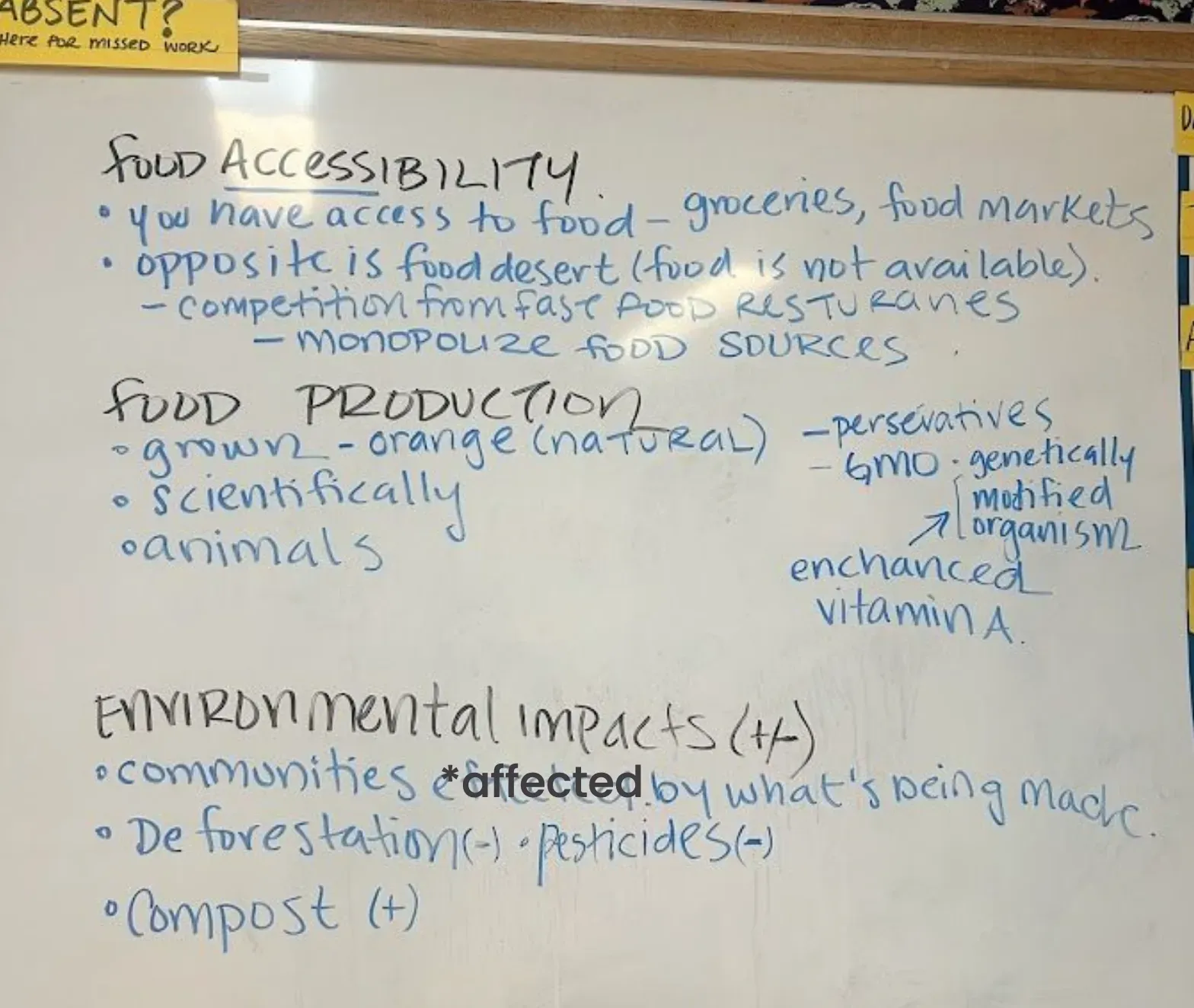
They then used Pulitzer Center reporting to analyze different food systems. They completed a graphic organizer to analyze the articles that they read.
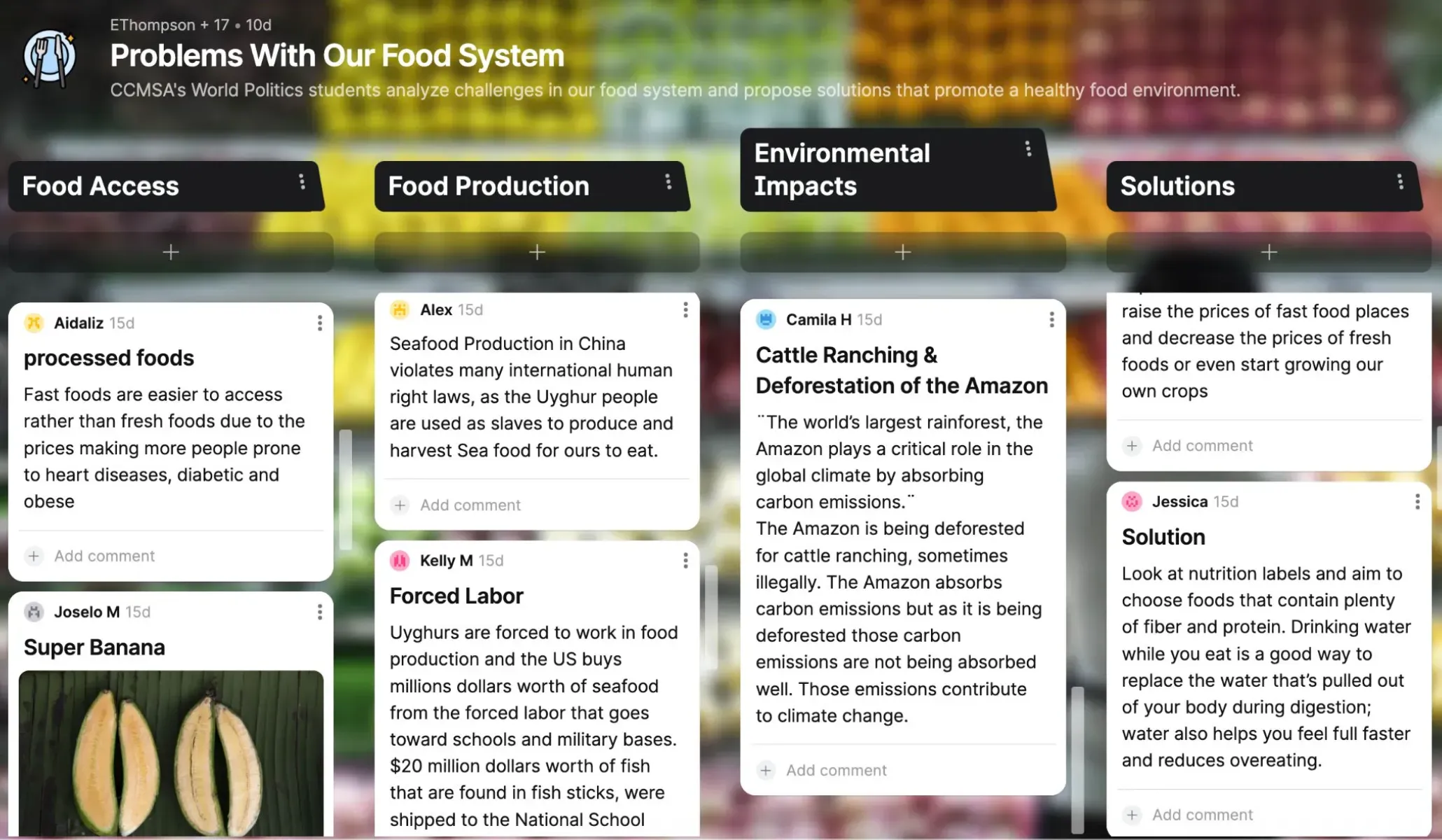
Students then shared their findings with each other using a digital message board (Padlet).
As a final project, students created Instagram carousels highlighting information about our current food system and encouraging consumers to take action to improve that food system.