Lesson Plan October 6, 2025
La Salud: Un Derecho Humano
Country:
Grades:

This lesson plan was created by Maria Eugenia Zelaya, a high school Spanish educator in Gainesville, Florida, as part of the 2024 Pulitzer Center Global Health Teacher Fellowship program. It is designed for facilitation across three days.
For more lessons created by Pulitzer Center Teacher Fellows in this cohort, click here.
Give the students the opportunity to express their ideas on issues they care deeply about and give them the tools to contribute to the solution. Use the Local Letters for Global Change contest in your classes. This is a very rewarding experience for your students.
maria eugenia zelaya, Fall 2024 Teacher fellow and educator in gainesville, Fl
Lesson Overview:
As part of the unit on Human Rights, students will read the declaration of human rights as a class and focus on article #22: “We all have the right to affordable housing, medicine, education, and childcare, enough money to live on and medical help if we are ill or old.” They will analyze an article about access to health care in a Spanish-speaking country, review how to write a formal letter, and then write a formal letter to a government representative about their local connections to the article they analyzed. The letters will be sent to the Pulitzer Center contest, Local Letters for Global Change.
Performance Task(s):
Students will apply analysis of a Spanish-language news article focused on a global health issue impacting communities in Latin America to write a letter in Spanish that will be submitted to the contest Local Letters for Global Change.
Assessment:
This lesson was designed for Spanish 4 and Spanish 5 IB classes. Facilitation is suggested across three days This lesson plan includes pacing, texts and multimedia resources, teacher-created resources, suggestions for implementation, and a rubric for assessment.
| Reporting and Texts | “Shortages of Key Drugs Have Alarmed U.S. Medical Officials. Could Puerto Rico Offer an Answer? By Rick Barrett and Mark Hoffman for Milwaukee Journal Sentinel “El dinero o la salud: El alto precio de la insulina dificulta el control de la diabetes en América Latina” by Alicia Tovar, Pamela Huerta, Fabiola Torres, Daniel Mitma, Sergio Silva Numa, Diego Quiceno Mesa, Daniela Guazo for salud con lupa “Diabetes a Major Factor Behind Declining Life Expectancy in Rural Areas” by Dr. Alok Patel and Caleb Hellerman for PBS Newshour “México: Un paciente con diabetes gasta entre $35 y $109 en insulina si no la encuentra en el seguro social” by Daniela Guazo Manzo for salud con lupa “¿Cuánto cuesta realmente producir insulina?” By Alicia Tovar, Pamela Huerta, and Fabiola Torres salud con lupa |
| Teacher-created resources | Global Health Lesson, Day 1 Slides [pptx] [.pdf] Global Health Lesson, Day 2 Slides [.pptx][.pdf Global Health Threats in Conflict Zones: From Between Shades of Gray to Ukraine and Beyond[.docx][.pdf] Advocacy Project on Global Health: From Fear to Informed Action [.docx][.pdf] Global Health Advocacy Mini-Project Rubric [.docx][.pdf] |
International Baccalaureate Diploma Program
- Identities: Explore the nature of the self and what is to be human.
- Sharing the Planet: Explore the challenges and opportunities faced by individuals and communities in the modern world.
Topic: Health and well-being, Human Rights, Equality
The following are example of work from students in Gainesville, FL who engaged with this lesson in fall 2024.
- Students start this lesson by translating and discussing the lyrics of "El Niagara en Bicicleta” by Juan Luis Guerra. This song talks about the lack of supplies/resources in the public health system in the Dominican Republic. They then engage in brainstorm about what themes come to mind when they thing of the term, "global health."
2. Next, students engage in a discussion about who or what bears the responsibility for supportng public health in communities globally. The discussion can also be had virtually on platform like Padlet.
"El gobierno y las instituciones son responsables de proveer los
recursos necesarios para la salud de las comunidades, pero es la
responsabilidad de la persona a mantener su salud."
yihan, a student in gainesville, fl responds to the padlet prompt, "¿Quién es responsable de la salud de las comunidades?"
3. Students then select one of the following articles from a Spanish-speaking country related to global health and evaluate local connections to the issue presented in the article:
- “Shortages of Key Drugs Have Alarmed U.S. Medical Officials. Could Puerto Rico Offer an Answer? By Rick Barrett and Mark Hoffman for Milwaukee Journal Sentinel
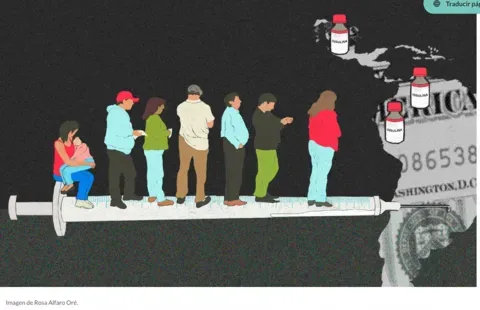
- “El dinero o la salud: El alto precio de la insulina dificulta el control de la diabetes en América Latina” by Alicia Tovar, Pamela Huerta, Fabiola Torres, Daniel Mitma, Sergio Silva Numa, Diego Quiceno Mesa, Daniela Guazo for salud con lupa
- “Diabetes a Major Factor Behind Declining Life Expectancy in Rural Areas” by Dr. Alok Patel and Caleb Hellerman for PBS Newshour
- “México: Un paciente con diabetes gasta entre $35 y $109 en insulina si no la encuentra en el seguro social” by Daniela Guazo Manzo for salud con lupa
“¿Cuánto cuesta realmente producir insulina?” By Alicia Tovar, Pamela Huerta, and Fabiola Torres salud con lupa
I learned a lot about the issues that plague the drug production field. I particularly enjoyed reading about the differing opinions on whether or not Puerto Rico should be involved in drug manufacture because it was very interesting to see how an issue that pertains to everyone globally is viewed.
Student from gainsesville, fl in a post-lesson survey
4. Finally, students review the steps for writing a formal letter, evaluate who they might write to who could address the global issue they explored in the article they selected, and then write a letter informing the person they selected about the issue they analyzed. Students are invited to share their letters as part of the Pulitzer Center's Local Letters for Global Change contest. Of the 67 students who engaged with this lesson in fall 2024, 42 submitted their letters.
"En mi comunidad de Gainesville, existe una brecha de riqueza en la ciudad, causando que los ciudadanos del lado este de mi ciudad tengan más dificultades para acceder a la insulina debido a su alto precio. Los ciudadanos en mi comunidad que no tienen estabilidad financiera son similares a los ciudadanos en Latinoamérica porque los gobiernos de Estados Unidos y Perú/México no están tomando los pasos necesarios para combatir el oligopolio de la insulina."
Gainesville, FL student in their letter responding to the pulitzer CEnter-supported project, "The Insulin Oligopoly and the Diabetes Epidemic in Latin America" from salud con lupa
"La disparidad económica no debería ser causa de la falta de acceso a esta medicina."
Gainesville, FL student in a letter written as part of engagement with this lesson
Teacher Reflection
Give the students the opportunity to express their ideas on issues they care deeply about and give them the tools to contribute to the solution. Use the Local Letters for Global Change contest in your classes. This is a very rewarding experience for your students."
maria eugenia zelaya, Spanish educator EDUCATOR, TEACHER FELLOW
What is the focus of your lesson plan, and why did you write this lesson for your community?
I wrote this lesson as part of a larger unit on Human Rights. The idea was to first introduce students to the concept of global health as one of the basic human rights. The students brainstormed words that came to mind when we mention global health. They also answer the question, “Who is responsible for the health of the community?” This lesson allowed the students to think not just about global health but also about local health. I believe this lesson was extremely valuable to the students for two main reasons: reading and writing in the target language about global/local issues and connecting global issues (such as global health) with their local community.
How did you build this lesson with your community in mind?
My students are part of the IB program and they are taking either Spanish B SL or Spanish B HL. Our school serves the East of Gainesville and has several programs: International Baccalaureate, Institute of Culinary Arts, Medical Skills program, 3DE program and the regular high school program. I developed this lesson as part of a larger unit on Human Rights that I teach under the IB Language B theme: Sharing the Planet. This lesson is for students that are in their fourth year of Spanish class, as it requires them to read newspaper articles in Spanish, as well as write a formal letter.
What did your students learn while engaging with the lesson?
The comments of my students during the brainstorming of global health topics was very interesting. A lot of them mentioned access to food, drinking water, and exercise as important global health topics. This was interesting because they connected global health immediately to their local community and the food deserts. As part of the lesson, the students wrote letters to an elected official who could potentially help with the issue they read about.
One of the students wrote to our major and used one of the articles about diabetes and the cost of insulin. He connected the issue with food deserts and the lack of healthy food options in the east part of the city, where our school is located. He mentioned the case of one of the students at our school who passed away in his sleep for unknown reasons but that unfortunately did not have the best options when it came to healthy food choices in his community.
I learned a lot about the issues that plague the drug production field. I particularly enjoyed reading about the differing opinions on whether or not Puerto Rico should be involved in drug manufacture because it was very interesting to see how an issue that pertains to everyone globally is viewed."
gainesville, fl student who engaged with this lesson in fall 2024
What were your takeaways from this experience, and what advice do you have for other educators who may want to engage with your lesson?
This experience has been more than I expected. I truly enjoy every virtual meeting we had and all the speakers. I truly value the time we had with the journalists and how well they explained their research and writing processes. It was great to see how they made connections with the communities they were writing about and followed up to keep helping them address the issues.
For other educators, my advice is to give the students the opportunity to express their ideas on issues they care deeply about and give them the tools to contribute to the solution. Use the Local Letters for Global Change contest in your classes, this is a very rewarding experience for your students.
REPORTING FEATURED IN THIS LESSON PLAN
-

Pulitzer Center Update
Winners and Finalists: Local Letters for Global Change 2024
The Pulitzer Center congratulates the 2024 Local Letters for Global Change contest winners and...
January 16, 2025