Pulitzer Center Update August 20, 2026
Illinois Students Examine Poverty Through Inter-School Exchange
Country:

The reasons people left the county echo the social and economic shifts of rural American life.


Rivanna Jihan is a high school social studies teacher in Chicago. Jihan created the lesson plan “Bold Promises to End Poverty,” as a part of the spring 2025 Pulitzer Center Teacher Fellowship program, “Global Issues, Local Contexts: News for Civic Knowledge and Engagement.”
Her lesson reached 14 students in the 11th and 12th grades. At the conclusion of the Fellowship, Jihan shared the following reflections on her experience developing and teaching the lesson.
How did you build this lesson with your community in mind?
I teach at an application-based career and technical high school on the South Side of Chicago, serving a student body of 1,100 students. The student body is 99% African-American and low-income. The class in which the unit was taught was a small 12th-grade dual credit U.S. history course, and seven of the nine students looped up with me from 11th-grade civics.
I partnered with a small high school in rural southern Illinois, with a student population of 200. In the partner school, 99% of the school is low-income, and 60% of the student body is African-American, 40% white. The class in which the unit was taught was an 11th-12th-grade current events course.
What is the focus of your lesson plan, and why did you write this lesson for your community?
I wrote a mini-unit that draws parallels between the struggles of poverty on the South Side of Chicago and the struggles with poverty in southern Illinois. I chose this topic because I wanted my students to see how they are connected to young people outside of the city, and how poverty impacts people in both similar and different ways.
Chicago is often portrayed in one of two ways to Illinoisans outside the city: either as wealthy and white, or as Black, poor, and dangerous. Meanwhile, Illinois outside Chicago and the collar counties are often portrayed as backward and white, but financially secure.
All of these stereotypes are grossly inaccurate, and they sow division between people who could be working together to solve the problems that impact the whole state. In addition to the details of how poverty impacts Illinois, the unit focused on how connecting with others can change our understanding of ourselves and the world, and the role that media plays in our understanding of others and the world.
What did your students learn while engaging with this lesson?
I took six articles from the Pulitzer Center written about Alexander County in southern Illinois, focused on housing, jobs, local politicians, child care, food deserts, and the impact of incarceration, and paired them with six articles on the same topics written by journalists here in Chicago. Then, each student read one pair of articles, drawing parallels between the two regions.
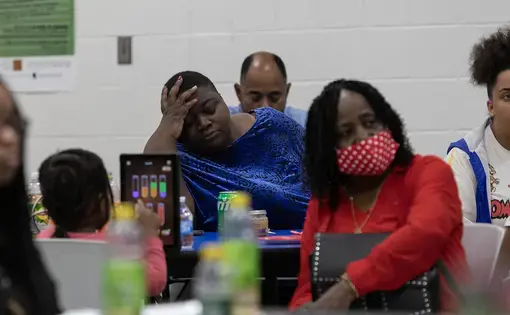
After virtually connecting with our partner classroom in southern Illinois, students discussed the six facets being impacted by poverty together. In many ways, these are two very different communities, and yet, the ways the two communities struggle with poverty are very similar.
Students had the opportunity to engage with journalists about the articles and discuss the impact of journalism on policy and perception. Four journalists joined virtually to speak with both classes of students, including three who were involved in the articles' reporting, and one who reports on the impacts of policy for Chicago public radio.
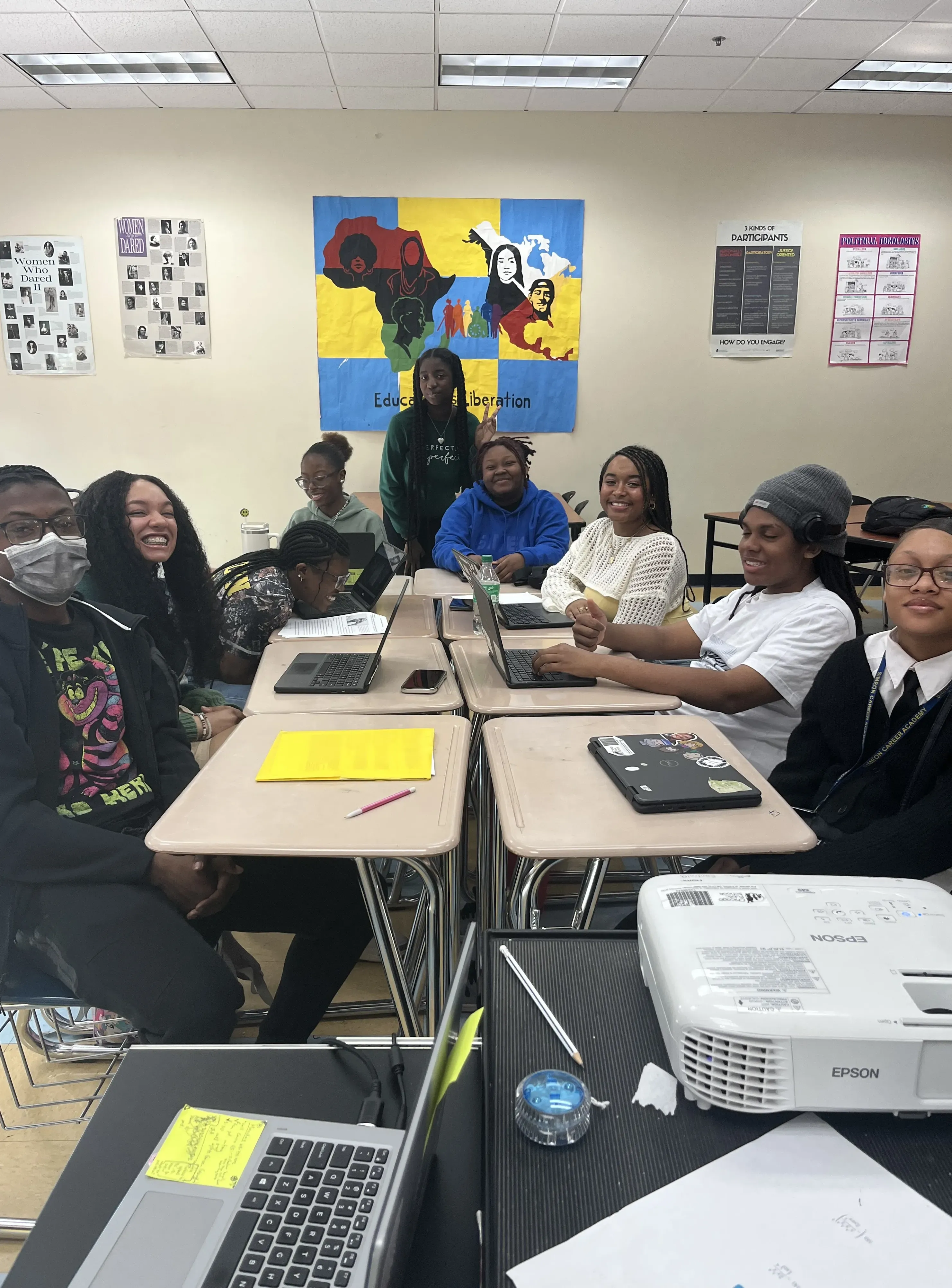
Through these lessons, students were able to examine efforts to end poverty, compare their own lived experiences to those of other young people elsewhere in the state, and to analyze the role that media plays in both reporting and shaping our perceptions of ourselves and others.
Students drew connections in the following ways via their questions to the journalists (quoted from virtual discussion):
- To past units: Is the Norfolk Railroad in Englewood a kind of redlining, given how they are taking over minority property?
- To discussions of bias and objectivity: How do you think your biases showed up in writing this story?
- To communication and the role media plays in society: What media platform do you think is best to spread information like what is presented in these articles?
Students also connected during discussions, asking things like (quoted from virtual discussion):
- Are young people in Chicago worried about being able to find housing after graduation?
- Do you expect to stay in Pulaski County after graduation and get a job where you are?
What did you learn by creating and teaching this lesson?
I created both a short, three-day version of the plan and a longer, five-day version. The three-day version doesn’t require the cross-school connection or the journalist visit, and it allows the class to focus more specifically on the articles and supporting information in order to write a reflection.
In creating both options, my biggest takeaway was the realization about the time commitment and front-loading it takes to bring in another school and to coordinate the journalists. At the same time, the depth of understanding, the questions and conversations, and the much more far-reaching impacts of the unit are only realized with outside people visiting the classroom. It is worth the extra time and effort to bring in the journalists, at the very least. But providing the opportunity for students to connect with other youth is the step that clinches the biggest leaps in empathetic learning and broadening of horizons.
Speaking to the topic of poverty, generally, it is important to stick with the articles' information, to interrogate the systemic causes of poverty, and to challenge any thinking on the part of the students that if people just “work harder,” they can overcome the systematic oppressions of poverty as portrayed in these sets of articles.
One overarching goal of this mini-unit is to derail the individualist thinking that supports the perpetuation of such systems.