Story
 June 1, 2026
Project Profile: 'Repatriated' Refugees Trapped in Resettlement Limbo
Country:

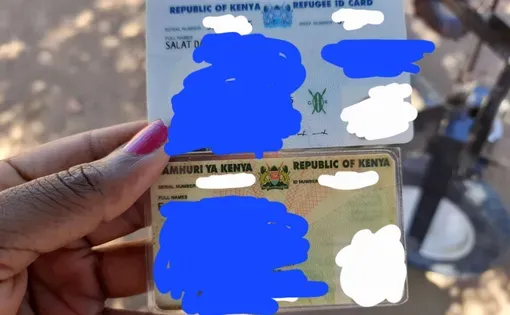
Some Kenya residents register as refugees to get what their government was not offering them.
In this fifth and final part of the Project Profile investigation into the use of biometrics, Naipanoi Lepapa narrates the harrowing story of refugee Jessica P, who found herself denied resettlement in a third country because she was wrongly recorded as having been repatriated to Congo.
Jessica P* was shocked by rumours swirling around that embassies were withdrawing resettlement applications for refugees found to have been voluntarily repatriated from Kenya. She remembers it was one boiling hot day in November 2021 at the Dadaab refugee complex.
The native of the Democratic Republic of Congo (DRC) was just 26 years old at the time. Scared she might be on the repatriation list, which would put her relocation to Australia at risk, Jessica P enquired from a group of refugees she found talking about the issue: “How can I find out?”
The refugees shared with her a contact at the International Organization for Migration (IOM). When Jessica P made the phone call, a man answered. His name was Warsame. What he told the single mother of three left her dazed, unable to process what she had just heard.

As a nonprofit journalism organization, we depend on your support to fund more than 170 reporting projects every year on critical global and local issues. Donate any amount today to become a Pulitzer Center Champion and receive exclusive benefits!
According to Warsame, Jessica P’s resettlement application had been impacted as she couldn’t obtain an exit permit because her last-born child, Baby M was marked down as having been repatriated from Kenya when he was two years old.
“How can a two-year-old be repatriated?” she’d asked him after she recovered from the shock. He did not give her an answer. Instead, she recalled in an interview with The Elephant, “He hung up the phone.”
Dissatisfied, Jessica P phoned Warsame again a week later. This time, the story had been revised, she told The Elephant. According to Warsame, it wasn’t Baby M (now 7 years old) who had been repatriated. It was Jessica P herself.
Since September 2023, The Elephant has been investigating the harms of the deployment and use of biometric recognition technology in the humanitarian aid sector in Kenya as part of Project Profile.
The Elephant has highlighted the stories of Kenyan citizens denied their citizenship rights because their fingerprints were found in the refugee biometric database.
This investigation by The Elephant in partnership with the Pulitzer Center artificial intelligence (AI) fellowship found that Jessica P is among several hundred refugees who, according to sources, were left stranded in limbo at the Dadaab refugee complex because their records held in the government database showed them to have been voluntarily repatriated back to their countries of nationality.
As such, the Kenyan government could not issue exit permits to enable their resettlement in third countries, documents and interviews reveal.
Resettlement withdrawal letters sent to refugees and reviewed by The Elephant state that resettlement countries withdrew the refugees’ applications and closed their files because they were unable to obtain exit permits for their resettlement outside Kenya. Sources said they had completed all other checks.
“You also haven’t provided written evidence from the government of Kenya or United Nations Humanitarian Commission for Refugees (UNHCR) to show that you have not been repatriated and that you will be issued with an exit permit,” reads one withdrawal letter from the Canadian government to a South Sudanese refugee in November 2022.
Repatriation, resettlement, and local integration are the three durable solutions recognized by the UNHCR for refugees.
“It is like killing a person when they are still alive,” said Jessica P, who believes she is at risk in the camp and needs safety.
Dadaab is a complex of three camps comprising Ifo, Dagahaley, and Hagadera located in Garissa County, about 500 kilometres to the north-east of Kenya’s capital, Nairobi.
“They have put me in uncertainty like I have no life,” she said, her voice ringing with emotion.
When reached, Warsame did not offer a comment and instead directed the reporter to the IOM for a response. The IOM did not comment on Warsame’s call with Jessica P. On the repatriation matter, the IOM stated that “the organization is not part of the registration and fingerprinting process, does not maintain a database with biometric details, and thus is unable to comment on the matter… If not already done, IOM recommends that the story be shared with UNHCR for its comment.”
The UNHRC confirmed to The Elephant that some refugees faced complications in being resettled in third countries because data showed that they had been repatriated, but did not respond to specific questions about the situation.
A spokesperson for the Australian Department of Home Affairs informed The Elephant in an email that it does not comment on individual cases. Asked how many refugees slated for resettlement in Australia had been impacted, the department did not respond.
The spokesperson stated that the Department of Home Affairs was “extremely limited in its ability to influence exit processes set by host governments. If a refugee is denied an exit permit, the Department does not cancel the granted visa. If possible, the Department would attempt to resolve the issue. This is managed on a case-by-case basis owing to their different circumstances. Refugees’ visas remain valid for 5-years from the date of grant and would not be cancelled unless new information arises which warrants cancellation of the granted visa, for example, criminal activity.”
The Elephant also submitted questions to the Canadian federal department that manages Canada’s immigration, refugee protection, and citizenship services. Immigration, Refugees and Citizenship Canada (IRCC) responded that, for security and privacy reasons, it could not provide information about specific refugee cases and did not confirm the number of impacted refugees. Canada does not determine whether a refugee has been repatriated, stated IRCC, adding that this information is provided by the Government of Kenya and the UNHCR.
IRCC stated that when a refugee voluntarily repatriates and departs Kenya, they lose their legal refugee status. According to IRCC, Kenya’s Department of Refugee Services, which registers asylum seekers and determines the legal status of refugees in Kenya in coordination with the UNHCR, records their departure, and their Refugee Status Determination (RSD) and registration are cancelled. If the individual later returns to Kenya, they must apply again for asylum and undergo a new RSD process. Without a valid refugee status, they cannot obtain an exit permit. Exit permits are issued by the Government of Kenya, and travel for resettlement to Canada cannot proceed without them, IRCC explained.
The U.S. Department of State Office of Press Relations was contacted through its journalists’ portal and subsequently via email. The U.S. Embassy in Nairobi was also contacted via email. Neither office had responded by the time of publication.
Kenya’s Ministry of Interior, the Department of Refugee Services (DRS) in charge of refugee affairs, and the Directorate of Immigration Services (DIS), which issues exit permits, did not provide a comment.
False repatriation claims
Like Jessica P, all the refugees interviewed by The Elephant claimed that they had been falsely recorded as having been repatriated to their countries. They told The Elephant they couldn’t go back to their countries because the same conditions that forced them to flee still persisted.
The refugees hoped to start life afresh in a safe environment in third countries. Some refugees told The Elephant that they have never set foot in their native countries. Either because they were born in Dadaab or because they were born in another country of asylum.
Jessica P, whose story reads like something out of a horror movie, is a model example. Her father’s Congolese family rejected the union to her mother, a Burundian, resulting in banishment from their family home. A misfortune soon followed when “they killed my father and brother” in tribal clashes. Her mother, pregnant with Jessica P, was forced to flee to Tanzania, where Jessica P was born in 1995.
When Jessica P was two years old, her mother got married to a Tanzanian, and at age six, her mother died. In the years that followed, her stepfather remarried, but Jessica P and the woman “could not see eye-to-eye,” and she was ultimately thrown out onto the streets.
Jessica P found herself living at the mercy of a woman who exploited her; at the woman’s house, Jessica P was offered to men for sex, and “they paid her.”
Jessica P was just 14 years old.
At 16, Jessica P became pregnant. Because she had been forced to have sex with multiple men, “I did not know who impregnated me. So I chose the one that I saw that could understand me, and I told him that the pregnancy was his. He said that he would marry me.”
Like her mother, Jessica P found herself rejected by her husband’s family. This forced her to return to her stepfather’s “lands filled with stones” with her new husband. While there, they cultivated large tracts of cassava and hoped to one day buy their own piece of land with the profits.
Jessica P gave birth to her son on her 17th birthday, on New Year’s Day in 2012.
In 2014, while pregnant with her second child, robbers stormed the farm, “some armed with guns, others with knives” and stole all their savings. Without mercy, they killed her husband and slashed her two-year-old son in the back of the head with a machete. “They did not harm me because I was pregnant,” she said.
Fleeing to Kenya
Certain that her dead husband’s family would be looking for him, Jessica P fled with her son to Mwanza, where she was arrested by Tanzanian law enforcement officers who later took her son to hospital for treatment. After being discharged, Jessica P realized that she had nowhere to go and “the only option” was to flee to Kenya to seek sanctuary.
In Kenya, Jessica P’s biographical data, facial image, and fingerprints as well as those of her son, were captured by a UNHCR representative for registration after deep questioning on why she had fled her country.
The fingerprint recognition technology that captured their two index fingers is called BioRegister and was developed by HBS Netherlands. It was deployed in Kenya in 2006.
Jessica P’s data, together with her son’s, was stored in the Profile Global Registration System (proGres), which was first deployed in Kenya in 2004. proGres is the backbone of the UNHCR’s operations.
Jessica P had been handed over to the UNHCR in the Westlands area of Nairobi by Kenyan law enforcement officers. From Westlands, she was moved to Kangemi where she remained for three weeks before being relocated to Dadaab, where she has been residing ever since.
Between 2017 and 2018, the UNHCR conducted thorough interviews to establish if Jessica P was eligible for resettlement. Her resettlement application was submitted to the government of Australia for consideration in 2018.
Following an interview with the Australian government, Jessica P was approved for resettlement in February 2019 under Subclass 204, also known as the Woman at Risk visa, according to records reviewed by The Elephant.
The Subclass 204 permanent visa provides a safe and secure environment for refugees who have faced or are at risk of harm and abuse because they are women. Applicants are required to prove that they and their children are under continuous threat and do not have the protection of a male relative or any other place to be resettled.
Each Australian visa is assessed individually according to the Australian Home Affairs spokesperson. Visa processing depends on the supporting documents submitted and how long it takes to obtain health, character, and security information from other agencies.
When a refugee is accepted for resettlement in a third country, their departure from Kenya is conditioned upon successful completion of other remaining clearances, findings show. Because of public safety considerations, and to ensure that they are fit to travel, the refugee must undergo a thorough medical examination to identify communicable diseases. Some health conditions are grounds for exclusion from resettlement but may be waived on humanitarian grounds or in the public interest.
Records show that medical examinations for refugees were carried out at the IOM Migration Health Assessment Centre (MHAC) located at 78 United Nations Crescent, off UN Avenue, Gigiri, Nairobi, and some in Dadaab Clinic.
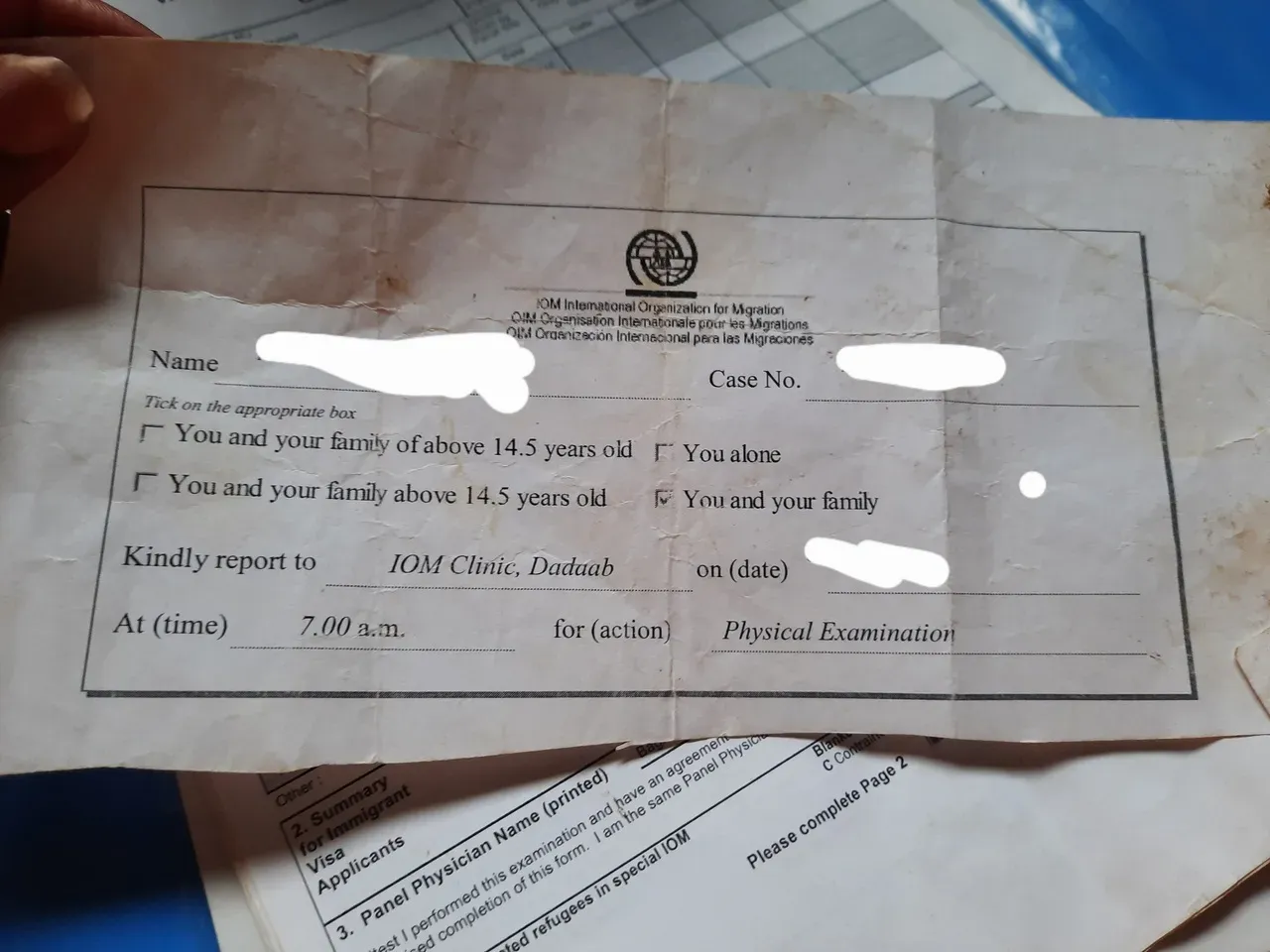
Jessica P first underwent a medical assessment at the MHAC in 2019. During her medical exam, she was shocked to discover she was pregnant.
“I struggle with mental health,” she told The Elephant. Whenever she is experiencing a mental health crisis, she becomes disoriented and walks aimlessly. Good Samaritans often rush her to hospital where she is put under medication.
In February 2019, however, there was no one to rescue her when she experienced a mental health crisis for a period of two weeks. Instead, someone took advantage and raped her, resulting in the birth of Baby M in November 2019. “I don’t know who used me and got me pregnant,” she told The Elephant.
That and the COVID-19 pandemic would lead to her resettlement in Australia being delayed until 2021.
In July 2021, Jessica P’s now family of four underwent medical examinations again at the MHAC. Baby M’s details were also added to Jessica P’s case file in the proGres database after the courts granted Jessica P full custody in accordance with UNHCR procedures.
After the medical assessment, refugees then go through counselling and culture orientation to help with integration in resettlement countries. Prior to their departure from Kenya, refugees must submit biometrics, and arrangements are made for their travel documents, visas/residency permits, and exit permits. Biometrics are collected to verify identity and for security and record-keeping purposes.
The Australian Home Affairs stated that it works with the UNHCR “and with host countries regarding departures and exit permits.”
The UNHCR states on its website that it is mandated to make pre-departure arrangements for refugees. The agency coordinates with resettlement countries, the IOM and/or other contracted partners, and with Kenya’s Department of Refugee Services (DRS).
The DRS is the body responsible for the management of refugee affairs, including the registration of asylum seekers and conducting Refugee Determination Status (RSD). Once a refugee is recognised as such, the DRS issues them with an identity card (ID)/alien card that is valid for five years.
According to The Elephant’s findings, resettlement countries send travel requests to the IOM and the UNHCR. The IOM and the UNHCR facilitate the obtention of exit permits, which the UNHCR states on its website are issued by the Department of Immigration (DIS).
Travel expenses are often covered by resettlement countries while the IOM makes travel arrangements, including booking tickets, arranging transport from Dadaab to the airport, and sometimes even offering airport assistance to ensure refugees reach their resettlement country safely.
Responding to The Elephant, the IOM stated that it “provides pre-migration health activities, movement assistance in-country and across borders, and pre-departure and post-arrival integration support for refugees being resettled around the globe to third countries such as Canada and the United States of America.”
In the past, the IOM paid the salaries of DRA workers to expedite the resettlement process. The IOM said that it “provides support to the Department of Refugee Services (DRS) in both the camps and at the Nairobi level. The DRS is a key partner in refugee resettlement processing and IOM does work alongside and provides capacity building and administrative support to DRS to ensure that refugee resettlement departures take place in a reliable and organized fashion.”
Being in Dadaab is like being in a warzone in Congo
In August 2021, Jessica P received a call from the IOM instructing her to surrender her ID and submit her fingerprints to Kenya’s Refugee Affairs Secretariat (RAS).
RAS replaced the Department of Refugee Affairs (DRA) in 2016. In 2022, DRS was established under the Refugees Act 2021, Kenya, effectively replacing RAS.
In May 2016, the Ministry of Interior and National Administration, a state organ in charge of internal security, citing “national security interests,” announced that the DRA had been disbanded as a starting point towards putting an end to the hosting of refugees in Kenya. Refugee camps would be shut down and refugees repatriated.
When the DRS takes back an alien card and captures fingerprints, this signals that a refugee has completed all the required checks and is to be relocated at any time, according to sources.
But that is not how Jessica P’s story unfolded. Instead, she was informed that she was not being relocated to Australia. In November 2021, the IOM’s Warsame relayed the news to her that records of her fingerprints appeared in the list of the repatriated.
Now Jessica P is stuck in Dadaab. She said she should be given “justice as a refugee” or be returned to her country of origin as there wasn’t any difference between being in Congo and in the camp. “This is because I am still at war, I am suffering, and if there is war in Congo, they should take me there,” she said.
“I have no parents, I have no siblings, I have no husband,” says Jessica P, who was banking on her resettlement to Australia. She had hoped that her children would be educated in Australia so that they could “develop a brain” of their own and become independent. But all that was taken away from her, she says. “I saw everything crumble.”
For three months Jessica P battled mental health problems. “After recovering, that’s when I wanted to commit suicide.”
At the end of June 2024, this reporter received a message from a refugee stating that at least 45 families had had their resettlement impacted after they were falsely accused of having Kenyan IDs and having been repatriated” to their countries by the DRS. According to the source, some refugees had completed all the required checks but their flights were cancelled.
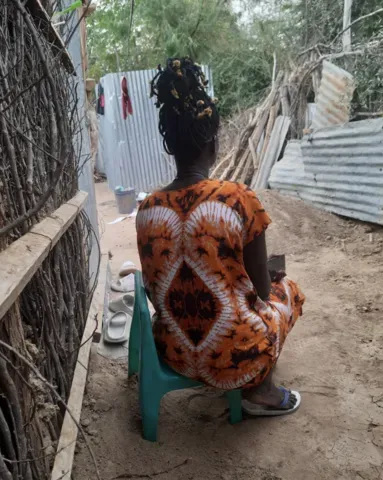
In mid-July 2024, the reporter travelled to Dadaab to investigate this issue among others. She spoke to refugees who stated that a woman named Jessica P had been placed in a safe house to avoid self-harm because of the distress brought on by the false repatriation claims. The reporter was finally able to contact Jessica P in August 2024.
“She was taken to the protected area next to the health facility so as not to harm herself,” a source close to the matter said.
For a family of four, Jessica P sometimes received KSh2,000 or KSh3,200 from the World Food Programme (WFP) through the Bamba Chakula (Get Your Food) food voucher. Bamba Chakula was launched by WFP in 2015 and is provided through Safaricom, Kenya’s biggest mobile network operator. It is integrated into the UNHCR’s proGres database and links the vouchers to biometrics.
“I survive by washing clothes so I can get money to feed the children because the food rations are not enough,” Jessica P told The Elephant in a telephone interview in August 2024, adding that on some days the family slept hungry.
Jessica P told The Elephant that in late 2023, “Life became so difficult that I had to go to the forest for firewood.” She described the horrific ordeal she suffered on one such visit to the forest, where she was raped by three men whom she described as having Somali and Sudanese features. She couldn’t tell if they were refugees.
After they were done, they beat her up and then “they inserted a stick inside me and pulled it from outside and it came out with some meat”, she tearfully told The Elephant.
Jessica P was hospitalized on 26 October 2023 at the Ifo 1 Hospital, which operates with support from the Kenya Red Cross, where she received medical care and trauma counselling. According to her medical report, the doctor performed a full haemogram (complete blood count), along with pregnancy and HIV tests. The results of all tests were negative. The report shows she was also diagnosed with depression, then discharged on 16 November 2023 from the psychosocial clinic with antibiotics and painkillers and instructions for follow-up support.
An OB from Ifo Police Station records that on the 26th of June, 2024, at 8:20 p.m., Jessica P was robbed as she came from work.
Jessica P told The Elephant that she had another horrifying experience not long after. She remembers she was coming from work very late one evening in July 2024 when she was accosted by “two men of Kenyan origin who wanted to rape me.” She lied that she was HIV-positive, “but they said it doesn’t matter. They will use my mouth”.
“After they finished, I went to the hospital.” For three days, Jessica P was unable to eat.
Dr. Catherine Bosibori, a Gender and Security Expert, has found that gender-based violence is prevalent in Dadaab. Her “Sexual and Gender-Based Violence (SGBV) in Dadaab Refugee Complex, Kenya” report finds that 21.4 per cent of the violence was rape and sexual assault. Firewood and water collection points were some of the places where the assaults took place.
Jessica P remains severely unwell. Whenever she is startled, she urinates involuntarily. Now, her 12-year-old son skips school and goes with her to work because he fears “I will go out there and die, and he will become an orphan. So what is this life?” Jessica P asked. She said she had reported the rape to agencies like the UNHCR and the Kenya Red Cross, who said they were following up on the matter. So far, she said, “There is no feedback at all.”
Ahmed Idris, the Secretary General of the Kenya Red Cross Society, told The Elephant that “for cases involving sexual abuse, Kenya Red Cross ensures that survivors receive the full spectrum of appropriate support, including clinical care, psychosocial support, referral-pathway guidance, and legal support where necessary.” The UNHCR did not comment.
“A technical error”
Given its initial limited capacity in the early ’90s, the Kenyan government authorized the UNHCR “to undertake the registration of refugees and asylum seekers and the issuance of documentation.”
This was following a large influx of refugees, mainly from Somalia, that had overwhelmed Kenya’s refugee system starting from 1991. Initially, there were 15 refugee camps set up to cater for the large population before they were consolidated into the Dadaab and Kakuma refugee camps in 1998.
Dadaab was created as a refuge for at least 90,000 Somali refugees while Kakuma in north-west Kenya was set up to shelter minors fleeing civil war in Sudan.
In 2006, the UNHCR helped draft and lobbied for the 2006 Refugee Act that led to the establishment of the Department of Refugee Affairs (DRA) in 2007.
From 2004 onwards, the UNHCR together with donor countries like Denmark capacitated the DRA to enable it carry out its mandate of registering asylum seekers and conducting RSD. The DRA began registering refugees in 2011. In 2014, a phased approach to the handover of responsibility for registration from the UNHCR to the Kenyan government began to take shape. According to a factsheet published by the UNHCR and reviewed by The Elephant, the DRA officially took over from the UNHCR in April 2016. According to the brief, a memorandum of understanding (that was never made public) had been signed with the DRA to enable the department to gain access to the proGres database “pending the creation of DRA’s refugee management system.”
The government and the UNHCR did not share the MoU with The Elephant. The UNHCR said, “Any disclosure of any bilateral or multilateral agreement requires the consent of all the parties to the agreement. The publication of any agreements with a refugee-hosting government is at the discretion of the government concerned.” The 2016 MoU has since been replaced by an updated MoU signed with Kenya’s Department of Refugee Services (DRS) — which succeeded the RAS in 2022 — concerning access to the UNHCR’s Population Registration and Identity Management Ecosystem (PRIMES).
The 2016 brief also stated that the UNHCR would deploy the Biometric Identity Management System (BIMS) from June 2016 during the refugee population verification exercise that was to be conducted jointly with the government.
Developed by Accenture, BIMS is integrated into the proGres database and captures the facial images, fingerprints, and irises of refugees.
The UNHCR stated in its 2016 Kenya Refugee Comprehensive Programme report that BIMS was intended to “support the efforts to eliminate the potential for substitution in cases identified for resettlement.” A UNHCR report states that the agency shares refugee data, including biometric data, with resettlement countries, and that the biometric records of over 25,000 people of concern were transferred to key resettlement states to support resettlement processing.
BIMS, the agency added in the Kenya Refugee Comprehensive Programme report, “will also be useful to the ongoing support for the voluntary repatriation process to South-Central Somalia.”
A tripartite agreement governing the voluntary repatriation of Somali refugees to Somalia had been signed between the UNHCR and the governments of Kenya and Somalia in November 2013.
And while the sharing of data held in proGres was still in place, the UNHCR stated in the Kenya Refugee Comprehensive Programme report that during the verification exercise, “the Government through the National Bureau of Registration (NRB), which is the custodian of the national refugee database and which produces the Kenyan and refugee identification cards” was rolling out “a live capture biometric civil registration system” and that the “Government’s centralized data management system (IPRS) and the NRB system will also collect all 10 fingerprints”.
The use of the Integrated Population Registration System (IPRS) during the refugee verification exercise would “ensure the authenticity of documents issued to both refugees and asylum seekers and also allow them to access the Kenya Revenue Authority Personal Identification Number (PIN).”
The IPRS functions as Kenya’s National Master Population Database. It consolidates civil registration data, including records of births and deaths, national ID data, passport and immigration records, and refugee registration information. Authorized public and private entities rely on the IPRS to verify the identity credentials presented by individuals.
The IPRS is managed by the NRB, the state agency responsible for collecting biometric and biographical data, maintaining biographical records of individuals in a central database that has historically been partially manual, and issuing national and refugee identification documents. In processing ID applications, the NRB relies on both the IPRS and the Automated Fingerprint Identification System (AFIS). A former NRB worker who did not want to be named told The Elephant that “IPRS cannot work alone” and must work “together with AFIS, to ensure the data is accurate.”
While the IPRS is used to validate biographical data and legal status, the NRB’s AFIS confirms fingerprint biometrics and helps detect duplicate or fraudulent registrations. Together, the two systems form the backbone of identity verification within Kenya’s national registration framework.
Under the government’s current digital identity reforms, this framework now operates within what officials describe as the Maisha Integrated Identity System. Officials say the new system is not a replacement but an extension of existing infrastructure. One official from the State Department for Citizen Services added that the government opted to upgrade the system rather than build a new one and recollect data. In this configuration, the IPRS serves as the central reference database underpinning the issuance of the Maisha Number — a unique lifetime personal identifier — and the Maisha Card, which replaces previous generations of national ID cards. Rather than constituting an entirely separate database, the Maisha system layers new credentials and numbering architecture onto the existing IPRS–AFIS infrastructure.
The same verification structure extends into immigration processes. When refugees apply for exit permits, officers from the Directorate of Immigration Services (DIS) check their registry, then query the IPRS to confirm biographical details and recorded legal status. They also query AFIS, which contains biometric records for citizens, refugees, and other foreign nationals. Approval depends on successful cross-verification between civil records and biometric identity; discrepancies between the two may result in denial. Within the Maisha framework, these checks also validate the individual’s Maisha Number record stored in the IPRS.
The IPRS and AFIS operate as interoperable components of Kenya’s broader identity infrastructure, enabling cross-checks between biometric and civil records before IDs are issued, replaced, or immigration approvals are granted. Government descriptions characterize the IPRS as a central linking system that supports verification processes across agencies and digital platforms such as eCitizen.
First introduced in 2016 and deployed at Huduma Centres for biometric enrolment, the Live Capture Unit (LCU) links field-level data collection to the national registration infrastructure. According to agency documentation, the LCU enables interconnectivity between the UNHCR’s proGres refugee database and Kenya’s national registration systems, namely AFIS and IPRS, which now operate within the broader Maisha identity architecture.
To register refugees and verify their identity during the 2016 refugee population verification exercise, the NRB collected an individual’s all 10 ink-rolled fingerprints.
Philosopher and researcher Dr. Claire Elizabeth Walkey describes the fingerprinting procedure in her report “Building a Bureaucracy: The Transfer of Responsibility for Refugee Affairs from United Nations Refugee Agency to Kenya Government.”
“Fingers were held and rhythmically rolled, one at a time, onto an ink-coated block then rolled again onto the printed form — one for each box. A once damp wipe was shared around by the refugees to try and clean off the black ink from their hands.”
Thereafter, the prints were digitized by scanning the fingerprint forms. Stored in the NRB’s AFIS system, fingerprint records can be automatically searched and compared to identify an individual.
A Ukrainian company called EDAPS was awarded the contract to develop the IPRS in 2009. Officially launched in 2015, the IPRS was a project funded by the Kenya Transparency and Communications Infrastructure Project (KTCIP). The project was supported by the World Bank and was expected to build a national ICT infrastructure. One of its goals was to replace paper-based records with a digital system through the IPRS. The Kenya National Human Rights Commission (KNHRC) had called for the development of the IPRS after a 2007 investigation revealed that Kenyan Somalis were being systematically denied IDs.
The NRB and the DIS both operate under the Ministry of Interior and National Administration, as does the DRS which replaced the RAS and the DRA. In May 2016, less than a month after the DRA assumed responsibility for RSD from the UNHCR, the Ministry of Interior, citing “national security interests”, announced that the DRA had been disbanded as a starting point towards putting an end to Kenya’s hosting of refugees. Refugee camps would be shut down, and refugees repatriated.
The Elephant noted that refugees still use the acronyms DRA and RAS when referring to the DRS.
The refugees that were interviewed, including Jessica P, told The Elephant that they had been informed by IOM officials that a “mistake” or a “computer error” had led to their being recorded as repatriated in the government database, causing them to be denied exit permits for resettlement in third countries.
Contacted, the UNHCR said, “In past years, a technical error within the government’s database has erroneously marked some refugees as repatriated, impacting resettlement processes for some refugees.” The agency did not respond to specific questions on the matter.
The Elephant submitted questions to the NRB, DRS, DIS, and other government officials, but no responses had been received by the time of publication. The Dadaab Camp manager was also approached, but did not provide a comment.
It is not clear how many refugees were affected by the repatriation misclassification that complicated their resettlement. In March 2026, a refugee leader told The Elephant that about 350 refugees had been affected, with some already cleared and removed from the list, while 180 remained stuck in Dadaab.
Refugees themselves described a smaller, more visible group among those affected. Three refugees told The Elephant that over a hundred refugee families had been affected. According to Jessica P, 150 refugees who had been impacted by the false repatriation claims formed a WhatsApp group in an effort to find effective solutions. She said the group no longer exists, as the fingerprints of most of the refugees had been “removed” from the government’s list of repatriated refugees.
A 25-year-old refugee from South Sudan, referred to here as GEE, said there were at least 145 people at the time he joined the WhatsApp group.
The Elephant met and interviewed GEE together with his two brothers and his guardian at the Dadaab Refugee complex in July 2024. "I remember that IOM used to tell me, ‘Your fingerprints appear as if you went back to South Sudan during Corona,’” GEE told The Elephant.
Resettlement withdrawal letters from the Canadian government, seen by The Elephant, informed them, “You were unable to obtain an exit permit from the Kenyan authorities as you were listed as repatriated in the government database.”
The family was eventually resettled in Canada in October 2024 after their fingerprints were deleted from the list of repatriated refugees.
Sources, including Kong Wiyual Bil, the chairperson of non-Somali refugees in Dadaab, told The Elephant that to be deleted from the list of repatriated refugees, one must present oneself to the DRS to prove that they had never left Dadaab. Inked fingerprints are taken and sent to Nairobi, where, once an individual’s identity is verified, DRS updates their status and deletes the prints from the government’s database of repatriated refugees.
Bil said refugees from South Sudan, Sudan, Ethiopia, DR Congo, Rwanda, Uganda, Eritrea, and Burundi who had been scheduled to be resettled in the United States, Canada, and Australia had been affected.
The UNHCR told The Elephant that it has “continuously advocated with the Government of Kenya on the matter and continues to support the verification of affected individuals.”
However, refugees interviewed by The Elephant stated that there was an absence of communication from both the government and the UNHCR. Many of the refugees said they learnt about the technical error from IOM officials. Contacted, the IOM said, “The organization is not part of the registration and fingerprinting process, does not maintain a database with biometric details, and thus is unable to comment on the matter.”
The Elephant found that some refugees were not aware they had been recorded as repatriated due to a technical error, while others believed the error was intentional. The UNHCR and the government did not respond to The Elephant’s specific queries regarding the technical error, including where it occurred, when, or what caused it.
It remains unclear where the error originated.
A source at the State Department for Immigration and Citizen Services, who requested anonymity, said that repatriation status is managed within refugee administration systems rather than national identity databases. “So the repatriation database is done separately because that’s not an identity business process. It’s more of a refugee management process. It’s outside the identity. So we will only be informed that this human being is a refugee, is no longer a refugee, and is bound to go back home. Then NRB will revoke the ID they had.”
The official explained that the DRS, like other government departments, maintained its own local registry of refugee records. Before granting the government access to its proGres database in April 2016, UNHCR had deemed Kenya’s system, which used Microsoft Access software, inferior and “lacking basic functionalities,” such as tracking the progress of applications, adding newborns, identifying multiple registrations, and managing transfers between camps.
The Elephant also spoke with two former employees of the Ministry of Interior who did not want to be named. Both experts, with experience in ICT, automation, and database management at the NRB and at Huduma Kenya, explained that errors in databases often result from a combination of automated processes and human mistakes. They said that an incorrect ID number can cause algorithms to update the wrong record, similar names can confuse matching systems, and low-quality data from one source may overwrite correct information during system synchronization. Bulk update scripts and integration tools that sync multiple systems can propagate these errors without human verification, unintentionally amplifying inconsistencies.
The experts also highlighted challenges in reconciling biometric and biographical data. Fingerprints and other biometrics may not always link correctly to records, creating duplicates or mismatched entries. Such inconsistencies can result in refugees being incorrectly flagged as repatriated or having their legal status misrepresented, limiting access to essential services, travel permits, and resettlement opportunities.
The experts said that audit logs, batch update records, and system error documentation — any internal or external reports, monitoring, or evaluation documents related to the management, synchronization, and verification of refugee and Kenyan citizen biometric and biographical data across proGres, IPRS, AFIS, DRS local registry or other relevant systems, including investigations of technical errors, misclassification, or denied exit permits — could be requested to trace how errors occurred. However, a request submitted to the Ministry of Interior by The Elephant in February has not been responded to — the Freedom of Information Act stipulates that a response should be provided within 21 days.
A 2018 UNHCR Strategy on Digital Identity and Inclusion report emphasized that linking refugees, stateless persons, and other forcibly displaced populations into national identity systems “not only makes sense but is the right thing to do.” However, in practice, automated systems can unintentionally exclude refugees.
Refugees receive ID cards at 18, valid for five years, which include a serial number and fingerprints. The IDs are issued by the NRB through the DRS, with the process involving “basic interoperability between NRB’s identification system and DRS’s refugee management database, supported by UNHCR,” according to the UNHCR’s Country Summary as at 30 June 2024.
The report also states the NRB has made progress linking refugee ID data in the proGres database to the IPRS, allowing refugees access to e-Citizen and other government services, including immigration for refugees. However, the report notes that inconsistent synchronization of refugee data in the IPRS continues to create barriers to accessing these services and negatively impacts refugees’ socioeconomic outcomes.
The report "Integration without Identification? ID System Challenges for Refugees and Migrants in Kenya" documents inconsistencies arising from the integration of refugee and national identity systems. Efforts to align refugee identification numbers with Kenya’s national ID format have, in some cases, resulted in duplicate or conflicting records, with refugee ID numbers matching those of Kenyan citizens in the IPRS. Such overlaps have led to instances where individuals’ details appear incorrectly when records are queried in the IPRS.
Live capture devices in Kenya’s Huduma Centres facilitate inter-connectivity between proGres and Kenya’s national registration system. DRS officials in Kenya are responsible for registration and refugee status determination (RSD) and have access to proGres database for their specific functions. UNHCR and the Government of Kenya did not respond to questions, including the system interconnectivity.
Jessica P and other refugees told The Elephant that UNHCR had confirmed their legal status remained active in its proGres system, despite being misclassified as repatriated in the government database. According to Jessica P, even though her refugee card had been recalled by the DRS in 2021, she had continued to receive aid — both in kind and cash.
A human rights defender who did not want to be named told The Elephant that the repatriation claims had been escalated to the UNHCR itself, the Kenya National Human Rights Commission (KNHCR), and Kituo cha Sheria. The KNCHR investigates rights violations, including by the government, while Kituo cha Sheria represents marginalized communities through legal aid. Despite this, he said, refugees had still not received the much-needed help. The agencies did not respond to a request for a comment. The Elephant is aware that the KNCHR had commenced an investigation into the issue, but was unable to obtain the findings.
According to some refugees, the false repatriation claims, as they referred to them, became known to them during the COVID-19 pandemic. One refugee who has since been resettled in a third country told The Elephant that refugees from South Sudan were informed that their fingerprint records showed that they had been repatriated to their country during the pandemic.
And although testimonies from refugees, withdrawal letters from third countries, and the UNHCR’s response to The Elephant suggest that refugees were denied exit permits because they appear in the repatriated list in the government database, an official from the DRS blamed the UNHCR, according to Jessica P. He told her that the technical mistake had occurred in the “UNHCR system” during the refugee population verification exercise in 2016.
Jessica P remembers the exercise. The UNHCR and the DRA (now DRS) asked refugees if they were willing to return home. She explained that those who said they would return were recorded as planning to leave. Jessica P did not consent to being repatriated, and her son Baby M had not yet been born. Because there were plans to close the Dadaab camp, Somali refugees would return home and refugees from minority groups would be relocated to Kakuma, she recalled.
Reached for comment, the DRS official said he could not comment on or provide information regarding the investigation. He advised The Elephant to channel its questions directly to the department. “As a Government of Kenya employee, I am bound by the public service code of conduct, the Official Secrets Act, and internal policies that prohibit the disclosure of sensitive or official information pertaining to the operations, data, or affairs of DRS,” he said. “In line with these ethical and legal obligations, I am therefore unable to respond to the specific issues you have highlighted.” The Elephant followed this guidance and directed questions to DRS, but the department did not respond.
In her report, Walkey states that the refugee verification exercise “was UNHCR’s bureaucratised response to the government’s pressure to close Dadaab and reduce the number of refugees in Kenya. Instead of the government’s violent police round-ups to remove refugees from Nairobi and threats to suddenly close the camp, it was attempting to find individuals who might be willing to return and reduce the official statistics.”
In July 2024, a human rights defender told The Elephant that repatriation claims was just one factor keeping refugees trapped in the Dadaab refugee complex.
“For the past four months, the refugees are facing another setback,” the rights defender said. Refugees, he said, “were also being denied exit permits” because their “fingerprints” were “found missing” in the Kenyan “system.”
According to the rights defender, some refugees were also stranded in Dadaab because their refugee ID cards (alien cards) “were not found in the database.”
The rights defender compared the “false repatriation claims” with events in the past where refugees were often blocked from being resettled in third countries because of accusations of having “Kenyan IDs.” The UNHCR and the government did not respond to questions from The Elephant.
A report of the 2016 refugee population verification exercise conducted in Dadaab showed that out of 341,574 individuals registered in the Dadaab camps, 283,558 individuals lived in the camps, of which 69,532 Somalis, 264 Ethiopians, and 15 nationals of other countries had expressed a desire to return to their countries of origin.
According to the report, a total of 24,655 individuals confessed to being Kenyan citizens registered as refugees. At least 15,799 individuals (from 3,355 households) were found to have applied for or held a Kenyan ID card. The two groups (40,454 persons in total) caught between the NRB’s database and the UNHCR’s proGres database are referred to as double registered persons by the Ministry of Interior.
According to the rights defender, after a lot of advocacy work, the number of refugees registering as Kenyan citizens and obtaining Kenyan IDs has dropped. He added that it made no sense how “a single person is subjected to repatriation, yet the rest of the family members are clean [have not applied for voluntary repatriation].”
Asked for a comment, the UNHCR said it “liaises with DRS to resolve such situations on a case-by-case basis.” When asked if there were Kenyan citizens still living in the refugee camps, the UNHCR said, “Only verified Refugees and asylum seekers are authorized to live in refugee camps by the Government of Kenya.” The agency did not respond to specific questions about refugees denied exit permits because of missing fingerprint records and IDs, or those registered as Kenyans. The Elephant also submitted the questions to the government, but did not receive a response.
The resettlement countries — Canada, Australia, and the U.S. — also did not comment on the issue.
Two experts told The Elephant separately that they were aware of refugees being denied exit permits because their fingerprints were found in the Kenyan database.
A South Sudanese refugee whose family was resettled in Canada in 2022, while she was left behind with her daughter because of the repatriation claims, told The Elephant that the separation from her family had hit her daughter the hardest, and sometimes she refused to attend classes. The two were reunited with their family in Canada in late 2024.
In October 2025, a 28-year-old Somali refugee shared with The Elephant a screen grab of a WhatsApp group with 13 refugees. Calling itself “Dadaab resettlement false claim of repatriation,” the group was created in September 2023 and initially had 14 active members. One has since left the group.
The Somali refugee, who was born in Dadaab, is stranded at the camp together with his parents. He said that he had given up hope of reunification with his siblings and extended family members in the US.
The Elephant is aware of at least 31 refugees who could not be resettled and were stuck in Dadaab from 2021 after being recorded as repatriated. Some of them have since left for third countries.
Jessica P told The Elephant in October 2025 that the DRS had fingerprinted her in 2021, 2022, and 2023. She said that her case has since been moved from the IOM to the Toll Group which was selected by the Australian Department of Home Affairs to “deliver assisted passage, medical, and related services for Australia’s Offshore Humanitarian Program” in November of 2023.
According to Jessica P, the Toll Group informed her in October 2025 that her fingerprints had been removed from the repatriated list but her exit permit had expired and required renewal.
The system that determines who eats, who receives cash, and who is cut from assistance
In the same month, the reporter received a WhatsApp voice note from a sobbing Jessica P. “To be honest, the factors surrounding this process have left a fog in my brain. I have lost all hope,” she said, her voice laced with sadness, grief, and frustration.
“I’ve had enough. I won’t pursue this further. I held on. I waited, but now I’m at my limit. I am spent,” she said, her sobbing intensifying as emotions overwhelmed her. “Worse, with all my poverty and sickness, WFP has categorized me in Group 4,” she cried.
Jessica P was referring to the system used to determine eligibility under the Differentiated Assistance (DA) framework.
Responding to questions from The Elephant concerning the DA system, the WFP said it is applied “in Dadaab and Kakuma camps and Kalobeyei settlement to prioritise support to the most vulnerable refugee households, in coordination with UNHCR, the Government of Kenya and partners.”
Under the DA model, refugee households are assessed and grouped into four vulnerability categories. Aid is allocated based on need, rather than displacement status, marking a shift from the previous system where all refugees automatically received food and cash assistance.
Refugees like Jessica P say they were wrongly classified under the rule-based system by being placed under the “self-reliant” households category instead of “ highly vulnerable,” which worsened their hardship. A rule-based system makes decisions by following a set of predefined rules or criteria, rather than calculating outcomes through complex algorithms or learning from data. They also report a lack of transparency in how the process works, leaving refugees uncertain about why certain households receive different levels of assistance.
Refugees started reaching out to the reporter in July 2025 with complaints about the categorization. A refugee from Kakuma who had been placed in Category 3 said the situation was dire. “Even today, there is a protest,” the refugee told The Elephant. At the time, only Categories 1 and 2 received food rations and Bamba Chakula — just 40 per cent and 20 per cent of a full ration, respectively, each month.
Categories 3 and Category 4, in which Jessica P was placed, were cut off from receiving aid entirely.
In November 2025, the refugee from Kakuma told The Elephant that in October and November, she had received KSh530 without food rations. In total, her family of four received KSh 2,120 each month.
In December, the refugee shared a pamphlet from the WFP and the UNHCR outlining food distribution cycles from December 2025 to March 2026. According to the document, Category 1 receives 60 per cent of the full food rations, Category 2 receives 40 per cent, Category 3 still receives Ksh530 without food, while Category 4 receives nothing.
Asked for a comment about the DA framework, the UNHCR told The Elephant to direct its questions to the WFP.
In an email response, the WFP said, “For accountability and transparency, a recourse and feedback desk is in place in the camps and settlements. These desks are jointly managed by WFP, UNHCR, and partner organisations and provide a channel for refugees to raise questions or request reviews related to household categorisation and assistance.”
The Elephant asked the WFP to furnish it with the DA system’s methodology and the criteria used to assign vulnerability scores to refugee households, as well as any monitoring, evaluation, or audit reports related to potential misclassification or errors in aid allocation, as well as data on household categorization and anonymized statistics on aid distribution outcomes.
In response, the WFP directed The Elephant to the WFP’s Kenya Country Briefs for June and October (2025), which provide general context, but not technical details that include the scoring methodology or criteria.
Asylum seekers and refugees, considered extremely vulnerable with no ability to meet their basic needs, are placed in Category 1, according to the WFP reports. They include households headed by minors, single mothers, persons with disabilities, the elderly, the chronically ill, and new arrivals.
Vulnerable persons with a limited ability to meet their basic needs are placed in Category 2 and include households with basic education and skills, with inconsistent employment, or running small-scale businesses. Other households with similar needs but considered partially self-reliant are placed in Category 3. Those considered self-reliant with the ability to fully meet their basic needs but require other forms of assistance are placed in Category 4.
The Kenyan government collected the refugee categories household data in Dadaab and Kakuma through the Enhanced Single Registry (ESR) from April 2025, according to the WFP October report. This, said the WFP, aligns with the Kenya Shirika Plan (formerly the Marshal Plan) that the government is currently implementing in collaboration with the UNHCR.
The UNHCR had previously told The Elephant that “the Government’s refugee management policy [was] evolving towards more integrated settlements, where refugees and host communities live together and share access to services.” Kenya is trying to move away from the encampment policy that restricts refugees to camps and renders them aid-dependent.
Operating under the Ministry of Labour and Social Protection, the National Social Protection Secretariat (NSPS) led the April ESR data collection exercise, which was endorsed by the DRS and facilitated by UNHCR, the WFP, and the International Labour Organization (ILO). The exercise registered 102,177 households representing 510,885 individuals, according to the WFP report.
The ESR is a centralized socio-economic database that stores the data of poor and vulnerable households in Kenya, including existing and potential beneficiaries of social protection. The Harmonized Targeting Tool (HTT), a mobile questionnaire in the ESR, collects household-level socio-economic data such as demographics, household composition, income sources, assets, education, housing, and vulnerability. The data helps identify households eligible for social protection programmes, prevents duplication, and supports planning.
The ESR is linked to the IPRS, which allows beneficiaries to be verified using their national ID numbers, according to the Ministry of Labour and Social Protection website. The ESR brings together household and social protection programme data, including Inua Jamii’s three cash transfer schemes — for older persons, orphans and vulnerable children, and persons with severe disabilities — and the WFP’s Cash for Assets programme. Built under the Kenya Social and Economic Inclusion Project (KSEIP I) and funded by the World Bank, it records household information used for classifying vulnerability and determining eligibility for assistance.
Under KSEIP II, the WFP supports the Kenyan government by co-designing the programme, providing technical assistance and helping use ESR data to expand social protection, economic inclusion, and targeted support for vulnerable households, according to WFP reports.
The reports suggest that the WFP and the UNHCR already had a system in place for profiling and categorising refugee households, and once data-sharing clearances were obtained, they incorporated ESR datasets to support that process. The WFP has described the use of ESR data as a refinement of household categorisation to enhance its accuracy. However, it remains unclear whether this refinement affected how households were analysed, altered the classifications, or had any tangible impact on eligibility for assistance.
The Ministry of Labour was formally contacted under Article 35 of the Constitution of Kenya and the Access to Information Act, 2016. The Elephant submitted detailed requests seeking clarification on the government’s role in data governance, the ESR, the classification of refugee vulnerabilities, and any related audits or safeguards. The ministry had not provided a substantive response to these requests by the time of publication.
The UNHCR-WFP Joint Hub Country Support Brief and the Joint Hub Annual Report indicate that both agencies used the ESR data and other existing datasets, including from proGres to classify refugee households under the DA. The ESR provided socio-economic information, while proGres contained refugee registration and assistance history. The datasets were analyzed together to identify the households considered most vulnerable and prioritize them for assistance. The Joint Analytical Framework (JAF) guided this process, providing a standardized method to assess household vulnerability, food security, and self-reliance.
Based on the analysis, refugees classified as highly vulnerable are intended to receive full assistance, those deemed moderately vulnerable receive partial aid, while households labelled self-reliant receive limited aid or no aid at all.
In its reports, the WFP states that the DA model is aimed at making better use of limited funding, reducing dependency on humanitarian aid and encouraging self-reliance.
The UNHCR had previously told The Elephant in its official communication that the funding cuts had affected aid delivery in the camps, as most agencies had been impacted.
In January 2025, the United States issued an Executive Order that froze foreign assistance under the U.S. Agency for International Development (USAID), bringing uncertainty to the fate of vulnerable populations like refugees.
A report by the NGO Refugee Group (NRG) examining the effects of US funding cuts and the DA model reveals a humanitarian system under strain and nearing a tipping point. GBV cases have gone up with core services like resettlement and mental health assistance being scaled down or closed entirely.
Bil, the chairperson of non-Somali refugees at Dadaab, told The Elephant that the DA classification would spike the mental health crisis in the camp.
In May 2024, a refugee at Kakuma refugee camp hanged herself from a tree. The family told The Elephant that she was depressed after she got into debt because the food rations and Bamba Chakula were not sufficient. The WFP and UNHCR did not comment regarding suicides or deaths directly or indirectly linked to food insecurity or reduced food rations.
Four researchers from Oxford and Harvard conducted a multi-country survey of refugees and host community members in cities and camps across Kenya, Uganda, and Ethiopia. In the “Depression, violence and socioeconomic outcomes among refugees in East Africa: evidence from a multicountry representative survey,” they reported that they suffer from high levels of depression, making it harder for them to rebuild their lives.
“I am asking, I am kindly asking you, to stand up for us because we cannot fight these injustices,” Jessica P pleaded with The Elephant.
*The Elephant has given Jessica P a pseudonym to protect her privacy and safety. Sources requested that anonymity be maintained and that any identifying information in documents or photos be redacted.
Story editing by Betty Guchu.