
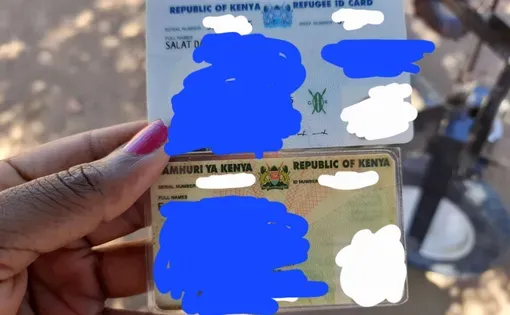
Some Kenya residents register as refugees to get what their government was not offering them.

In the fourth part of the Project Profile investigation into the use of biometrics in the humanitarian sector in Kenya, Naipanoi Lepapa looks at how the UNHCR’s sharing of biometric data with the Kenyan government led to the violation of the human rights of both Kenyans and refugees.
The United Nations High Commissioner for Refugees (UNHCR) deployed its biometrics in a grey zone. The Data Protection Act, which requires that data controllers and processors obtain consent from the data subject before collecting, using, or disseminating the information, was enacted in 2019.
The UNHCR also adopted a data protection policy in 2015 (upgraded in 2022). The policy requires the agency to inform a data subject in a way that is comprehensible to them, the specific purpose for which their personal data will be processed, whether the data will be transferred to third parties, or whether the data is being collected by partners on behalf of the UNHCR.
A data subject has a right of access to correction or deletion of their data and to submit a complaint with the UNHCR, an option that was never made available to any of the double-registered persons interviewed before their data was shared with the government.

As a nonprofit journalism organization, we depend on your support to fund more than 170 reporting projects every year on critical global and local issues. Donate any amount today to become a Pulitzer Center Champion and receive exclusive benefits!
Sources said they wouldn’t have registered as refugees had they been informed about the risks. They were also never given the option to refuse or to opt out of the registration while still being eligible to receive aid.
A double-registered person who now wishes she had had prior understanding of the dangers told The Elephant that she gets nauseous and feels like vomiting whenever she hears the words “refugee camp.”
The UNHCR is required to carry out a data protection impact assessment before transferring data to third parties. The UNHCR is also required to undertake a data protection impact assessment before deploying new technology.
“Although proGres v4 had already been deployed in 2015, a data protection impact assessment [that would] help detect data protection difficulties in the early stage and to design and build safeguards (…) had [not] been conducted” by April 2020, subjecting the data of 6.9 million vulnerable persons “to data transfer,” a U.N. financial report and audited financial statements for 2019 stated. ProGres is an abbreviation of the Profile Global Registration System of the UNHCR.
Dr. Keren Weitzberg, a researcher and an expert on biometrics in East Africa, told The Elephant that the UNHCR had shared proGres data with the government of Kenya “without thinking through what the implications would be for people who were in the refugee system but who were actually Kenyan citizens.”
For the UNHCR, Weitzberg said, “It was about creating a large platform which their partner organization could use” while the agency could “audit everything so they say they are saving cost and preventing fraud.”
In 2001, the UNHCR’s Executive Committee had stated that sharing data in line with data protection principles “can assist states to combat fraud, address irregular movement of refugees and asylum seekers and identify those not entitled to international protection.”
According to a 2005 audit, Project Profile was fated to enhance partnerships; host countries would get a clearer picture of the refugees within their territories, donor governments would receive programmes based on realistic and verifiable populations, while partner organisations like the World Food Programme (WFP) and the International Organization for Migration (IOM) would improve their programme delivery and refugees would be better identified and traced for protection and aid. ProGres 4 offers just that; the interoperable centralised cloud-based online software enables the UNHCR to grant access to governments and partners like the IOM and the WFP.
The UNHCR did not provide a specific comment on Project Profile.
During the bidding for the Biometric Identity Management System (BIMS — a centralised system integrated into proGres), a concerned vendor sought clarification as to whether the UNHCR was planning to share biometric data with NGOs and governments and whether the legal implications had been considered. The agency responded that “biometrics will be used at UNHCR’s discretion. Whether or not UNHCR exchanges data with partners is not relevant.”
In an official statement through its Communications Officer and Spokesperson Faith Kasina, the UNHCR told The Elephant that BIMS is holding 15 million biometric identity records of vulnerable persons while proGres has 20 million registration records.
Both BIMs and proGres are housed under the Population Registration and Identity Management Ecosystem (PRIMES), also an interoperable system that facilitates data sharing with governments and partners. PRIMES was deployed in Kenya in 2019.
The Elephant asked the UNHCR whether third parties, including the Kenyan government, have access to the entire proGres database or whether it is limited to querying the system.
UNHCR said it shares data with humanitarian and implementing partners “to facilitate the provision of assistance and protection, in full accordance with principles enshrined in UNHCR Data Protection Policy.”
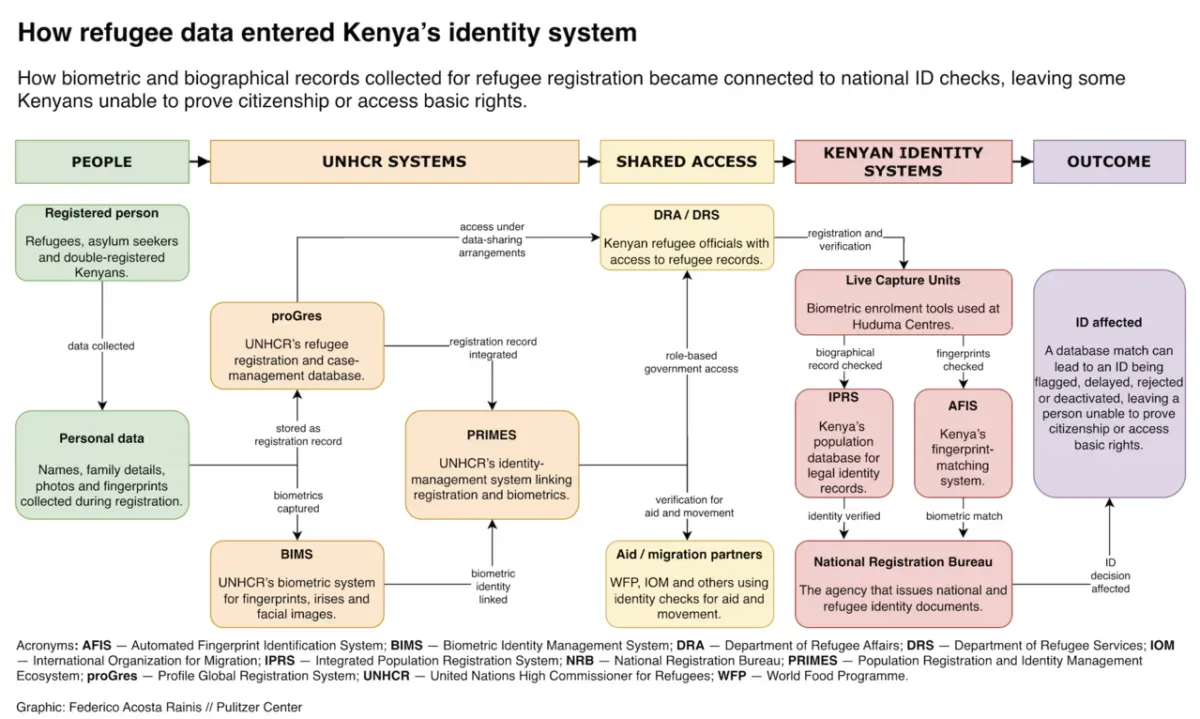
The UNHCR responded that “government staff who are responsible for conducting registration of refugees and asylum seekers are granted access only for their relevant role in Kenya accessing Kenyan data.” According to the agency, these staff, “cannot access registration records created and managed outside of Kenya.”
“Similarly, read-only accesses are granted to staff who do not have a role to make changes in proGres,” the agency said. “WFP, IOM, and other NGO use PRIMES (BIMS and other tools) to verify identity during humanitarian activities such as food distributions, and for the management of referrals and resettlement processes.”
According to the UNHCR, this access management setup is “applicable to all proGres users including UNHCR, Government as well as partners” and is “governed by established data sharing agreements.” In November 2024, John Burugu, the former Commissioner for Refugee Services, disclosed that the government of Kenya was a third-party processor of the proGres data stored in Hungary. According to Burugu, Kenya was “supposed to be the custodian of this database and while we are involved in processing it, we do so as data processors for a third-party organization. I want to assure this committee that we are working with partners to develop a more accurate and localized refugee database for Kenya.”
On the country’s refugee website, the government states that Kenya currently hosts 835,793 refugees and asylum seekers (as at December 2025). However, in November 2024, Burugu also stated that the government “cannot fully confirm the numbers we receive from the UNHCR represent the actual refugee population in Kenya.” The UNHCR did not respond to the government’s claim.
Some experts have raised questions about the data ownership, with experts like Alexandrine Pirlot de Corbion, of Privacy International inquiring, “What is the lifecycle of the data?”
Responding to questions from The Elephant, the agency stated that the “data lifecycle follows UNHCR’s General Policy on the Personal Data Protection and Privacy and the Policy on the Management of Records and Archives, with retention limited to the period necessary for the purposes for which the data is being processed”.
ProGres database and counterterrorism
“Once you surrender yourself to UNHCR, it’s a must that you’ll be registered,” Farrah Budhul Uleh, a double-registered person, told The Elephant. “They put you in that database. In a computer system,” he said, unaware of the name of the database.
Like all sources interviewed by The Elephant, Uleh fails to understand why the UNHCR shared with government officials his data contained in the proGres database.
The UNHCR announced in a factsheet that it granted Registration and Refugee Status Determination (RSD) officers of the Department of Refugee Affairs (DRA) access to the proGres database in April 2016 as part of the handing over of responsibility for registration and Refugee Status Determination (RSD) to the government. Responding to The Elephant, the agency said, “Data sharing with the Government of Kenya took place within the framework of the 2016 MoU to enable the government to gradually assume responsibility for refugee registration and documentation in line with the Refugees Act (2006). All access was governed by strict authorisation protocols and limited to trained officials for legitimate protection and administrative functions. Personal data could not be used for non-protection-related purposes under the agreement.”
The agency had begun conducting registration of refugees and asylum seekers and the issuance of documentation in the early ’90s at the request of the Government of Kenya in view of its “limited capacity,” the UNHCR told The Elephant. The Kenyan asylum system had been overwhelmed by a flood of refugees arriving mainly from Somalia.
Based on various reports, it would appear, however, that even though the Kenyan government is primarily responsible for the management and protection of refugees, authorities were also motivated to take back the responsibility for registration and RSD because of security concerns, as terrorism was seen as “infiltrating the asylum space.” The same motive appears to be the reason why Kenya pushed for the proGres database to be surrendered to them by the UNHCR.
On 10 November 2013, in the wake of the Westgate Shopping Mall attack in September 2013, the governments of Kenya and Somalia signed a tripartite agreement with the UNHCR for the voluntary repatriation of Somali refugees.
Days later, from 13 November, Kenya and the UNHCR held a joint retreat, during which they agreed on the terms under which the UNHCR would gradually transfer registration and refugee status determination (RSD) responsibilities to the DRA.
In January 2016, the UNHCR stated in its Kenya factsheet that an agreement between the DRA and UNHCR would result in joint registration using the proGres database commencing in March 2016, as part of the phased approach to handing over responsibility. “This will address the issue of parallel registration at DRA and UNHCR,” the agency said.
A Memorandum of Understanding (MoU) appears to have been signed officially on 15 April 2016, according to a UNHCR in its Kenya factsheet reviewed by The Elephant. The UNHCR said it had granted the DRA access to the proGres database “pending the creation of DRA’s refugee management system.” The factsheet stated that the agency would deploy BIMS from June 2016 during the refugee population verification exercise to be conducted jointly with the government.
And while the sharing of the data held in proGres was still in place, the UNHCR stated in the 2016 Kenya Comprehensive Refugee Programme that the Kenya government would also use the centralised Integrated Population Registration System (IPRS) during the refugee verification process.
The IPRS would “ensure the authenticity of documents issued to both refugees and asylum seekers and also allow them to access the Kenya Revenue Authority Personal Identification Number (PIN)”, the UNHCR stated. The IPRS aggregates data from various government registries and was officially launched in March 2015. During verification, UNHCR stated the “NRB system will also collect all 10 fingerprints.”
Kenya’s National Bureau of Registration (NRB) manages both the IPRS and the Automated Identification System (AFIS), which stores and compares fingerprints data. The NRB issues IDs for Kenyan citizens and refugees (through the Department of Refugee Services).
According to sources, during national ID application processing, fingerprints may be checked against proGres records. Sources, including a DRS registration and an RSD officer, also indicated that refugee fingerprints may be checked against Kenyan records during registration.
In response to questions from The Elephant on whether there was ever any cross-matching of refugee fingerprints held in the proGres database against those in the government database during the registration of asylum seekers, the UNHCR Communications Officer and Spokesperson Faith Kasina said there was not. The Government of Kenya did not respond to questions.
The UNHCR first planned to transfer proGres data to the government in 2005. Negotiations on joint registration and data sharing with the government using proGres commenced in 2012. The DRA had started registering refugees in 2011, the same year Kenya had launched Operation Linda Nchi, with its military crossing over into Somalia to cripple Al-Shabaab, leading to an increase in terror attacks in the country. According to reports, negotiations stalled after the government allegedly pushed for proGres to be ceded to them instead.
In April 2014, Kenya launched Operation Usalama Watch, a major counterterrorism operation carried out in Eastleigh, a predominantly Kenyan Somali neighbourhood in Nairobi. Kenya’s law enforcement agencies reportedly requested access to proGres data during the operation, which was characterised by human rights violations, including police round-ups, arbitrary arrests and detention, forced encampments, and deportations, including of registered refugees.
Amnesty International stated that Operation Usalama Watch appeared to be a blanket punishment of the Somali community in Kenya, which was being scapegoated; both Kenyan Somalis and Somali refugees had been targeted.
The UNHCR states in a report that there was “increased interest on the part of law enforcement authorities in access to data of non-Kenyan citizens” during Operation Usalama Watch, raising “concerns that confidential asylum-seeker data could be used for non-protection-related purposes.”
According to the UNHCR assessment report, the agency denied the request as access would have violated its data principles.
“Kenya should be in a position to put in place confidentiality and data protection arrangements to limit the purpose for which it [data] can be searched, accessed and used, as well as the identity of officials and institutions that can use it,” the UNHCR stated.
Data collected for a specific thing should not be used for another, says Prof. Vukosi Marivate, the co-founder of Deep Learning Indaba, the largest Machine Learning/Artificial Intelligence workshop on the African continent. “If the contract changes in the future, permission must be asked again, otherwise it erodes trust,” he says.
Nevertheless, the UNHCR had already “provided access for DRA to its proGres database for limited purposes” even though negotiations for data transfer “had not moved ahead significantly over the years."
The UNHCR pushed for joint registration and data sharing through proGres because the agency wanted to remain involved to protect refugees. It deemed Kenya’s database utilizing Microsoft Access software inferior and “lacking basic functionalities” like tracking the progress of applications, adding newborns, identifying multiple registrations, or making transfers between camps. proGres data was also more detailed and dated back to 2008. It was also cheaper to use proGres than to fund a new database for the government.
A government source who spoke on condition of anonymity told The Elephant that the government was interested in accessing the proGres database due to security concerns, particularly over refugees obtaining Kenyan IDs.
According to the source, for many years, “UNHCR was hesitant to share with the Kenyan government.” Things changed after Operation Usalama Watch, he said. “Once the government was able to push them to the wall, they were able to open up access to part of the data.”
He added that, to permanently address the vulnerability, checks may be conducted between AFIS and proGres records during ID application processing to verify identities. Neither the Government of Kenya nor UNHCR has confirmed or acknowledged such cross-referencing.
According to philosopher and researcher Dr. Claire Elizabeth Walkey, “the government’s interest in UNHCR’s proGres database, which contained all the registration details of refugees, was rooted in how it could stop double registration (registration of refugees in the city and camps) in urban areas and thus enforce encampment.”
In 2012, 2013, and 2014, authorities had ordered all urban refugees to relocate to refugee camps. Registration, RSD, and aid distribution were halted in urban areas, and thousands were targeted to be rounded up and transported to camps.
In “Building a Bureaucracy: The Transfer of Responsibility for Refugee Affairs from United Nations Refugee Agency to Kenya Government,” Walkey states that authorities were using police round-ups, encampment, and repatriation to address security concerns. Research conducted by Walkey between 2015 and 2019 analyses the UNHCR’s transfer of responsibility of the management of refugee affairs to the government of Kenya.
Repatriation, resettlement and local integration are the three solutions recognised by the UNHCR as durable for refugees.
In December 2014, Kenya passed the Security Laws (Amendment) Act 2014 to strengthen security and provide tougher anti-terrorism measures. The law also tightened the implementation of the encampment policy. It had proposed capping refugee numbers at 150,000, which, if implemented, would have resulted in non-refoulement.
In May 2016, less than a month after the DRA assumed responsibility for the RSD, citing “national security interests”, the Ministry of Interior and National Administration, a state organ in charge of maintaining internal security, announced that the DRA had been disbanded as a starting point towards putting an end to Kenya’s hosting of refugees. Refugee camps would be shut down, and refugees repatriated.
According to the government, the camps — specifically Dadaab — had “become hosting grounds for Al-Shabaab.” Terrorists had used the camp as a logistical base from which to launch the Westgate, Garissa University, and Lamu attacks. Dadaab had been hosting Somali refugees whose prima facie status was revoked that April yet no refugee has ever been prosecuted for terror acts.
According to Walkey, the DRA was perceived to be an obstacle to the security agenda of the Ministry of Interior. The Ministry was planning to expedite the repatriation of Somali refugees, and the department seemed to obstruct this.
Months later, the DRA was replaced by the Refugee Affairs Secretariat (RAS) whose staff were former intelligence and military officers who, according to Walkey, were aligned with the Ministry’s security agenda. In 2014, the Ministry had transferred three DRA staff, including the commissioner, and replaced them with personnel with military backgrounds.
According to the UNHCR’s Policy Development and Evaluation Service (PDES) report covering the period between October 2014 and January 2015, refugees were terrified to learn that the DRA was taking over from the UNHCR. “If you give DRA responsibility for RSD, it would be like killing all of the refugees,” they said.
In particular, Ethiopian refugees expressed fear that the Kenyan and Ethiopian governments would share information and that, with the DRA in charge and holding all the information on refugees, their situation would worsen.
The UNHCR also expressed concerns in a meeting evaluating the transitioning of the RSD to the government. Authorities had constructed a narrative that refugees, particularly Somali refugees, were a security and terror threat. The UNHCR saw the management of refugees by the DRA under the Ministry of Interior as Kenya’s security strategy to control and monitor refugees, particularly through the encampment policy. The UNHCR worried that these measures, while aimed at national security, might increase the vulnerability of refugees.
The DRA previously operated under the Ministry of State for Immigration & Registration of Persons, but following structural changes, the DRA and Immigration became departments under the Ministry of Interior in 2014.
In the summary report of the PDES Steering Committee meeting on the RSD transition from the UNHCR to the government held on 27 October 2014, a representative of the DRA stated that there was “a security concern in Kenya as regards asylum seekers and refugees” and as such, authorities wanted to know who was residing in the country, “hence the concern to take responsibility for RSD.”
Responding to The Elephant, UNHCR stated that it “does not provide access to its registration systems for law-enforcement or security operations. Any request from authorities is reviewed against UNHCR’s Data Protection Policy and the applicable agreements to ensure it serves a legitimate humanitarian or protection function.
Where requests fall outside those purposes, access is not granted. Our cooperation with the Government of Kenya focuses on registration, documentation, and assistance delivery — not on criminal or immigration enforcement.”
The UNHCR also told The Elephant that it “never shares personal data with authorities in the country of origin without the consent of the individuals concerned. Data processed for voluntary repatriation may only be shared with the written consent of the refugees.”
The agency also said that during the registration and refugee population verification exercises, refugees and asylum seekers are informed both verbally and in writing, in a language they understand, about the type of personal data collected, the reasons for its collection, and with whom it may be shared for protection and assistance purposes.
The agency says that access to this sensitive data is governed by strict authorisation protocols and limited to trained officials for legitimate protection functions. The procedures are conducted in line with the UNHCR’s Data Protection Policy, Kenya’s Data Protection Act, and established data sharing agreements.
According to the UNHCR, the 2016 MoU between Kenya’s DRA and agency stated that, “personal data could not be used for non-protection-related purposes.”
The 2016 MoU has since been replaced by an updated MoU signed with Kenya’s Department of Refugee Services (DRS) — which succeeded the RAS in 2022 — concerning access to the UNHCR’s Population Registration and Identity Management Ecosystem (PRIMES).
The agency did not share the MoUs with The Elephant because, it said, “any disclosure of any bilateral or multilateral agreement requires the consent of all the parties to the agreement. The publication of any agreements with a refugee-hosting government is at the discretion of the government concerned.” The government did not respond to The Elephant’s request to share the MoUs.
The UNHCR also shares biometric and biographic data of refugees it refers for resettlement in the United States with the U.S. Department of Homeland Security (DHS). Under a 2019 Memorandum of Understanding (MOU), this information is transmitted to DHS systems such as the Automated Biometric Identification System (IDENT) and its successor, Homeland Advanced Recognition Technology (HART), and can be accessed by federal agencies responsible for security and counterterrorism, including the Departments of Defense and Justice. Civil society organizations have raised concerns that this access may expose refugees — including those who may never enter the United States — to security surveillance and privacy risks.
In 2009, the U.S. was concerned about terrorist exploitation of Somali refugees in Kenya. The U.S. stated that it would encourage Kenya to cross-check “refugee prints with its TIP-PISCES system that might catch terrorists posing as refugees once Kenya’s TIP-PISCES system is equipped with a biometric capability,” according to a cable leak.
PISCES stands for Personal Identification Secure Comparison and Evaluation System. Developed by Booz Allen Hamilton, PISCES is part of the U.S. Terrorist Interdiction Program (TIP) and is employed by the Ministry of Interior at border points, including the Jomo Kenyatta International Airport (JKIA) and the Immigration Department.
Kenya and the U.S. are key allies in the global war on terror, with the latter providing financial aid, training programmes, and equipment. The U.S. is also the UNHCR’s biggest donor and has funded projects like the Security Partnership Project and staffing for the DRA’s registration and RSD personnel.
The State Department and the DHS did not respond to The Elephant’s questions on their data-sharing agreement for refugee biometric data stored in systems such as IDENT and HART, which U.S. federal agencies may access, and nor did they respond to questions about what data privacy protections or access controls are in place to prevent unauthorised or unrelated use of the data.
Government capacity building
“Please don’t quote me,” began a former DRA security guard who also served in the military, whom we shall refer to as SS. SS was among what Prof. Walkey described in her study as “Project Staff.”
Project Staff are government-contracted employees who, in 2014, made up 80 per cent of DRA staff, as stated by a DRA representative during the PDES meeting of 27 October 2014.
“Individual contracts are signed with the employer, the DRA,” said SS, adding that their salaries are paid by the department. However, “originally, the salary comes from UNHCR [and] passes through the Ministry of Interior to DRA.” Multiple sources said that the salaries of some DRA workers (and current DRS staff) originated from UNHCR but were channeled through the government.
According to SS, they were unlike the UNHCR’s contracted staff, who were “paid tax-free salaries.” He worked with the DRA from 2014 to 2016, and their lower salaries were taxed. SS said they held meetings with the Commissioner for Refugees, where they constantly asked for “permanent and pensionable jobs.”
Because of the UNHCR’s annual budget cycle, project staff sign a one-year contract and are not automatically guaranteed continued employment. When their contracts end, they go on leave; some seek to move to other jobs with long-term security. MM, who has worked with the UNHCR and other aid organisations, told The Elephant that if the UNHCR stopped funding the DRS, staff would be forced to go home.
The Department of Refugee Services (DRS) is the legal body established under the Refugee Act 2021 to manage refugee affairs. The DRS replaced the RAS in 2021.
“It’s time to say that DRS is not a government institution but a UNHCR institution,” MM said. While it operates under the Ministry of Interior, the government doesn’t commit any resources “for DRS to work independently,” MM said.
According to SS and MM, the UNHCR pays salaries and provides vehicles, fuel, and computers, among other things. “Without UNHCR, RAS [Refugee Affairs Secretariat, which had replaced the DRA] did not have an office building, equipment, or most of their staff,” Prof. Walkey said in her study.
MM and SS believe that the UNHCR controls the department with its resources.
According to biometric expert Dr Weitzberg, if the UNHCR hadn’t funded, supported, and supplied technical support, the Kenyan government would not have assumed the role of registering and recognizing refugees. By 2018, the UNHCR was training RAS staff to use proGres, BIMS, and BioRegistor.
The UNHCR is mandated to assist governments which bear the primary responsibility of protecting refugees through capacity-building initiatives.
According to the UNHCR, it supports the Government of Kenya in managing refugee affairs through technical and financial assistance, including training, provision of equipment, and temporary support to specific government functions where needed, but “does not pay salaries of Government staff.” All support arrangements, the agency said, are agreed with the government and aim to strengthen national capacity so that these responsibilities can be fully assumed over time.
The agency says that sharing of personal data — with adequate data protection safeguards in line with the UNHCR’s Data Protection Policy — is part of its mandate and is necessary as part of the collaboration with the Kenyan government in order to ensure effective protection, access to assistance, and eventual durable solutions.
The agency began strengthening the government in 2004 through the Strengthening Protection Capacity Project (SPCP) pilot.
The SPCP began by conducting research and publishing a comprehensive report on the protection capacity gaps and existing capacities before developing intervention projects to improve the protection environment.
“The host communities surrounding the Dadaab and Kakuma camps are, in many ways, more impoverished and desperate than the refugees in the camps,” the report said. While they could access some camp-based services, “more could be done to build a sustainable economic environment.”
“In Dadaab, the project supported the identification of over 10,000 persons who were found to be Kenyan citizens. The deregistration of the Kenyan citizens is in the process and will be completed in the following months,” the UNHCR stated in a 2008 SPCP report.
The SPCP report had identified that Kenya lacked a legal framework that specifically addressed refugee matters. The UNHCR helped draft and lobby for the passing of the Refugee Act 2006 “before the general election in December 2007,” according to an SPCP brief.
Passed in December 2006, the Refugee Act was enacted in May 2007, leading to the establishment of the DRA under the Ministry of State Immigration and Registration of Persons. It also legalised the rights and duties of refugees and officially formalised the encampment policy that restricted refugees to residing inside the camps.
Commenting on the act in “Borders recolonised – the impacts of the EU externalisation policy in Africa,” Dr. Bosco Opi observed, “Kenya is one of the African countries in which the UNHCR implements the EU’s externalisation policy.” In the study, Dr. Opi argues that the Act’s “strict encampment policy” mirrored “the EU’s externalisation policy.”
Initially funded by the European Commission and the governments of Denmark, the Netherlands, and the U.K., the SPCP improved, among others, registration, RSD, issuance of ID cards, health, education, and conducting training for judicial NGOs and security officers. Other SPCP funders included Switzerland.
The IOM and Denmark funded similar staffing initiatives for the DRA. The IOM paid the salaries of DRA workers to expedite the resettlement process. The organisation clarified that it “provides support to the Department of Refugee Services (DRS) in both the camps and at the Nairobi level. The DRS is a key partner in refugee resettlement processing and IOM does work alongside and provides capacity building and administrative support to DRS to ensure that refugee resettlement departures take place in a reliable and organized fashion.”
Through the Danish International Development Agency (DANIDA), Denmark also funded the “Capacity Building of the Kenyan Refugee and Asylum System: Implementation of a New Refugee Act.”
“In March 2011, DRA took over responsibility from UNHCR on the reception of refugees in Dadaab,” Denmark said of the project, adding, “This is a major accomplishment.”
The Denmark project was part of the Region of Origin Initiative (RIO) launched in 2005 by Denmark’s Ministry of Foreign Affairs, aimed at improving the conditions of Somali refugees and hosts in north-eastern Kenya by strengthening Kenya’s refugee protection capacity. By addressing displacement in the region, the RIO hoped to indirectly reduce migration pressures toward Europe, including Denmark.
DANIDA was also funding a “national registration database” for Kenya but this was never completed Danish funding was suspended at the end of 2013, according to a UNHCR PDES report. The report states that DANIDA was open to contributing “to DRA resources for staffing” and preferred to “provide directly to the Kenyan National Treasury, rather than directly to DRA or via a third party” and expected to see a “commitment to and evidence of effective use of those resources.”
According to the UNHCR PDES report, donor countries capacitating the DRA hoped that one day the institution would fully function independently without aid, with the country developing into “a first asylum country to which non-refugees, who had applied and been rejected in their own territories in the industrialised world, could eventually be returned.” By 2005, the UNHCR had also been ready to provide Kenya with “registration software” and technical assistance, as it considered a database “a matter of priority.”
Responding to The Elephant, the Danish Ministry of Foreign Affairs stated, “Denmark contributed financially to the project Capacity Building of the Kenyan Refugees and Asylum System from 2009 to 2013, but did not provide any direct financial contribution to the development of a centralised database system and central registry for the Kenyan government under the project.
While the database was referenced in the project objectives, this specific objective was, however, not directly financed by Denmark. As the database had not yet been developed at the time Denmark exited the project in 2013, we do not know what name it was ultimately given and cannot comment on its further development.”
The Elephant submitted questions regarding this investigation to the Ministry of Interior, the National Registration Bureau (NRB), and the DRS, but had not received a response at the time of publication.