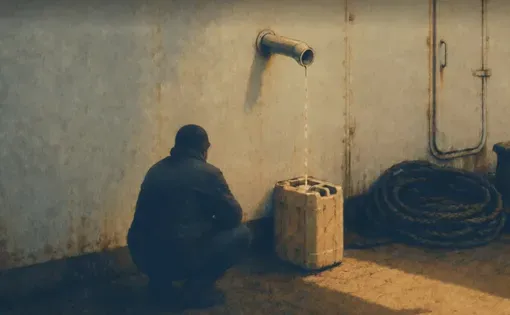
The high demand for seafood is not matched by the availability of domestic labor.
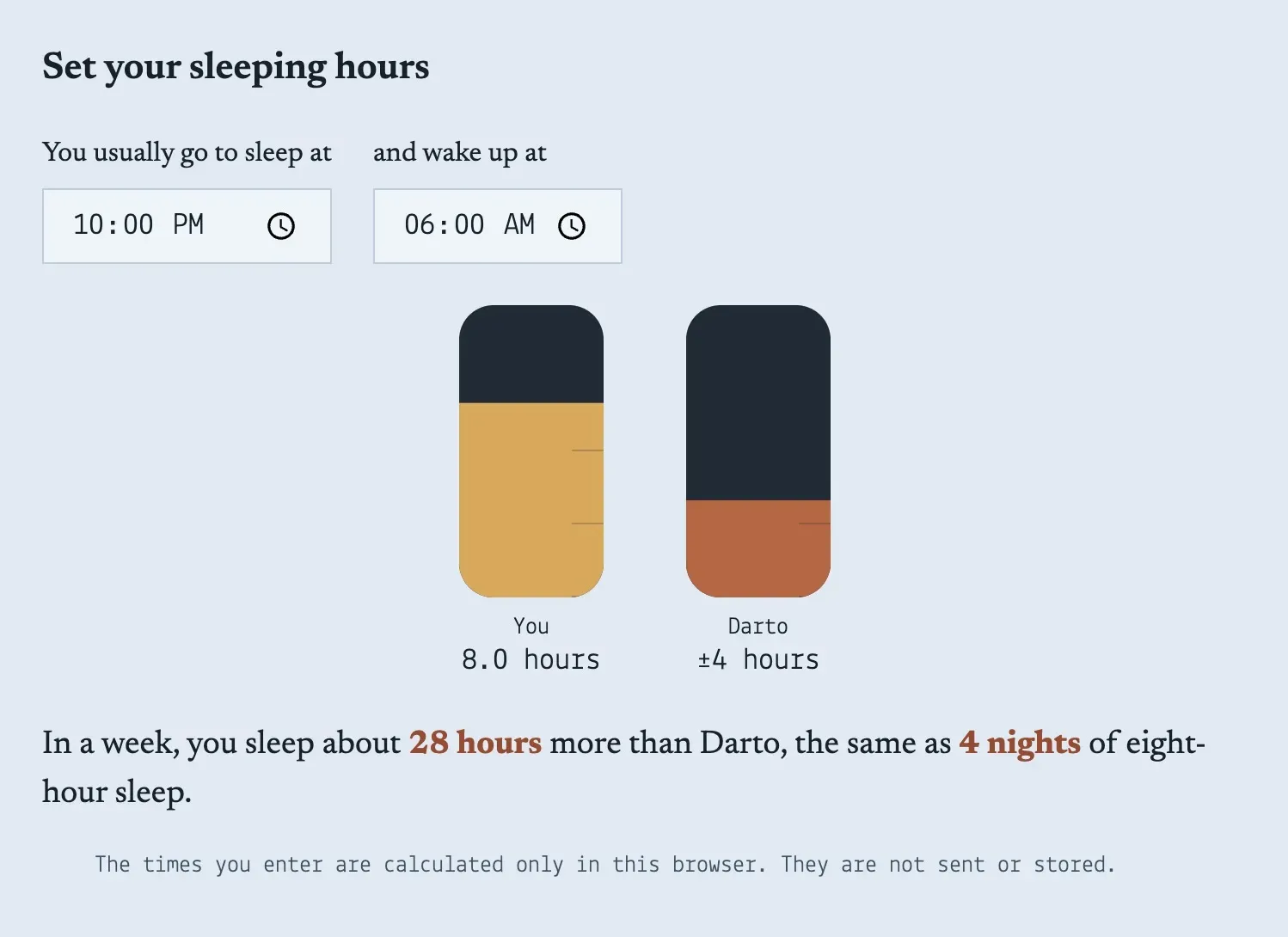
It is 12:13 where you are. At this hour, on the squid boat where Darto works: boat leaves again. He can sleep only in 20 hours, and only for about 4 hours.
Hoping for higher pay and shorter voyages, Indonesian fishing crews moved from distant-water vessels to South Korea's coastal boats. What they found instead was four hours of sleep a day, work their contracts never mentioned, and violence they suffered themselves or watched fall on new crew members.
His name is Abdurrohim. The 39-year-old from Indramayu, West Java, had sailed four times on South Korean-flagged fishing vessels operating in Russian waters. Among Indonesian fishing crews, known by the Indonesian acronym ABK, such ships are called "kapal lepas" or "LG" (distant-water vessels), which carry them to work for months far from land.
In October 2023, Abdurrohim left for Korea again. After years on distant-water vessels, this time he tried his luck on a coastal boat, the crews' term for fishing vessels that operate in Korean waters.
"I hoped for better pay, fairer pay," Abdurrohim said. On distant-water vessels he earned at most 600 US dollars a month, about IDR 10.7 million. On coastal boats, his pay was at least 2.3 million won, about IDR 30.6 million, nearly three times as much. "Like the friends who made it, some made it and built houses."

As a nonprofit journalism organization, we depend on your support to fund more than 170 reporting projects every year on critical global and local issues. Donate any amount today to become a Pulitzer Center Champion and receive exclusive benefits!
Abdurrohim is not the only one. Through early 2026, we interviewed seven Indonesian crew members who work or have worked on South Korean-flagged coastal boats. Most come from the north coast of Java: Indramayu, Tegal and Pemalang. Five of them had worked on distant-water vessels flagged to China, Taiwan or Korea before switching to coastal boats. Two of them are identified by pseudonyms.
In 2025, South Korea's Ministry of Oceans and Fisheries recorded 9,517 foreign crew members working on coastal boats of more than 20 tons. That is more than half of the 18,097 crew on vessels of that class. Most foreign crew come from Indonesia and Vietnam. Korea's reliance on foreign crew keeps growing. In 2003, foreigners made up only 15 percent of all seafarers working in Korea. Two decades later, in 2023, their share reached 49.9 percent. By the end of 2025, according to the Korean Seafarer Statistics 2026 published by the Ministry of Oceans and Fisheries, 33,171 of the 60,543 seafarers working in Korea were foreigners, or 54.8 percent.
In our two previous reports, we traced the fate of Indonesian crews in Korea's distant-water fleet. One crew member spent 14 months in the Pacific Ocean and at one point drank water from an air-conditioner drain pipe. A squid vessel disappeared from satellite tracking for 10 months, with Indonesian crew on board.
Coastal boats promised a different life. These small and medium-sized vessels catch squid, hairtail, crab and anchovy around the Korean Peninsula, then return to port after a night or a few days at sea.
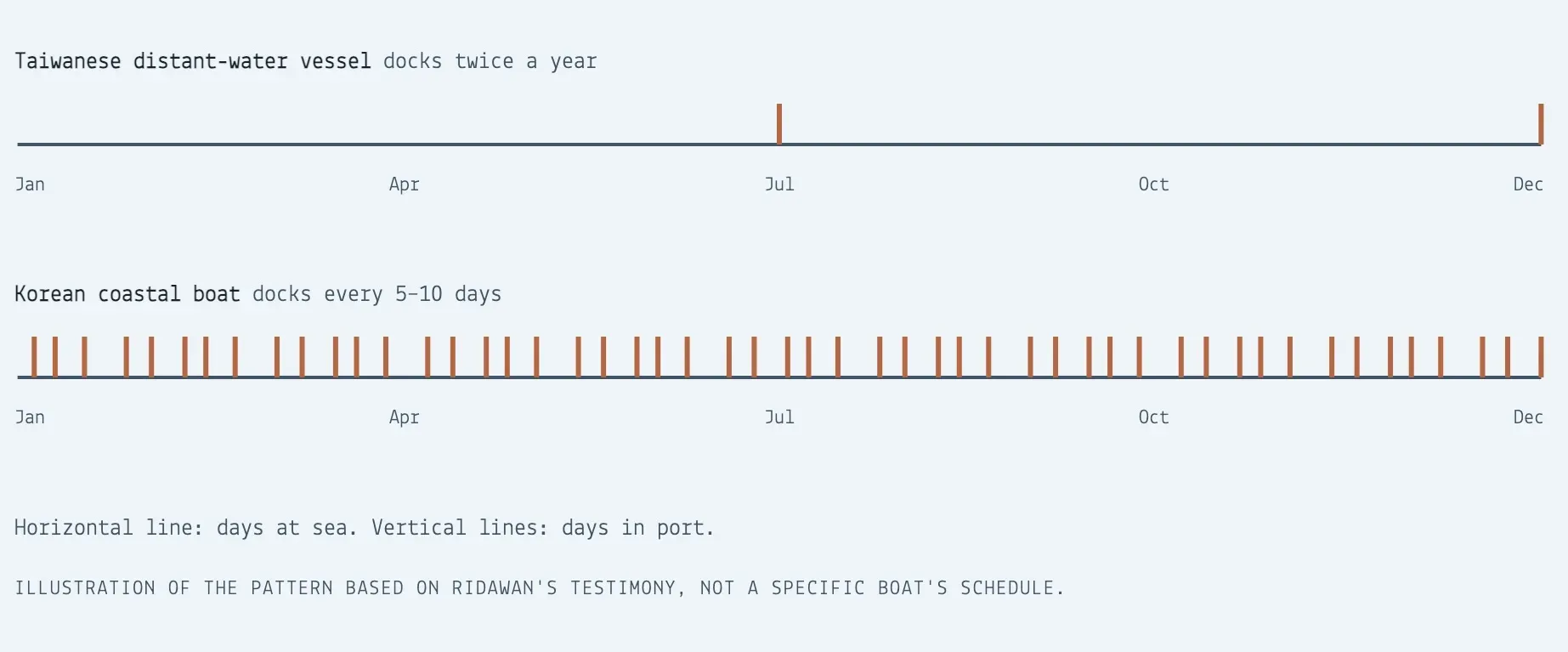
Ridawan worked two years on a Taiwanese vessel before moving to a crab-trap boat in Korea. The Taiwanese vessel, he said, docked only twice during his contract. "A year at sea, a year. Docked only twice," he said. On a South Korean-flagged coastal boat, a single voyage lasted "five days, ten days at most," he said.
Darto, not his real name, worked three years on Taiwanese vessels before leaving for Korea in December 2022. The reason was money. "On Taiwanese ships the pay is next to nothing. In Korea it's fairly big," he said.
Muhammad Tresno Widianto (30), known as Tresno, a crew member from Tegal, Central Java, spent five years moving between Chinese and Korean distant-water vessels before switching to coastal boats. "Because the pay (on South Korean boats) is tempting." On the coastal boat he earned 2.4 million won a month, about IDR 32 million, before deductions. But according to Tresno, that pay was not always paid every month.
The picture of lighter work did not last long. Kiki Iskandar, a crew member from Pemalang who left for Korea in 2013, described what goes through newcomers' heads. "They think, 'Wow, the pay there is big, the work must be easy.' But in Korea the work is ten times what it is here, more exhausting," he said.
“But in Korea the work is ten times what it is here, more exhausting.”
Kiki Iskandar, describing what newcomers think about
Caswanto, who had never been to sea before leaving for Korea, said he was shocked. "I imagined the work wouldn't be that extreme. When I actually did it there, it was more extreme than I imagined," he said.
Darto also found work on Korean coastal boats harder than on Taiwanese vessels. On coastal boats with few crew, everyone has to know every job. "On the LG ships everyone just does one job, because there are many people," he said.
Too Tired to Fall Asleep
The squid boat Darto worked on left port at 1 p.m. Two or three hours later, the crew dropped a parachute anchor and waited for night. Around 6 p.m., the josangi started up. A josangi (조상기) is an automatic squid-jigging machine: motorized reels lined along the side of the boat that endlessly lower and haul in lines strung with rows of hooks, while bright lamps above the deck draw squid up to the surface. Darto and three fellow Indonesian crew stopped to eat at 8 or 9 p.m., then hauled squid until 5 a.m.
At night, the sea east of the Korean Peninsula fills with points of light. In a photo taken by the crew of the International Space Station in September 2016, NASA identified those points as fishing boats in the East Sea.

Once the boat docked, they unloaded the catch until 7 or 8 a.m., then slept. At noon or 1 p.m., the boat went back out. That meant Darto had only about four hours of sleep a day.
Even that was often cut short. "Sometimes less. If the josangi or the engine breaks, you're told to help out. Sometimes one hour, sometimes no sleep. You sleep on the way out," Darto said.
Darto worked this pattern from December 2022 until April 2025. If he looked sleepy at work, his employer scolded him. "The boss wakes you up: 'What are you doing?' Tells you to make coffee, wash your face, don't be sleepy," he recalled.
"When you're short on sleep you work anyway, you could say you work half-asleep," Darto said.
Caswanto (39), a crew member from Indramayu, lived a similar pattern on a hairtail longliner. He and the other crew got up at 3 a.m. to prepare bait. At 5 a.m. they set the lines, ate, then slept for half an hour. At 7 a.m. they went back to work until 8:30 or 9 p.m.
"Just a quick cigarette and straight to bed. Then at three, half past two, they wake you up again," he said.
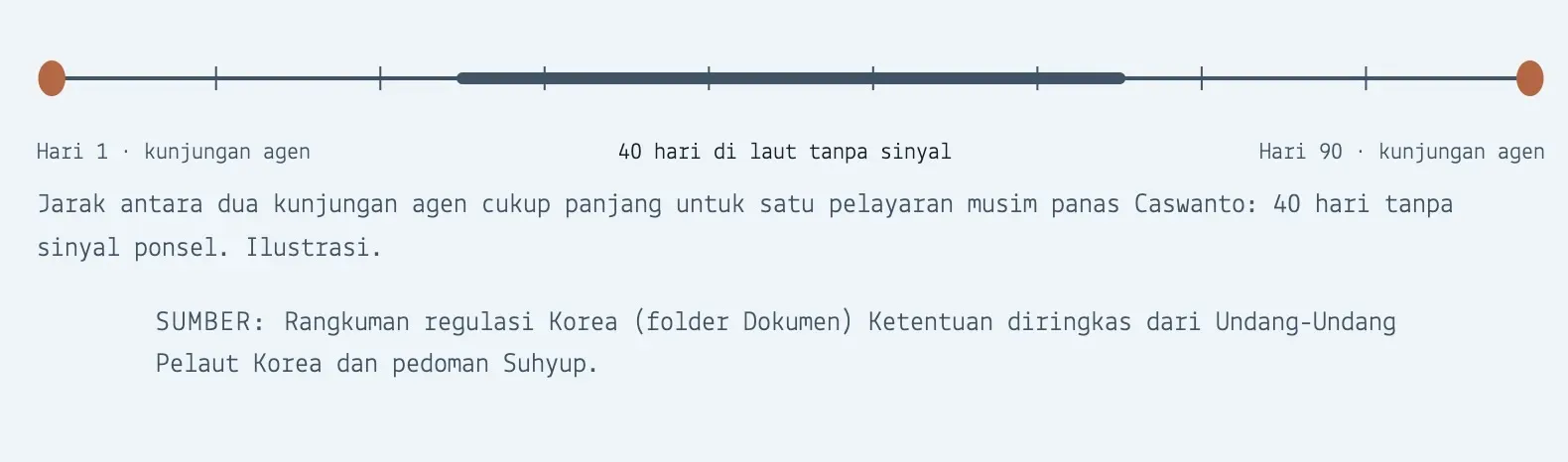
In summer, Caswanto's boat sailed as far as the waters near Taiwan. He could be at sea for up to 40 days before returning to land. During that time the working hours were longer and the crew could not contact their families. "No Wi-Fi, not even a signal," he said.
Tresno worked on a crab-trap boat. On an ordinary day he started at 6 a.m. and stopped at 2 or 3 a.m. the next morning. "On normal days, usually up to 20 hours. I find it exhausting," he said.
Before the boat came in to dock, the crew had to haul every trap on board. According to Tresno, that job could take 37 hours without sleep. "At most you eat, then start again right away," he said.
Abdurrohim lasted only 12 days on his first boat, a net boat. When the net tore, the crew had to mend it on the spot. "The work was too heavy. Sometimes almost two days in a row without rest, without eating," he said. He then asked the agency to move him to another boat.
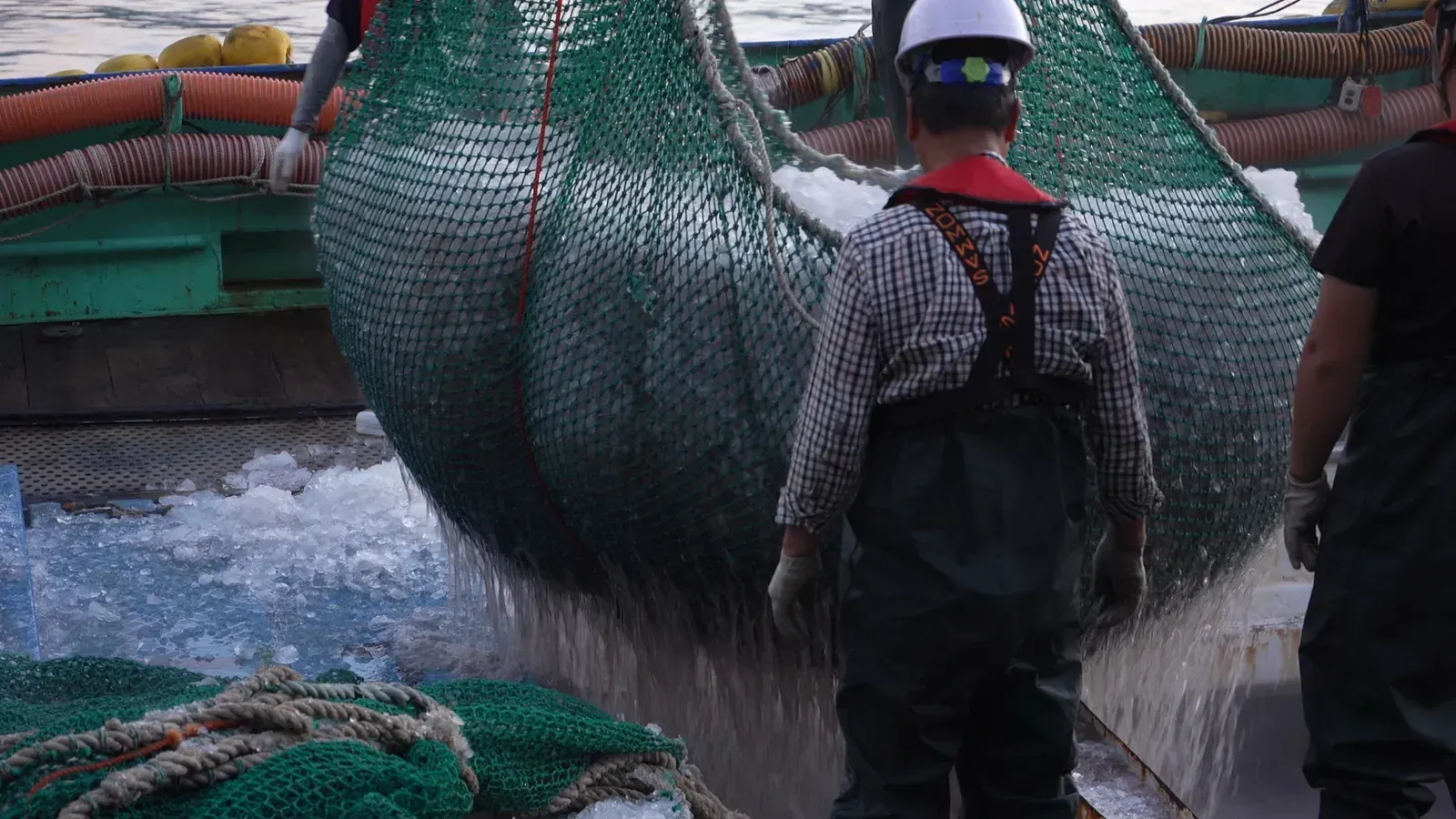
Kiki, who came through the government-to-government program, was placed on an island and worked on a small boat that went out overnight. He was often woken two hours after falling asleep to carry fishing gear to a truck. According to Kiki, that work fell only on foreign crew.
"The Koreans are still asleep. Only the foreigners load the gear. Once all the gear is loaded, we're told to wake the Koreans. They get a decent rest, we foreigners get two hours. Almost every day," he said.
Not every crew member objects to the long hours. Fajar, also a pseudonym, left for Korea in June 2024 after seven years on Chinese and Taiwanese vessels. He worked from 4 a.m. to 7 p.m. on a net boat in Ulsan, or until 10 p.m. if a line broke. "For me, as a seaman, that's normal," he said. "When there are lots of fish, sometimes you sleep only one or two hours."
But Fajar's contract set no limit on working hours. His employer did not pay overtime either. "All he knows is the work has to get done," he said. Ridawan, who worked nearly five years on a crab-trap boat in Mokpo, said the same. "On the boat there's no overtime," he said.
Hours that long do not break Korean law. Korea's Seafarers' Act exempts fishing crew from limits on working hours. The standard contract for foreign crew on coastal boats says only that their hours match the "customary working hours" of Korean seafarers and that the employer must give "sufficient rest", without any figures.
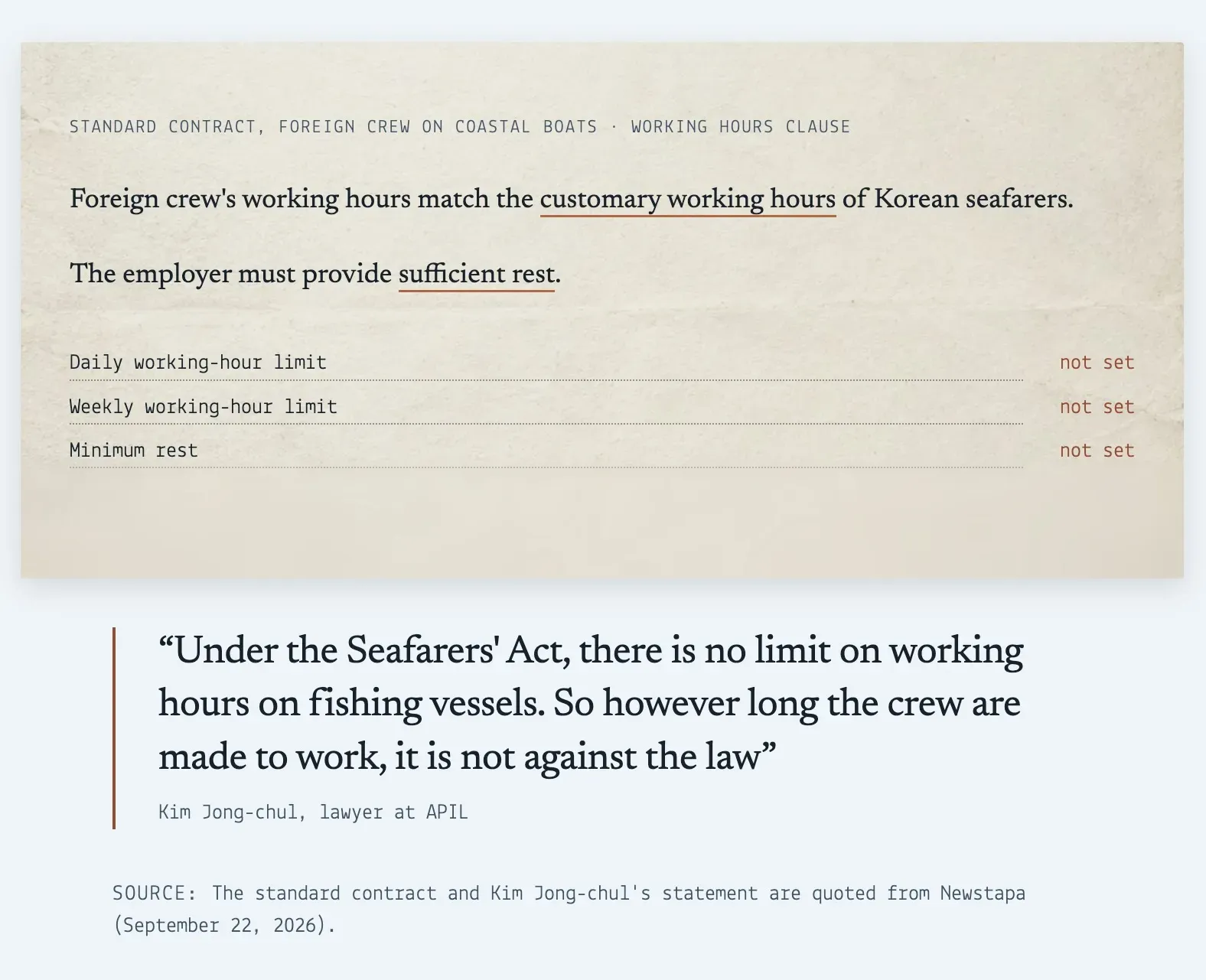
"Under the Seafarers' Act, there is no limit on working hours on fishing vessels. So however long the crew are made to work, it is not against the law," Kim Jong-chul, a lawyer at Advocates for Public Interest Law (APIL), told Newstapa.
Contracted for the Boat, Put to Work on Land
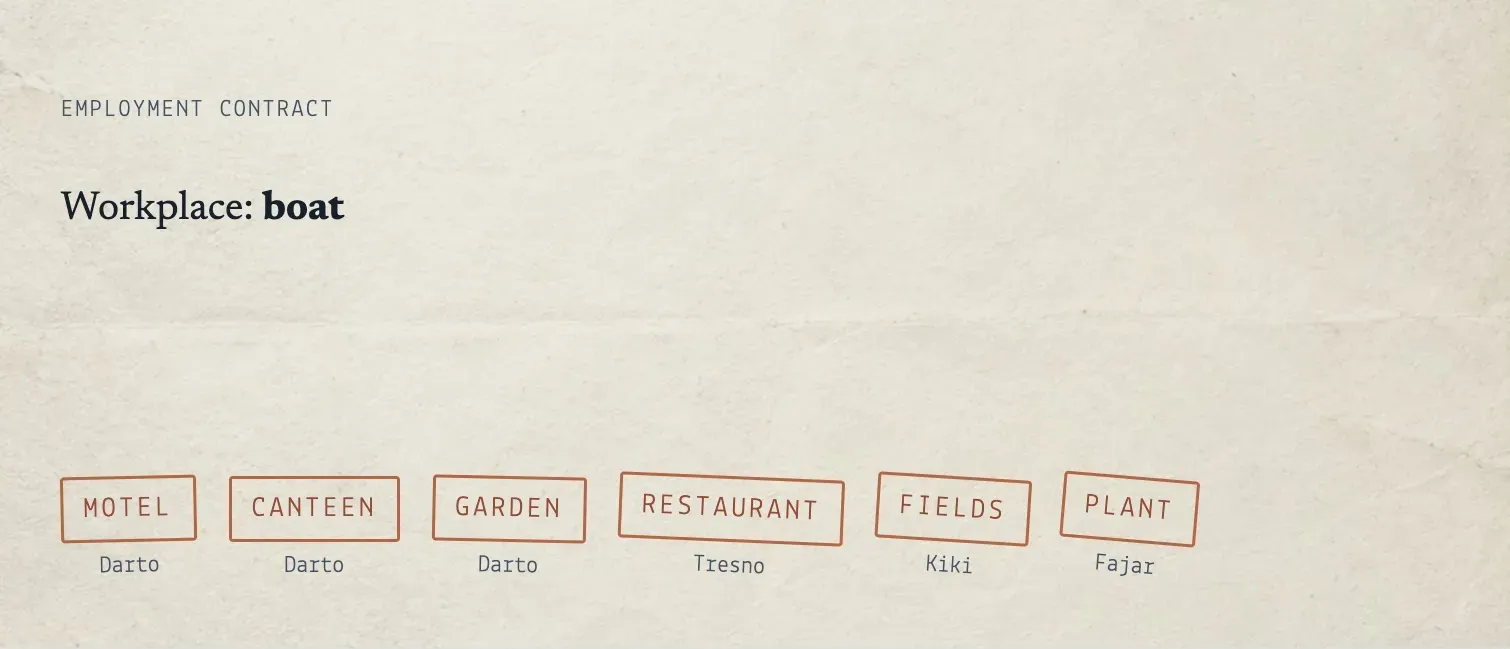
Darto's employment contract named only one workplace: the boat. "As far as I knew, I was hired to work on the boat, not to be put to work on land or anywhere else," he said.
But every time the boat docked, his employer sent Darto to work at his other businesses. "There's the motel, there's the canteen, there's the garden. His own motel, his own garden, his own canteen," he said.
Darto said he was afraid to refuse because it was his first job in Korea. The extra work ate into his rest. "You're tired, just finished work on the boat, you get off, and you're told to work again," he said.
Time to call his family in Indramayu went too. "Sometimes in the dorm everyone is on the phone with their families, and you're told to work at the motel. No time for family," Darto said.
Tresno had the same experience. His dorm was in the same building as a restaurant owned by his employer. "During my rest time the boss kept ordering me around. It felt like doing extra work, when that was my time to rest," he said.
On the island where Kiki worked, the employer's family gave orders too. When there were no nets to mend, his employer's grandmother sent Kiki to the fields. "Hoeing, harvesting, spraying the crops," he said. Kiki was also told to help the employer's neighbor renovate a house. At night, after cleaning the house, he still had to keep older Korean crew company while they drank. "We're tired, really tired already," he said.
After two months on the job, Fajar's employer moved him from the net boat to an anchovy-processing plant on land. He was put in the packing section. Fajar accepted the decision. According to him, the agency had told him the employer had the right to decide where he worked. "Working on the boat or at the plant, it's up to the employer. 'Are you ready?' I said I was ready, wherever I work," he said.
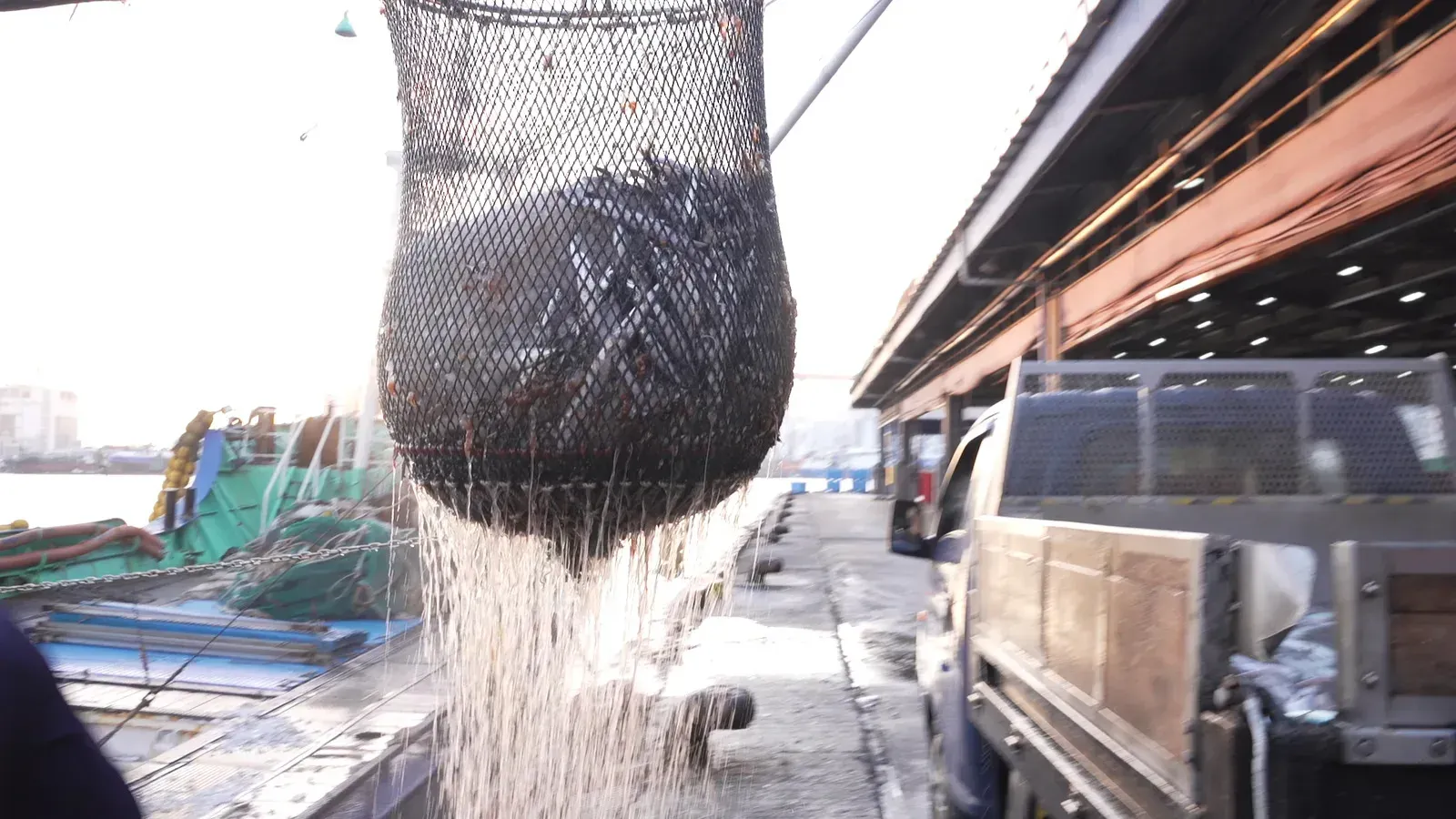
Yet foreign crew on coastal boats enter Korea on a residence permit as fishing-vessel crew. According to Newstapa, that kind of permit does not allow work in a fish-processing plant.
Later, Fajar and his colleagues found their pay had shrunk without notice. "He didn't tell us at all. When we got our pay, it turned out to be less than usual," he said. The employer told them to ask Suhyup, the National Federation of Fisheries Cooperatives, which handles the placement of foreign crew on coastal boats. Only from Suhyup did they learn that the employer was deducting 215,000 won, about IDR 2.9 million, each month for accommodation.
Fajar's pay already followed the minimum wage, first 2.4 million won and now 2.6 million won. After deductions for Korea's national pension and accommodation, he takes home about 2.08 million won, or about IDR 27.7 million.

Blows to Greet the Newcomers
Abdurrohim has his own explanation for violence on fishing boats. "The reason is simple. On a boat you're too sleepy, tired. Once you're sleepy and tired, you're close to violence," he said.
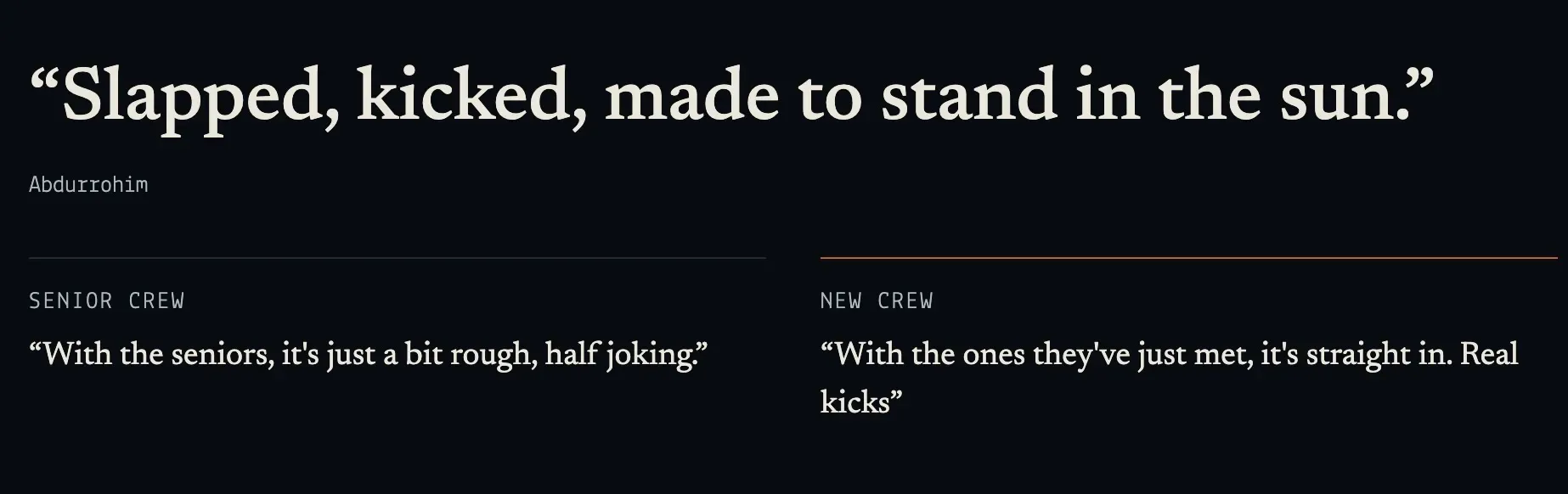
After leaving his first boat, Abdurrohim was moved to a hairtail boat in Jeju. He lasted 25 days. Asked what violence he experienced on that boat, Abdurrohim answered briefly. "Slapped, kicked, made to stand in the sun."
According to Abdurrohim, the violence happened about twice a week and hit the eight Indonesian crew on that boat. Senior crew were treated more lightly. "With the seniors, it's just a bit rough, half joking. With the ones they've just met, it's straight in. Real kicks," he said.
One day the waves were high and the boat caught nothing. The captain was angry, and Abdurrohim was kicked three times. He then asked to leave the boat. Abdurrohim was also disappointed in his fellow Indonesian crew who did not stand up for him. "I'm disappointed in my fellow Indonesian crew. They won't teach a lesson for the sake of the new ones," he said.
Fajar suffered violence on his first boat. A Korean crew member in the engine room judged Fajar too slow at throwing a line and shouted "pali-pali" at him, Korean for "hurry, hurry". "I was already working as hard as I could, but he still didn't accept the way I worked. I don't know why, he hit me on the head from behind," he said.
Fajar said he was hurt and angry. "For Indonesians, the head is a crown," he said.
His colleagues told Fajar to be patient instead. "I was told to be patient, not to move. That man just likes to treat new people that way," he said. According to Fajar, the new crew who came and went while he worked on that boat were all Indonesian.
Darto witnessed similar violence on the squid boat. On two different days, his employer's younger brother hit a new Indonesian crew member on the head and the backside. According to Darto, the man did not yet understand orders in Korean.
Kiki named the language barrier as the main trigger. He had studied Korean before leaving, but the language on the boat was different from the textbook. Once a Korean crew member asked for a hammer, and he brought a piece of iron instead. "Once, they'll let it go. Once, twice, they'll surely be fed up," he said.
Kiki also knew where on the boat the violence usually happened. "The camera usually faces forward, not backward. The violence usually happens at the back," he said. Kiki himself was once hit on the head with an iron bar by the boat owner, a man of about 70. He hit back, and both ended up in the hospital.
Caswanto was never beaten. But the Korean crew on his boat often threw fish at his body on purpose. "They pretend it happens while they're hauling the line, and throw it at my body," he said.
Caswanto also saw the Korean crew treat Vietnamese crew better. "When they talk to Indonesians they have no manners at all. But when it's the Vietnamese, even a new one, they're still respected, still spoken to softly," he said. According to him, heavy work fell more often on Indonesian crew.
Ridawan witnessed violence on his first day at sea in Mokpo. A Vietnamese crew member failed to watch a line and a crab trap got crushed. The captain then hit the man on the head. Ridawan compared it with his time on a Taiwanese vessel. "At sea for years at a time, there was no violence like this. This is Korea, a developed country, so to speak. And yet they're so quick to hit," he said.
Three and a half months later, the captain hit Ridawan. He fought back. "None of the seniors ever dared to fight back. Only I fought back," he said. The fight continued on land. The captain told him to leave, while the boat owner, the captain's father, asked him to stay. Ridawan chose to move to another boat.
"Sometimes they cook chicken or meat only once a week."
Caswanto






Scraps for Meals, Work Without End
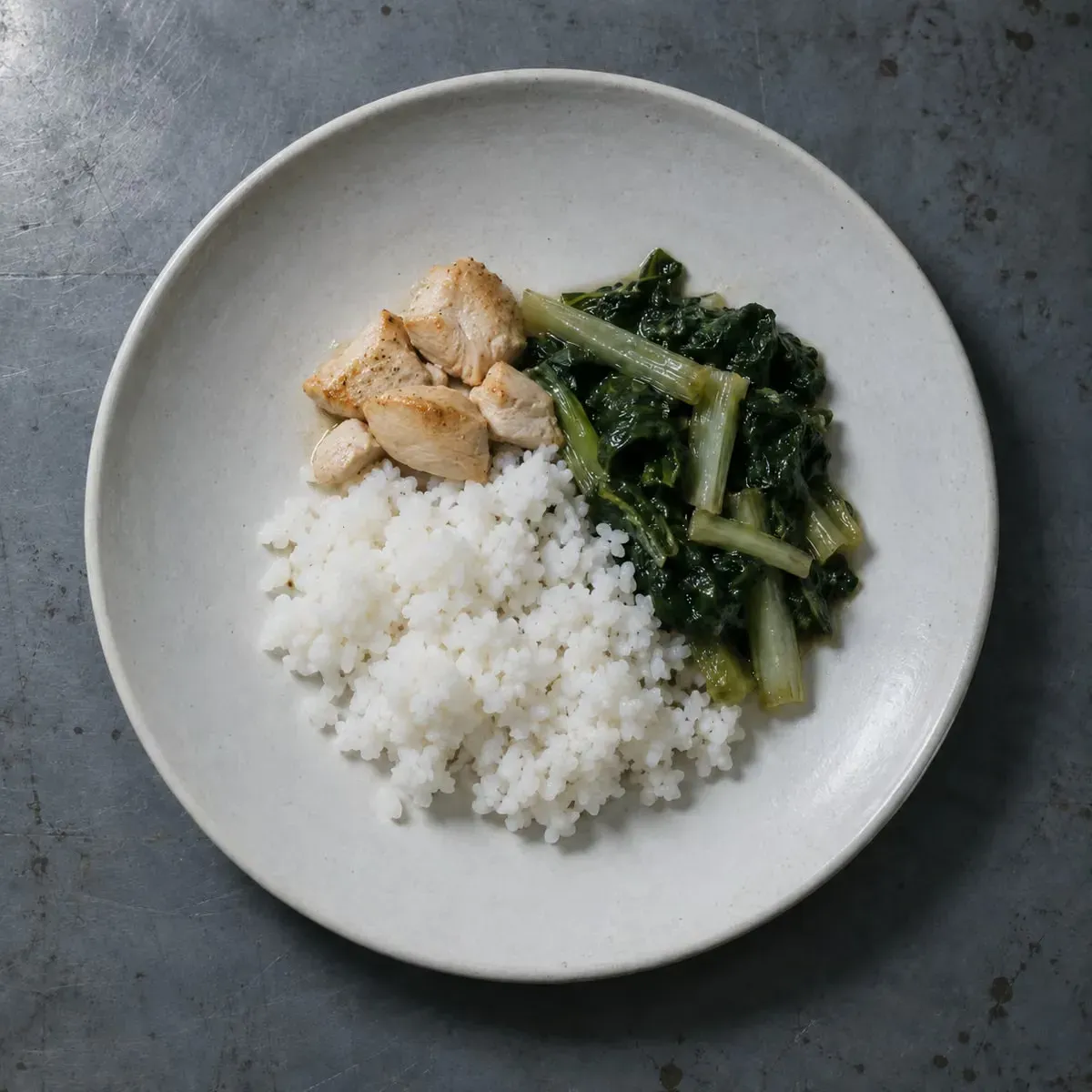
Caswanto and three of his colleagues on the hairtail boat are Muslim. The ship's cook, a Korean crew member, almost always cooked pork. Chicken or beef, Caswanto said, was cooked only once a week.
Caswanto and his colleagues could eat only whatever side dishes were left. "Like tofu and vegetables. Sometimes just vegetables and rice," he said. "I lacked energy and protein."
Caswanto once raised the issue with his employer. But the change lasted only a day. "The boss isn't the one cooking. One day, yes, then the days after it's back to normal," he said.
This was not the case on every boat. Fajar said the food on his net boat was enough and the crew got bottled water. Darto and Ridawan also found the food on their boats decent. Abdurrohim, on the other hand, said he often went hungry. He lost 8 kilograms during two months in Korea.
No Saying No to a Storm
During two years on the squid boat, Darto said he often worked in bad weather. "Very often. Really dangerous," he said.
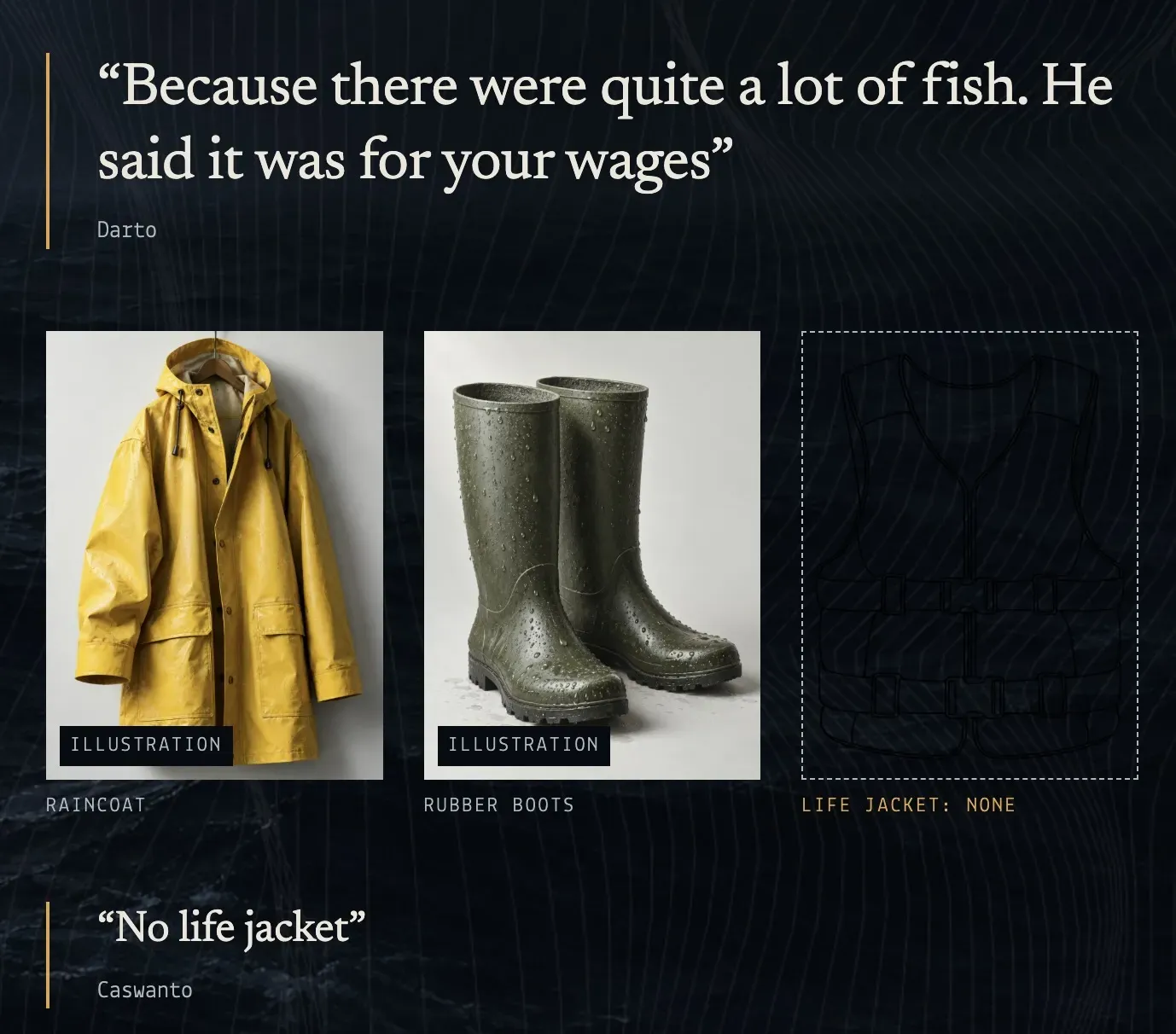
According to Darto, the boat stayed in port if a storm arrived before departure. But if a storm hit when the boat was already out at sea, the crew kept working. Darto remembered the reason his superior gave. "Because there were quite a lot of fish. He said it was for your wages," he said.
Darto also heard from colleagues that before he joined, a big wave once slammed into the bow and threw a senior crew member. The man's forehead had to be stitched.
Caswanto called working in storms his worst experience in Korea. The crew on his hairtail longliner used heavy bamboo poles as line markers. They had to lift the bamboo and throw it into the sea against the wind. "The rope can catch your hand or your leg. If you're not quick, it can break," he said.
In storms, Caswanto wore only a raincoat and rubber boots. "No life jacket," he said. He said he could not refuse. "It's my duty, my job position is there. Like it or not I have to do it, even though it's risky."
Only on July 1, 2026, did the Korean government require everyone on the open deck of a fishing vessel to wear a life jacket, whatever the weather and however many crew are on board. According to Korea's Ministry of Oceans and Fisheries, fishing-boat accidents such as collisions, capsizing and groundings claim about 100 casualties every year.
Tresno menyampaikan hal senada. "Biasanya bos tetap berangkat, tetap kerja. Disuruh kerja, nggak mikirin ABK-nya," katanya.
Ridawan membandingkan praktik di pelabuhan Korea dengan Taiwan. Di Taiwan, menurut dia, petugas pelabuhan mencatat dan memeriksa awak setiap kali kapal keluar. Di pelabuhan tempatnya bekerja di Korea, ia tidak melihat pemeriksaan semacam itu. "Keluar masuk bebas. Kadang angin-angin juga malah pada keluar itu kapal," ujarnya.
Bila kapal sedang melaut, pemeriksaan laporan perundungan boleh ditunda sampai kapal tiba di pelabuhan berikutnya.
Menelan Luka demi Tetap Bekerja
Di atas kertas, hukum Korea melindungi mereka. Undang-Undang Pelaut Korea melarang siapa pun di kapal memaksa awak bekerja dengan kekerasan, ancaman, atau pengurungan, serta melarang perundungan di tempat kerja. Agen penempatan di Korea wajib mengunjungi awak dan majikan setidaknya sekali dalam tiga bulan, membuka layanan konseling lewat telepon, dan melaporkan hasilnya kepada Suhyup.
Namun, undang-undang yang sama membolehkan pemeriksaan laporan perundungan ditunda bila kapal sedang melaut, setelah mendengar pendapat korban, sampai kapal tiba di pelabuhan berikutnya.
Pedoman Pengelolaan Awak Asing yang diterbitkan Kementerian Kelautan dan Perikanan Korea memuat jalur serupa untuk kekerasan di kapal. Bila kekerasan terjadi, kapten melapor kepada pemilik kapal, lalu komite disiplin di atas kapal menjatuhkan sanksi kepada pelaku. Laporan kepada kepala kantor kelautan dan perikanan daerah baru wajib dibuat "segera setelah kapal masuk pelabuhan dalam negeri".
Para ABK yang kami wawancarai jarang memakai jalur itu. Sebagian besar memilih diam.
Caswanto, misalnya, tidak pernah melaporkan awak Korea yang melempar ikan ke tubuhnya. "Selama saya di sana, saya masih bisa ditangani sama saya sendiri," katanya. Ia mengaku ingin membalas, tetapi menahan diri. "Gak bisa apa-apa. Saya jalanin aja sesuai kontrak."
Menurut Caswanto, ia takut masalah membesar. Ia juga sadar posisinya lemah bila perkara itu sampai ke aparat. "Bahasa juga minim, beda dengan orang Korea. Bahkan bisa memutar-balikkan faktanya," ujarnya.
Fajar tidak membalas pukulan di kepalanya karena tidak tahu harus mengadu kepada siapa dan belum lancar berbahasa Korea. Makian dari awak senior ia anggap biasa. "Tujuan saya dari Indonesia bekerja mencari uang. Jadi nggak saya ambil hati," katanya.
Abdurrohim menimbang hal serupa saat ditendang di kapal layur di Jeju. "Pikiran saya gak ngelawan daripada dipulangin," ujarnya.
Ketakutan yang sama disampaikan seorang ABK Indonesia yang menyelesaikan kontrak 4 tahun 8 bulan di kapal pesisir Korea kepada Newstapa. "Kalau kami melawan, kami takut dipulangkan ke Indonesia. Ombak tinggi pun kami harus tetap bekerja," katanya.
Belum Hilang Lelah, Sudah Diseret Laut
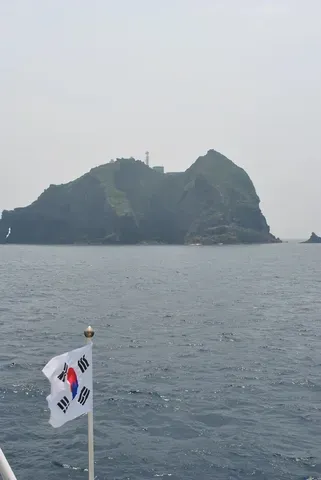
Pada Januari 2025, kapal perangkap kepiting tempat Tresno bekerja beroperasi di dekat Pulau Dokdo, perairan perbatasan Korea dan Jepang. Menurut Tresno, suhu udara pagi itu minus 15 derajat Celsius.
Malam sebelumnya ia baru tidur pukul 03.00. Sekitar pukul 05.30, ia bangun dan mulai bekerja.
Langit masih gelap. Tresno sudah melempar dua perangkap kepiting ke laut ketika seutas tali melilit tubuhnya dan menyeretnya ke dalam air. "Untungnya talinya lepas. Saya renang-renang sebisa mungkin sambil menunggu bantuan," tuturnya.
Seorang rekannya melihat Tresno jatuh dan melapor kepada kapten. Kapal berputar balik dan tiba di dekatnya sekitar 10 menit kemudian. Rekan-rekannya melemparkan pelampung, turun lewat tangga, mengikat tubuh Tresno, lalu menariknya ke atas kapal. "Saya sudah enggak bisa, benar-benar lemas," katanya.
Di atas kapal, awak melepas pakaiannya yang basah dan membaringkannya di kasur penghangat. Tresno menyebut pertolongan itu "ala kadarnya". Leher dan kepalanya terluka. Tangan kanannya tidak bisa digerakkan dan berlumuran darah. “Seperti terasa remuk,” katanya lirih.
Kapten lalu mengarahkan kapal mendarat dan mencari dermaga terdekat. Perjalanan memakan waktu 17 jam.
Kecelakaan seperti yang menimpa Tresno bukan peristiwa langka di kapal ikan Korea. Menurut analisis Korea Maritime Transportation Safety Authority (KOMSA), dalam lima tahun terakhir 428 awak kapal ikan tewas atau hilang. Sebanyak 261 orang di antaranya, sekitar 61 persen, menjadi korban kecelakaan kerja di atas kapal, seperti jatuh ke laut, terlilit tali, atau terjepit alat tangkap, bukan karena kapal tenggelam atau bertabrakan.
Ikon orang: dalam lima tahun, 428 awak kapal ikan Korea tewas atau hilang. 261 di antaranya akibat kecelakaan kerja di atas kapal. Pada 2024, korban tewas dan hilang di kapal ikan naik dari 78 menjadi 118 orang.
Angkanya memburuk pada 2024. Data Pengadilan Keselamatan Maritim Korea (KMST) yang dikutip harian Kyunghyang menunjukkan jumlah awak kapal ikan yang tewas atau hilang naik dari 78 orang pada 2023 menjadi 118 orang. Awak asing ikut menanggungnya. Menurut Maeil Shinmun, kasus korban jiwa dan luka di kalangan awak asing melonjak dari 16 kasus pada 2023 menjadi 52 kasus pada 2024, sekitar sepertiga dari seluruh korban kecelakaan laut tahun itu.
Ketika ditanya apakah ia kelelahan pada pagi yang menyedihkan itu, Tresno menjawab datar. "Kalau capek, sih, ya biasa."
Jadwalnya malam itu bercerita lain. Ia akhirnya mengakui baru tidur pukul 03.00 dan bangun pukul 05.30. Tidurnya tak sampai tiga jam, setelah sehari bekerja hampir 20 jam. Ketika tali itu menyeretnya, ia baru setengah jam terjaga, di geladak yang gelap dan dingin.
Kurang tidur menggerus kewaspadaan tanpa terasa. Dalam studi yang dimuat jurnal Sleep pada 2003, peneliti Universitas Pennsylvania membatasi tidur relawan menjadi enam atau empat jam semalam selama dua minggu. Kemampuan berpikir mereka merosot hingga setara orang yang tidak tidur sampai dua malam berturut-turut. Para relawan sendiri nyaris tidak menyadarinya.
Tresno enggan menyalahkan siapa pun atas kecelakaannya. Namun ketika diminta menyampaikan pesan, ia tidak bicara soal tali, cuaca, atau pelampung. "Jam kerjanya itu kan kadang gak mikir. Kadang kita kerja 24 jam," katanya.