Journalist Resource November 16, 2026
How To Investigate the AI Companies Mining Your Brain: Just Ask Them.
Country:

How weak regulation leaves brain data largely unprotected
Consumer neurotechnologies often look like everyday items: earbuds, headphones, beanies. But hidden inside them are sensors that can track or even stimulate your brain. Some wearables monitor how tired you are. Others provide you feedback as you meditate. Others still claim to help treat depression.
Prior to the fellowship, my writing on the subject for Science and The New York Times had focused on the potential privacy and human rights risks these devices posed. Our brains encode everything that happens in our internal lives: from our thoughts and feelings, to the perception of the world around us. What if companies or governments used these devices to peer into our minds? What if they were used to surveil people at work? Multilateral institutions, including UNESCO, OECD, UNICEF, and recently the UN Secretary-General all warned of these and other risks.
But I kept wondering: Sure this could happen. But has anything actually happened? It all felt a little dystopian.

As a nonprofit journalism organization, we depend on your support to fund more than 170 reporting projects every year on critical global and local issues. Donate any amount today to become a Pulitzer Center Champion and receive exclusive benefits!
Over the course of a year, I set out to try and find out. I had many leads, but ultimately focused on two topics that I thought were particularly interesting and important: the race to build AI-driven models of the brain commonly referred to as “brain foundation models,” and the growing use of neurotechnologies to track the tiredness of workers performing high-risk jobs, including construction workers and truck drivers.
These stories are ultimately about how companies and governments, known to collect all kinds of information—from our digital footprint online to surveillance footage—are entering a new era and harvesting the most personal and sensitive information yet: our brain data. The result is a two-part investigation published in Science magazine.
The race to build brain models
“Brain foundation models” are models of the brain that can be used in a wide variety of contexts—from understanding how focused you are at school to potentially helping clinicians diagnose Alzheimer’s early or helping automatically detect seizures in hospital patients. The key is that these models can move from one task to another with little additional training.
The training process is not unlike LLMs. Similarly to LLMs like Claude and ChatGPT, building these models requires enormous amounts of data so that the model can identify underlying patterns. But unlike LLMs, they rely on brain data rather than text. While there are open platforms that provide brain data online, my hypothesis was that at least some companies were training these models directly from their users.
In investigative journalism we’re often trained to take a very cautious approach. I’ve been taught to identify your “target” entity—for example a neurotechnology company or an individual—by first speaking to people on the outside, and slowly building connections that ultimately get you to understand how the company operates from the inside. A “concentric circles” approach.
I took the opposite approach: I went straight to the companies building the models and asked them how they do it.
I think the concentric circles approach is a fair way to do investigations, especially when you’re dealing with secretive companies. But, for the moment, most consumer neurotech companies are actually incredibly open, in part because they want to showcase their work, and partially because they are receiving a tremendous amount of scrutiny from multilateral organizations.
Two companies—Emotiv and Interaxon—told me that they trained their foundation models in part or primarily on user data. I then checked their privacy policies and noticed that neither of them explicitly stated this, which many experts I spoke to said was highly concerning. Users I spoke to also were surprised to hear their brain data was being used to train these AI models. Even if these models weren’t necessarily going to be used for nefarious purposes, they felt they had not been given explicit consent. (Both companies amended their privacy policies after I brought this up to them.)
It seemed like a gap in the industry, but I wanted to learn more. A previous privacy policy and user agreement analysis from 2024 focusing on 30 U.S.-based companies had found that the vast majority placed no meaningful limitations on how they handled user’s brain data. What if these lapses applied more globally? It seemed like an important research question.
I contacted NGOs and think tanks working on the subject and built a spreadsheet of all the consumer neurotechnology active in this space, which amounted to a dizzying 150. Not all of these were relevant for my purposes: For example, some devices focused on stimulating rather than tracking the brain, and some companies were not actively selling their devices just yet. Ultimately, only 57 made the cut for the analysis.
I initially did an AI-assisted analysis of these 57 using ChatGPT Plus. I first provided instructions to the large language model, telling it that I was going to feed it dozens of privacy policies in PDF format and that its task was to answer key questions I found particularly relevant from a user’s perspective about the content. These included whether companies mentioned collecting brain data; whether this data could be transferred to other companies if they were acquired; and whether public authorities like law enforcement or governments could access this data if they requested it. I prompted the chatbot to respond in a systematic way by answering “yes,” “no” or “not specified” and to flag situations where it was unclear. I also asked it to provide the relevant links and parts of the text that corroborated its assessment. I then fed the privacy policies one by one, so that the output was a small table for each privacy policy, answering the questions I had set.
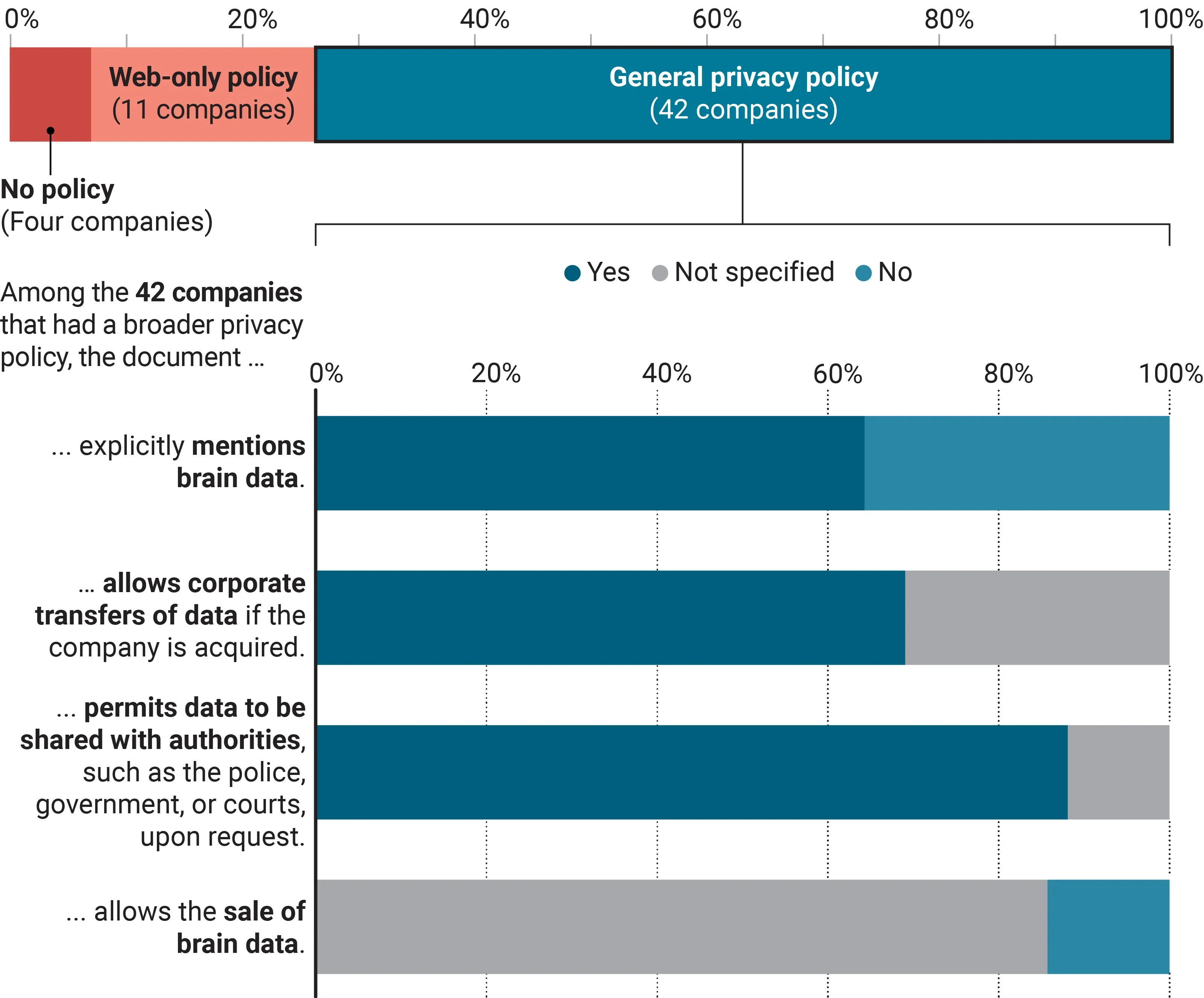
I then manually inspected each privacy policy (it had gotten an overwhelming majority correct) and the results were striking. Only about two-thirds of these companies explicitly mentioned gathering brain data. Just six explicitly stated they would not sell your brain data. And all explicitly stated that they would provide their data upon request by public authorities, including police, government, or courts.
| Spreadsheet columns | Additional description | Possible values |
| Full company name | Registered company name (not the product itself) | yes/no/not specified |
| Manual inspection | Marking down whether I have manually inspected the privacy policy in question | TRUE/FALSE |
| Brain data mention | Whether the privacy policy explicitly mentions “brain data” or equivalent terms (for example “EEG” or “brainwave data,” or “neural data” | yes/no/not specified |
| Brain data specified | If they do specify the term, what specific wording they use | Text |
| Sell/trade/rent forbidden | Whether the company explicitly forbids selling, trading, or otherwise monetizing personal information and/or brain data explicitly | yes/no/no (brain data)/ not specified |
| Police/gov access | Whether the company explicitly mentions whether law enforcement, governments, or courts, or other public authorities could access data upon request | yes/no/not specified |
| Algorithm mentioned | Whether the company specifies the use of AI or equivalent terms (e.g. “AI” or “machine learning”) | yes/no/not specified |
| Corporate data transfer | Whether the company explicitly states that it will share its data if acquired by another | yes/no/not specified |
| Website heavy | Whether the privacy policy is heavily focused on website analytics, rather than other forms of data collection | yes/no |
Policy breakdown
Science reviewed the privacy policies of 57 consumer-oriented companies from around the world that collect electroencephalography data. Some of these had no privacy policy at all. Of those that had a policy, some focused only on website user data. Others allowed liberal use of brain data.
Fatigue-monitoring systems
The second story builds on an article that came out in 2018, published by The South China Morning Post. The reporter found that a company called Shanghai Diyi Technology, also known as Deayea, was using a brain device to track how tired train drivers were. The device was marketed as a safety tool to prevent accidents. It seemed like a promising case study, but there had been no follow up news and little to no information about its continued use. I wondered: What had happened since 2018?
I learned that a subsidiary of the company had launched another initiative in 2020 focusing on truck drivers. That initiative was being piloted in two cities, and I came across a national standard that suggested it was going to spread across the country.
Investigating China is hard from outside the country. Company documents are often paywalled; entering government websites often requires specialized VPNs or Chinese numbers; and sources in China are generally hesitant to speak to journalists, especially foreign ones. Deayea did not respond to our request for an interview, nor did a dozen neurotech experts in China who I reached out to for comment about the industry.
Entering the country was not recommended as an investigative journalist who had written about China and drugs before.
Thankfully, I found enough evidence to build a story through some creative OSINT work. Local TV news had done multiple reports on the benefits of the technology in truck drivers. Traffic police had also publicly announced how the technology was being used to help them investigate incidents. At conferences, the company had exhibited their technology captured on video.
These videos sometimes showed the dashboards traffic police and companies were using. Zooming into them, you could see exactly what kind of data they were collecting.

By analyzing this footage and getting it checked by a Chinese research assistant for verification, I was able to see that Deayea collected truck driver data at the individual level—including their full name, worker ID, the date and time, and the truck driver company name. The videos also included shots of traffic police surrounded by this data, showing that they had direct access. That data was being combined with measures of how tired the worker was, building a rich profile of individuals that many experts I spoke to said warranted serious concern. A safety tool could very quickly turn into a highly sophisticated surveillance instrument, they said.

The other Chinese company of interest was called Huanao Security (Beijing) Technology. Their technology includes a helmet that has sensors tracking fatigue levels, along with your posture and blood oxygen levels. With this information clients who use their technology can generate AI-driven metrics, including whether a worker is at risk of an accident.
Similarly to Deayea, footage of its dashboard could be found online. This time on their WeChat—the main social media platform in China—which showed they collected lots of different kinds of data.
Unlike Deayea, Huanao Security was actually very open to speaking. I had one exchange with their general manager online, followed by multiple exchanges—both by email and through WeChat—to discuss the details of how their technology works. Writing for a well-reputed publication that takes facts seriously, Science, obviously helped.
The information they provided was revealing: They openly told us that they had collected over 300,000 hours of brain data on workers and used the helmets to both screen people prior to work and monitor them during the job. They also acknowledged that clients obtain brain data in “raw” format, which meant it wasn’t filtered and therefore contained more information.
Neuroscientists and data privacy experts I spoke to said raw EEG is particularly concerning since it means they can do all kinds of sophisticated analyses with it that may infringe on people’s privacy.
I learned the most with Huanao Security through the “rights of reply” process—sending the company your key findings at the very end so they have a chance to respond to them. From my experience working in cross-border teams, often journalists give companies or individuals a week, maybe two, given time constraints.
I like to give them ample time to reply, because I find the right to reply exchange is often a fruitful place for honest conversation and insight. With Huanao Security, they helped me fact-check that they themselves don’t gather raw EEG data, but that their clients do. They also provided me with data on how effective their technology is that raised more questions.
OSINT is helpful, but often speaking to the companies themselves, or going on the ground, if that’s possible, is the only way you can ascertain what you’ve found in the digital space.
Lessons learned:
- Break your stories down: Covering a topic can be overwhelming. In my case I was essentially covering an entire industry and had collected over 150 privacy policies. Initially the idea was to write one big piece that brought together all my different leads. We later realized that it made more sense to break it up into two focused stories that revealed different, but overlapping, aspects of the industry. When a story feels like a mouthful, maybe that’s a sign that it should be turned into two parts, or even a series.
- Engage with companies early: Not always, but especially when an industry is growing and publicly discussing some of fraught questions you’re looking into, sometimes it’s actually more effective to engage with the companies you are focusing on relatively early in the reporting and establish trust, rather than only towards the end when filing a “right of reply.” Early engagement means you can open up a frank dialogue, get access to insider information, and ultimately generate impact.
- Public information is your friend: Especially when you’re investigating a country that is hard to penetrate, like China, open source information becomes indispensable. Social media, local news reports, videos, images—these are all instruments that can help you get more information. Learn how that country operates, what platforms the company you’re investigating uses, and what key words are going to help you gather more evidence.
- Collaborate with people who will know best: I am not Chinese, I don’t speak the language, and have never traveled there (despite really wanting to!). Collaborating with a Chinese researcher on this was a no-brainer, and I’m glad we did. I would never have felt confident with the findings and comfortable with the approach taken if we had not collaborated closely with a Chinese researcher.