Story
 October 1, 2026
Shots on Goal: Can Africa Make 60% of its Vaccines by 2040?
Country:

Project
Global Health Under Construction
After the end of USAID, the global health community is searching for a way forward.

That’s a tall order, as the travails of South African companies show
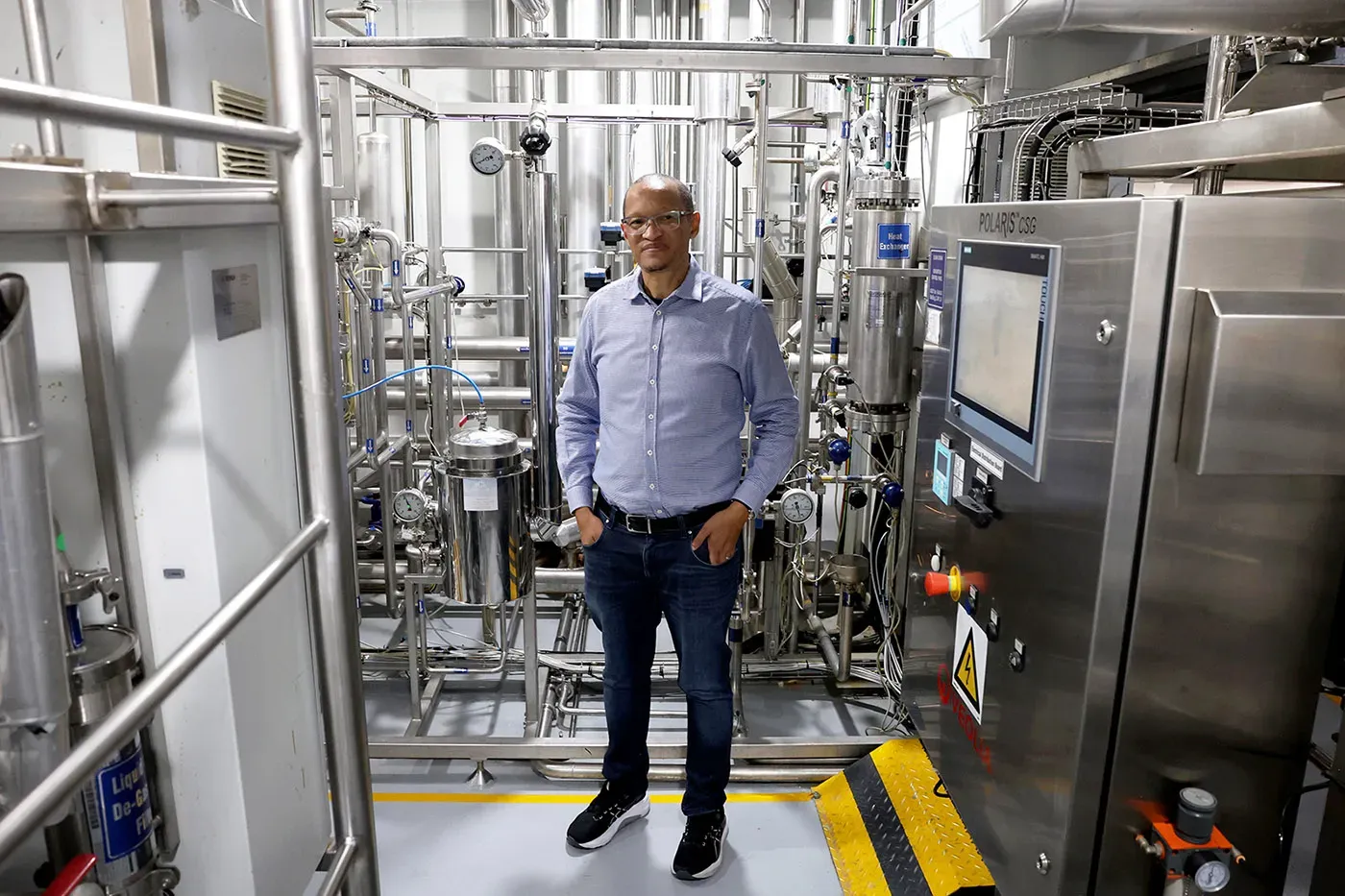
Cape Town, South Africa—Morena Makhoana can see the city’s spectacular landmark, Table Mountain, from the grounds of Biovac, the vaccine manufacturer he runs here. “When you’re stressed and you don’t know what to do, you just look there,” Makhoana says. “It keeps us a little bit sane.” He has just stepped out of a Biovac building constructed during the COVID-19 pandemic to hold the “freezer farm,” which today symbolizes one of the company’s—and one of the African continent’s—great disappointments.
When the first COVID-19 vaccines became available in 2021, deep-pocketed governments outside Africa snatched them up, pushing even the wealthiest African countries to the end of the line. Then Biovac cut a deal that held great promise: Pfizer and BioNTech would provide their popular messenger RNA (mRNA) vaccine in bulk, which Biovac would put into vials—a process known as “fill and finish.” The company aimed to start to supply vaccine by early 2022, and to produce 100 million doses a year, storing 20 million at a time at the farm of specialized freezers that maintained the required –80°C. The deal would give Africa its own dedicated vaccine supply.
But it took longer than expected to formalize the agreement and gear up for production, and once Biovac had its first doses available at the end of 2022, demand for the vaccine had evaporated. “We never sold a single dose,” Makhoana says, and the freezer farm remained idle.

As a nonprofit journalism organization, we depend on your support to fund more than 170 reporting projects every year on critical global and local issues. Donate any amount today to become a Pulitzer Center Champion and receive exclusive benefits!
Biovac’s travails mirrored those faced by other bids to speed delivery of COVID-19 vaccines to Africa. They also added to a decadeslong history of setbacks for efforts to establish a vaccine industry on the continent, which in 2021 produced just 0.1% of the shots it used. But the pandemic, with its stark inequities in vaccine access, sparked a new resolve among African governments, health officials, and scientists to change that.
The result was an initiative called the Partnerships for African Vaccine Manufacturing (PAVM), launched in April 2021 and spearheaded by the African Union and the Africa Centres for Disease Control and Prevention (Africa CDC). PAVM aimed to help companies access financing and build expertise, and to get neighboring countries to pool resources, creating larger marketplaces for manufacturers in their regions. PAVM had an ambitious—some said unrealistic—goal: to drive up the proportion of African-made vaccines to a staggering 60% of demand by 2040.
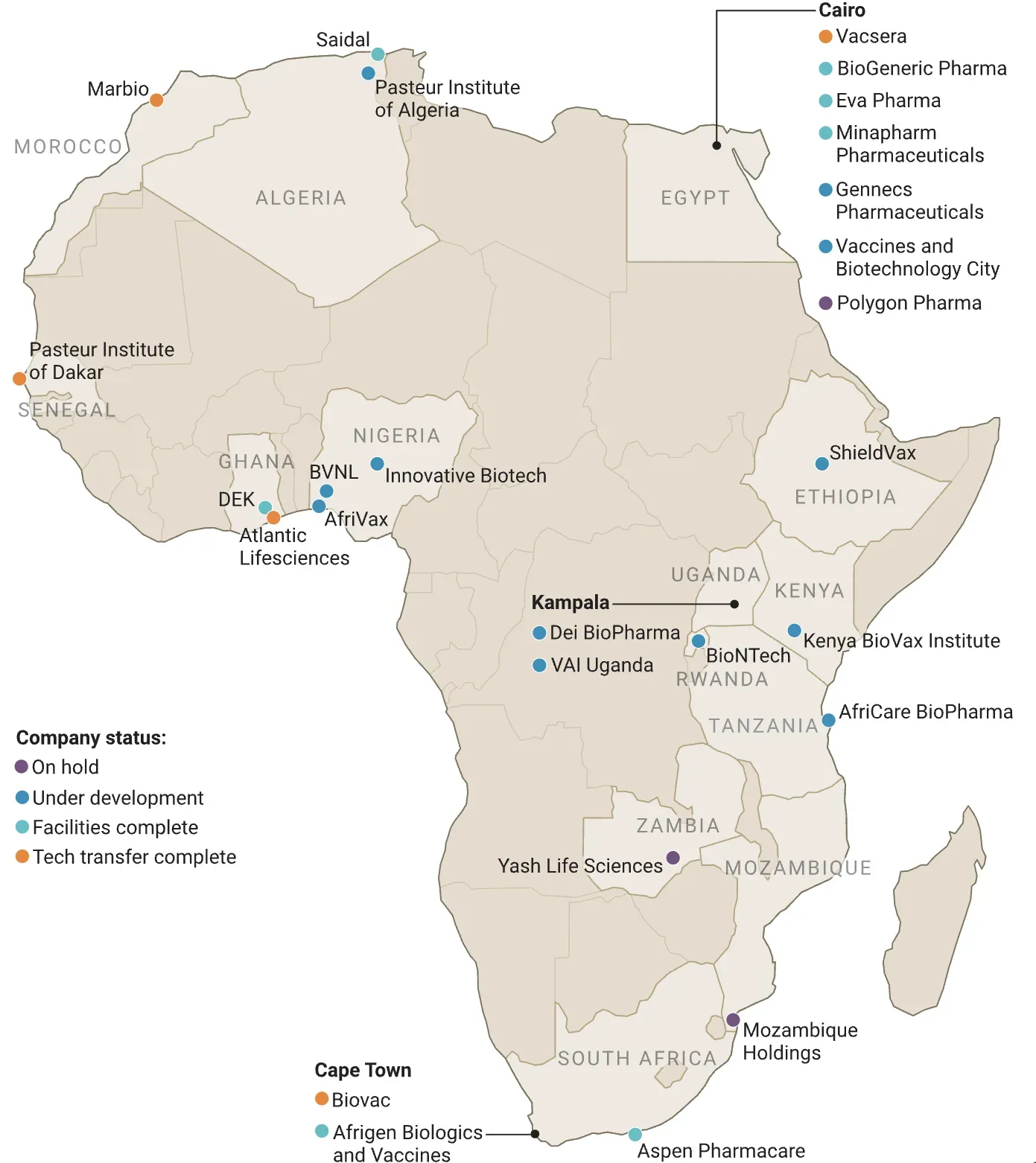
More than 2 dozen companies are now vying to seize the postpandemic momentum and contribute to PAVM’s vision. Media have intensively covered African presidents and global health leaders holding shovels at groundbreaking or ribbon-cutting ceremonies for new and expanding plants. But the experiences of Biovac and South Africa’s two other vaccinemakers, the tiny, mRNA-focused Afrigen Biologics and Vaccines and the giant Aspen Pharmacare, show tremendous hurdles remain—even in a country that has the largest economy on the continent and one of the most developed infrastructures.
Vaccines are more complex to manufacture than chemical-based drugs, and plants are expensive to build and maintain. To compete in the market, companies typically have to produce vaccines on enormous scales. And to fit the budgets of developing countries, they must be inexpensive. “That’s why the global vaccine market is controlled by six or seven companies,” says Afrigen’s CEO, Petro Terblanche.
African companies also face steep challenges securing loans from banks and investments from venture capitalists. Their cash-strapped governments are reluctant to make purchasing commitments unless companies show their products can compete with vaccines available from established manufacturers outside the continent. As the COVID-19 experience showed, demand can be fickle. And funding to test new vaccines is scarce. “We’re in a bloody tough time,” Makhoana says.
Yet simply relying on established producers outside of Africa isn’t an option, he contends. “If it was a commodity like cars, you could argue about whether you want to make them locally or import them, and it’s not a life-or-death discussion,” he says. “We need vaccine manufacturing on the continent as a health security issue. It’s a no-brainer.”
Biovac began in 2003 as a partnership between the South African government and privately held health care companies. It first aimed to make a liquid form of a freeze-dried vaccine against the bacterium Haemophilus influenzae, which causes respiratory infections and other conditions including meningitis. The company planned to include it in a vaccine produced by Sanofi in France that also protected against diphtheria, tetanus, pertussis, and polio, creating a single broad-spectrum shot for children. It set about restoring a dilapidated state-run vaccine plant as its headquarters. (Biovac made the liquid product, but Sanofi figured out how to manufacture it, too.)
Just then, global events underscored the need for developing countries to have “vaccine sovereignty.” A bird flu virus alarmed the world when it started to infect people in several Asian countries, killing 79 of the 148 confirmed cases by 2005. A viral sequence the Indonesian government shared with the World Health Organization (WHO) became the basis for an Australian vaccine company’s product, which Indonesia presumably would not be able to afford. Anger at rich countries for controlling essential vaccines intensified with revelations that the U.S. government and U.S. companies and research institutions had patented sequences of bird flu viruses from Indonesia and Vietnam. “It was a political dog’s breakfast,” says Martin Friede, who began working at WHO in 2003 and headed its vaccine research unit when he retired last year.
At the request of U.S. health officials, WHO launched a project to help several countries build manufacturing plants for flu vaccines. Friede, who led the effort, says it faced one problem after another. One was that flu vaccines were made by growing influenza viruses in fertilized chicken eggs, which manufacturers had to order from farmers at least 6 months in advance. If a bird flu pandemic had exploded, vaccine production would have lagged. Lesson No. 1, Friede says: “Don’t use a technology where if a pandemic happens, you won’t be able to get the raw material.”
"We need vaccine manufacturing on the continent as a health security issue. It’s a no-brainer.
Morena Makhoana, of Biovac
A second lesson involved economies of scale. A government-owned plant in Thailand was producing 15 million doses a year of flu vaccine. The vaccine cost $6 per dose, but the country could buy a similar vaccine from Sanofi for half the cost. At first, the Thai government said, “Well, that doesn’t matter because this is national health security,” Friede remembers. But when the country’s leadership changed, the new health minister phoned. “He said, ‘National health security? Baloney. We’re going to buy from Sanofi because we’re running out of money.’”
Biovac would learn that lesson firsthand following a major 2015 agreement with Pfizer to fill and finish a Streptococcus pneumoniae vaccine called Prevnar. The South African government initially agreed to buy the locally filled vials, but in 2023 decided to purchase Prevnar from the Serum Institute of India—the world’s largest producer of vaccines—for about one-third of the price, forcing Biovac to lay off 85 of its 450 employees. The firm has stayed afloat thanks in part to a multiyear deal with Sanofi to fill and finish a six-in-one vaccine—it adds hepatitis B—at the Cape Town facility, which can vial 15 million doses a year.
Friede’s third critical takeaway from WHO’s efforts is that vaccine plants cannot financially survive if they only exist for health security during pandemics. “Quite a few companies were able to get the technology up and running, and then a year or two later, we began getting calls from the chief executive officer saying, ‘Right, we’ve built this flu facility, but we’re not selling any flu vaccine,’” he says, noting it can cost millions of dollars a year to maintain an empty plant. Several pivoted to making routine childhood vaccines—taking themselves out of contention as flu vaccine suppliers in the event of a pandemic.
When the COVID-19 pandemic struck, health officials tried to learn from the past, but Biovac’s effort to secure Africa’s access to vaccines wasn’t the only one to fall short. Aspen early on signed a deal with Johnson & Johnson to fill and finish a single-dose COVID-19 vaccine that could have protected 300 million people annually, but contamination of the bulk product at a U.S. plant and other problems delayed the effort, and Aspen never sold a dose. Similar snafus undermined would-be fill-and-finish efforts by companies in Ghana and Morocco.
Efforts launched from outside Africa fared no better. The most devastating and high-profile letdown was a campaign by the nonprofit COVID-19 Vaccines Global Access (COVAX) Facility to supply Africa with COVID-19 vaccines made elsewhere: It faltered because it relied too heavily on the Serum Institute, which could not export doses in the spring of 2021 when its own country had a surge in cases. Patrick Soon-Shiong, a biotech billionaire in Los Angeles who grew up in South Africa, in 2022 pledged to invest $200 million in NantSA, a new vaccine company here that would produce 1 billion COVID-19 doses by 2025. After breaking ground on the plant, he shut it down, in part because of the country’s infrastructure problems. “No power was available to that plant!” he wrote in a text to Science. Moderna announced it would invest up to $500 million in a Nairobi, Kenya, mRNA vaccine plant that supposedly could have produced 500 million doses a year—a plan it abandoned 2 years later.
Made in Africa
African countries make less than 1% of the vaccines they use, and a massive push is underway to boost manufacturing on the continent. More than 2 dozen companies are vying to fill the gap, but only a few have finalized agreements to transfer vaccine technologies from major pharmaceutical companies abroad.
Africa’s response was PAVM. In March 2022, it published a detailed plan to strengthen local regulatory agencies, create training centers for scientists and engineers, coordinate technology transfers and sharing of intellectual property, and organize the continent into regional purchasing pools.
The call to produce 60% of the continent’s vaccine needs by 2040 “was an aspirational goal at that time, which was necessary to move things forward and to bring excitement to the space,” says John Nkengasong, who led Africa CDC when PAVM was formed and now works at the Mastercard Foundation guiding investments to strengthen education and health in Africa. Aiming high makes sense given Africa’s population growth, he says. “One out of four human beings will be African” by 2040, Nkengasong says. “Can you afford not to invest in your own development of your biomedical countermeasures?”
When PAVM launched, only one product, a yellow fever vaccine made by the Pasteur Institute of Dakar (IPD), was being produced in Africa from scratch, so-called end-to-end manufacturing. In PAVM’s vision, the burgeoning African vaccine industry would initially consist mainly of companies focused on fill and finish, like Biovac. That type of arrangement gives countries some control over vaccine supply and brings revenue to local businesses that provide things such as glass vials and their rubber stoppers. The vaccine companies would, over time, “backward integrate” and learn how to produce all the necessary ingredients themselves.
Seth Berkley, who led a public-private partnership called Gavi, the Vaccine Alliance for 12 years before stepping down in August 2023, says that when PAVM launched and attracted a flood of interest from would-be manufacturers, he warned that most wouldn’t manage to create sustainable businesses, given the many challenges of the vaccine industry. He urged Africa CDC and WHO officials to concentrate their energy on the most promising firms, says Berkley, who also helped create and run COVAX. “At the end, it was kind of, ‘Well, we’ll let them go on, and we’ll see who succeeds.’”
For the many contenders, new investment opportunities bloomed thanks to the organized, continentwide efforts of PAVM. Gavi, which each year purchases and distributes product for more than half the world’s children, made a notable commitment the year after Berkley left. It pledged to invest up to $1.2 billion over 10 years in a combination of financial rewards for African companies that hit milestones such as regulatory approvals and per-dose subsidies to lower the prices of approved vaccines. Gavi plans to make the first of the milestone payments later this year, though it hasn’t revealed the recipients.
The Gavi pledge has made Biovac more attractive to investors, Makhoana says. This year, the company secured more than $100 million in new funding from the European Investment Bank, the International Finance Corporation, and the African Development Bank Group to more than triple production capabilities to 50 million vials a year by 2029. And it hopes to soon bring in revenue from end-to-end manufacture of a cholera vaccine developed by South Korea’s International Vaccine Institute. Still, the company has yet to earn substantial profits from vaccines.
Afrigen, just a 20-minute drive away from Biovac, is a much smaller operation, occupying two rented warehouse buildings in a business park. It, too, has had a bumpy road.
The company has been struggling to keep the lights on since it opened its first lab in 2016. Launched two years earlier as a partnership between the South African government’s Industrial Development Corporation and the Infectious Disease Research Institute (IDRI) in Seattle, Afrigen at first aimed to bring a tuberculosis vaccine to market. But financial woes forced IDRI to sell its 51% interest in Afrigen to Avacare, which primarily manufactures and distributes generic drugs.
Under pressure from Avacare to make money, Afrigen took a left turn. It began to produce an emulsion of cannabidiol (CBD), a compound extracted from cannabis said to help with anxiety, inflammation, and pain. One of Afrigen’s most popular products was a CBD paste that cat owners could squirt onto climbing poles for their cats to lick. That venture petered out when the South African regulatory agency cracked down on the sale of CBD around the start of the pandemic.
In April 2021, Afrigen bid to return to vaccines. It responded to a call by WHO and the Medicines Patent Pool to apply for a grant to set up a training hub for companies interested in making mRNA vaccines.
The mRNA technology allows a maker to quickly tailor a vaccine to a new pathogen or strain, and the product can then be made in bioreactors rather than chicken eggs. During the COVID-19 pandemic, when the Moderna and Pfizer-BioNTech vaccines showcased the power of the technology, “countries [were] screaming blue murder, ‘Not fair, not fair, we want access!’” recalls Friede, who spearheaded the mRNA training hub idea.
Afrigen “hadn’t touched mRNA,” says Caryn Fenner, a bioprocessing engineer at the company, and it only had the shell of a pilot vaccine production plant. But the company, one of 20 applicants, won the job to train scientists from far and wide. “We were just a little bit gobsmacked,” Fenner says. At first, they joked they were building the airplane while flying it. “We changed it to: We’re all running down the runway, flapping our arms.”
Moderna, Pfizer, and BioNTech each came to visit Afrigen, but none wanted to partner with the fledgling mRNA manufacturer. So the company teamed up with researchers at the University of the Witwatersrand, who showed them how to make mRNA and formulated a version of the Moderna COVID-19 vaccine based on a sequence of the viral surface protein that Stanford University researchers had published. Afrigen then hosted scientists from 15 low- and middle-income countries to make a mimic of the Moderna vaccine, and 13 came back to learn how to work with other pathogens.
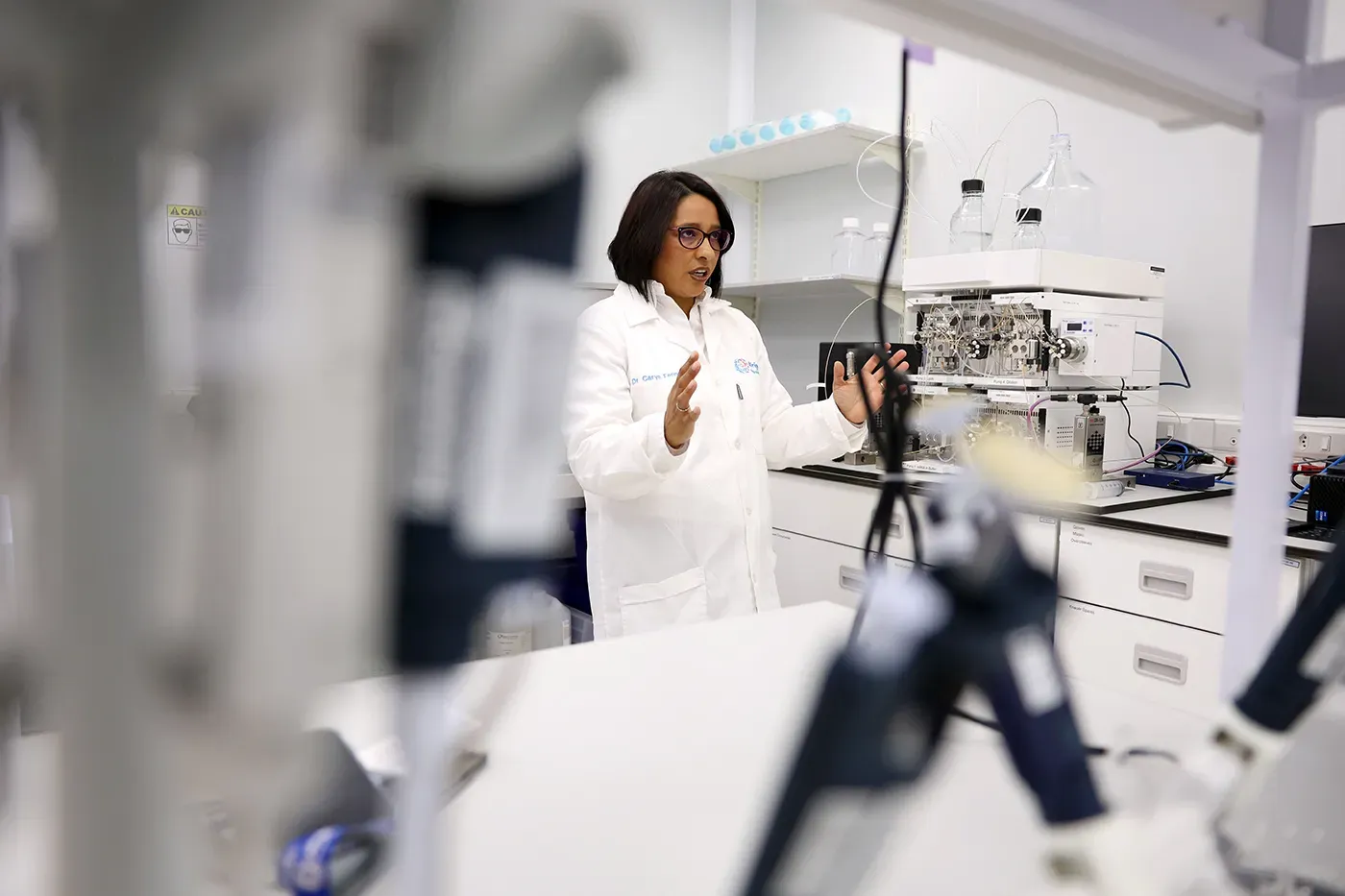
The grant ends in December, and although the company now has the expertise and small plant to make mRNA vaccine products itself, it recently suffered yet another setback: Financial troubles at Avacare forced it into “business rescue” (a form of receivership) in February. Afrigen is now attempting to restructure itself as a nonprofit. “We’ve weathered two big storms already, this little company, and we’re in our third one,” Terblanche says. “This will be do or die.”
South Africa’s third vaccinemaker, Aspen, is well aware of the perils of vaccine production. “African manufacturers have had countless, endless challenges with a sustainable demand for vaccine,” says Stavros Nicolaou, a pharmacist and executive at Aspen, which has a sprawling complex in Gqeberha (formerly Port Elizabeth). So the company, the largest pharmaceutical company in Africa, currently isn’t planning to do any end-to-end manufacturing. It does fill and finish of four vaccines that it imports from the Serum Institute: a six-way vaccine similar to the Sanofi-Biovac product and ones that protect against S. pneumoniae, rotavirus, and meningococcal bacteria.
If Aspen were to make the vaccines it now imports, Nicolaou expects the Serum Institute would simply undercut it. “There are times where I’ve been a naïve optimist around this whole localization thing,” Nicolaou says, “but that was many years ago.”
Makhoana, in contrast, still exudes abundant optimism about local, end-to-end production of vaccines. His vision is that South African vaccine producers will build and share talent, and the government will invest more in the education of scientists. “I do wish that Aspen thrives. I do wish that Afrigen survives. If there’s any competition, we’ll just be competing commercially. But we need the ecosystem.”
To further improve that ecosystem, the Mastercard Foundation in 2023 awarded $45 million to IPD to train young African scientists to produce vaccines. Nkengasong says he wants to see similar investments by African countries. “You cannot talk about African health sovereignty for vaccines without investing in universities,” he says. “Otherwise, you still wait on an American, a Canadian, a European, or Chinese young scientist to invent something, and then share the patent with you. That’s not sovereignty.”
In another potential boost for African vaccine manufacturing, China last month reached an agreement with the 16-country Southern African Development Community to bolster pharmaceutical development on the continent. Although the details are vague, China promises to increase technology transfers and training of workers.
Africa CDC is continuing its attempt to design a vaccine marketplace that can sustain companies. It is pushing for an Africa Pooled Procurement Mechanism, in which governments from five different regions would band together and purchase vaccines collectively. All 55 African Union member states signed on to this commitment in February. “The question is going to be how reliable will the payments be?” Berkley says. “It’s a little naïve to just say we’re going to do it and everybody’s going to fall in line.”
A June report issued by the Clinton Health Access Initiative interviewed the three manufacturers in South Africa and 24 others to assess the state of vaccine production on the continent. “What we found is a sector making genuine progress and running into serious headwinds,” its report concluded. Biovac and IPD are the only two African companies that will likely do end-to-end manufacturing of vaccines in the next five years, it predicts. In the same time frame, Aspen and Egypt’s Vacsera are the only two that will receive bulk product made elsewhere and do fill and finish.
Makhoana says he still applauds PAVM’s ambitious 60% goal. “If 2040 comes and let’s say we are even at 11% manufacturing vaccines, for me, that’s a 1000-fold from where we were,” he says. “You must have vision and a target in life, even if it’s a stretch. You must dream.”