

The socio-environmental impacts of the extraction of critical minerals in the Amazon

When we talk about the energy transition, how often do we connect it to the land? Do we consider where new projects will be developed and how they might affect the communities that live there? These are the kinds of questions that strong investigative journalism can help answer.
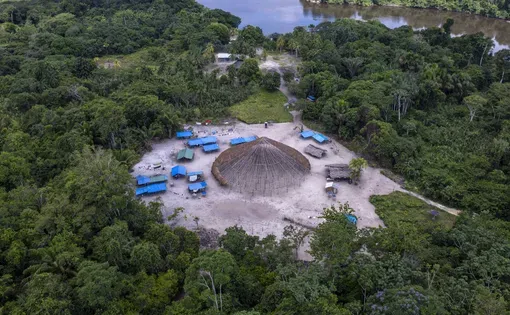
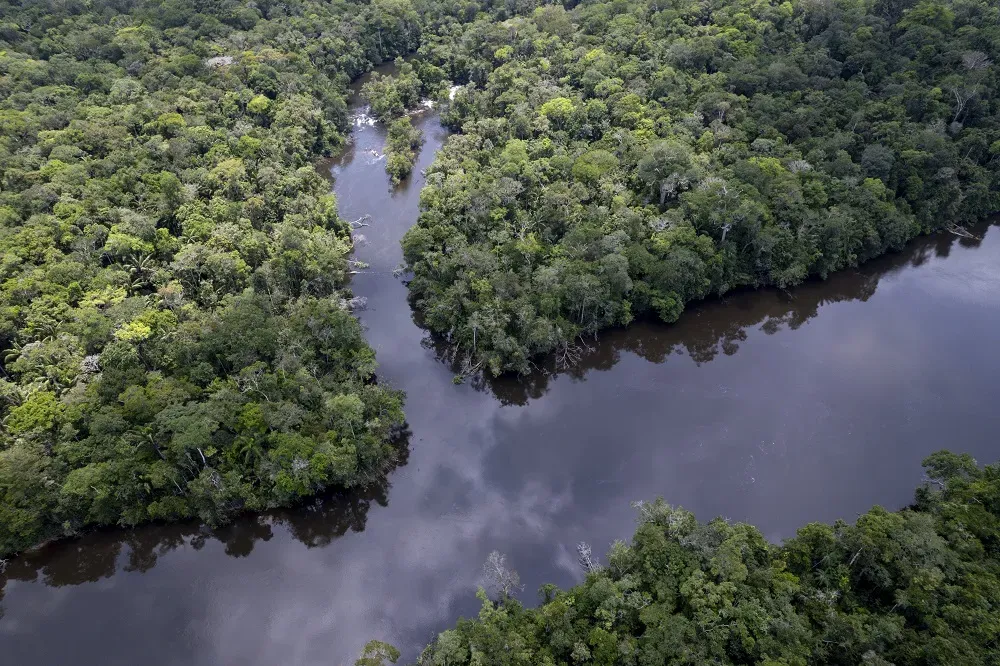
The Pulitzer Center's Rainforest Investigations Network (RIN) Fellow Isabel Harari began asking those questions while investigating Mineração Taboca, Brazil's largest tin producer, which is currently controlled by a Chinese state-owned enterprise. The company operates the Pitinga mine near the Waimiri Atroari Indigenous Territory in the Brazilian Amazon. Federal prosecutors are investigating allegations that the company contaminated local waterways with heavy metals, including lead and arsenic.
As Harari dug deeper into the story, she realized that the environmental and social impacts of mining for critical minerals extended far beyond a single company or location. There was a broader story to tell about rare earth elements, mineral extraction, and the growing demand for resources linked to the global energy transition. The Energy Transition Observatory was created to help uncover and track those connections, providing journalists with the tools and data needed to investigate how the transition to a greener economy is reshaping communities and ecosystems.

As a nonprofit journalism organization, we depend on your support to fund more than 170 reporting projects every year on critical global and local issues. Donate any amount today to become a Pulitzer Center Champion and receive exclusive benefits!
“Critical minerals are not extracted from empty lands,” said Harari. “There are people, communities, and protected territories in the path of the energy transition. This platform was created to make those impacts visible. It brings together public data that was previously scattered and shows, in a clear map, which communities and protected areas are under pressure, and which companies are behind these projects.”
The Energy Transition Observatory is a tool created by Repórter Brasil, in partnership with Inesc (Institute for Socioeconomic Studies) and PoEMAS (Research Group on Politics, Economics, Mining, Environment, and Society), to monitor the impacts generated by renewable energy projects—such as wind and solar power plants, critical mineral mining, and transmission lines—on Indigenous and Quilombola territories, conservation areas, and agrarian reform settlements.
The initiative is supported by the Ford Foundation and the RIN.
In a recent webinar about the tool, held with the intention of introducing the tool to other journalists, panelists highlighted that while the transition to renewable energy is necessary, it often functions as an industrial expansion that threatens territories belonging to vulnerable communities.
The platform was built by crossing multiple public databases that had not been previously integrated. These sources include the National Electric Energy Agency (ANEEL), the National Mining Agency (ANM), the Energy Research Office (EPE), the National Foundation for Indigenous Peoples (FUNAI), the National Institute for Colonization and Agrarian Reform (INCRA), and the Ministry of Environment.
By using open-source data from various government agencies, the tool provides unique visibility by mapping over 12,000 protected areas against thousands of energy and mining projects, revealing that over 30% of these territories are already affected by activities tied to the energy transition and nearly 60% could be affected in the future.
The data is free to download and the team said that their hope is that other journalists can use the tool to pursue their own stories. So let’s dive in to some of the functionalities:
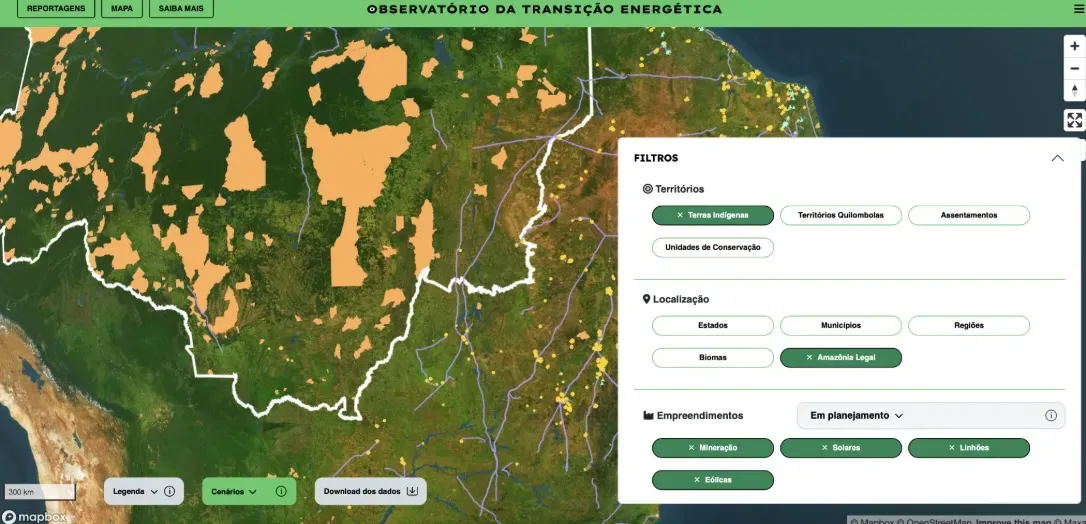
In this first example, we're filtering for 1) Indigenous territories that are 2) located in the Legal Amazon and that have 3) initiatives connected to wind farms, solar plants, critical mineral extraction, and transmission lines.
Because we saw overlaps, we could go and explore the data further.
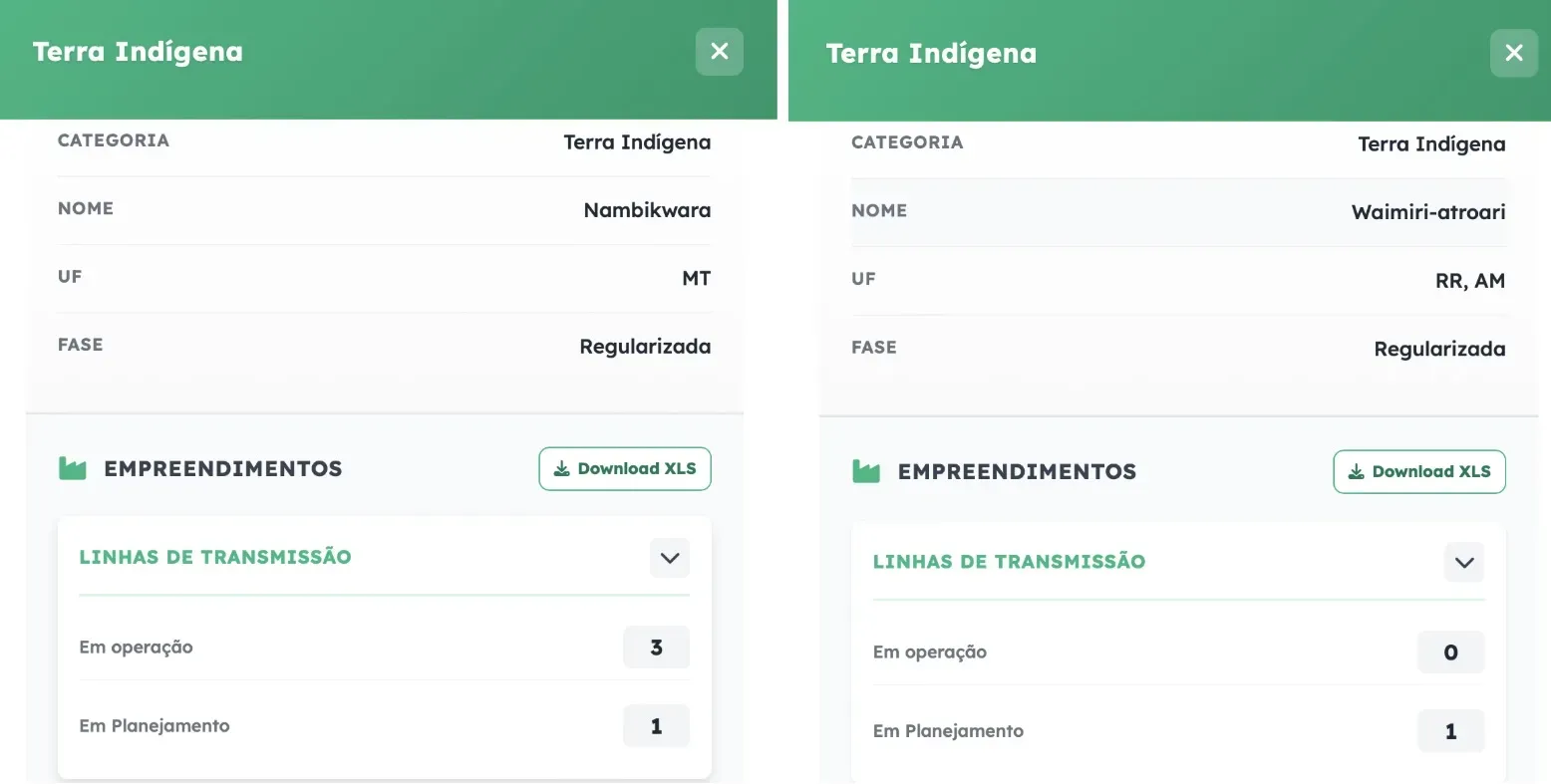
These cards reveal the name of the Indigenous lands affected by transmission lines and how many are in operation and how many are in the planning stage. All the data can be downloaded.
But let’s say we're not interested in transmission lines, but in mining.
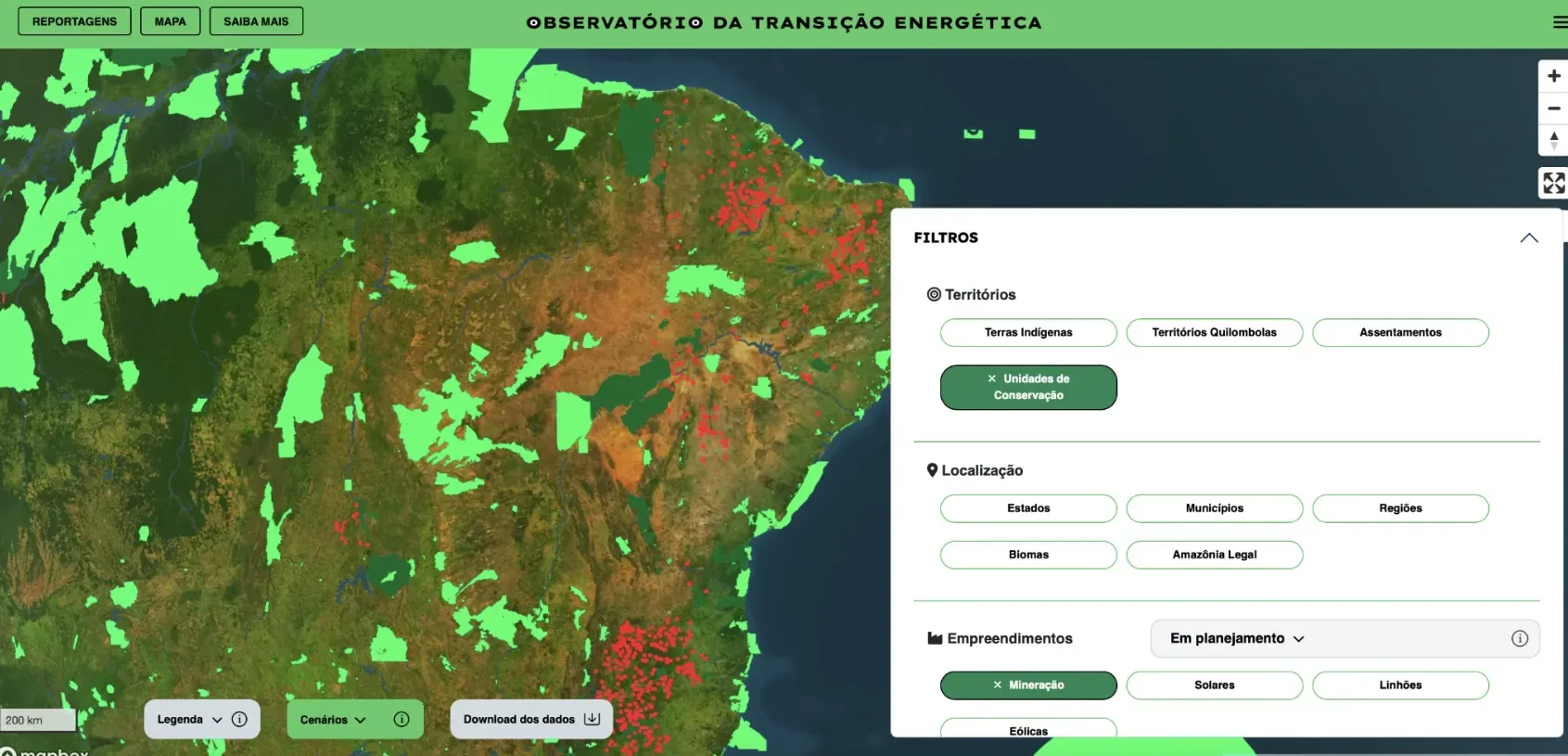
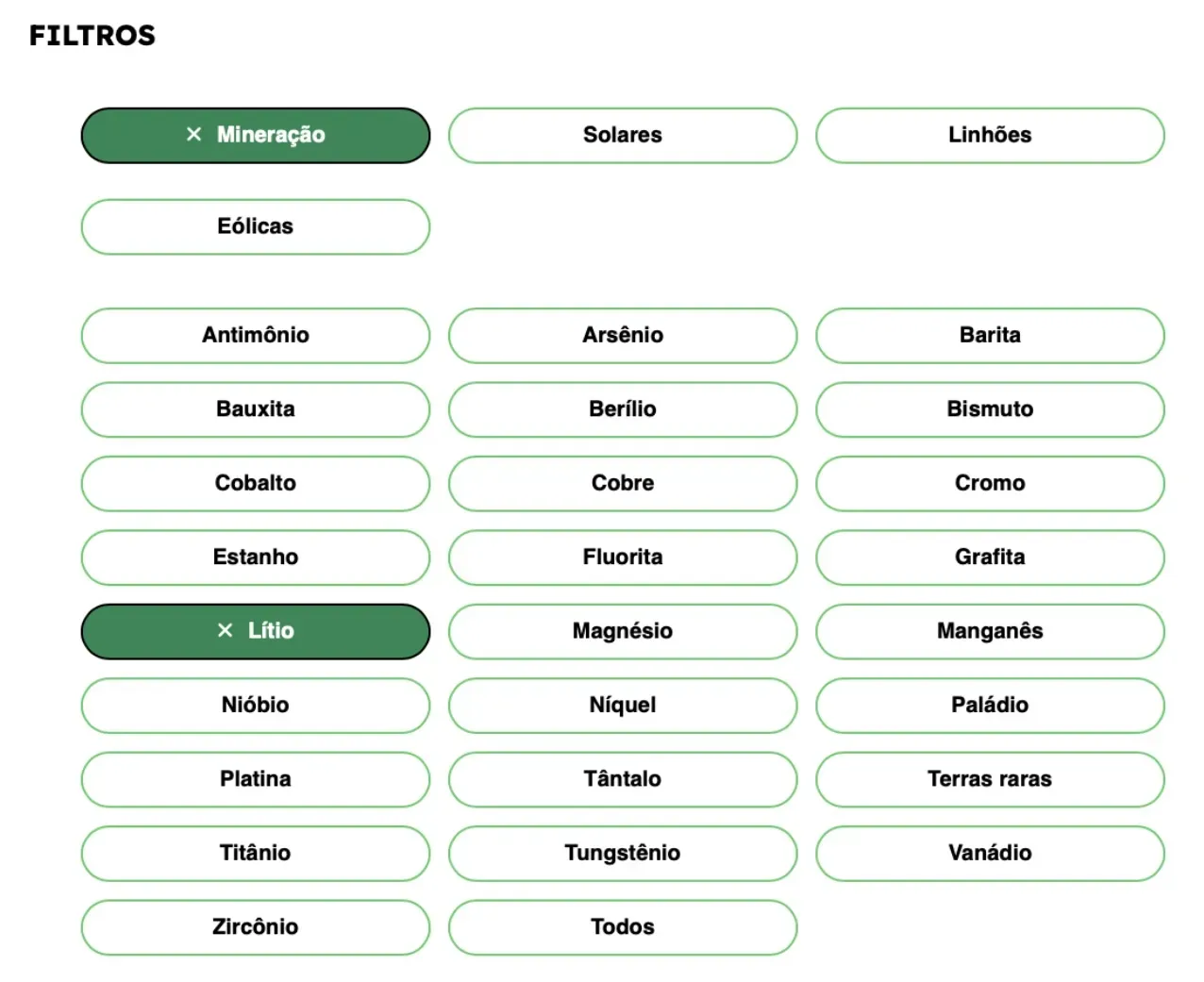
In the map above, we're overlapping 1) conservation areas and 2) mining permits of lithium specifically. But we could also choose another mineral from this list:
In a final scenario, let’s say we're interested in rare earths.
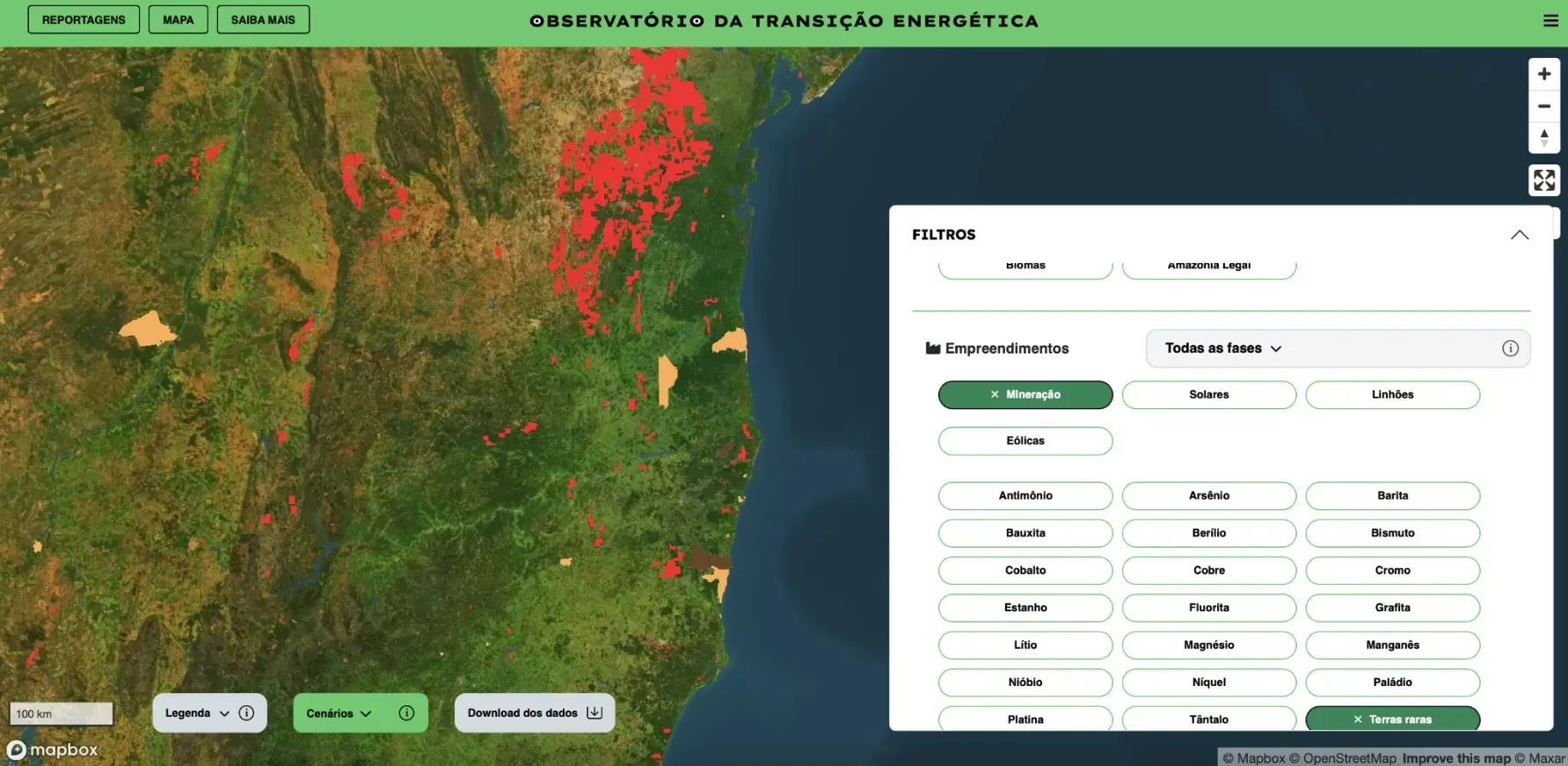
We can see that just off the coast of Brazil, there are many overlaps with Indigenous lands. Among them, the Barra Velha do Monte Pascoal. We then can expand the card:
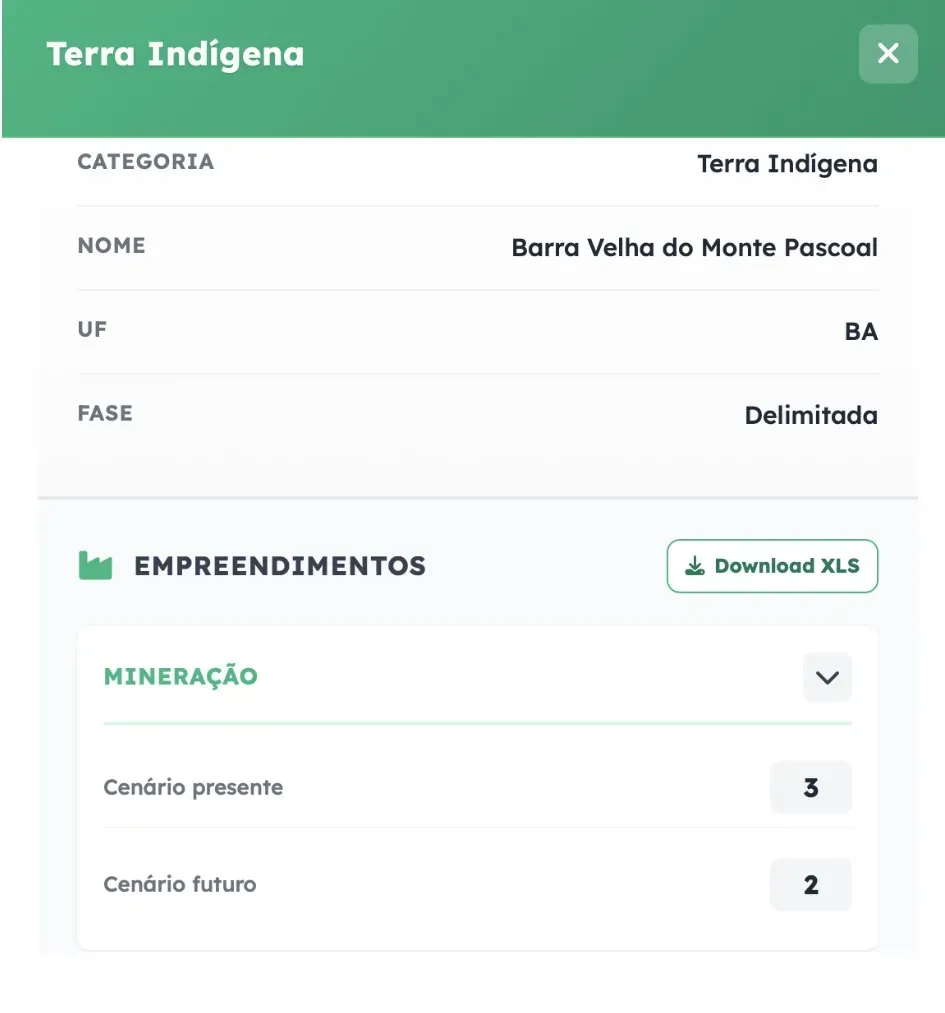
And from this point, we can download the data to see the three permits that are already ongoing and the two that are planned. When downloading the data, we receive a wealth of information. Let's zoom in a bit:

We can see 1) the number of the process at the National Mining Agency (ANM); 2) the year it was recorded; 3) the amount of hectares that will be needed; 4) the phase in which the development is currently in; and 5) the name of the company that is leading the activity.
The use cases for this tool are numerous. By crossing public data on transmission lines, wind farms, solar plants, and critical mineral extraction, The Observatory serves as a "sentinel" for journalists and activists to investigate human rights violations and environmental damage. It also aligns with RIN’s mission of not only supporting investigations and in-depth reporting, but also helping Fellows amplify the impacts of their reporting by building journalism infrastructure that can inspire and facilitate more impactful investigations by other journalists.