Lesson Plan April 27, 2026
The Health and Politics of School Lunch
Country:
Grades:

This lesson was created by Patrick Sprinkle, an American History and Government teacher in New York City, as part of the fall 2024 Pulitzer Center Teacher Fellowship program. It is designed for facilitation across two class periods.
For more lessons created by Pulitzer Center Teacher Fellows in this cohort, click here.
By exploring the Mid-Day Meal Program in India, students gain a deeper understanding of global health issues, poverty, and the importance of access to education. This fosters a sense of global citizenship and encourages them to consider their role in addressing social and economic inequalities.
Lesson Overview
Day 1: In this lesson, students will complete an analysis of a school lunch program of India. Students will not only evaluate the financial costs of the program against the benefits, but look deeper into how school lunch connects to the nutritional, emotional, environmental, social, and cultural needs of students. To conclude, students will complete a cost-benefit analysis and evaluate whether the benefit of the program is worth the cost
Day 2: Students delve into the critical components of a successful school lunch program by ranking essential criteria such as nutritional value, food safety, variety, accessibility, and sustainability. Through class discussion and debate, students prioritize these elements based on their perceived importance for student health and well-being. Armed with this knowledge, students collaborate to create a compelling public service announcement that highlights the most crucial aspects of school lunch and advocates for improvements within their school or community. The PSA will serve as a platform for students to raise awareness about the significance of school nutrition and inspire positive change. Alternatively, students will create a survey to gather data about perceptions and beliefs about school lunch in their school community to inform stakeholders.
Objectives
- Day 1: Students will be able to evaluate the economic impact of school lunch programs on individuals, schools, and communities by using a cost-benefit analysis.
- Day 2: Students will create effective public service announcements (PSAs) about the federal school lunch program in their community or conduct action research about school lunch in their local community.
Performance Task
Day 1
- Facilitate a class discussion on the findings of the cost-benefit analyses.
- Ask students to share their conclusions about the overall value of school lunch programs. How does the school lunch program contribute to students’ health?
- Discuss the challenges of quantifying costs and benefits, especially intangible ones.
- Explore potential solutions to address identified problems or improve the program.
- Complete a Four Corners Activity with students responding to the following prompt: Do the benefits of school lunch in both the United States and abroad outweigh the costs?
- Allow students to move to the corner of the room (Strongly Agree, Agree, Disagree, Strongly Disagree) that most aligns to their opinion.
- Allow students to share their opinions in a whole-class setting.
Day 2
- Students create their PSAs or surveys. This rubric can be used to evaluate the PSAs.
Assessment
Day 1: Students will be asked to evaluate the cost-benefits of India’s school lunch program in anticipation of examining our local community in the next lesson.
Day 2: Final Reflection: Written reflection on public service announcement collaboration and the overall significance and importance of school lunch in American politics.
Two-day lesson plan, including warm-ups, texts and video resources, discussion questions, activity, and performance tasks. Download below to read the complete lesson plan.
Lesson Resources
| Pulitzer Reporting | “School-Lunch Program Provides Unexpected Benefits for Rural Indian Women” by Rhitu Chatterjee for NPR “Power Lunch: India's Mid-Day Meal Program (Animation)” by Rhitu Chatterjee and Mathilde Dratwa “Illinois Students Struggle To Find Halal Food” by Tasmiha Khan for Borderless |
| Teacher-created Resources | Lesson Rubric |
Food Education Standards
7. We can advocate for food choices, and changes that impact ourselves, our community and our world.
Food Education Standard 4:
4. Food behaviors are influenced by external and internal factors.
NCSS Standard #5
Individual, Groups, and Institutions
Social studies programs should include experiences that provide for the study of interactions among individuals, groups, and institutions.
NCSS Standard #6
Power, Governance, and Institutions
Social studies programs should include experiences that provide for the study of how people create, interact with, and change structures of power, authority, and governance.
12.G5c (New York State)
Successful implementation of government policy often requires cooperation between many levels of government, as well as the cooperation of other public and private institutions. Conflicts between different levels of government sometimes emerge due to different goals, ideas, and resources regarding the creation and implementation of policy.
The following student work examples were created by New York City high school students who engaged with this lesson in the fall of 2024.
We cannot underestimate the power of storytelling and when those stories come from underreported places we can learn more information about how we connect with the world.
Student from NYC Lab School
At the start of the lesson, students analyzed their experiences of their school lunch program and compared their experiences to Pulitzer Center reporting on a school lunch program in India. They then used Post-it notes to document and guide a discussion on the costs and benefits of school lunch programs.
Next, students used a series of discussion questions to analyze the Pulitzer Center reporting on school lunch programs in India:
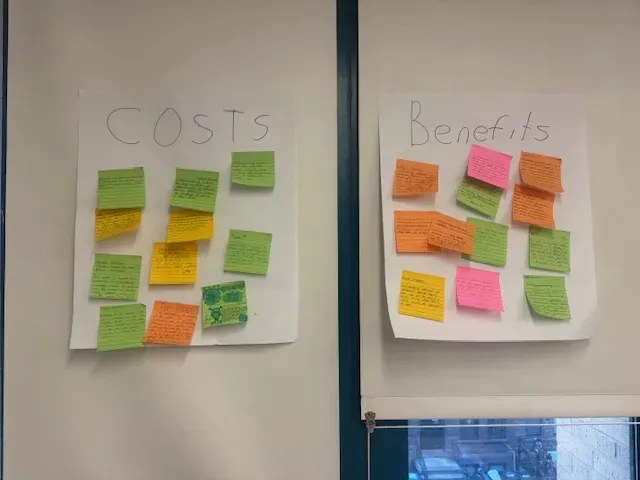
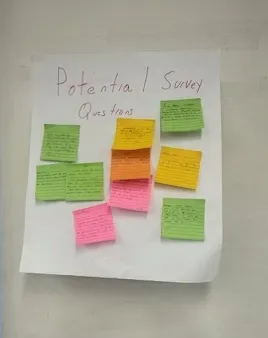
I really enjoyed how we began the process of writing and crafting survey questions for the community to learn about their beliefs and patterns.
Student from NYC Lab School
Students then conducted the reporting to research on school lunches in their communities and created a survey that they used to research students' experiences of school lunches at their school.