Lesson Plan March 12, 2026
Writing Our Voices: Using International Health Reporting To Write Open Letters
Country:
Grades:

This lesson was created by Nicole Cusick, a high school teacher in New York City, as part of the fall 2025 Pulitzer Center Teacher Fellowship program. It is designed for facilitation across approximately five 45 minute class periods.
For more lessons created by Pulitzer Center Teacher Fellows in this cohort, click here.
I wanted students to grapple with what wealthy countries like the U.S. should do to help countries with fewer resources, and I wanted students to understand that many privileged countries use foreign aid as a source of “soft power.” I was struck, too, by one of the reporters featured in this series discussing how global health challenges don’t know borders; viruses and diseases have a way of traveling across the globe. My students saw instantly through this reporting that those in more privileged positions should help those who need it – and that, perhaps more selfishly, there are ways in which the U.S. giving aid to other countries has legitimate stabilizing effects on our security at home.
Lesson Overview
This unit invites students and educators to explore how journalism sheds light on global health inequities – and why those stories matter. Using the Pulitzer Center’s “The Children Left Behind in Global Health Cuts” as a foundation, students will analyze how reporters use facts, storytelling, and ethical journalistic standards to convey complex – and often painful – human issues.
Students will then use this new knowledge as a foundation to research a health inequity of their choosing to write an open letter spreading awareness about their topic and advocating for change. The purpose of this short unit is to introduce students to the work of the Pulitzer Center and to help students see how informed, persuasive writing can amplify voices, create empathy, and drive authentic connection to stories around the world.
Objectives
- Students will read, annotate, analyze and discuss high-quality global health reporting from the Pulitzer Center.
- Students will read, evaluate and synthesize information about the three modes of persuasion (ethos, pathos, and logos).
- Students will read, analyze and discuss 1-2 student-written open letter samples.
- Students will identify and research a supplementary underreported global health story about which they are passionate. They will use this research to do step 5.
- Students will craft an open letter on their selected topic.
- Students will read, evaluate, and edit the work of their peers.
- Students will edit their written piece and be encouraged to submit it for publication.
Essential Questions
- How do journalists craft compelling, well-reported articles on how policy decisions in the U.S. impact global citizens?
- How can rigorous reporting and strong storytelling shape national understanding and policy-making around global health issues?
- Which factors – ethical, political, socioeconomic – influence who receives adequate health care in the U.S. and around the globe?
- How can students use rhetorical devices of persuasion as well as strong writing skills to advocate for change with global health inequity stories?
Performance Task
Students will research, report, write, edit, and refine an open letter on a topic related to an underreported global health inequity or a health inequity occurring currently in America. These inequities may be tied to recent funding cuts. The writing they produce should:
- Be 500-600 words.
- Be about a current global or local health inequity affecting a vulnerable population.
- Make use of the three Modes of Persuasion we studied in class (ethos, logos, pathos).
- Identify and refute a counter-argument.
- Use a Pulitzer Center article as one form of evidence.
- Use at least two other pieces of evidence (anecdote, reporting, direct quotes from interviews, recent students, etc.).
- Include a “Call to Action” – steps readers or the recipient of the letter can/should take to address the health inequity being explored.
After reading, discussing and analyzing their assigned article from The Children Left Behind series, students will study the three main rhetorical devices or persuasion (ethos, logos, and pathos). They will use the Pulitzer Center archives to find a global health story that intrigues them. Finally, they will write an open letter on the topic, using at least one Pulitzer Center article as evidence to advocate for a specific change or “call to action” they’d like to see undertaken.
Assessment
- I will check the students’ Article Analysis Template for Completion.
- I will observe students' jigsaw lesson discussions to make sure each class member speaks/shares.
- I will assess student exit cards to make sure they are making robust connections between articles and seeing how funding choices made by the United States government impact communities all over the globe.
- I will assess their open letter writing pieces using the list above and one of the rubrics in my folder.
Notes on Context & Content Advisory
This unit was developed for 9-12 grade journalism students at a high performing public high school in New York City. Students accessing this short unit have already studied some basic journalism skills and techniques; they are already familiar with different types of articles (Op-Eds, feature articles, and hard news stories, to name a few). They also have already done work to evaluate and write leads, kickers, and proper article attribution. Some may have already studied the three primary modes of persuasion (ethos, logos, and pathos) in 9th grade.
Five-day lesson plan, including warm-up, texts, discussion questions, research assignment, and final activity for the mini-unit. Download below to read the complete lesson plan.
Lesson Resources
| Pulitzer Reporting | “The Children Left Behind in Global Health Cuts”by Jon Cohen, Martin Eserink, and Catherine Offord “Treating HIV/AIDS abroad without US Aid and PEPFAR” by Jon Cohen and Brian Lehrer “U.S. Aid Helped Two African Countries Rein In HIV. Then Came Trump” by Jon Cohen “Without a Lifeline” by Catherine Offord “U.S. Helped Beat Back Malaria in Guinea. Now, the Disease Is Set To Soar” by Martin Enserink and Marta Moreiras “One of the Cheapest Ways to Save a Life is Going Away” by Jon Cohen, Kate Concannon, Julia Ritchey, and Darian Woods |
| Teacher-created Resources | Article Reporting Analysis Graphic Organizer PDF (.docx) Logos, Ethos, and Pathos Handout PDF Op-Ed Open Letter - Peer Editing Organizer PDF (.docx) Open Letter Brainstorming Graphic Organizer PDF (.docx) |
CCSS.ELA-Literacy.RI.9-10.1
Cite strong and thorough textual evidence to support analysis of what the text says explicitly as well as inferences drawn from the text.
CCSS.ELA-Literacy.RI.9-10.2
Determine a central idea of a text and analyze its development over the course of the text, including how it emerges and is shaped and refined by specific details; provide an objective summary of the text.
CCSS.ELA-Literacy.RI.9-10.3
Analyze how the author unfolds an analysis or series of ideas or events, including the order in which the points are made, how they are introduced and developed, and the connections that are drawn between them.
CCSS.ELA-Literacy.RI.9-10.6
Determine an author's point of view or purpose in a text and analyze how an author uses rhetoric to advance that point of view or purpose.
CCSS.ELA-Literacy.W.9-10.1.b
Develop claim(s) and counterclaims fairly, supplying evidence for each while pointing out the strengths and limitations of both in a manner that anticipates the audience's knowledge level and concerns.
CCSS.ELA-Literacy.W.9-10.2.b
Develop the topic with well-chosen, relevant, and sufficient facts, extended definitions, concrete details, quotations, or other information and examples appropriate to the audience's knowledge of the topic.
Warm up Reflections
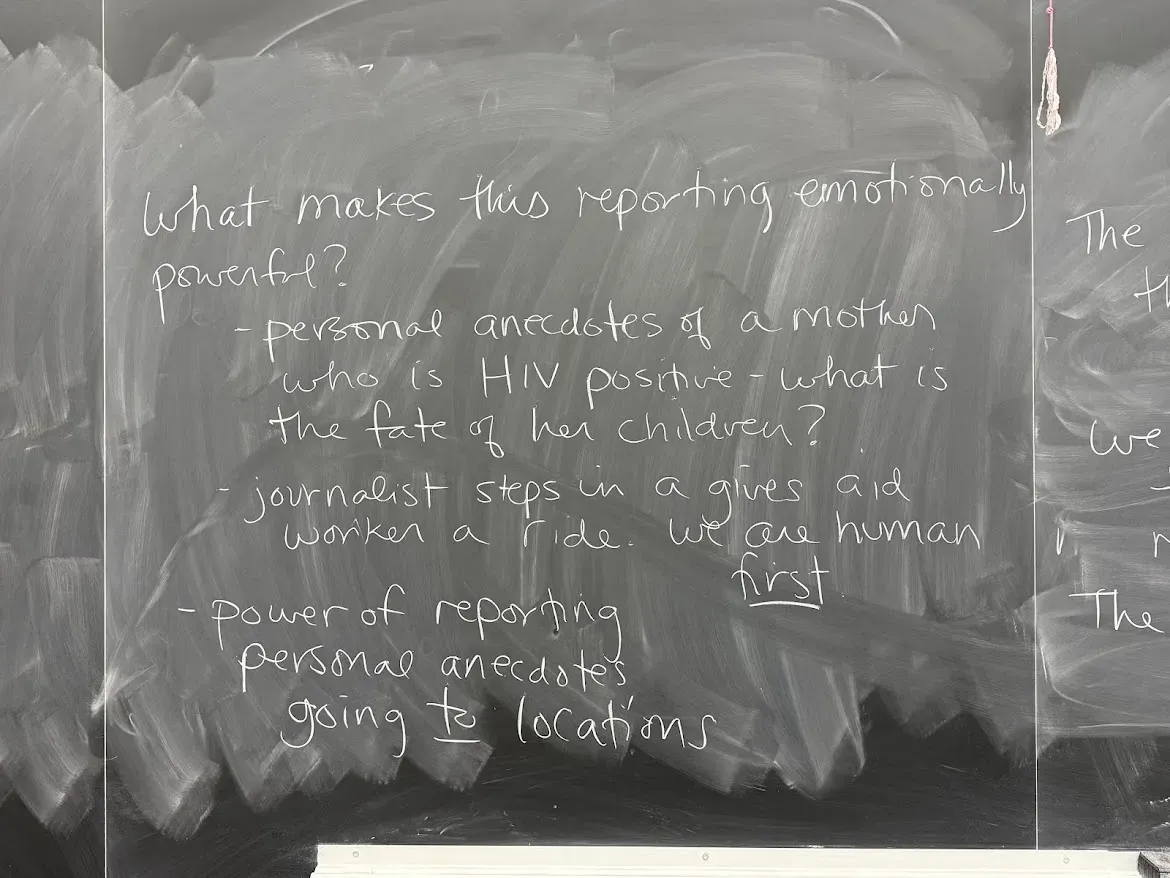
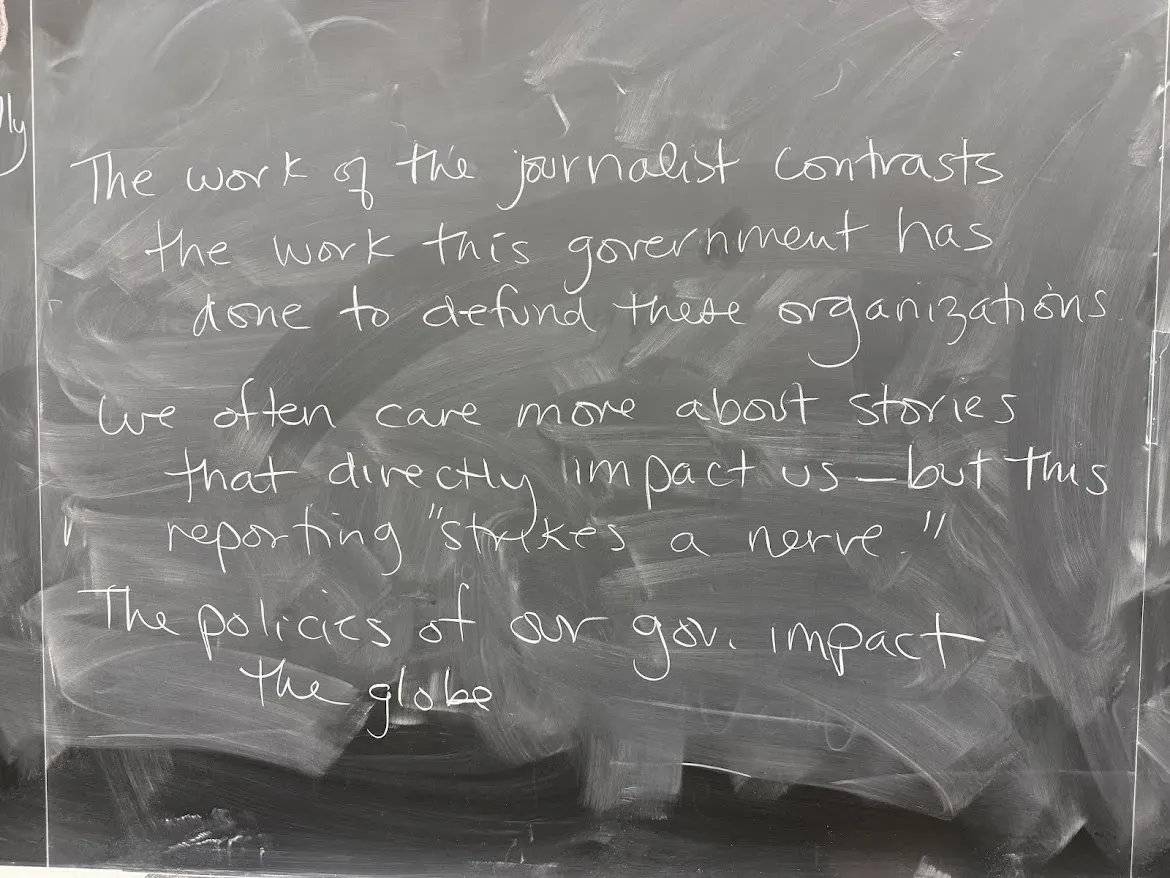
For this lesson, students began the unit by learning about the role of journalists and the tools they use to make reporting emotionally resonant.
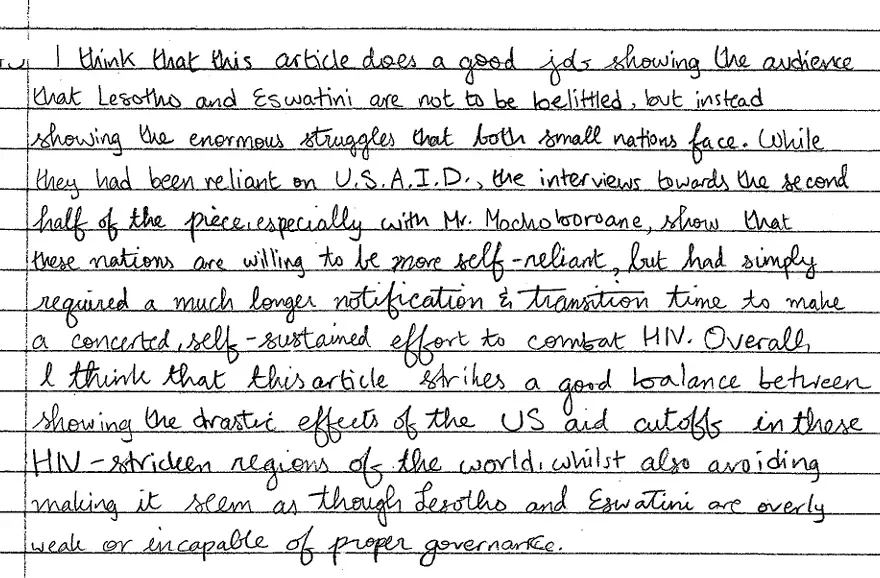
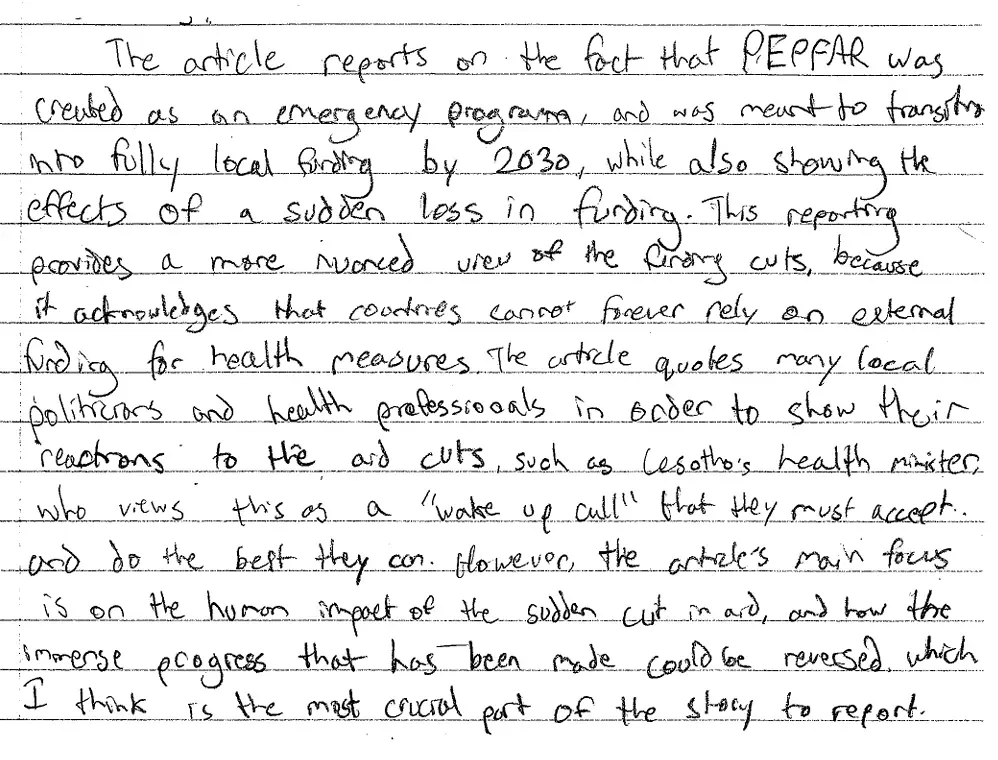
Student Reflections
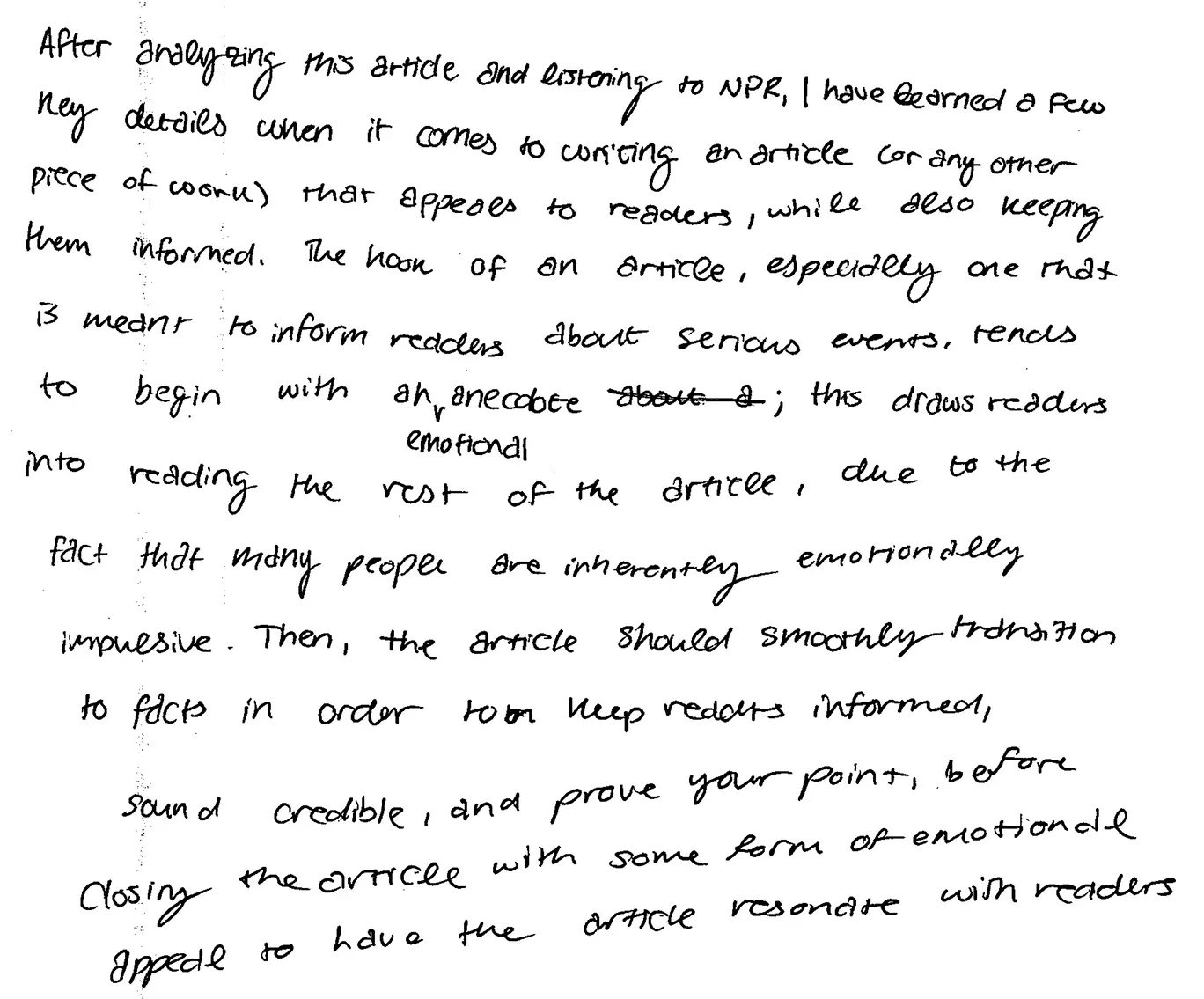
Students read Pulitzer Center reporting about global health inequities and analyzed the international consequences of various U.S. policy decisions.
Final Assignment
To complete the unit, students were tasked with writing an open letter to a figure or institution of authority in order to demand change regarding a particular issue regarding public health.
REPORTING FEATURED IN THIS LESSON PLAN
-

The effects of these cuts on the well-being of children