Lesson Plan March 27, 2026
Reporting as A Form of Community Education
Country:
Grades:

This lesson was created by Theodore Frank, a high school history teacher in Milwaukee, WI, as part of the fall 2024 Pulitzer Center Teacher Fellowship program. It is designed for facilitation across approximately two 85 minute class periods.
For more lessons created by Pulitzer Center Teacher Fellows in this cohort, click here.
My students could not believe the disparity in the rates of maternal mortality present in the United States.
Lesson Overview
This lesson is about using media as a form of community education by examining the disparity in mortality during childbirth between Black and white women and the associated socioeconomic healthcare costs. These costs include death, the lack of understanding and support by healthcare professionals when a woman of color has concerns during the birthing process, and the associated healthcare costs of additional burden and hospital time that are associated with complications in the delivery room.
The theme of this lesson is a modern healthcare issue in the United States: the disparity in birth rate and mortality between Black and white mothers. The skills students will use include media literacy, critically reading an article for information, using a graphic organizer, creating a video, persuasive speaking, and civil discourse. There are two goals with this project. Goal one is to inform students about a social issue, with the hope that they will share this knowledge with their families. The second pedagogical goal is to have students condense multiple sources into a brief video or slideshow and to explain the issue presented succinctly.
Objective
Students will:
- Examine three articles about the disparities in health care between Black and white women, especially around the mortality rates during the birthing process
- Develop a video or presentation describing the disparity in maternal health care between Black and white women in the United States.
Essential Questions
- How is reporting a form of community education?
Performance Task
Students will use their answers for questions 1-4 and 7 to create a Public Service Announcement on the issue of maternal mortality.
- Students will use the attached Pulitzer Video Rubric to plan their videos or slideshow presentations
- Have students present their video or slideshow to the class
Assessment
- After reviewing each video, have students vote for the one that is the most effective at explaining the issue.
- Use the rubric to evaluate each video.
Notes on Context & Content Advisory
The population of the urban Title I school where I work is…
- More than 98% BIPOC [Black, Indigenous, and people of color]
- More Than 86% Free and Reduced Lunch
- More Than 30% Students with disabilities
Two-day lesson plan, including warm-up, texts, discussion questions, and final activity. Download below to read the complete lesson plan.
Lesson Resources
| Pulitzer Reporting | “‘Racialized Myths,’ Medical Exploitation, and Dire Results,” by Kylie Marsh and Herbert L. White for The Charlotte Post “‘I Just Don’t Want To Die’: Black Pregnant Women Are Turning to Midwives for Personalized Care—And a Better Chance at Survival,” by Karen Kasmauski and Louis Hansen for the Virginia Center for Investigative Journalism “‘A Second Level of Power’ for Black Birthing Families,” by Kylie Marsh and Herbert L. White for The Charlotte Post |
| Teacher-created Resources | Magazine Article Analysis Worksheet Rubric (.docx) |
Wisconsin Standards for Social Studies
SS.Inq2.b.h
Analyze and weigh relevance of a source through a disciplinary lens to determine how the author, context, audience, and purpose affect the reliability, limitations, and usefulness of a source.
SS.Inq5.a.h
Explore opportunities, informed by the knowledge and methods of the social sciences, for personal or collaborative civic engagement with community, school, state, tribal, national, and/or global implications.
In this lesson, students completed a worksheet to help them analyse Pulitzer Center reporting on Black maternal mortality. After, they used their findings to create public service announcements about the public health issue. Here are some of their reflections:
What do you think doctors should do when people go to the doctor's office? Why?
I think doctors should focus on why you are really there and what could make you feel better faster.
Student Notes
Summary A
"Black women are up to four times more likely to die due to pregnancy- and birth-related complications than their white counterparts. Among the reasons are a legacy of experiments on Black women by white doctors since the first Africans were brought here as chattel and racist assumptions that underpin gaps in cultural competency today. [The medical] profession has been trained over generations, and a lot of it is rooted in these racialized myths about Black people, especially with this idea of race as biology rather than race as a social construct. J. Marion Sims and his decision not to provide appropriate anesthesia to enslaved women [during surgery] along with Black people being perceived as not experiencing pain in normal ways that can be connected to treatment. 'Disparities when it comes to diagnosis – and a lot of the more than 80% of maternal deaths are preventable – sometimes it's because when Black women report pain, they are not believed,' Bentley-Edwards said. 'You can point to this idea of Black women specifically being somewhat histrionic or overly emotional and attention-seeking. So, when you combine those two, it sets up for disaster, and you can see that these myths about having thicker skins and oral tissues, exaggerating pain, being overemotional instead of being seen as self-advocating for your care.”
Summary B
"Black women in the United States are three times more likely to suffer a pregnancy related death than white women. In Virginia, black women in recent years have been more than twice likely as other mothers to have a death attributed to childbirth.The national crisis for Black maternal health came into even sharper focus recently with a pair of high-profile cases. Torie Bowie a world-champion sprinter and Olympic gold medalist, died in May from childbirth complications. Bowie, eight months pregnant and in labor at the time of her death, was found lifeless in her home, alone. She was 32. And tennis legend Serena Williams has shared how she struggled to get medical professionals to take her seriously when she suffered serious health complications after giving birth.Both cases highlight the risks that Black women — even those with celebrity, accomplishment and wealth — face during childbirth. And study after study back up their stories.Health experts say the country should be doing much more to improve maternal health and reach levels equal to other developed nations. More than 8 in 10 pregnancy related deaths in the United States could have been prevented, according to research by the Centers for Disease Control and Prevention."
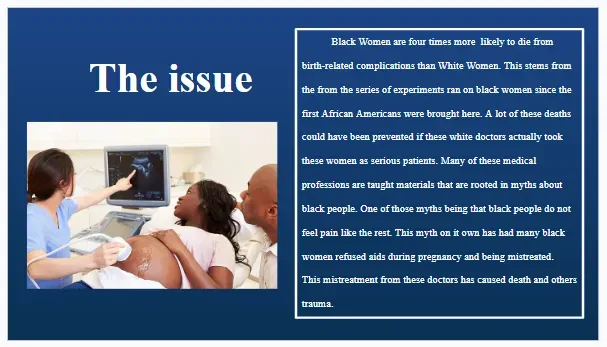
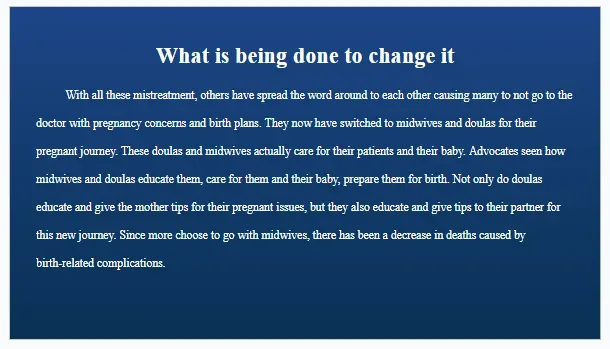
Sample Student Presentation
Teacher Reflection
What is the focus of your lesson plan, and why did you write this lesson for your community?
I work in an urban school that is more than 98% BIPOC [Black, Indigenous, and people of color] and more than 86% free/reduced lunch in Milwaukee, a minority-majority community. My students overwhelmingly have the potential to be faced with the issues faced by women of color during childbirth. My daughters will also face these issues if they decide to have children when they get older.
How did you build this lesson with your community in mind?
I wrote this lesson partially to inform my students of potential issues they may face during pregnancy, but also as a girl dad who does not want his own children to face the pregnancy and childbirth trauma experienced by many women of color. As a teacher, I approached this lesson with the idea that my students should be aware of potential issues they may face in the future, or have already been exposed to (at least one of my students is a parent, and there are other students in the school who have children).
The issue of maternal mortality is one issue that hopefully all women will be able to avoid, but women should be aware that the potential issues they may face during childbirth have solutions and strategies to help them avoid life-threatening problems. These are discussed in the articles we reviewed as a class.
Maternal mortality is not unique to Milwaukee; it is an issue faced in other American cities with women of color.
What did your students learn while engaging with this lesson?
My students could not believe the disparity in the rates of maternal mortality in the United States. Their comments included: “I can’t believe that,” “How can that be?”, and “That's B.S.”
Students also learned the role of a doula in delivery and other resources that may help during pregnancy and childbirth. Academically, students used skills including note-taking, synthesis of ideas, creating a finished product, public speaking, and civil discourse.
What did you learn by creating and teaching this lesson?
My takeaways from this project were that students are much more invested when an issue affects them directly, and that even though this was not a topic normally seen as one that is one of those “difficult conversations,” it was an area that was out of my area of expertise from a health standpoint, even if the specific topic was not difficult for me to discuss.
Underlying areas of slavery, racism, and the ongoing discrimination, the topic of maternal mortality may lead to rich discussions, as the background of some of the medical practices that led to the disparity is still present.
About Theodore Frank
Theodore is an educator with over 10 years of experience teaching in SE Wisconsin, primarily in Milwaukee. In addition to teaching, Theodore has participated in many national teacher programs including Retro Report, the National Constitution Center, FTE, and SPHERE.