Lesson Plan August 5, 2026
Global Issues Gallery Walk
Country:
Grades:

This lesson was created by Stephanie King, a high school English Language Arts teacher in Washington, as part of the Spring 2025 Pulitzer Center Teacher Fellowship program. It is designed for facilitation across approximately two days.
For more lessons created by Pulitzer Center Teacher Fellows in this cohort, click here.
My goal was to expose students to local news outlets. I wanted them to discover that many underreported stories are covered, though not in mainstream media, and don’t get very much attention because of the topic or the subject. This is often due to the fact that stories focus on marginalized communities or groups of people.
Lesson Overview
In this lesson, students will read, discuss, and annotate various articles supported by the Pulitzer Center and connect the central global issue to a local issue.
Once students have answered a set of questions within small groups, they will create a poster paper with their responses using markers. These questions will include evaluating what the issue is, whose voices are featured in the story, which voices are missing, and possible solutions to help address the problem. Then, students will find an article from a local outlet that connects the issue to their community.
Once these posters are created and the articles are printed, students will post them around the room so they can engage in a gallery walk, read each other’s responses, and engage in a silent discussion: students will use sticky notes to reply to responses on the article and generate questions about peer-found articles, bringing the global or national issue to a local context.
Essential Questions
- How do we read to evaluate and understand a specific issue?
- Why is it important to read both national and local articles to draw connections?
Performance Task
Preparation
Students will create a poster paper that responds to the following prompts:
- Summarize this article.
- Explain why the problem (homelessness, drug use, pollution, etc.) is a problem.
- Describe what they learned
- Evaluate the author’s stance on the issue (for/against and why; how do they know this?)
- Find, print, and paste a local article from our geographic location dealing with the same issue. Students will use the listed local news outlet resources in the additional resources section of this lesson plan. The Yakima Herald-Republic, KIMA CBS Yakima, Local News Now, The Tri-City Herald, and the Sunnyside Sun
Part 1 - Gallery Walk Activity
Students engage in a structured gallery walk.
- Explain to students that they will then be engaging in a gallery walk. Students will review and engage with each other’s posters using sticky notes.
- They will remain in their groups, reading and reviewing one poster at a time. Each student must formulate an opinion on what they read, write that opinion on a sticky note, then place the sticky note on the poster without covering up any information.
- In addition to a response, they must use a second sticky note to write a question about the local article. As a group, they only need to come up with one question.
- Provide each student with a pad (or a few) of sticky notes. Try to give each group a different color if possible; if not, have each person in each group put their group number on their stickies. Because there should be 3-4 people in each group, they do not need to put their names on their sticky notes; This will help students comfortably share their thoughts.
- After experiencing this and helping students through the first poster, have them rotate around the room, repeating the process. Put a timer in the front to help groups stay focused and use the time responsibly.
Part 2 - Silent Discussion
Students will rotate through the gallery walk for a final time, responding to sticky note questions posted from the previous activity. Hold less time for this activity than the gallery walk activity.
- Instruct students to find their poster in the gallery.
- They should respond to the sticky note questions created by their peers. Each student from the group should respond to at least one of the questions attached to their poster. Ensure students stick their responses at the bottom of the appropriate question sticky note when responding.
**Educator note: If time allows, hold more than one rotation of this discussion format. In total, at least 3 rotations (1 for the original and 2 for the discussion) should be completed. Adjust the time based on your students’ needs. Recommended time is 45 seconds.
Assessment
Preparation
**Educator note: Create a rubric evaluating the five components of the performance task. Share the rubric with students while introducing the task.
Exit Ticket:
Have students respond to the question with a list of 3 takeaways: What did you learn today?
**Educator note: Review the exit ticket to determine if there needs to be reteaching at the start of the next lesson before preparing for the gallery walk.
Activity
Posters will be formally assessed, while the gallery walk and discussion will be informally assessed through observation.
- Create a rubric to assess student learning and engagement with their original article. Posters should be assessed using a checklist of criteria based on the required pieces stated in the lesson.
- Assess the silent discussion by reviewing the sticky notes placed on each poster. Because the stickies are anonymous but connected to each specific group, check in on the posters after two rounds and make sure each group is on task. Teachers can also follow along with a group if there are concerns about participation or understanding of the task.
Notes on Context & Content Advisory
My student population has a high percentage of ELL (35 %+), Migrant (20 %+), Hispanic (90 %+), and low-income (95%) students. This was important in the selection of the articles compiled for student use and the gallery walk.
Two-day lesson plan, including warm-ups, texts resources, discussion questions, and two-part final activity. Download below to read the complete lesson plan.
Lesson Resources
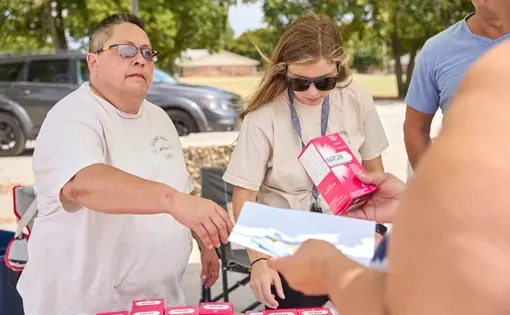
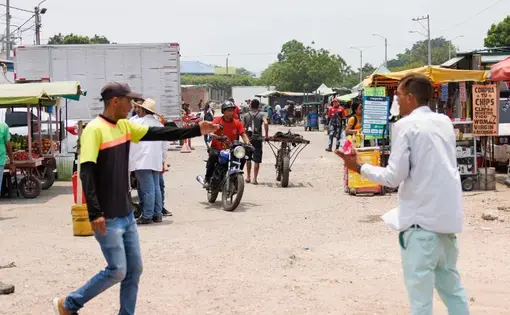
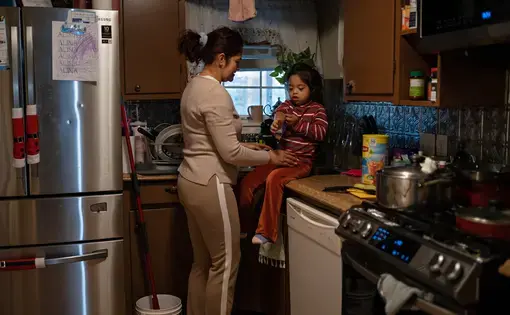
| Pulitzer Reporting | "The Venezuelan Migrant Experience — in Colombia, in Chicago," Democracy Solutions Project for WBEZ Chicago, by Meha Ahmad, Chip Mitchell, Sasha-Ann Simons, and Anthony Vazquez “Farmworker Housing in America” by Sky Chadde and Esther Honig for Investigate Midwest “Neglected and Exposed: Toxic Air Lingers in a Texas Latino Community, Revealing Failures in State’s Air Monitoring System,” by Jimmy Evans, Greta Díaz González Vázquez, Alejandra Martinez, Go Nakamura, Wendy Selene Pérez, and Danielle Villasana “Uncovering Deaths in Pennsylvania Jails” by Brittany Hailer and Joshua Vaughn for The Patriot News "Choctaw Nation Found a Better Way To Deliver Harm Reduction. It’s Working." Addiction Care in Native American Communities by Alyse Wilde for Native News Online |
CCSS.ELA-Literacy.RI.9-10.6
Determine an author's point of view or purpose in a text and analyze how an author uses rhetoric to advance that point of view or purpose.
CCSS.ELA-Literacy.RI.9-10.8
Delineate and evaluate the argument and specific claims in a text, assessing whether the reasoning is valid and the evidence is relevant and sufficient; identify false statements and fallacious reasoning.
In this lessons, students studied Pulitzer Center journalism to see how issues present around the globe are also unfolding in their own communities. Students processed their findings by creating posters, which were displayed around the classroom like a gallery.
After participating in a gallery walk to observe their peers' work, students reflected on what they learned:
After this lesson I'm inspired to be way more appreciative now. These migrant farmworkers struggle to get enough money for most things that has inspired me to be more appreciative with the food that my parents put on the table for me and all the things that they are able to buy for me or do for me and even for the roof they are able to keep over my head.
Yasmin
That the role of local news in our communities is to show other people that they are not alone. And to help them get support, or help in the situations and problems they have, and to spread the message.
Evelyn
I think it is important to look for underreported news stories to understand global issues because they can have information that has been overlooked, which has happened before. Overlooked information could sometimes lead to the solution to many problems, well i believe they could. If every detail was looked more thoroughly it would show every problem that needs to be solved, since every piece of information is gathered.
Felix
The most important thing I learned in the lesson was when not tending to an issue that might seem unimportant in a way, can cause a lot of damage. Damage to people, not every single person but the people it is happening to, loss of a family member or maybe the health of a family member.
Carol
Teacher Reflection
Stephanie King is a high school English Language Arts teacher at Granger High School in Washington. King’s created the lesson plan, “Global Issues Gallery Walk” as part of the Spring 2025 Teacher Fellowship for alumni, “Global Issues, Local Contexts: News for Civic Knowledge and Engagement.” Her lesson reached 50 students. At the conclusion of the fellowship, King shared the following reflections on her experience developing and teaching the lesson.
How did you build this lesson with your community in mind?
My students attend a small, rural school in eastern Washington. Our community is based on agriculture, so careers are limited, and thus so is income. I used this lesson with my two English 10 classes of roughly 25 students per class. I approached this lesson by having students think about different topics that affect our community. I knew they would pick some of the same topics from the articles that I was going to use for the lesson. Those included farmworkers, migrants, poverty, and drug use. Even though my students have not traveled much, although some grew up in another country, they are aware that the issues we have in our community are present in towns across the world. I did this lesson halfway through the year, so I already had strong relationships and a strong sense of trust established in my classroom.
What is the focus of your lesson plan, and why did you write this lesson for your community?
My lesson culminated in a gallery walk activity so that students could engage with multiple topics and articles. I used the gallery walk because my students are very social and have a hard time sitting still, reading, and annotating on their own. I thought this strategy would be better for my students so they could have genuine discussions and ask questions about these issues that are in our town and around the country. My goal was to expose students to local news outlets. I wanted them to discover that many underreported stories are covered, though not in mainstream media, and don’t get very much attention because of the topic or the subject. This is often due to the fact that the stories focus on marginalized communities or groups of people. For example the coverage of Missing and Murdered Indigenous Women compared to that of missing blonde, white women. Within Native American publications and communities, this topic is prominent (as my district is partially on a reservation). Whereas the same attention is not given nationally or even regionally.
My students were able to see that what they believe only affects our community is actually a cause of greater concern because the issues exist outside of our town.
I teach about internalized violence and how my kids come to expect certain behavior from those around them. This lesson opened their eyes beyond their immediate surroundings.
What did your students learn while engaging with this lesson?
Students learned how to intentionally read articles with specific questions in mind that go against the grain of the story. They worked on their annotating skills and then collaborated in small groups to create their posters for the gallery walk. Students learned how to develop their abilities to hold and maintain a discussion with their peers without teacher interruption or redirection. Students helped develop their own questions to ask each other about their articles.
“The most important thing I learned in the lesson was how undervalued agriculture workers [are]. I always believed that they were much appreciated and acknowledged, because they are the base of agriculture, food, etc. Then I learned how they were standing up for their rights, but weren’t really given any spotlight.”
Evalynne
"I think it is very important to look for underreported stories to understand global issues because if they're underreported, how can people know about the issue? Not only that, but also given the fact that it’s an issue that occurs all over the world. It is very dangerous, for example: drug overdose and the consequences [of] drug overdose are death. Something that causes death should never be underreported. Another reason why important global issues shouldn’t be underreported is because if people don’t know about the issue, how can we fix it? It’s important for us to know about these stories and not be underreported.”
Ismael
What did you learn by creating and teaching this lesson?
Students need to learn about local news outlets and be given time to learn about what is going on in their communities. Many students get their information from social media, and they are aware of the news outlets in their area. Instead of watching news on TV or reading about news on a website, they rely on a post and then read the comments from random people around the area.
The main takeaway from this experience was that students do not trust what they read. Many students are actually very critical of what they see. They think that news organizations are either lying or that they use AI to create the stories that people read. Educators who may want to engage with this lesson plan should give students the websites where they can look for local news because many students may not know how to define local based on your geographic location.
Some advice for other educators is to understand your community beyond what you see in the classroom. Students perform one way in front of their peers and teachers, and are different at home. This is true no matter the context, and knowing your community and the good and the bad makes a big difference in how students will approach this lesson. If they trust you and feel free to be open and honest, they will be. If they know you have prejudice or bias, they will not want to partake and give their actual thoughts on any topic.
About Stephanie King
Stephanie King teaches English Language Arts and helps students establish University of Washington transcripts through College in the High School at Granger High School. She coaches middle and high school girls’ soccer and volunteers extensively within the community. Stephanie embeds global competencies in her units, which have been published through her Library of Congress, Pulitzer Center, and American University Open Educational Resources and Smithsonian Fellowships.
REPORTING FEATURED IN THIS LESSON PLAN
-

Each year an untold number of people die in jails across Pa. Their stories often go untold and their...