Lesson Plan March 25, 2026
Clean Water Heroes: Inspiring Change
Country:
Grades:

This lesson was created by Amanda Bryant, a 5th grade teacher in Bryant Pond, ME, as part of the fall 2025 Pulitzer Center Teacher Fellowship program. It is designed for facilitation across approximately two-three 45 minute class periods.
For more lessons created by Pulitzer Center Teacher Fellows in this cohort, click here.
The lesson may have been most inspiring because it gave students a sense of control. Students didn't just learn about a problem; they wanted to help fix it.
Lesson Overview
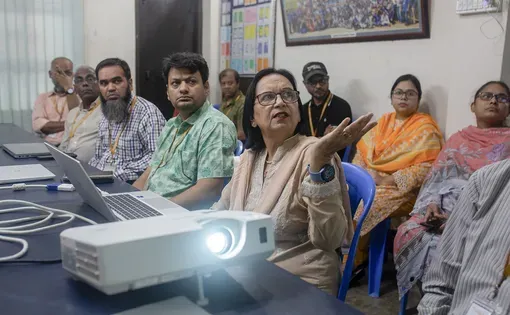
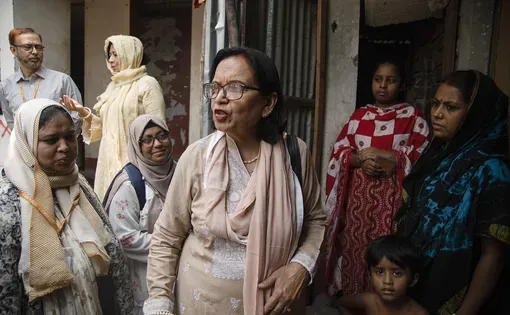
This lesson emphasizes the account of Dr. Firdausi Qadri – a Bangladeshi scientist who is working to stop cholera – to help students learn how health care is not equal around the world. Students examine the disparities in access to healthcare, clean water, and vaccines across several global regions and within their local context.
The skills and topics addressed in this lesson are not only pertinent to students' comprehension of global health challenges, but also to their evolution as empathetic and socially aware individuals.
The lesson's pedagogical vision is to teach students to think critically, to be empathetic, and to be socially responsible.
The goal is to raise a generation of students who are aware of the problems that marginalized groups experience and who want to make the world a better place.
This lesson for fifth graders talks about civic duty and how one individual can change the world. It also helps students become more aware of what's going on in the world, think critically, and care about other people. This mini unit functions as a call to action, urging students to think critically regarding the importance of sanitary water and access not only in their local communities, but also around the world. The lesson makes students think about what they can do to help bring about change and equality in their own communities and beyond.
Students can come up with inventive ways to solve problems and take action to right wrongs by learning about these global challenges.
Students learn to be responsible and caring through this lesson, which prepares them to be active and caring global citizens in the future.
Essential Questions
- How do global health problems, like cholera, show that some people don't have access to clean water and medical care?
- How can Dr. Firdausi Qadri's work motivate people to take action to improve community health?
- How can students help their own community be healthier and more equal?
Performance Task
Final Project: Global Health Multimedia Campaign
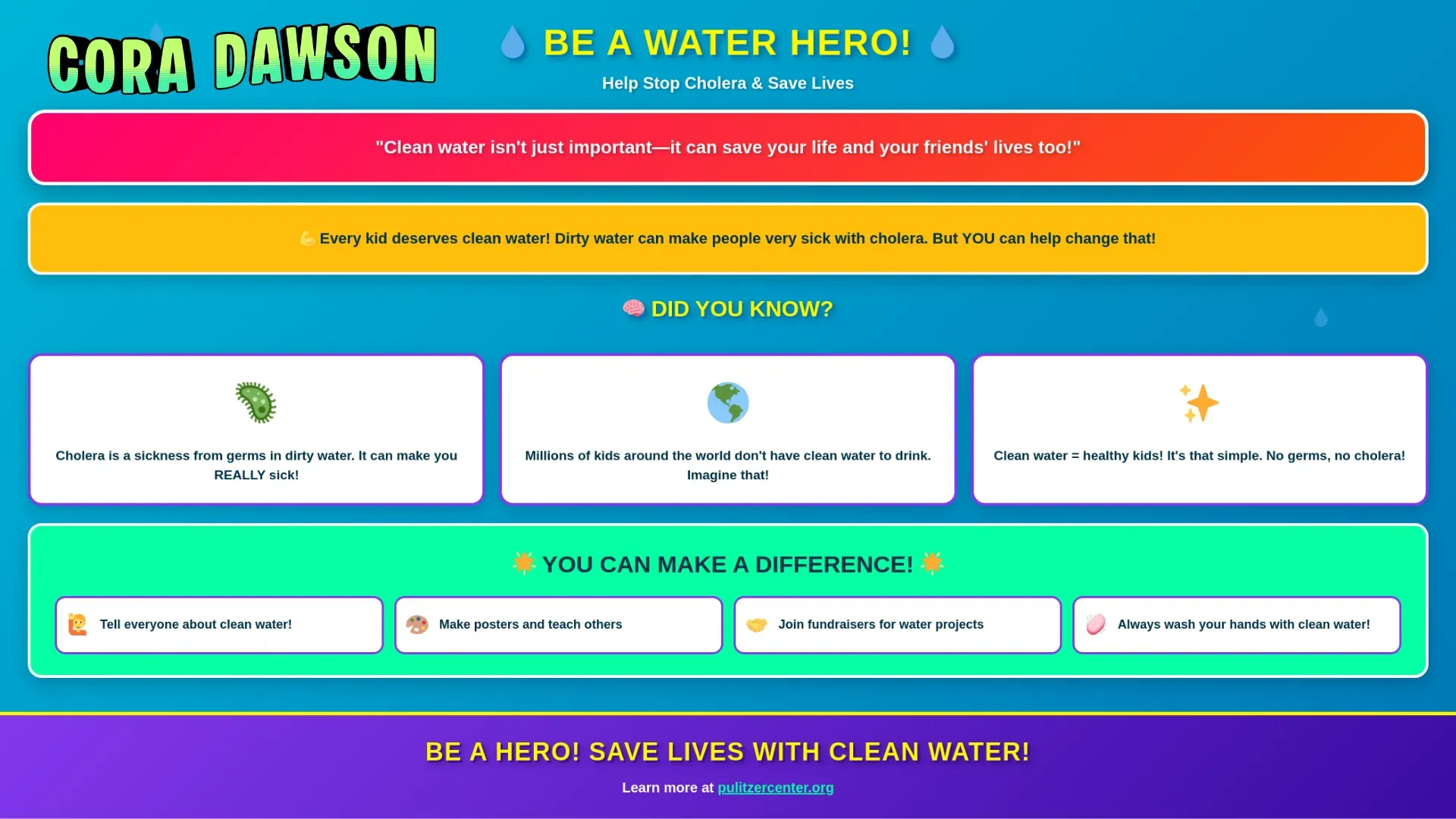
Students will work together to create a multimedia campaign using a digital tool like Canva, Google Slides, Prezi, or another website that has been district approved. Their educational campaign should focus on one of the following options: clean water access, vaccine promotion, or cholera education.
Within the Campaign students should:
- Aim to make people aware of Dr. Firdausi Qadri's work to fight cholera and help people get vaccines and clean water more easily.
- Show other people how cholera is a global problem and how it is connected to having clean water, good sanitation, and fairness.
- Talk about things that people, groups, or governments can do to improve public health.
- Show students how global health problems affect their own communities (for example, how clean water or vaccination campaigns affect Maine and other places) to get them to do something in their own communities.
Here are some ideas for campaigns:
- Make a digital poster or infographic with Canva.
- A short presentation in Prezi or Google Slides to spread the word
- A public service announcement (PSA) about clean water or a vaccines video
- A fake social media campaign (a set of slides that look like a message thread or posts to get people to pay attention)
To tie it all back to our article, all campaigns are required to have at least one quote or fact from the Pulitzer Center reporting in each campaign, and all sources should be listed.
Example for campaign project from Nigeria Centre for Disease Control
Example for the campaign project from Gavi, the Vaccine Alliance
Example for campaign project from We are World Change
Additional research for students when creating their campaigns :
WHO, Water, sanitation and hygiene (WASH)
Infographic: Which countries have the safest drinking water?
Assessment
Formative Assessments:
Comprehension questions, discussion participation, and student “Notice and Wonder” notes during reading.
Group brainstorming and project planning worksheets.
Summative Assessment: 4-point Scale Global Health Multimedia Campaign Rubric (student version)
Notes on Context & Content Advisory
The students in my classes are in 5th grade at a Title I school, facing lower socioeconomic backgrounds – with many facing challenges such as food insecurity at home. The ongoing impact of the drug epidemic has significantly affected our community, influencing both student well-being and levels of parental involvement. Additionally, approximately 23 of our 68 students receive some form of special education services. These factors were carefully considered while designing this lesson to ensure it meets students’ diverse academic, emotional, and social needs.
Two or three-day lesson plan, including warm-up, texts, discussion questions, and research assignment. Download below to read the complete lesson plan.
Lesson Resources
| Pulitzer Reporting | "Meet the Bangladeshi Scientist Who’s Helping the World Fight Cholera" by Martin Enserink “In the Cradle of Cholera” by Martin Enserink |
| Teacher-created Resources | Sanitary and Unsanitary Water Photos Day One Slideshow Definition Worksheet Notice Wonder Chart Journal Prompt Rubric PDF (.docx) Student Rubric |
Maine DOE Standards & Instruction - Social Studies
C1. Civic Engagement: Explain the individual and collective responsibilities of citizens in a democratic society.
E1. Global Connections: Explain how people in different regions of the world address common needs and challenges.
G2. Human-Environment Interaction: Explain how human actions modify the physical environment.
1. Research Process: Ask questions, gather and interpret information from multiple sources, and share findings effectively.
In this lesson, using Pulitzer Center reporting, students reflected on the work of Dr. Firdausi Qadri and her fight to combat the rise of cholera in Bangladesh. With Dr. Qadri's research as a model, "linking global problems to local actions," students were asked what they could do to help make their community healthier.
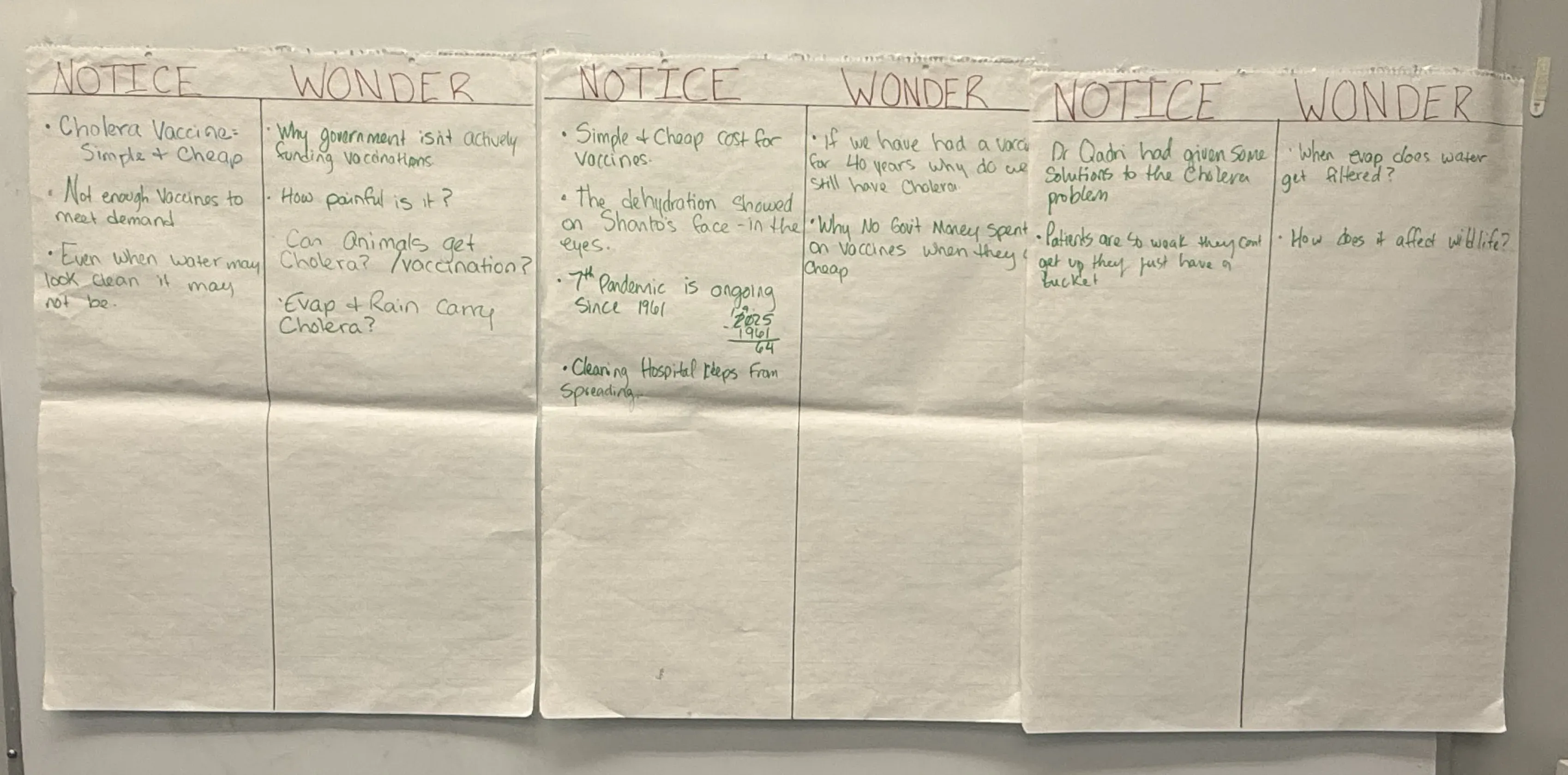
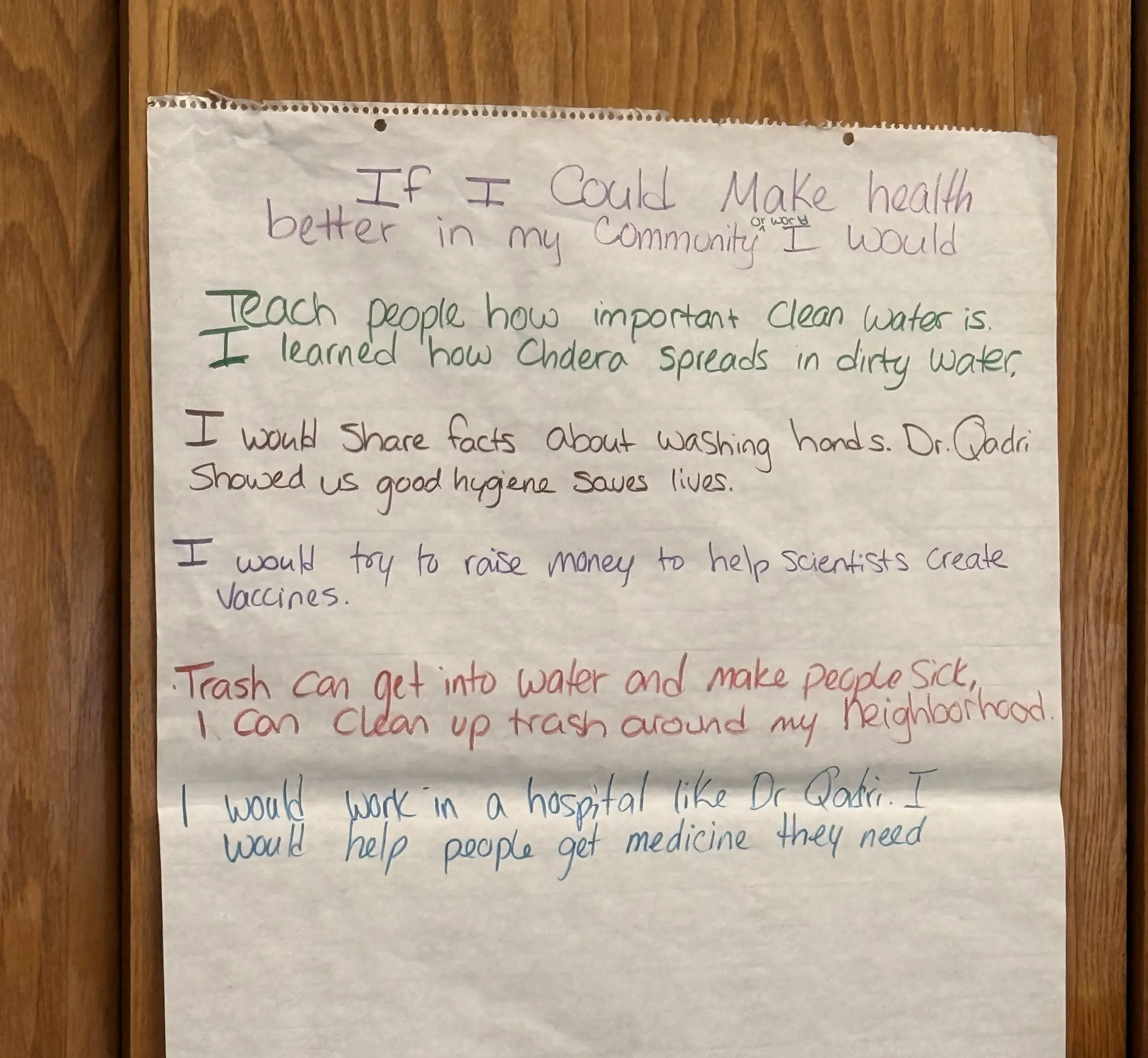
As a final project, students created multimedia campaigns to highlight public health issues in their community and to advocate for change.
Teacher Reflection
I wrote this lesson because I realized that many students think of history as something that happened in the past and is now fixed, rather than something that is always changing and affecting their lives now. My main goal was to help my students see current events in a real-world way so they would understand that they are witnessing "living history."
Amanda Bryant, Maine Educator and Teacher Fellow
What is the focus of your lesson plan, and why did you write this lesson for your community?
My students are in fifth grade, and they all learn in different ways and have different levels of reading and writing skills. In my classroom, there are a lot of personalities with different backgrounds and experiences that make it a great
My students are in fifth grade, and they all learn in different ways and have different levels of reading and writing skills. In my classroom, there are a lot of personalities with different backgrounds and experiences that make it a great place to learn. When I started writing this lesson plan, I wanted to make sure that the activities I included would work for everyone, no matter how knowledgeable or proficient they were.
Not only would it explain what cholera is in clear terms, but it would also let students express their understanding of what they learned in creative ways. I decided to include both visual and written aspects in the lesson to reach this goal. I began by reading a short passage that gave basic information about cholera to introduce the subject. This helped students who were more proficient in reading to learn more about the topic. I added pictures and diagrams to help explain important ideas for people who needed extra help.
How did you build this lesson with your community in mind?
I wrote this lesson because I realized that many students think of history as something that happened in the past and is now fixed, rather than something that is always changing and affecting their lives now. My main goal was to help my students see current events in a real-world way so they would understand that they are witnessing "living history."
Students too often live in a bubble around them. I made this lesson to break that bubble and show them stories and problems that happen outside of their own zip codes. The main point of this lesson is to connect the big picture with the small picture. I want my students to see how global problems affect their own lives. They can then connect these bigger ideas to their own communities in new ways. In the end, the goal is to give people power. I want my students to stop just watching the news and start getting involved by taking a stand and making a real difference.
What did your students learn while engaging with this lesson?
My lesson about Dr. Firdausi Qadri and her fight against cholera got the students very interested and made them think critically. The class learned about complicated public health issues, like how waterborne diseases spread and how to stop them (vaccines + hygiene), through "talk and jot" sessions and slide analysis.
Students showed what they had learned by linking global problems to local actions. They went from just remembering facts to being able to feel for others and solve problems. For instance, Braylon clearly stated the main issue when he said, "I learned that cholera spreads when water is dirty, so I would help make sure everyone has clean water to drink."
Students also showed that they knew that scientific solutions like vaccines work best when people in the community are educated about them. Raegan linked Dr. Qadri's research to everyday behaviors by saying, "Dr. Qadri showed that good hygiene can save lives, so I would remind people to wash their hands."
The lesson may have been most inspiring because it gave students a sense of control. Students didn't just learn about a problem; they wanted to help fix it. Kamber had a clear plan: "I would help health in my community by starting a Clean Water Team." We could check the water fountains and tell people not to waste water.
The lesson changed students from passive observers into aspiring scientists and community activists who want to protect not just their own neighborhoods but the world just like Dr. Qadri.
Below are quotes from student journals after learning about Dr. Quadri’s work with vaccines and cholera in Bangladesh:
- “If I could help make health better in my community or the world, I would teach people how important clean water is. I learned that cholera spreads when water is dirty, so I would help make sure everyone has clean water to drink.” — Braylon
- “I would help make health better by sharing facts about washing hands. Dr. Qadri showed that good hygiene can save lives, so I would remind people to wash their hands before eating and after using the bathroom.” — Raegan
- “If I could help the world be healthier, I would raise money to help scientists make vaccines. Vaccines helped stop cholera from spreading, and I want everyone to have medicine that keeps them safe.”— Lealynn
- “I would help my community by teaching my friends how to stay healthy. We could make posters at school about drinking clean water and staying away from germs.” —Isabel
- “I would help make health better by cleaning up trash in my neighborhood. Trash can get into water and make people sick, so keeping the environment clean helps everyone stay healthy.” — Isaiah G
- “If I could help the world, I would work at a clinic like Dr. Qadri. I would help people get medicine and learn how to stay healthy so we can stop diseases like cholera.” — Montana
- "I would help health in my community by starting a Clean Water Team. We could test water fountains and remind people not to waste water. Clean water keeps us strong.” — Kamber
- “I would help make health better by telling people not to drink water from places that look dirty. I learned that cholera spreads fast in dirty water, so we need to protect our water.” — Lily T
- “I learned that even water that looks clean can be full of bacteria that causes people to get sick. Dr. Qadri shows us that even with vaccines, we need everyone to participate and do their part to really get rid of cholera.” — Ben
What did you learn by creating and teaching this lesson?
What I learned in general: This lesson went very well. The information about Dr. Qadri really hit home with the class, which kept them very interested during the "talk and jot" and slide analysis. But the most important thing I learned is that it takes longer than I thought to do good creative work. The lesson plan had a timeline, but the students were so into the Performance Task that we needed a lot more time than we had planned to do their ideas justice. There was excitement, but the plans needed to be changed to fit their goals.
Advice for colleagues: If you want to teach this lesson, here are two important things to keep in mind:
Add "buffer" time for the performance task: don't rush through the last task. I realized that the amount of time suggested in the lesson plan wasn't enough for the students to do the work they wanted to do. I suggest either making the performance task a separate block or adding additional time to the lesson so that students may improve their work without feeling rushed.
Scaffold the "Podcast" option: A lot of students wanted to make a podcast but didn't know where to start. Before they ever hit "record" on Canva, we found success by slowing down and breaking the process down into steps.
The key is pre-production: We spent some time coming up with a creative name for the podcast and writing a script together.
Recording and visuals: After the script was finished, the students recorded the audio on Canva and then added graphics. This structure helped them go from a cool idea to a finished product they were happy with.
About Amanda Bryant
Amanda is a Maine educator who has been teaching since 2020. She has taught 5th grade for two years, taking on a lead teacher role, and previously taught 3rd grade. In 2024, she graduated summa cum laude with a Master’s in History and is passionate about teaching historical content in innovative and engaging ways. Outside the classroom, she has served her community as an EMT since 2018.
REPORTING FEATURED IN THIS LESSON PLAN
-

She leads the fight against cholera, a deadly infection that has surged globally.