Story
 April 9, 2026
A Dodgy Drug-Maker and Corporate Perks: How UK Health Aid Is Really Being Spent
Country:

Project
When Drugs Don’t Work
The weaknesses in safety nets that are letting bad medicines reach sick patients


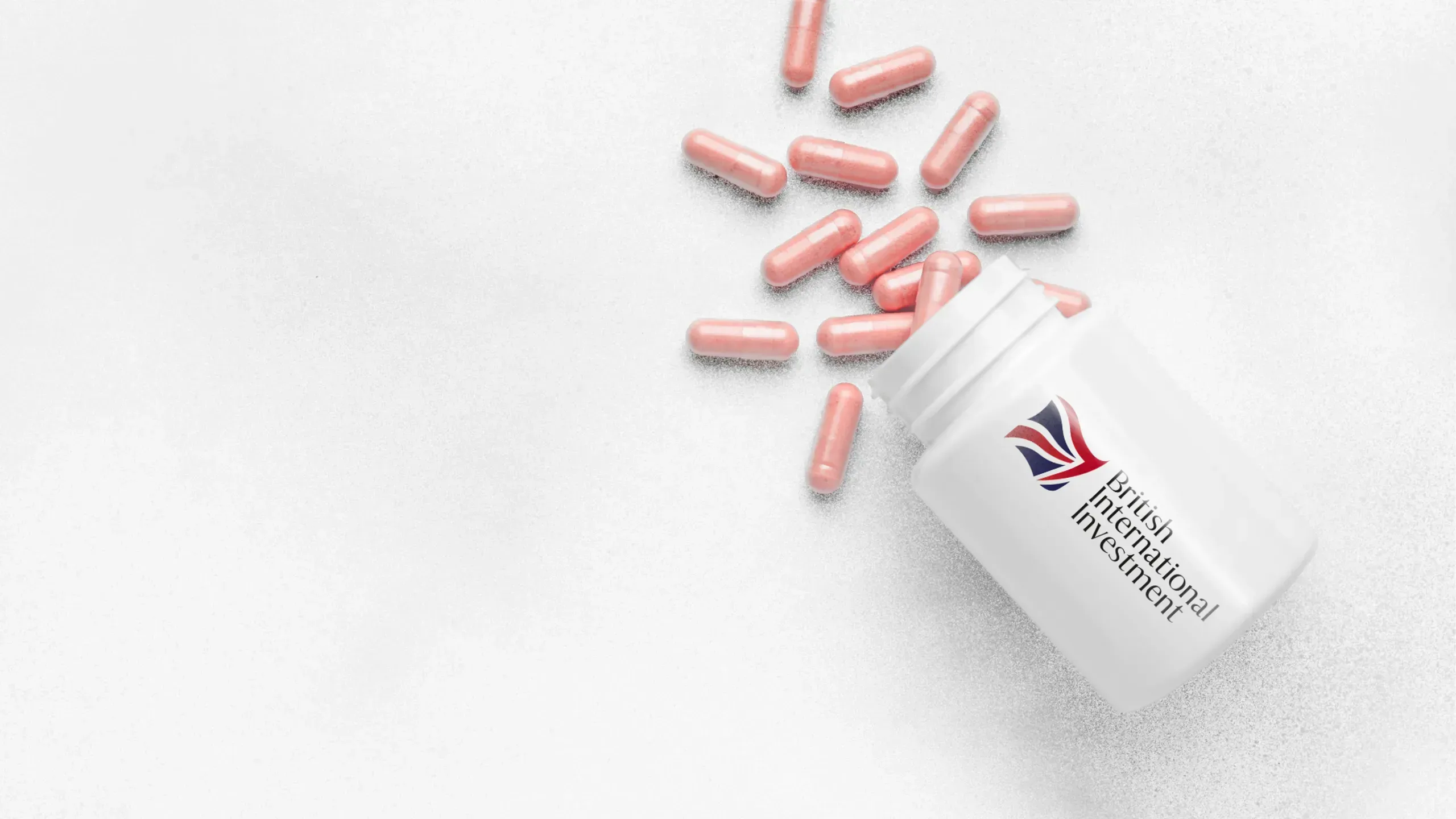
British International Investment has funnelled millions in public aid money to scandal-ridden companies
In brief
- Millions in UK aid is bankrolling companies linked to scandals such as contaminated medicines.
- The investments should be improving access to good healthcare in India, where millions cannot afford it.
- These taxpayer-funded investments count as part of the UK’s shrinking aid budget — this money needs to be carefully spent
Seen from the outside, 123 Victoria Street looks like any other glass-and-steel office block lining the busy thoroughfare leading to London’s Parliament Square. But inside this building, in the heart of the capital, decisions are made that determine the destination of billions of pounds in public money.
The office is the headquarters of British International Investment (BII), a company owned by UK taxpayers. Its remit is to help global development by investing money overseas to benefit “poor and marginalised sections of society”. In the last decade, it has received more than £5bn in government money, and much of this is used to improve healthcare systems in other countries. BII claims that its health investments treated over 13 million patients in 2024.

As a nonprofit journalism organization, we depend on your support to fund more than 170 reporting projects every year on critical global and local issues. Donate any amount today to become a Pulitzer Center Champion and receive exclusive benefits!
But despite the sums of public funds BII is entrusted with, some of its due diligence appears to fail the most basic of tests. We can reveal that millions of pounds in UK health aid managed by BII has been funnelled to deeply questionable companies, including one that made contaminated cancer medicine and another that provides corporate healthcare to billion-dollar businesses.
“Yet again we’re seeing alarming evidence that millions of pounds of UK aid are flowing into health investments linked to scandals and risks of patient harm,” said Anna Marriott, an independent advisor on the role of finance in global health.
These aren’t the first dubious deals to be done by BII. It has previously been reported to have doled out health funding to hospitals accused of human rights abuses. Last year, we uncovered how BII was channelling UK climate aid to fossil fuel firms.
The company’s track record has repeatedly prompted calls for the government to keep a closer eye on the billions it controls.
BII told us that it undertakes “rigorous due diligence” before making an investment and that its deals come with reporting requirements to help them monitor the companies in question. “Where concerns have been raised, we work with fund managers to understand what has happened and provide advice and support to mitigate or minimise the risk of a similar occurrence in the future,” a spokesperson added.
But none of this appears to have prevented BII ploughing millions into health companies that have endangered patients.
Sarah Champion MP, chair of the International Development Committee, told us: “BII needs to be entirely focused on investments that deliver both real change for people on the ground and progress on the UK’s development goals. Transparency should be its key aim.” She called for the government to lay out a plan to address the issue.
"Further investments should be paused and BII subjected to a fully independent investigation"
Anna Marriott, health finance advisor
“It raises serious questions about whether BII is failing to find the red flags or just choosing not to look,” said Marriott, formerly health lead for Oxfam. In 2023, her research exposed allegations of human rights abuses against patients at BII-backed hospitals in India and sub-Saharan Africa — including the imprisonment of new-born babies and children. BII said it took the Oxfam allegations seriously when they were raised but did not share detail of what actions it took in response.
“British aid is already stretched far too thin,” Marriott added. “It should never be putting patients at risk or making returns on harmful business practices.”
Scandal after scandal
BII’s funds are regularly topped up by the UK government — and these injections count as part of the country’s quota for international aid — so it’s vital that the company directs money to the right places.
One of the main such destinations is India, where the cost of healthcare pushes millions into poverty each year. And among the companies BII funds indirectly is an Indian pharma manufacturer called Beta Drugs Limited.
Beta’s drugs have raised red flags since as far back as 2018, when the Indian regulator found its cancer medicine to be contaminated with potentially deadly bacteria. This year, we revealed that the company made thousands of vials of cancer drugs that had to be stripped from hospital shelves in Peru after a batch was found to be faulty in 2024.
Yet, later that year, Beta received a cash injection of nearly $14m, in part from a BII-backed investment fund called HealthQuad Fund II.
These issues and others are variously detailed in media coverage, scientific journals and publicly available regulator reports. But BII was short of answers when we asked if it knew about them.
The only response it provided regarded academic research from 2025 (which we reported) showing that samples of Beta’s drugs did not contain the amount of key ingredient they should. Besides making some inaccurate claims about the condition of the samples tested in the research, BII said that Beta Drugs has “subsequently commissioned extensive independent reviews of their processes and has provided HQFII with assurances that their pharmaceutical products meet all required standards.” We have not seen these.
Also in India, BII has provided millions of dollars, both directly and indirectly, to a company called Boston Ivy Healthcare, which trades as Medikabazaar. BII also holds more than $20m in equity in the company.
Medikabazaar is a medical supplies platform that sells everything from X-ray machines to catheters. Quality equipment like this is vital to good healthcare; the importance of Medikabazaar’s service is not in question. But its business practices are.
For more than two years, the company has been embroiled in a major corporate scandal, kicked off by a whistleblower letter at the end of 2023. This triggered a forensic investigation and reported allegations of phantom inventory, fake transactions and shady dealmaking. In the fall-out, one company founder reportedly stood down, another was ousted and PricewaterhouseCoopers resigned as the company’s statutory auditor. Various strands of litigation have followed.
BII told us that it was aware of the allegations but couldn’t comment further because of ongoing proceedings. BII’s policies state that investees must not engage in corruption or fraud.
BII was founded with a mandate to “do good without losing money” and it models its objectives to align with the sustainable development goals — such as access to quality healthcare services for all, not just the wealthy.
Yet two funds it has backed have poured money into Ekincare, a company that provides “corporate health benefits” for clients including the accountancy firm KPMG and the asset-management giant BlackRock.
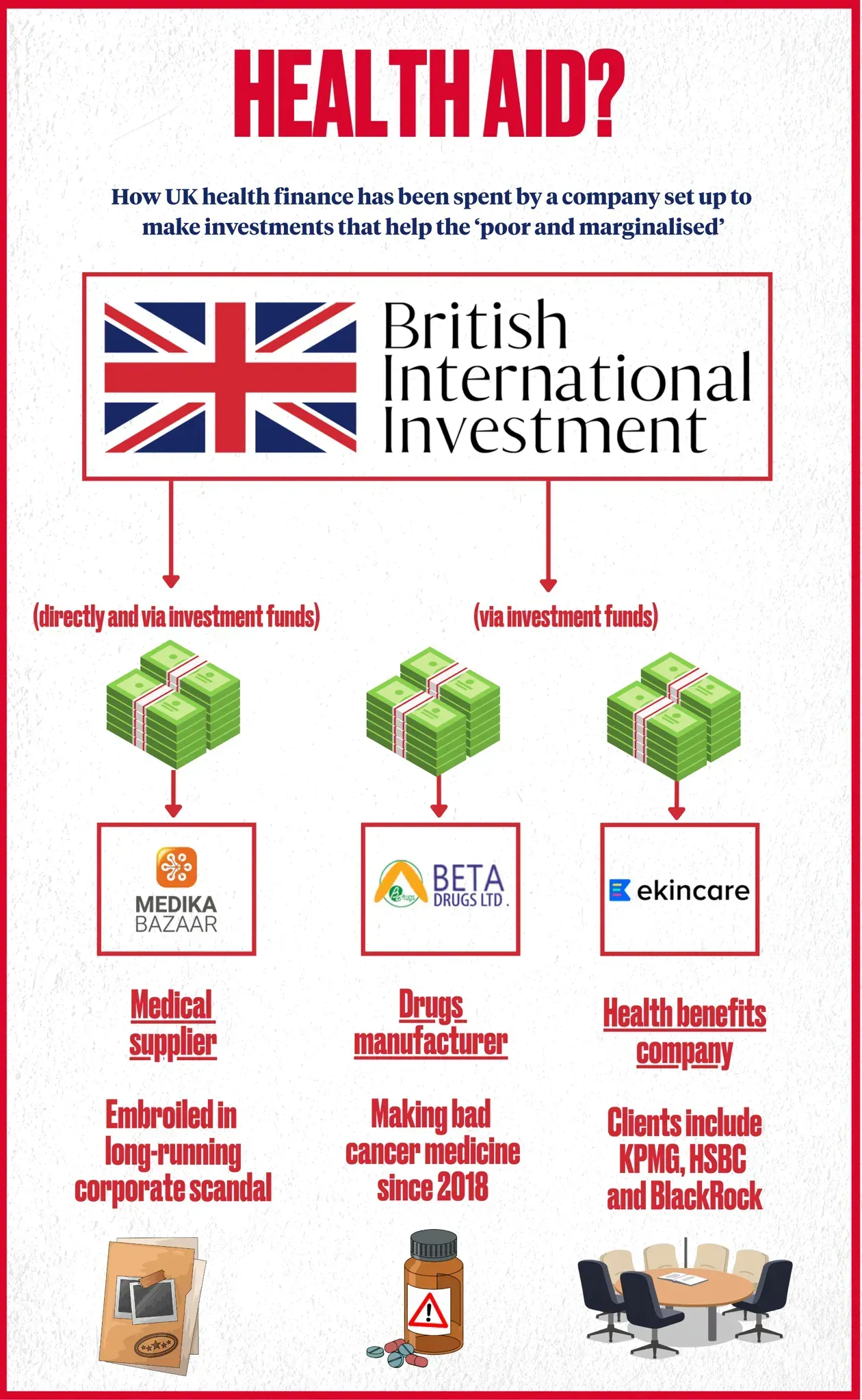
Asked what evidence it has that Ekincare is delivering on the above goal, BII pointed to the 2 million workers in India, including 10,000 gig economy workers, supported through Ekincare’s schemes. But these workers represent just 1% of Ekincare’s customer base.
‘The stakes are too high’
The UK government has invested vast amounts of taxpayers’ money in BII, including significant increases last year. And these capital injections all count as part of UK overseas aid — which has faced huge cuts in recent years. From next year, it will shrink from 0.5% to 0.3% of gross national income, down from 0.7% in 2021.
It’s not just the health sector into which BII has made dubious investments. Last year, we revealed that it has ploughed UK climate aid into luxury carmakers, telecoms giants and power companies. And the Independent Commission for Aid Impact (ICAI) has raised concerns about other Indian investments, such as a debt collection business.
A spokesperson for ICAI said: “As BII receives UK taxpayer funding it is important that the public know how this money is being invested and have assurance that it is contributing to poverty reduction.”
Such assurances are in short supply. Despite BII’s claims of attention to detail, its recent investment history points to an alarming inability to spot red flags.
“These are not hard to find — many are discoverable with the most basic due diligence,” said Anna Marriott.
“At this point, calls for greater [government] oversight are important but not enough. The stakes are too high. Further investments should be paused and BII's role in health subjected to a fully independent investigation. Continued ministerial silence in the face of repeated BII scandals is simply not acceptable.”
We sent multiple requests for comment to Beta Drugs, Boston Ivy and HealthQuad but did not receive a response.