Story
 April 10, 2026
In Dharavi, Kumbharwada’s Clay Economy Meets the Redevelopment Chokehold
Country:

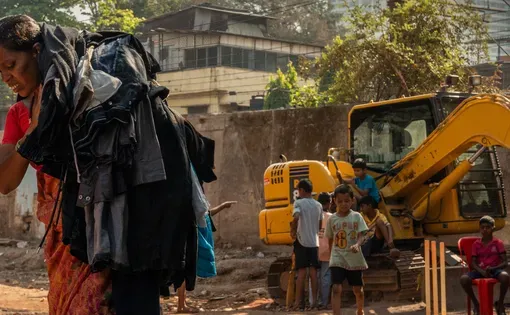
How an urban redevelopment project has become a vehicle for elite land capture
The Dharavi Redevelopment Project threatens to destroy Kumbharwada’s centuries-old pottery. It’s a survey that doesn’t see upper floors or shared kilns.
Dharavi’s Kumbharwada is Asia’s largest settlement of traditional potters. Formed by potter families from Gujarat who settled here in 1887 along the Mithi River, it drew on the soft, pliable mud of the riverbed at the edge of Mumbai. In 1933, the British government allotted 360 potters tenancy rights over vacant land, permitting long-term occupation without granting ownership. Over the last 90 years, even as the Mithi has turned into a fetid drain, Kumbharwada’s economy has expanded, its families multiplying to over 1,500 who continue in the trade.
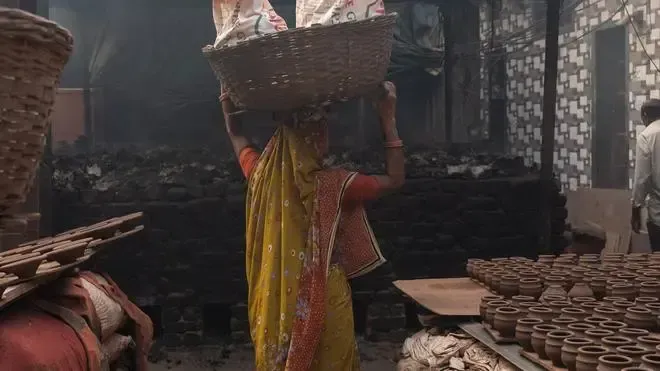
“The clay doesn’t come from the Mithi anymore,” says Manjula Maru, 51, born into a family of potters. “Mithi’s banks are now too polluted to yield usable earth—we get it from Gujarat now, and other parts of Maharashtra.” She steps out with a stack of baked pots balanced on her head, walking steadily towards the main road where trucks are lined up to carry them across Mumbai. Back in the lane, she kneads wet earth on the ground—palms pressing, folding, turning—until it yields like dough. Lifting a lump of clay high above her head, she brings it down sharply onto a slate, the thud cutting through the morning as she smoothens its grain, a rhythm shaped over generations.
Along the walls, rows of freshly shaped pots dry in the open, while others are being painted and varnished in quick, practised strokes. The neighbourhood appears almost built from the same material it works with—mud, dust, and clay blending into one another. A fine layer of ash settles over everything. In the background, furnaces that have burned for decades continue to breathe out smoke, staining the walls black, each unit marked by years of soot and labour.

As a nonprofit journalism organization, we depend on your support to fund more than 170 reporting projects every year on critical global and local issues. Donate any amount today to become a Pulitzer Center Champion and receive exclusive benefits!
Most business owners in Kumbharwada are potters themselves, working the wheel even as they employ a few helpers to keep up with demand. A medium-sized pot costs roughly Rs. 50 to produce—including raw material and labour—and typically sells for about Rs. 100. But once overheads such as electricity and rent are accounted for, margins shrink to barely Rs. 10–15 per piece. To stay viable, potters rely on bulk orders: from shopkeepers who retail them in smaller quantities, from restaurant chains—especially biryani houses—that use them directly, and from traders who buy in large volumes to resell across markets in the country.
Refusing to partake
It is this fragile economy that now stands on uncertain ground. As Dharavi faces the prospect of land acquisition under the Dharavi Redevelopment Project, surveys are being conducted by the Adani Group to enumerate units across the settlement. Kumbharwada, however, remains one of the few pockets to have collectively refused participation.
“Adani’s people came to survey us, but the entire wada drove them away. Why should we give them a survey? Who are they for us to prove our existence to?” says Manjula.
In this refusal lies a deeper scepticism—of redevelopment promises that speak the language of improvement, but threaten to dismantle the very conditions that sustain Kumbharwada’s centuries-old craft economy.
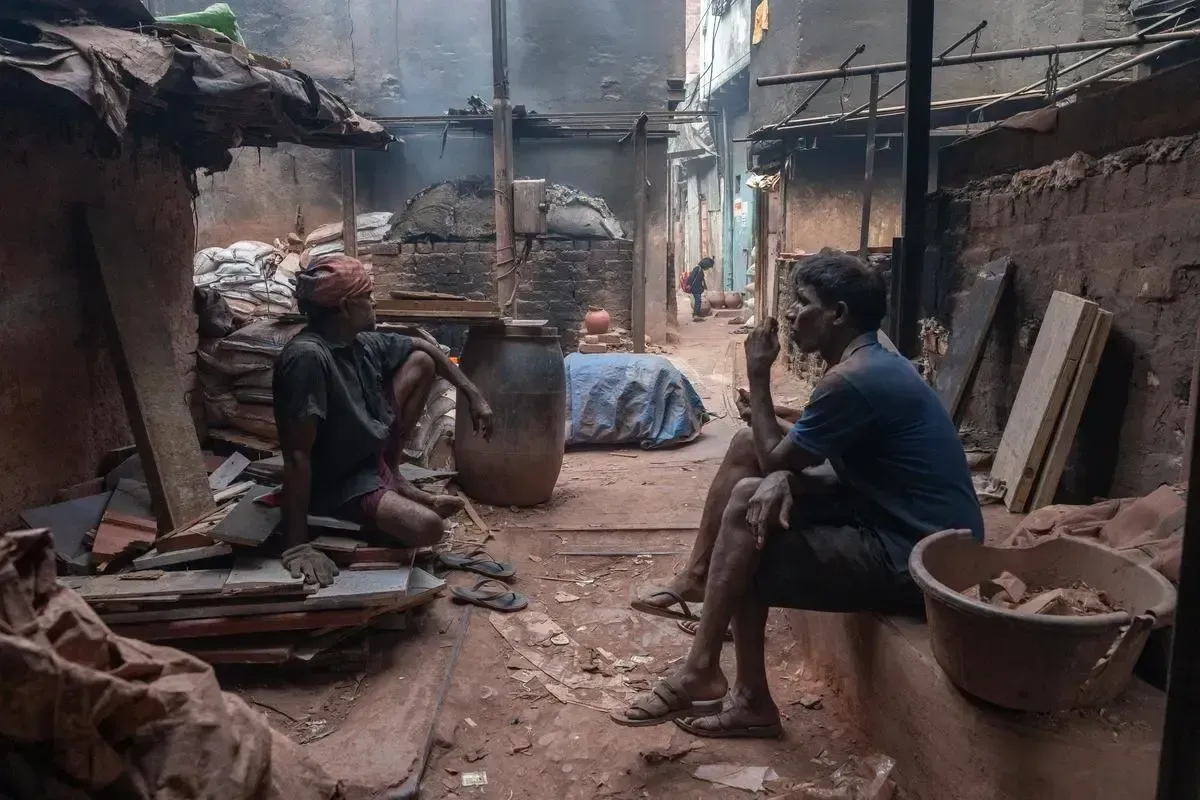
Kumbharwada’s housing follows what urban practitioners at Urbz, a design studio in the heart of Dharavi, describe as the “tool-house” model. Workshops on the ground floor with living spaces stacked above, a form common across much of Dharavi. Here, production and domestic life are inseparable, folded into the same vertical structure.
But under the government’s eligibility criteria, only ground-floor residential or commercial units established before January 1, 2000, qualify for free rehabilitation housing within Dharavi—typically a 350 sq. ft. flat. Commercial or industrial units, in turn, are likely to receive spaces of around 225 sq. ft., or their existing area, whichever is smaller. Those operating from upper floors are rendered ineligible, even if their work predates the cut-off.
In Kumbharwada, this effectively excludes a majority. With homes rising vertically, entire families risk falling outside the ambit of rehabilitation. “They might at best secure a small workshop space—and even that, the plan does not clearly specify in terms of location or suitability,” says Shweta Damle of the Habitat and Livelihood Welfare Association.
The mismatch is also spatial. Kumbharwada’s homes—spread across five dense lanes—are often larger than the standardised units being proposed. Manjula’s house, for instance, stretches across nearly 2,000 sq. ft., a ground-floor workspace with living quarters rising above, almost like a vertical street. “Even the workspaces they are promising are barely 225 sq. ft.—how are we supposed to manage in something so cramped? How is this fair to us?” asks her husband, Manji Punja Maru.
Adam Jala, who heads the Potter Welfare Association, has said to Scroll.in that residents do not want to move either their homes or their businesses out of Dharavi. “If the business moves out, it will be the end of Kumbharwada.”
This is because work here is deeply communal, with the street itself becoming an extension of the workshop—clay is mulched, pots are shaped, dried, and fired out in the open. The lanes are punctuated with shared furnaces that burn for five to six hours at a stretch, baking batches of pots. “We plan it so that our neighbours can use them too,” says Manji. “They’re also temporary in nature—we can dismantle and reassemble them if someone needs the space, for a wedding or a procession.” These kilns are often fired with offcuts from Dharavi’s textile units—discarded fabric finding a second life as fuel—binding one informal economy into another in ways that rarely announce themselves but quietly sustain the whole.
“The streets of Kumbharwada represent a deeply democratic use of public space,” says Samidha Patil, an urbanist with Urbz. “These are organically evolved spatial practices—it is not something you can simply recreate inside glass towers. How will any rehabilitation plan account for this?”
But, she adds, the redevelopment scheme—rooted in a Eurocentric vision of order—seeks to separate this very work from residence, relocating industries into distant, zoned enclaves. In doing so, it risks dismantling the very ecosystems it claims to improve.
“We are not asking for anything,” Manjula says, her hands still dusted with clay. “Just let us keep making our pots, here—like we always have.”
Anuj Behal is an independent journalist and urban researcher primarily focussing on issues of housing rights, urban justice, gender, and sexuality.