Journalist Resource
 December 22, 2025
How I Investigated Uganda’s Digital Number Plates as Surveillance Tools
Country:

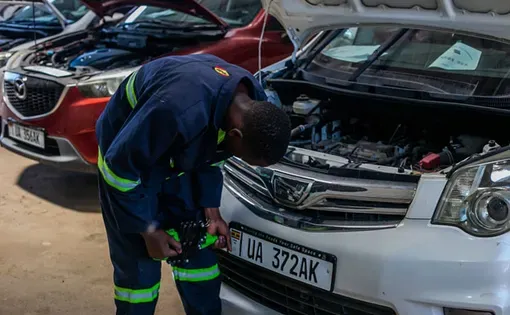
A Russian-supplied system provides digital number plates for motor vehicles.
When I pitched the idea of investigating Uganda’s new digital number plates as surveillance tools, I knew it was going to be one of the most difficult stories I would ever have to do. The plates are under an arcane system known as the Intelligent Transport Monitoring System (ITMS), which is owned by a shadowy Russian company called Joint Stock Global Security Company.
The company had been reported about extensively, but my task was to dig deep into the system and uncover how the plates fit into a larger surveillance system. I started by asking Ugandans who were critical of the new plates. The first person I reached out to on WhatsApp left my texts unanswered. It was understandable why the person did that—I was asking about surveillance on an online platform.
I consulted several people in security, transport, IT, and in the media industry. This was a mix of people I knew professionally and through third parties who helped me navigate this story. These people advised me on car mechanics, the latest technology embedded in cars, such as RFID chips, and how they integrate with CCTV surveillance systems, as happens in other countries.

So I began studying digital number plates in countries including the U.S., UK, China, and Russia, and how they have integrated motor vehicle movement with security. This helped me understand why, and later how, the ITMS was procured from the Joint Stock Company. This information came in handy on my field trips to sieve the technical aspects of digital number plates and how they fit into surveillance and automated systems in general.
I reached out to a police officer I know. Luckily for me, he was willing to talk to me about how the ITMS works. He was one of the first insiders I spoke to and he broke down some of the technicalities, such as teams working on it, its progress, the money component, and the control Joint Stock Company still has over it.
It occurred to me how ITMS had several moving parts that I had to coalesce into a coherent investigation to tell about the number plates.
My field visits with about two dozen boda boda riders, strangers, and motorists helped me understand how layered the ITMS system is and how the plates were merely the front end in a much larger arrangement that leaves data privacy on the edge. Armed with this realization, I did a piece-by-piece mapping of information I got in the course of my investigation.
A number of fellow journalists hinted at the possibility of the state using the tools to spy on Ugandans, since the CCTV network supplied by Chinese company Huawei already had Kampala’s public spaces on a 24-hour surveillance grid.
To learn more about the ITMS and how it works, I went scouting in Kawempe, north of Kampala, for an ITMS facility where most of the plates were being manufactured and fitted. It was here where I got my first real test of what I was up against: a wall of secrecy and privacy I had to climb before I could tell this story. The fact that boda boda riders did not know about the factory raised my eyebrows because they are usually in the know of such premises.
To my dismay, it was another dead end. This was surprising because the ITMS routinely made posts on X about this facility, but I could not find the factory on a field visit. My calls yielded nothing. My visit to Kawempe was not any different from my visit to the border areas of Malaba and Mutukula.
These are private facilities. But because of my experience as an investigative journalist, I know that some of the most critical nuggets of information are ones that you will land on by happenstance. Going on a mission hunt for the ITMS facility helped me detect how much power Joint Stock Company wielded privately and also over the government. Two communications officers of the Ministry of Works say they did not know the factory's location and could not help me book an appointment there in spite of it having oversight of ITMS.
I reached out to ITMS, and the communications officer initially seemed eager to speak to me, but he later stopped returning my calls.
However, I managed to find their offices in Kololo, an upscale neighborhood, but it was in a nondescript, colonial-style building in a gated community. These properties in Kololo—a hilly suburb—tend to be occupied by ministers, private organizations, and sometimes embassies. They are prized for their privacy.
It was a grueling investigation, but the level of secrecy compelled me to keep going: Information was hard to come by and people had little to no knowledge of how the number plates could be at the center of a state surveillance scheme. In the end, I had to rely on tracking government documents and building relationships.
Key takeaways
- Keep tabs on news stories, court rulings, and government documents related to your investigation. During my reporting, there was a court ruling compelling the Office of the President of Uganda to produce documents related to the Joint Stock Company, but the presidential office disregarded the court ruling.
- Meeting sources face-to-face is always helpful, especially when covering topics like digital surveillance.
- Consider everyone a potential source: strangers, co-workers, relatives, experts, politicians, regulators, journalists, whistleblowers, and students.
- Social media platforms are great open source tools. There are many people who share data and vital information on new number plates, such as a post on how one could scan the QR codes on the plates using their phone. It was after that when we learned the scan can only be done by the authorities. The official ITMS social media accounts run by Joint Stock Company were also flush with information.
- Interest in technology would serve any investigative journalist. I have been curious about AI and emerging technologies, which gave me a nuanced understanding of how the number plates function; for example, how Automatic Number Plate Recognition (ANPR) cameras use optical character recognition (OCR).