
Artificial Intelligence is being weaponised in Nigeria’s latest wave of Ponzi scams. Fraudsters now...
The idea for this investigation was born out of the collapse of the Crypto Bridge Exchange (CBEX) in April—a platform that vanished with over ₦1.3 trillion in investors’ funds after promising “AI-powered” trading and unbelievable returns.
Unlike many Nigerians, I was not much struck by the scale of the loss, but by how easily people had been convinced that artificial intelligence could double their money.
Although conversations centred more on how poverty and greed made people fall for the CBEX scam, a negligible factor was the lack of digital literacy. I discovered that, unlike previous schemes that had rocked Nigeria, CBEX had a sophisticated plan. The platform rode on the AI wave and touted itself as using AI for smart trading that guarantees high returns for investors. This prompted me to examine several Ponzi schemes that use AI hype to defraud unsuspecting citizens.
In Nigeria, many view AI as cutting-edge technology associated with innovation and financial opportunity. As a result, orchestrators of Ponzi schemes and their promoters rebrand age-old Ponzi structures as “AI-driven trading,” “AI-powered crypto arbitrage,” or “machine learning wealth platforms.” This language resonates with the aspirations of a digitally curious, yet economically vulnerable, population.
While many have heard of AI, most do not know how it works, and Ponzi scheme operators used an illusion to create faux credibility for themselves.

As a nonprofit journalism organization, we depend on your support to fund more than 170 reporting projects every year on critical global and local issues. Donate any amount today to become a Pulitzer Center Champion and receive exclusive benefits!
Reliance on OSINT
To uncover this ecosystem, I relied heavily on open-source intelligence (OSINT) and digital forensic techniques. I started by monitoring social media platforms like Facebook, YouTube, Instagram, and Telegram, where fraudulent investment advertisements were most active. I searched for posts and video ads using keywords such as “AI trading,” “AI arbitrage,” “AI-powered investment,” and “automated wealth platforms,” archived them using archive.today, and kept them in a separate document.

I noticed two major patterns: Some scammers used AI buzzwords to make their schemes look sophisticated and attractive, while others deployed AI-generated content, including deepfake videos and cloned voices, to deceive potential investors.
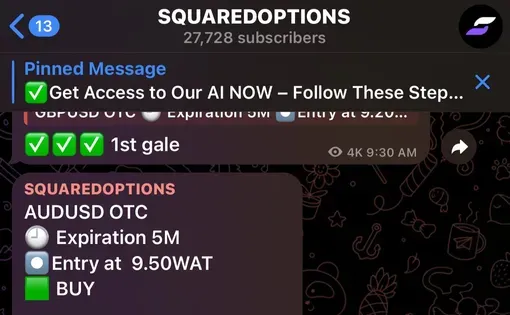
Once I had identified active schemes like SquaredOptions and Modmount, I tried to trace their ownership through domain tracing using tools such as who.is, which can list owner contact details and registration dates. I discovered that most of these sites were registered through privacy-protection services abroad — a sign of scam operations, though also utilized for some legitimate businesses. However, the website’s domains were also registered for a short time, which is not typical for a legitimate business. In addition, none of these platforms appeared in the Securities and Exchange Commission (SEC)’s database of licensed investment companies.
I then turned to digital communities such as Trustpilot, Reddit, and Telegram groups to trace user complaints, locate previous victims, and follow the schemes’ evolution across different countries. Several platforms that had been banned in Europe and Asia had quietly rebranded and resurfaced in Nigeria, taking advantage of the country’s lax digital oversight.
A crucial part of this investigation involved detecting AI-generated content. Using InVID-WeVerify, a digital verification tool, I extracted keyframes from suspicious video advertisements, such as those falsely portraying Peter Obi, Labour Party presidential candidate in Nigeria, and Nigerian lawmaker Saliu Mustapha endorsing fake investment platforms.
Reverse image searches revealed that the clips were doctored from old interviews and events. The tool was chosen for its reliability in breaking down videos into still images for closer analysis and facilitating reverse image searches to trace sources of videos.
For voice analysis, we combined human observations with AI-detection tools to check for traces of voice cloning and synthetic speech patterns, such as unnatural facial expressions and poor lip movement synchronization. Further verification on Loccus.ai, now Hiya, confirmed that several videos circulating on Facebook and YouTube, including one featuring a supposed TVC News anchor promoting a trading app, were AI-generated with almost 99% probability. Hiya creators say the platform has over 99% accuracy.
To understand how platforms like Meta and YouTube enabled these schemes, I examined their advertising policies on deceptive financial content. I then contacted Meta with evidence of the fraudulent pages and deepfake adverts. The company later confirmed that it had taken them down after our report — an admission that its existing moderation systems had failed to detect them earlier.
Throughout this process, verifying with my own experiences was key. I signed up on SquaredOptions using referral links posted by influencers and observed how their “AI signal groups” on Telegram operated. I received daily trading signals supposedly powered by “machine learning,” but all trades were routed through unlicensed brokers, a clear violation of financial regulations.
To protect myself during this investigation, I used a separate email account and phone number and avoided providing my correct personal information. These precautions were necessary to safely document how scammers solicit funds and data from unsuspecting users without compromising my own digital security.
Conclusion
This investigation revealed that AI has become the new disguise for old scams. Scammers now use AI to rebrand, scale, and automate deception. Reporting exposes both the ingenuity of fraudsters and the regulatory gaps and tech platform failures that allow them to thrive. Many of the adverts and videos I found had been running for weeks before they were eventually pulled down. By then, thousands of people had already signed up.
But beyond poor regulation, there’s a bigger issue: Many people still don’t understand how AI really works. Scammers take advantage of that gap. They use fake videos, cloned voices, and AI buzzwords to make their schemes believable. There is a need for more enlightenment and media literacy.
Key takeaways or tips for journalists
1. Preserve your evidence
Throughout the investigation, I made sure to archive all links, videos, and other materials used as evidence. The tool archive.today was particularly useful in preserving this content. Even after Meta took down some of the flagged posts and adverts, they remained accessible through their archived versions. This approach not only safeguarded the evidence but also helped me to avoid referencing direct links to fraudulent websites or giving their websites more traffic.
2. Use digital investigation tools
Investigating digital scams today requires both human observation and open-source tools. Verifying claims, tracing domain registrations, and spotting digital inconsistencies are now as essential as interviewing sources.
3. Don’t rely solely on AI-detection tools
Most AI-detection tools today are not 100% accurate in identifying AI-generated content. Always cross-check results through manual verification methods such as examining facial movements, lip-sync consistency, or spotting re-used footage to avoid drawing false conclusions.
4. Protect yourself while engaging with scammers
As a reporter investigating scams, always ensure you protect yourself in order for scammers not to harvest your information. Use burner emails and VPNs, and don't use your personal information when signing up or communicating with operators.
5. Share your findings with platforms and regulators
Sharing my findings with Meta helped us in achieving a bit of preliminary impact for this story, as all of the fraudulent ads referenced in the story were removed by the platform. This prevents people from coming across them on the platform.