Story
 October 15, 2026
Are Rhode Island’s Beloved Quahogs Disappearing? Shellfishermen Think So.
Country:

Are pollutants impacting shellfisheries?
WARWICK, R.I.— Rhode Islanders are proud of our quirks: coffee milk, bubblers, any drive longer than 15 minutes is a road trip and, of course, stuffies.
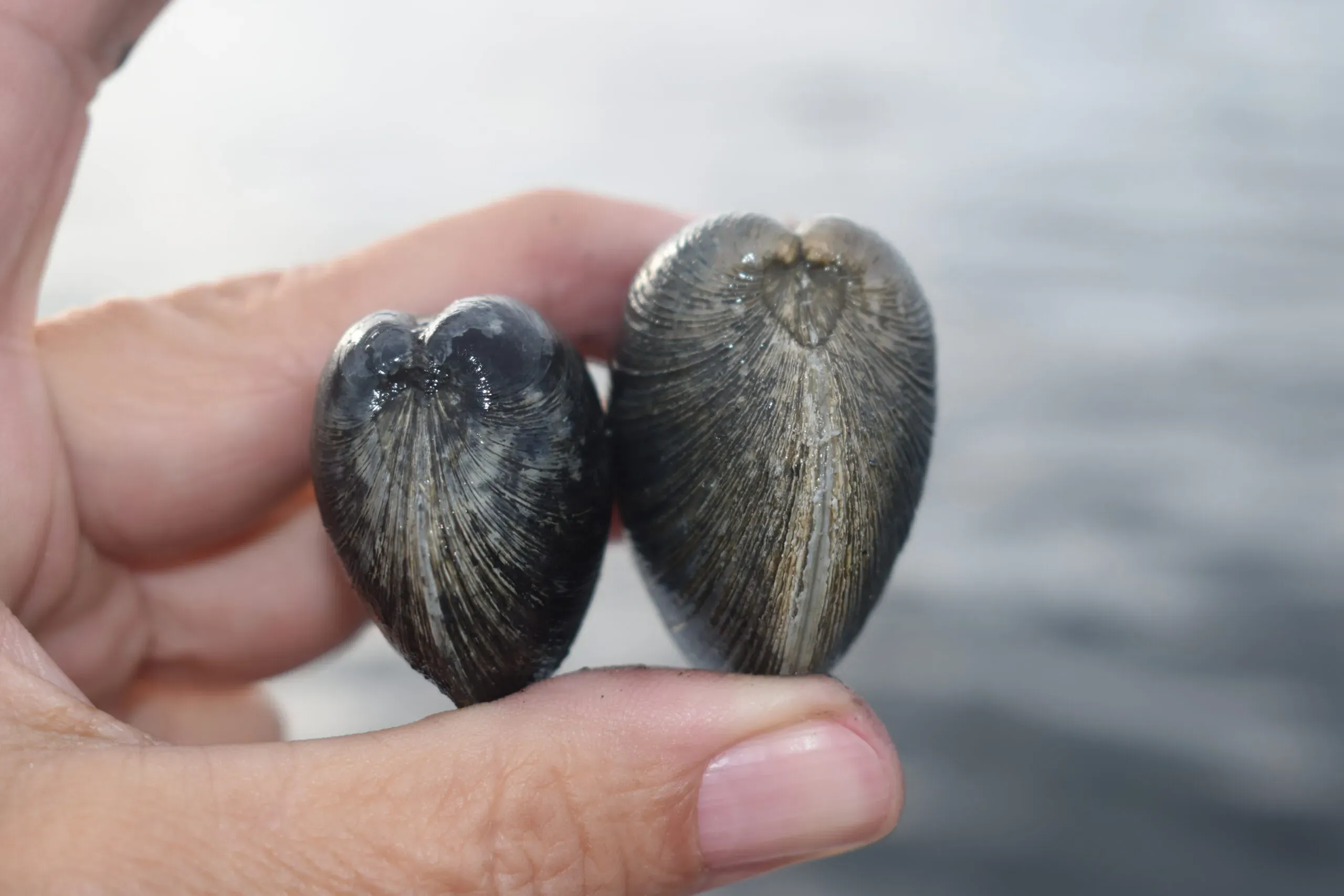
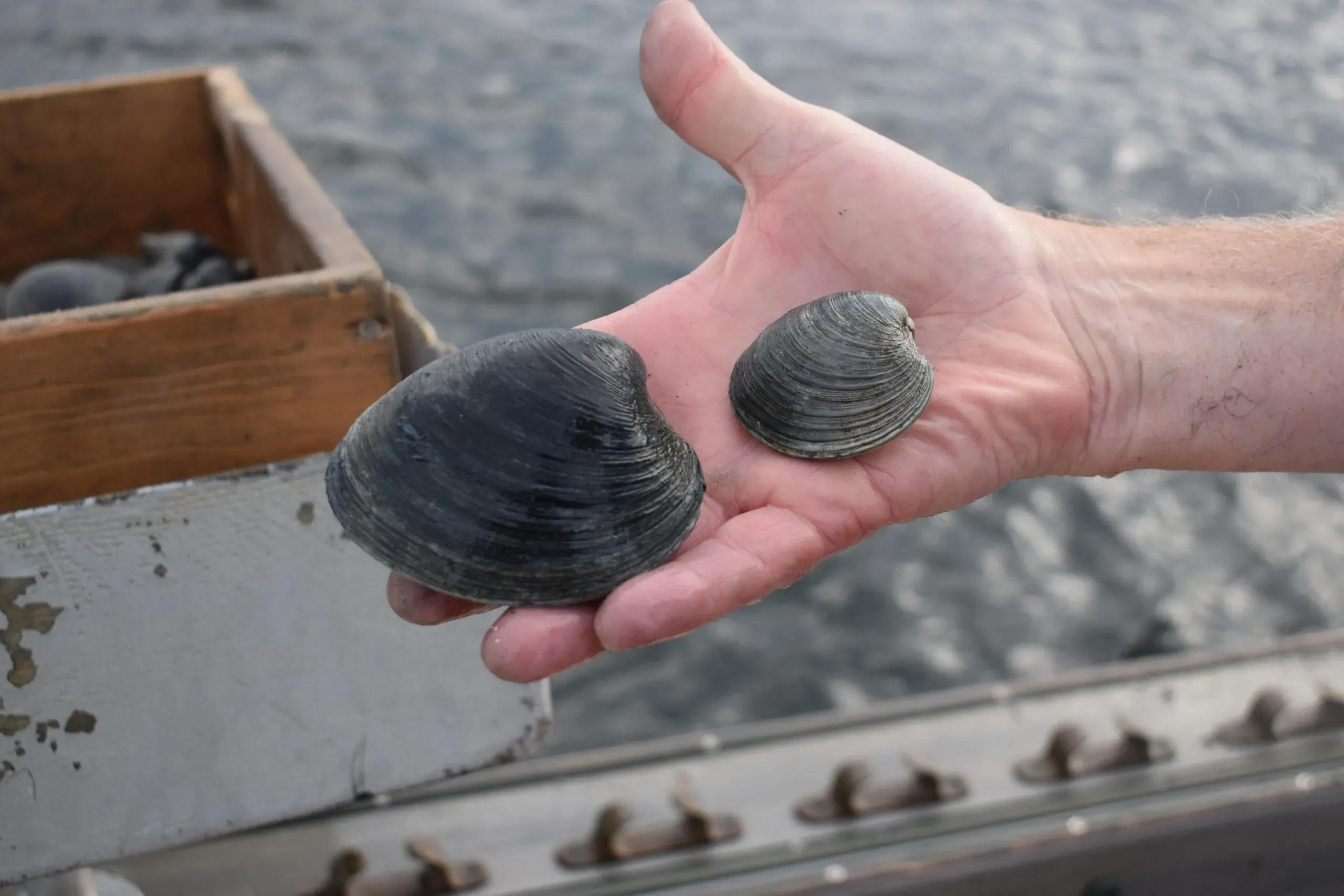
A larger, meatier version of a stuffed clam, a stuffie is made with quahogs, the official state shellfish, a hard-shell saltwater mollusk whose name comes from the word “poquauhock,” a Narragansett Indian Tribe term for the clam.
Every seafood restaurant in the state worth its salt has stuffies on the menu, and they’re so synonymous with the Ocean State that tourism officials spent $4.5 million to put 7-foot tall, three-dimensional stuffie installations in airports across the country with direct flights to T.F. Green International Airport.
As a nonprofit journalism organization, we depend on your support to fund more than 170 reporting projects every year on critical global and local issues. Donate any amount today to become a Pulitzer Center Champion and receive exclusive benefits!
Rhode Islanders’ right to harvest quahogs is baked into the state Constitution, and the clam is deeply tied to local history, culture, and cuisine.
But what happens if there are no more quahogs?
‘Substantial reduction’
“They’re in deep trouble,” said Jim Boyd, a retired coastal policy analyst for the Coastal Resources Management Council, a board member of the Rhode Island Shellfisherman’s Association (RISA), and a longtime quahogger.
“Quahog landings are down 70% since 2012,” he said. Department of Environmental Management data show that landings have dropped from a peak of 4 million pounds (more than 39 million clams) in 1982 down to roughly 397,442 pounds (about 17.7 million clams) by 2022. In its harvesting heyday, Rhode Island provided around 30% of the national market for quahogs; now, that figure is around 9%, Boyd said.
Back then, Boyd said, “Our industry was making landings of like $15 million a year. Last year we had landings of $3 million. That’s a pretty substantial reduction, right?”


According to shellfishermen such as Boyd and Michael McGiveney, RISA’s president, wild quahogs have all but vanished from lower Narragansett Bay, with the bulk of the population clustered now in Greenwich Bay, upper Narragansett Bay, and the lower Providence River, which was opened to shellfishing in 2021 after being closed for about 75 years. According to DEM data, in 2022 the lower Providence River was responsible for 60% of all quahog landings in the state.
A 2016 study by the agency examined where and when quahog larvae spawned and showed overwhelming concentrations of quahogs spawning in Greenwich Bay and upper Narragansett Bay, and relatively few in waters south of Prudence Island. Data from DEM for 2020 show that areas closed or prohibited to fishing are significant sources of quahog larvae throughout Narragansett Bay.
Like most organisms, quahogs go where the food is. As bivalve filter feeders, they pump water through their bodies, filtering their favorite food: microscopic plants called phytoplankton. The amount of phytoplankton in the bay at any given time, meanwhile, depends on how much nitrogen and other nutrients are in the water.
For a long time, Narragansett Bay had elevated levels of nitrogen in its waters, primarily from the 11 wastewater treatment facilities that piped effluent into the bay. While that might be good for phytoplankton, excessive nitrogen loading lowers dissolved oxygen levels and causes fish kills like that in 2003, which saw a million menhaden die.
Concerned over the levels of nitrogen in the bay, the General Assembly in 2004 passed a law requiring DEM to cut nitrogen loads from the treatment plants by 50% by the end of 2008. DEM set a 5 mg/L nitrogen discharge limit for May through October, aimed at reducing hypoxic events like that Greenwich Bay fish kill from 23 years ago. The limits took effect in 2005, and the 50% goal was met in 2012.
As a result, Narragansett Bay is cleaner than it has been in more than a century.
But quahoggers say the bay is too clean, and it’s greatly impacting the number of wild quahogs and their bottom line.
Boyd, McGiveney, and RISA vice president David Ghigliotty testified in 2024 before a legislative commission tasked with studying declining quahog landings. They noted that nitrogen discharge reductions have gone well past the 50% target: average reduction from 2020 to 2022 was 78% of early-2000s levels.
Regardless of the cause, shellfishermen are concerned about shrinking quahog landings, and that concern was palpable at the Oct. 7 meeting of the Rhode Island Marine Fisheries Council’s Shellfish Advisory Panel to set the following year’s shellfishing schedule.
“When we pull up a rake of dead clams, we get anxious,” one quahogger said.
“Everybody’s doing the science, but we’re not getting answers,” another said.
“This industry is declining rapidly, and if it continues at this rate, we’re not going to have a quahog industry at all,” Boyd told ecoRI News.
On the boat
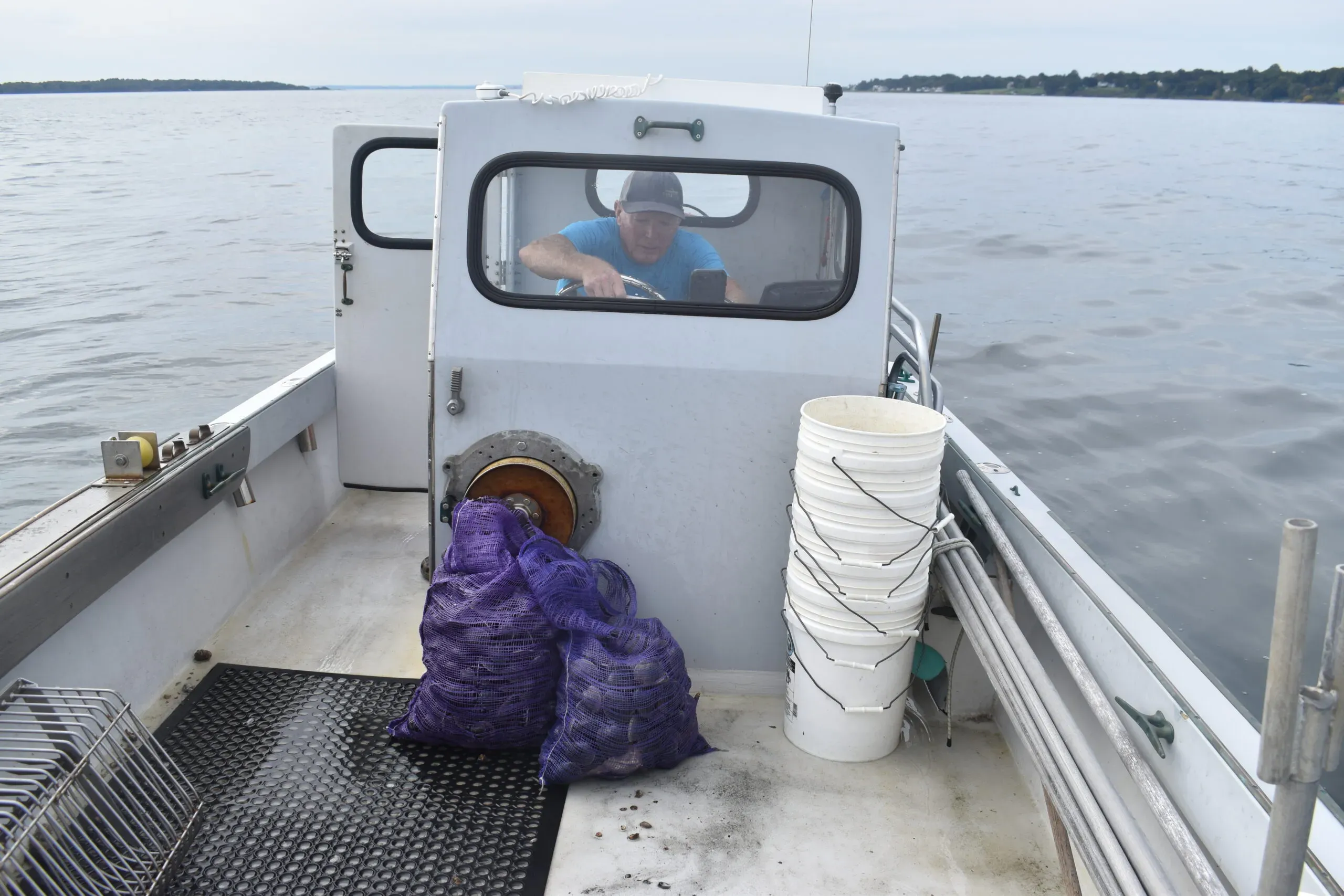
On the days when he’s quahogging, Boyd, 69, is on his 20-foot fiberglass boat docked in Warwick by sunrise.
On this September morning, he’s heading out to Area 1B in Narragansett Bay, classical music spilling from the boat’s radio.
“I’ve got salt water in my veins,” he said with a grin.
Rhode Island designates its shellfishing areas through a sanitary classification system run by DEM’s Office of Water Resources, under the FDA’s National Shellfish Sanitation Program, which allows shellfish caught in state waters to be sold across state lines.
The state is divided into 17 quahog growing areas and sub-areas, including Greenwich Bay, Narragansett Bay’s West Passage, and Mount Hope Bay. Area 1B is located in the bay between Rocky Point in Warwick and Colt State Park in Bristol.
The areas’ openings and closings are dictated by weather and the seasons. Some areas close for seven days after half an inch of rain in 24 hours, while others close at 0.8 inches and at 1.2 inches, with 10-day closures above 3 inches.
Hurricanes, extreme rain, algae blooms, oil spills, and sewer overflows can close shellfishing areas at any time. A sewer overflow means at least 21 days closed, unless shellfish testing clears the area sooner, further limiting the meager number of days allowed for shellfishing in some state waters.
Responsibility for managing shellfishing is divided among state agencies: DEM’s Office of Water Resources classifies and monitors the water; DEM’s Division of Marine Fisheries writes the harvest rules; the Department of Health regulates shellfish sales and does lab analysis; and CRMC oversees and inspects aquaculture farms.
Water classification is separate from harvest rules. Classification decides whether water is clean enough to harvest from, and the Division of Marine Fisheries then sets the rules covering seasons, size limits, and catch limits within that open water. No harvesting is allowed between sunset and sunrise.
Each shellfish management area has its own schedule. Some are open daily, some are closed outright, and some have limited seasons. Commercial harvest in the Providence and Seekonk rivers follows a specific 2026 calendar of two-hour windows from May through December. The area closes once it has been open 54 days between May and October.
The B in Area B stands for “barren,” Boyd joked, adding that while he was hopeful for a good haul, he wasn’t expecting much during the four hours of raking he was allowed on this day.
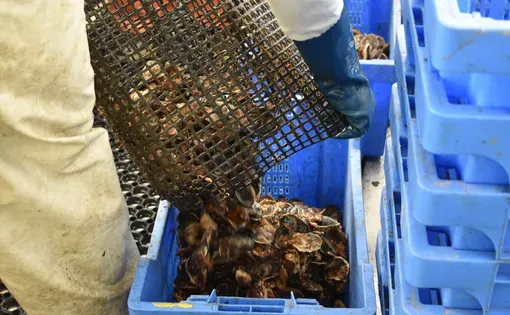
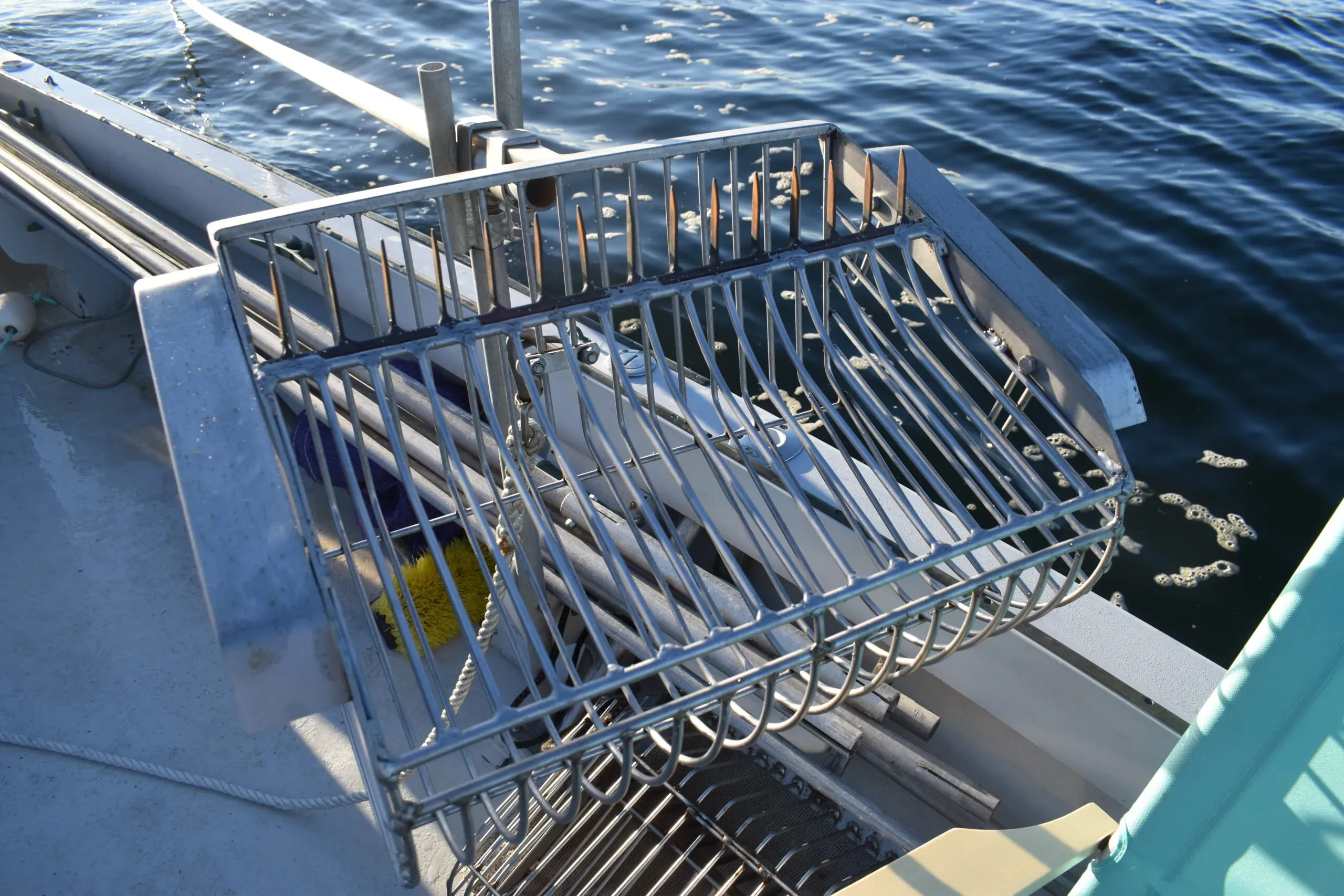
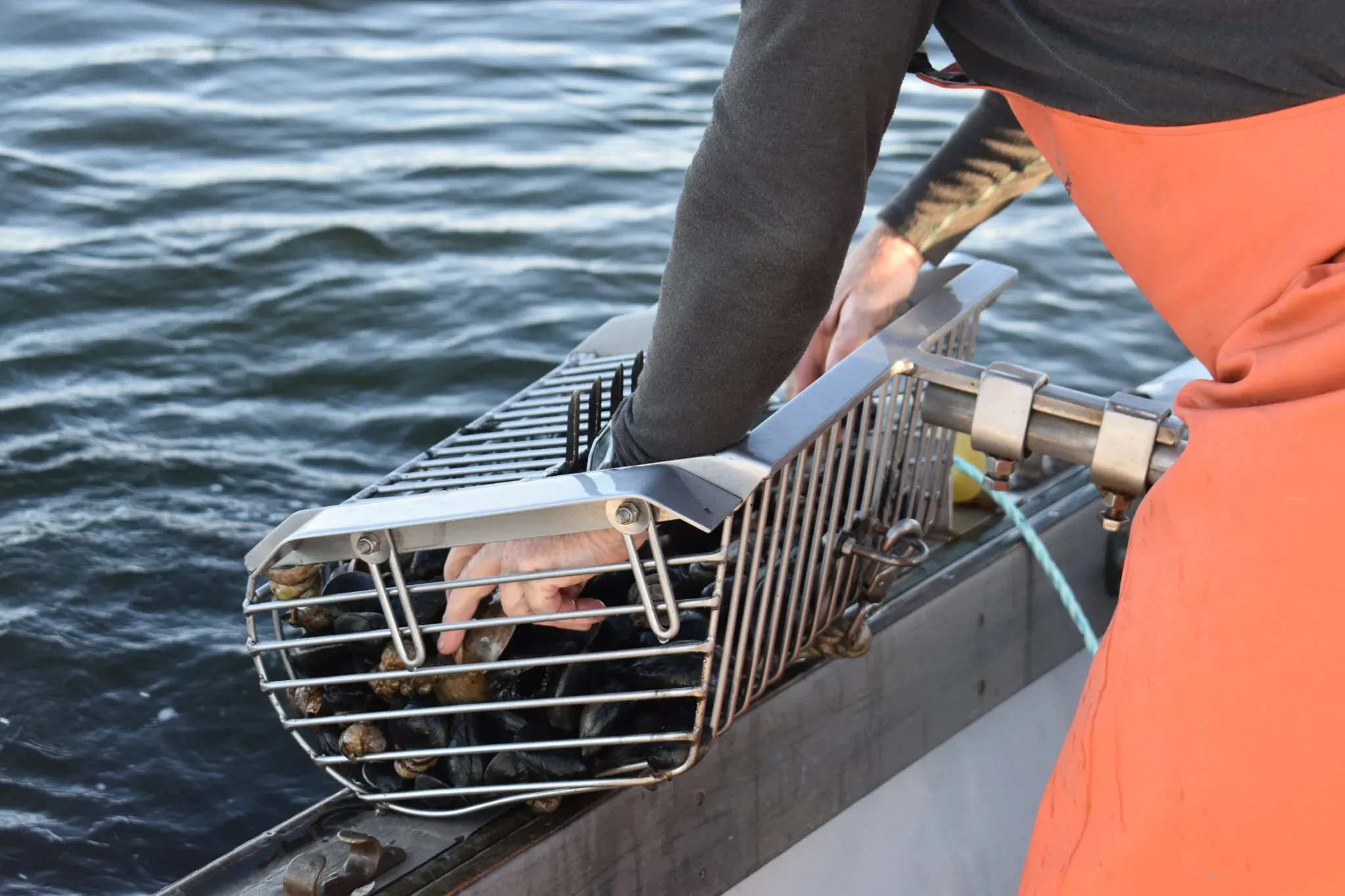
Most quahoggers use bull rakes attached to long hollow poles, or “pipes,” to scrape the bottom of the waterbody. The rake’s teeth pull the quahogs into the attached cage, which is then hauled up either by hand or hydraulics and dumped into buckets to be sorted. Boyd said the average price of a stainless steel bull rake is $550.
The pipes’ length can be adjusted based on the depth of the water, and on this day Boyd was using a 48-foot pipe. Gripping the T-handle on the end, he used a vigorous push-pull motion to scrape the rake along the sand.
“You’ve got to be able to cover the bottom,” he said.
Boyd said he prefers not to anchor his boat, instead letting the boat drift with the current and the wind. This allows him to use the boat’s drift to drag the rake along the bottom, rather than pulling it.
“It’s best when the wind and the tide work together” to move the boat, he said. When it’s “wind against the tide,” it’s more difficult.
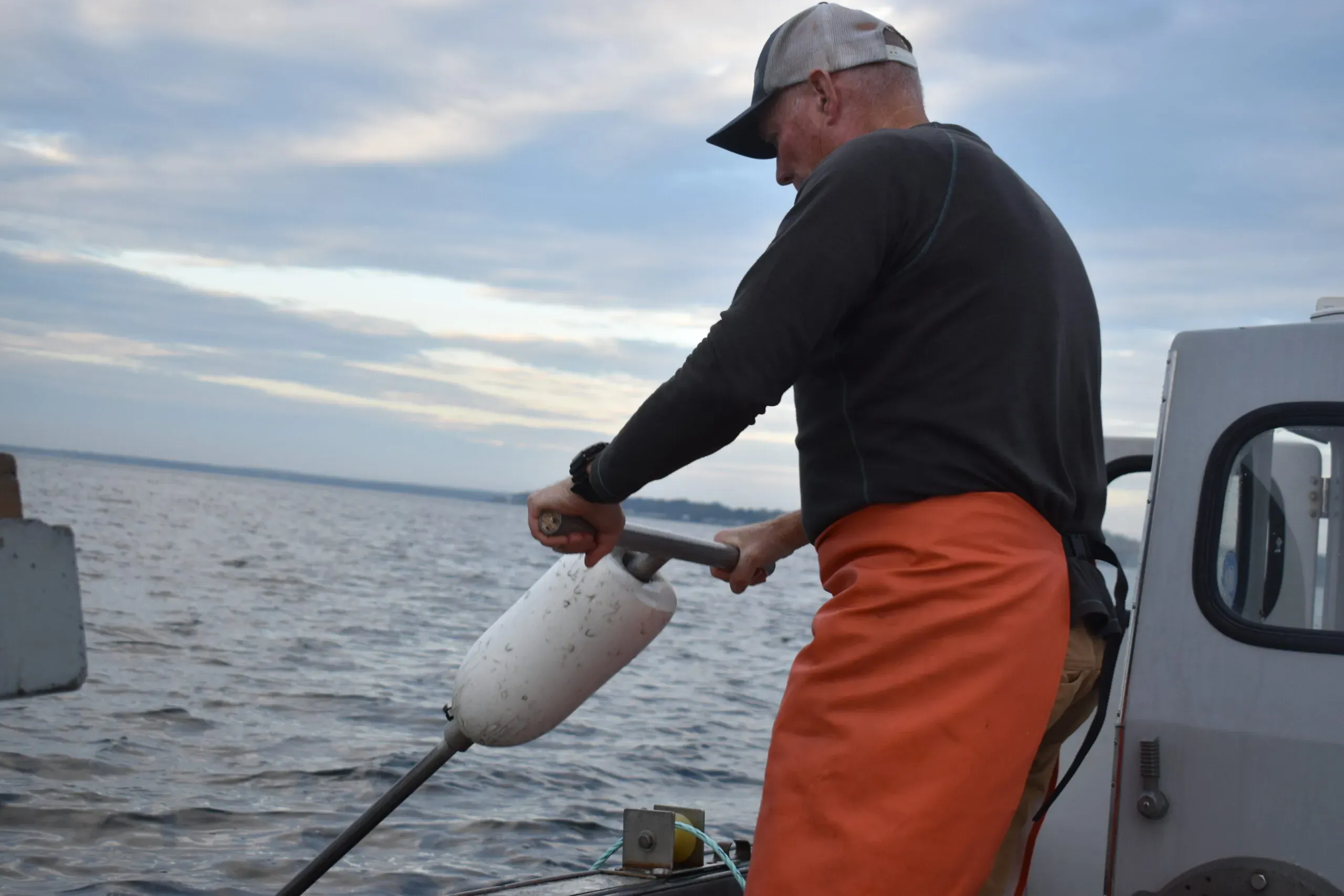
“If you’re drifting, you want the rake and handle in front of you and the boat to be moving away from the rake,” he said. “It’s a balancing act between the tides and the wind. You’re constantly calculating whether to stay or move, based on conditions.”
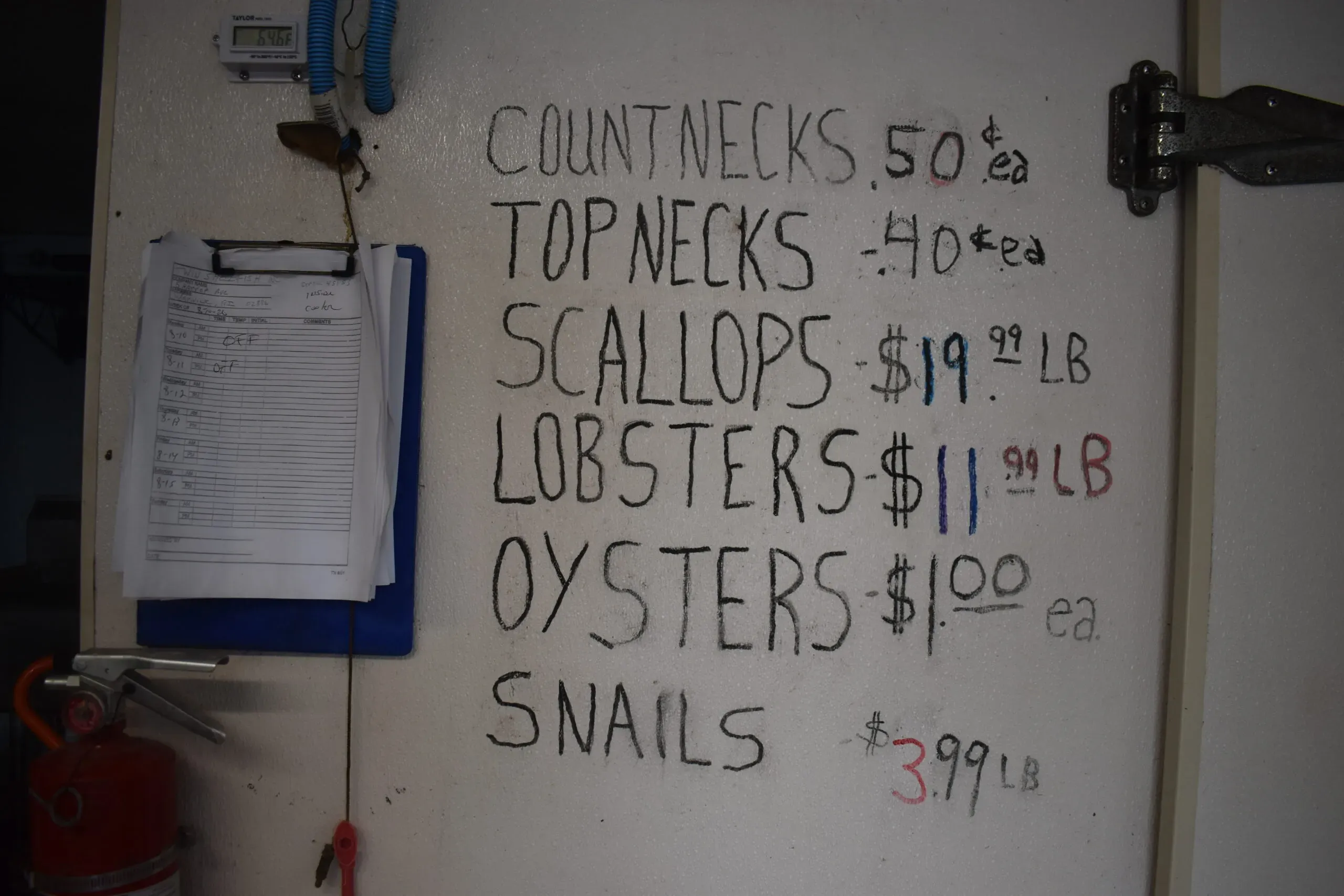
Each time he pulled up the basket he assessed the haul. Quahogs’ value is based on their size: littlenecks (the smallest, often eaten raw on the half shell) are the best, followed by topnecks and cherrystones (intermediate), and then chowders (the largest, used for chowders and stuffies).
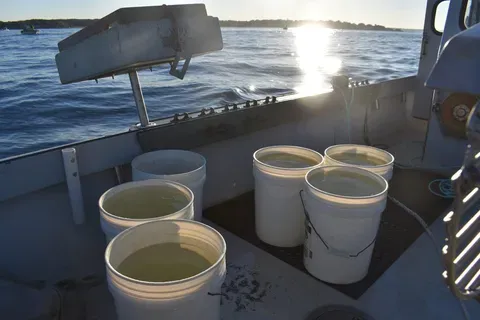
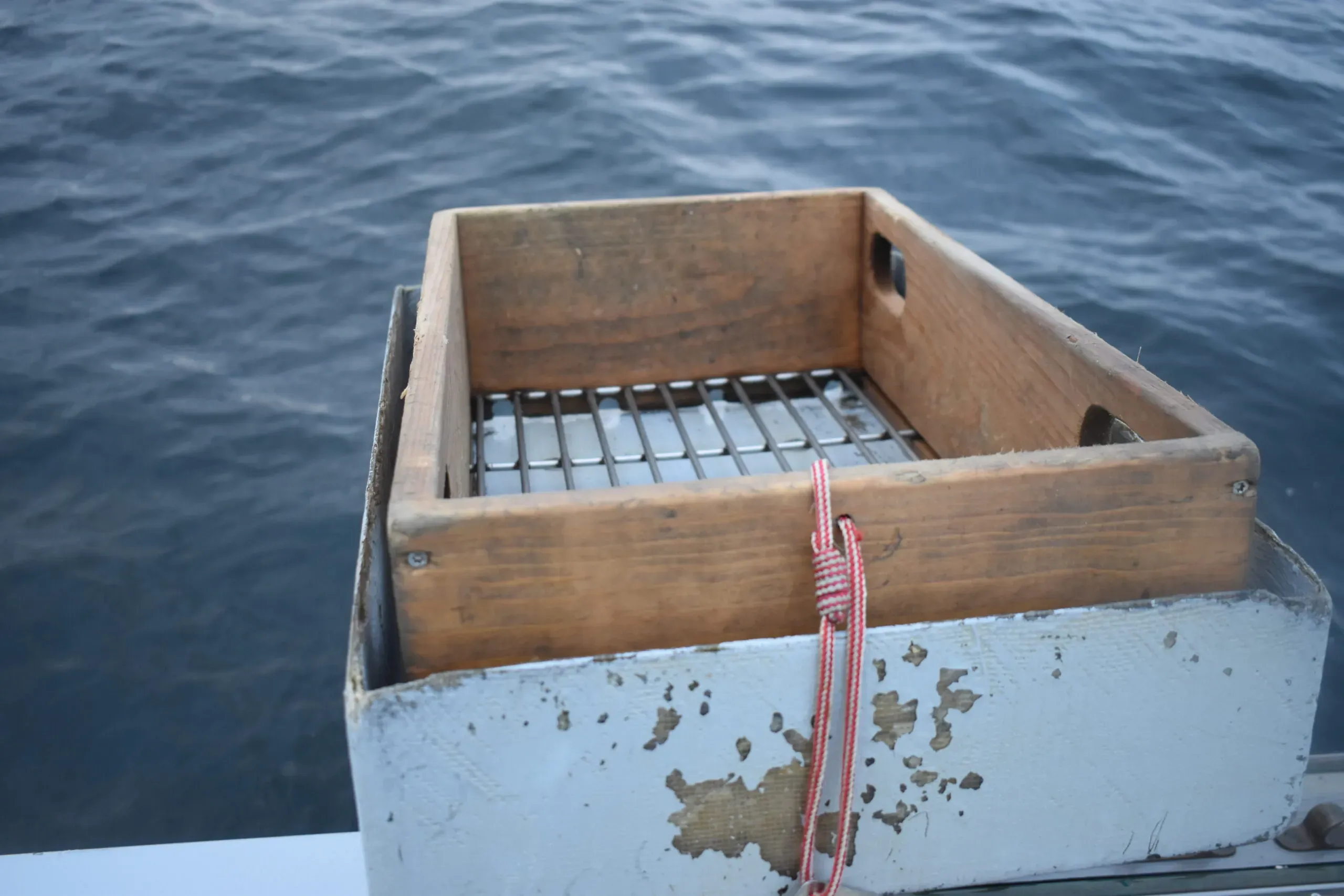
Once he had a basket full of clams, he would dump it into a sorting tray attached to the starboard side of the boat. The tray has roughly 1-inch gaps between the metal bars, allowing clams that are smaller than the 1-inch minimum length at the shell’s hinge to fall through. Moving quickly, he moved littlenecks into one bucket and topnecks into another, before sliding the rake back into the water.
“It’s definitely physical work,” he said, the boat rocking beneath him with each pull of the rake.
An uncertain future
And the workforce is aging. The average age of shellfishermen in Rhode Island is the mid-60s, according to RISA.
The largest group of commercial shellfish license holders, 124 people, is aged 63–70, and 62% of the fleet is 56 or older, according to RISA. Only 8% are younger than 26. In 2022, 79% of license holders fished fewer than 52 days a year.
State residents don’t need a license to harvest shellfish recreationally, as dictated by the Rhode Island Constitution. Non-residents need one of three licenses: a 14-day license ($11), an annual license ($200), or a $25 license for non-resident property owners.
Commercial harvest requires a commercial fishing license, the catch can be sold only to licensed dealers, and commercial harvesters must also complete an online education course and renew the license every five years.
For those shellfishing outside management areas, the daily catch limits are ½ bushel for residents, 1 peck for non-residents, 12 bushels for standard commercial licenses, and 3 bushels for student and 65+ licenses. If fishing inside a management area, the limits are 1 peck for residents, ½ peck for non-residents, and generally 3 bushels for commercial harvesters.
Boyd said it generally takes about 10 minutes of raking to fill the cage with quahogs. A full cage can weigh up to 80 pounds and is called a “bar shot” because the cage is full to the top bar. Some hauls yield a nearly full cage, while others have fewer quahogs. At a rate of five or six hauls an hour, four hours of harvesting yields around 24 hauls, he said.
On the day he was harvesting in Area B, Boyd’s haul was under the 3-bushel limit. Five mounded buckets of quahogs are equal to 3 bushels, he said.
Boyd estimated there were 15 quahog boats working Area B that day. In the boom days of the 1980s, as many as 2,000 boats could be found in the water on any given day.
“If you’re depending solely on quahogs to make a living, it is extremely difficult because the quahog populations in the bay presently are so depressed below Rocky Point,” he said. “You’re not making that much money. There’s really not a future for the full-time quahogger.”
The nitrogen question
Candace Oviatt, a professor emerita at URI’s Graduate School of Oceanography, has studied nitrogen levels in the bay and their effects on shellfishing for decades. She testified before the Legislature’s quahog commission in 2023 and said cutting nitrogen pollution cleaned up Narragansett Bay, but may have left quahogs in the upper bay underfed.
Oviatt said that since the 50% reduction, shellfishermen have reported fewer quahogs in some areas of the upper bay, with some in poor condition or dying. Quahogs in the upper bay are now in better condition, she found, but clams recovered from spawning faster in nutrient-rich areas like Greenwich Bay and the Providence River than in the upper bay.
A Rhode Island Sea Grant study suggested that a stronger winter-spring phytoplankton bloom improves hard clams’ reproductive potential. Recent research also shows that most quahog growth in the Northeast happens in spring and fall, after blooms.
Hypoxic events, such as the Greenwich Bay fish kill, happen when there isn’t enough oxygen in the water to sustain life, whether fish, shellfish, or plant.
Oviatt recommended the three large wastewater plants on the Providence River release nitrogen in winter to support a winter-spring phytoplankton bloom in the upper bay. Although the main concern with adding nitrogen is summer hypoxia, Oviatt said her data suggest this wouldn’t be a problem: days of summer hypoxia have trended lower since the nitrogen reductions began, and the storm-driven nutrient pulses of 2010 and 2018 didn’t cause more hypoxia than other summers without heavy rain.
RISA, in its testimony and report to the study commission, also recommended DEM change the discharge permits for the three plants on the river (Bucklin Point and Fields Point, owned by the Narragansett Bay Commission, and the East Providence plant, owned by the city) so they release more nutrients to fuel winter-spring blooms.
But, Oviatt cautioned, that wouldn’t be a long-term fix for the problem of declining landings.
“It’s not a long-term possibility,” she told the study commission. “As the waters [of the bay] get warmer and we experience more global climate change, there may be no more winter-spring [plankton] bloom.”
And the decrease in quahog landings pre-dates the bay’s cleanup, which has researchers questioning whether more nitrogen in the bay would be a long-term solution.
Robinson Fulweiler, a professor and researcher at Boston University, outlined for the study commission just how much has changed over the years in Narragansett Bay.
“I cannot in good science say that the decrease in productivity in Narragansett Bay is being driven solely by nitrogen,” Fulweiler said. “The decrease happened before that.”
The study commission’s final report recommended an increase in the number of quahog transfer and seeding programs, including a shellfish hatchery for quahogs and other shellfish restoration efforts, and more monitoring, but stopped short of recommending adding more nitrogen to the bay.
Currently, RISA works with Roger Williams University and the DEM to seed quahogs in the bay, and also works with the DEM and the Narragansett Bay Commission to transplant quahogs in the state.
Back on the boat
A few weeks after his visit to Area B, Boyd was back in his boat, this time heading to Area 16E in the Providence River. The area, which was opened to shellfishing in 2021 and is known for better yields, had just reopened after being closed after a heavy rain, and quahoggers had a two-hour harvesting window from 8-10 a.m.
Boyd’s VHF radio was crackling with the chatter of quahoggers getting their boats into position before the 8 a.m. start time. Each quahogger seemed to have their own preferred location, with some closer to shore and others further out. On this day there were more than 115 boats on the water, Boyd estimated, compared to the 15 or so in Area B, and the seas were rough from the boats’ wakes as they sped into position.
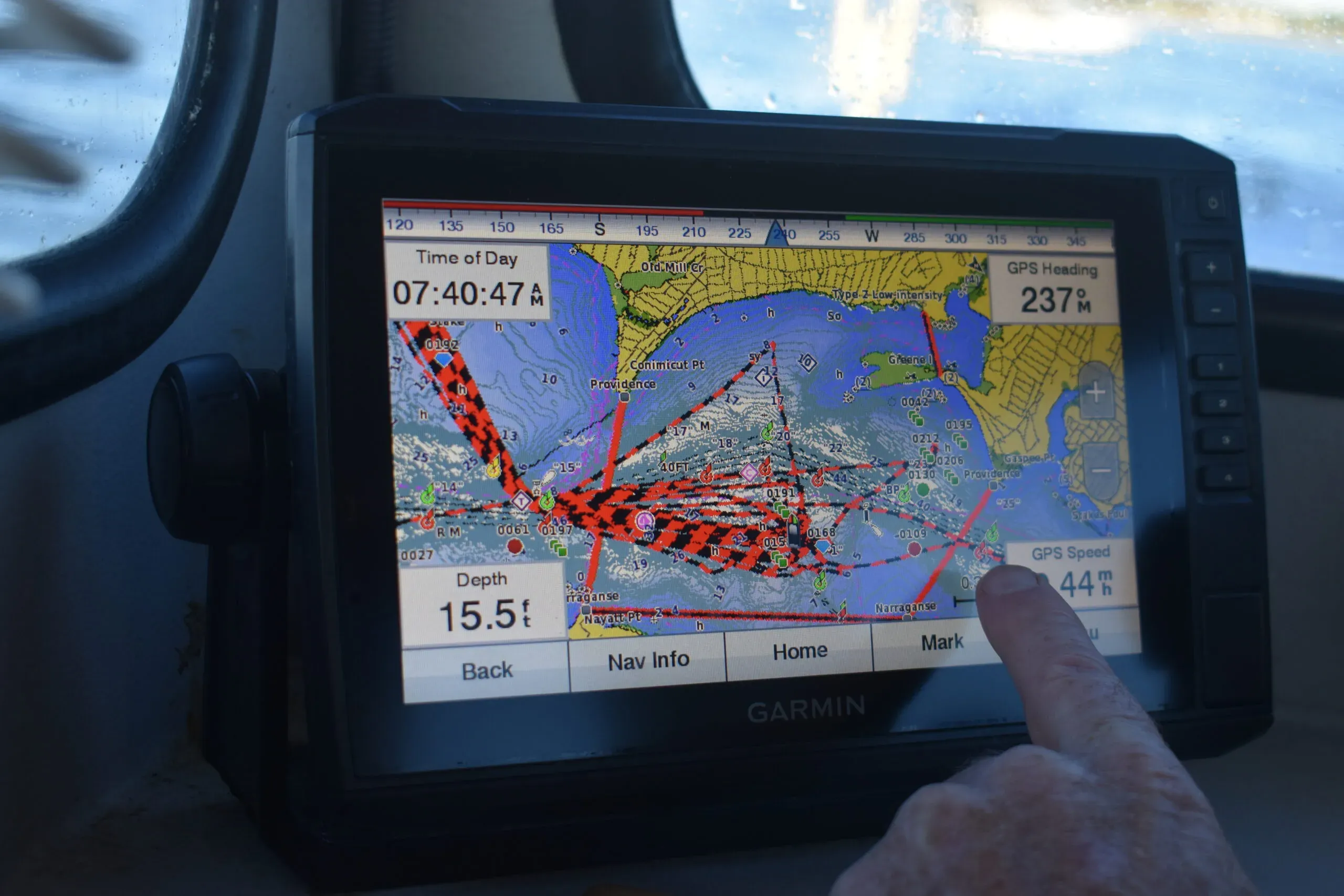
As the start time approached, quahoggers – some clad in the ubiquitous Grundéns waders, others in jeans or shorts – checked their rakes and sorting equipment, getting everything ready to go.
“It’s going to be fast and furious,” Boyd said. “We’re getting dialed in.”
At 8 a.m., Boyd’s rake went into the water. The temperature was around 40 degrees, with little wind and calm water once the wakes had died down. But that was expected to change soon.
His first haul yielded a nearly full cage, and Boyd was pleased. He shook the cage over the edge of the boat a few times, pulled out a few empty shells and other bits of detritus, and dumped the load into a bucket of seawater, getting the rake back into the water as soon as possible.
“It’s throw and go,” he said. “You’ve got to be as efficient as possible to meet the 3-bushell limit in the time allowed.”
After the third or fourth haul, Boyd was dissatisfied and decided to move the boat to a new position because his rake was picking up “too much junk.” He also lengthened his pole.
Adjustments like these make a big difference, and the next few hauls had Boyd smiling again.
“You can’t afford to make mistakes with your setup,” he said. “This already feels better.”
Around 9:30 the wind shifted to the west/southwest, and Boyd noticed the change almost immediately.
“This is not ideal,” he said, noting how the shift meant the wind was pushing the boat and working against his rake instead of with it.
At 9:53, with 7 minutes to go, Boyd turned his boat into the wind, hoping to get a few more hauls.
With a DEM boat cruising the perimeter, the quahoggers pulled their rakes at 10 a.m. If they hadn’t sorted their hauls yet, they had about 45 minutes left on the water to do so, Boyd said.
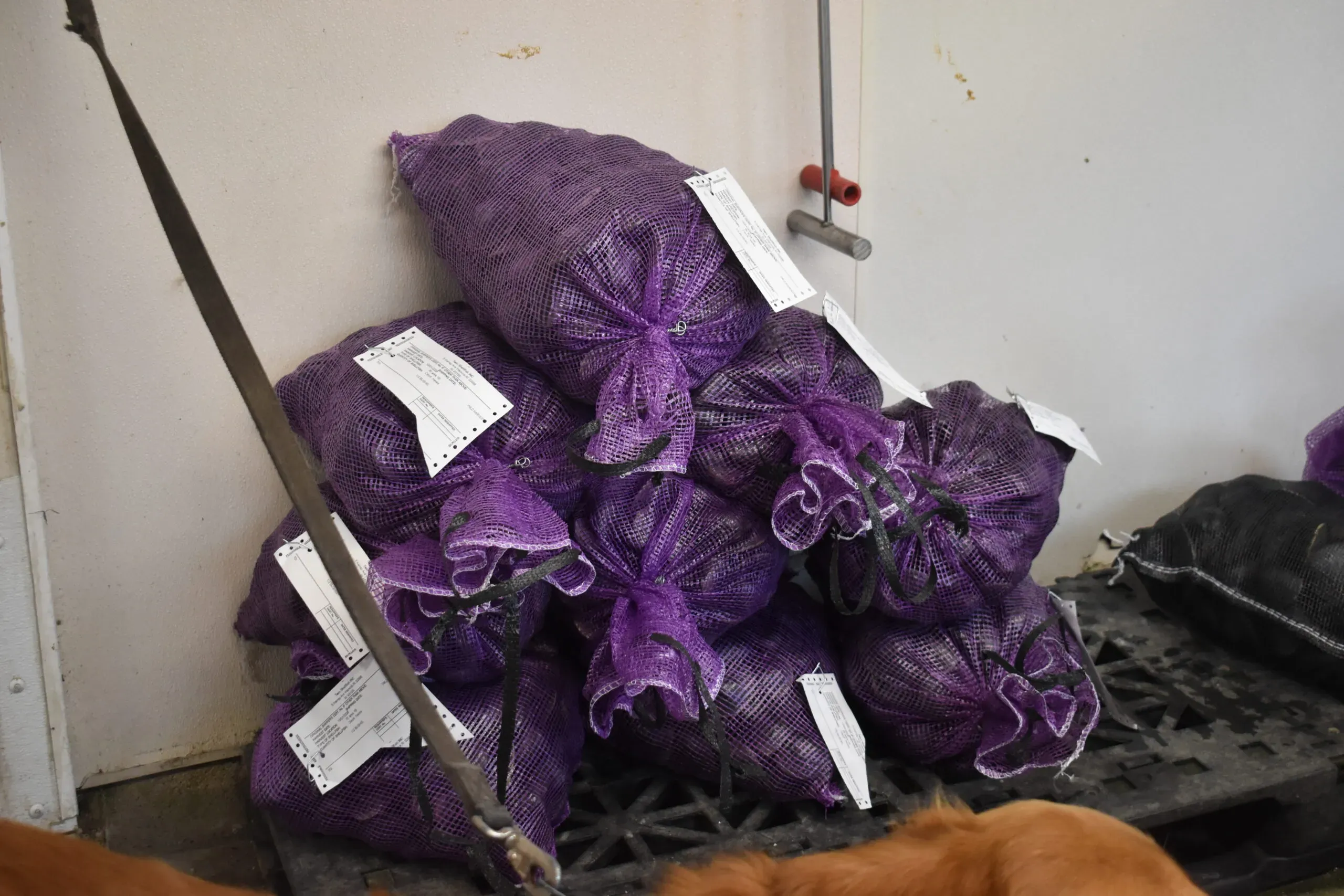
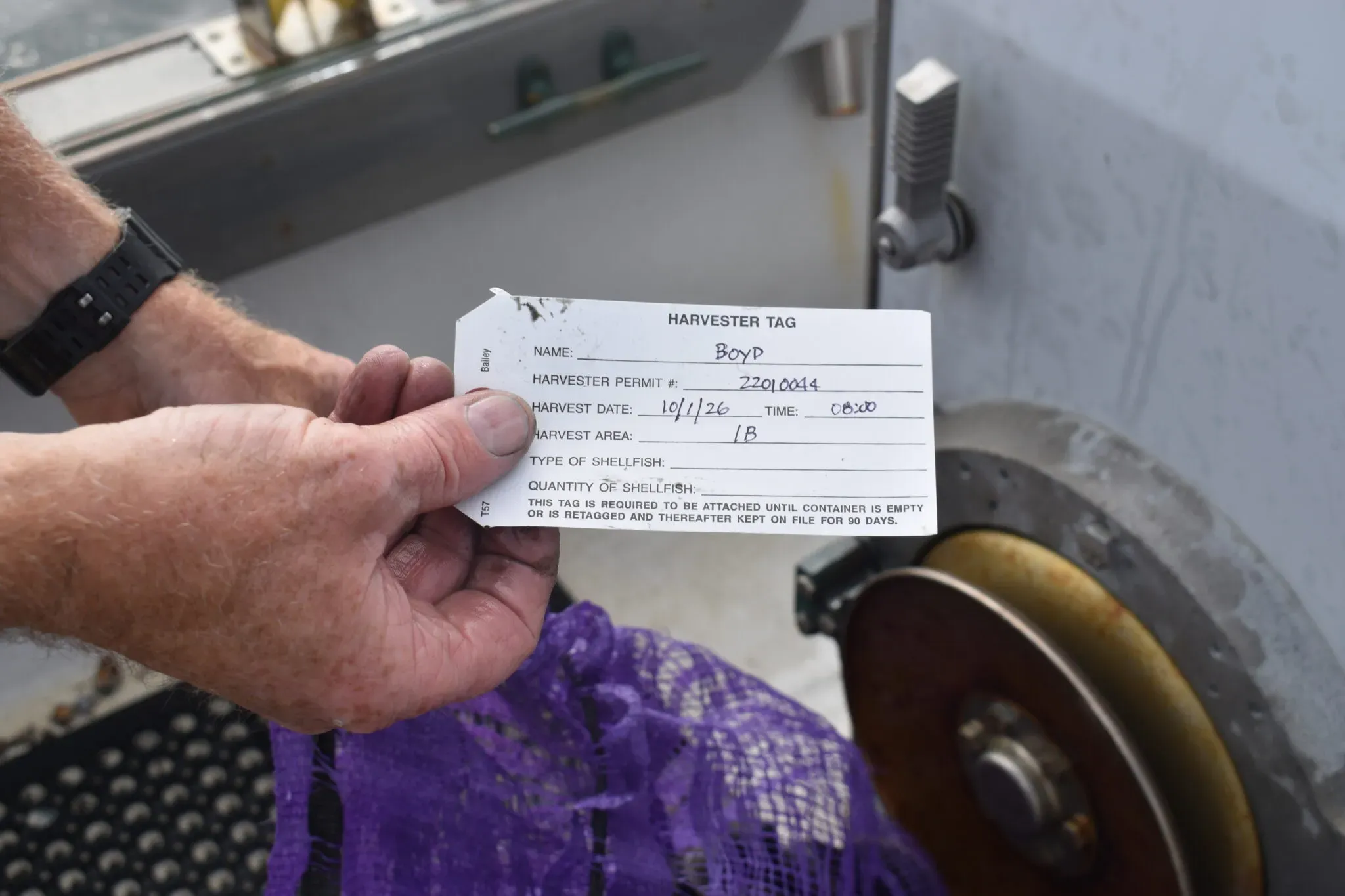
After sorting the clams in his sorting rack, Boyd transferred the clams to purple mesh bags, inserted a state-required harvest tag with his name and the date and location he’d caught the clams, and then headed back to the marina.
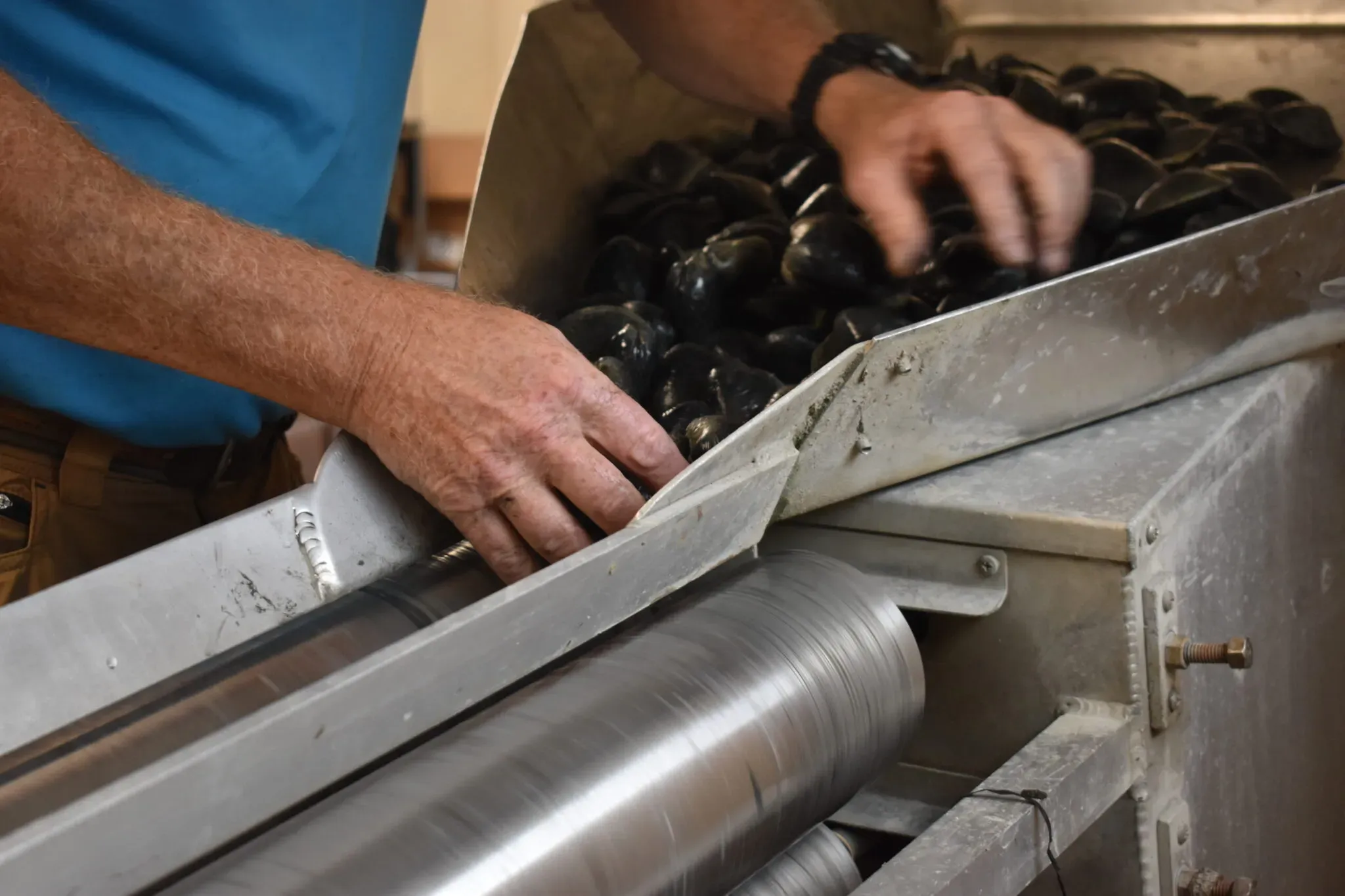
He would bring the clams to be sorted into separate bags by size at Twin Shellfish, just down the road from the marina in Warwick. Started by twin brothers Tim and Marty McGiveney in 2005, the store buys product from about 20 shellfishermen and distributes it.
The price for littlenecks that day was 29 cents, down from the 34 cents that was offered for his Area B haul. The price had lowered, Boyd explained, because the Providence River location had reopened after a heavy rainfall and a bigger haul was expected from the shellfishermen.
Boyd was pleased with the day’s catch. He’d make more money today, he said, than he made during four hours harvesting in Area B.
“You work as hard as you can as best you can, and then you go home and be grateful for what you caught,” he said.