Story
 July 12, 2026
National Park Service ‘Pauses’ Kalaupapa Tours After One Trip
Country:

Project
Whose Kalaupapa?
Journalist Mia Anzalone explores the future and legacy of Kalaupapa, a peninsula on the northern...
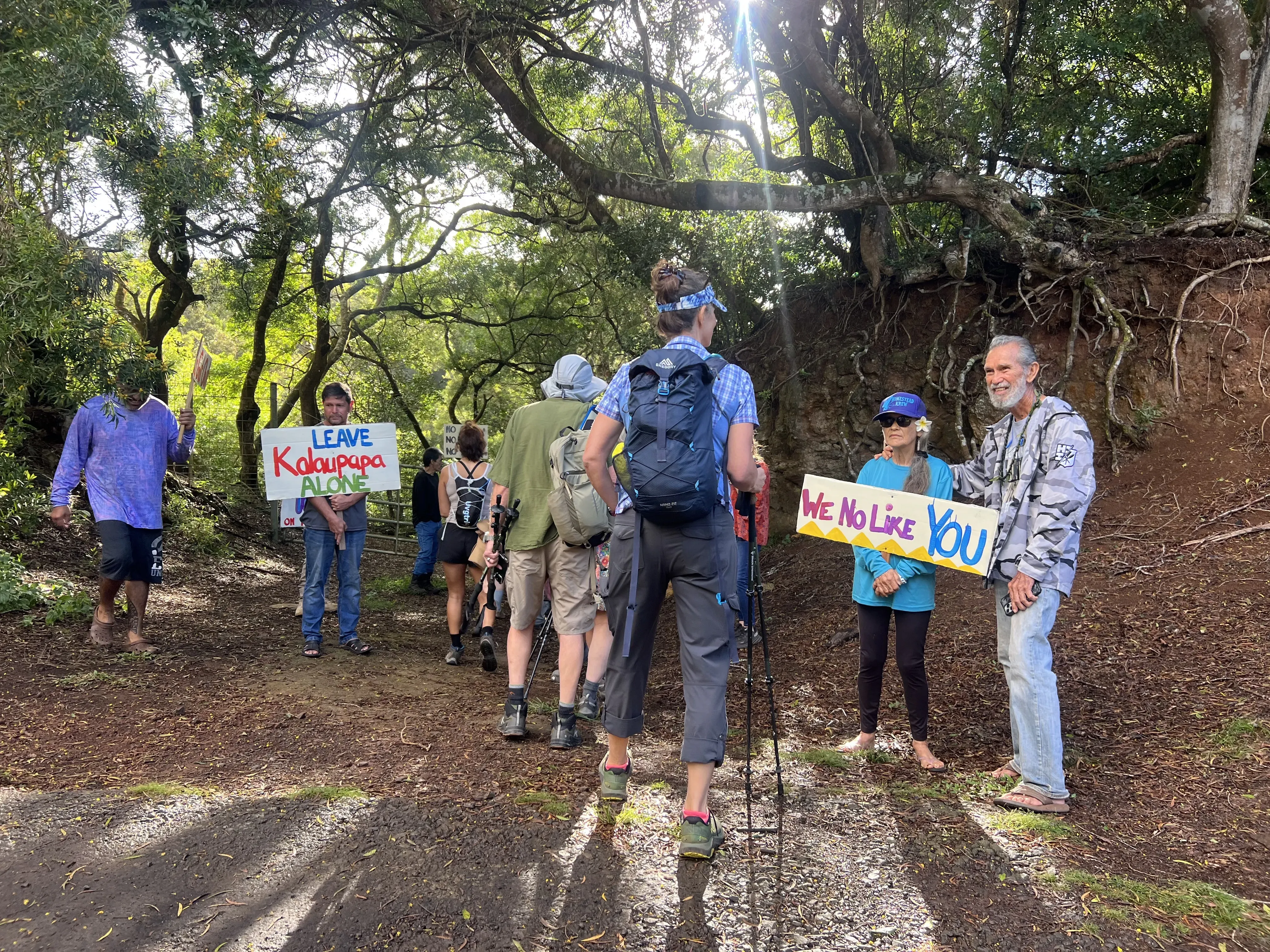
KALAUPAPA, Molokai— The National Park Service abruptly paused its planned twice-a-week walking tours of Kalaupapa National Historic Park after its inaugural trip Thursday was met by about 30 Native Hawaiians and Molokai residents demanding a say in the future of the site where 8,000 Hansen’s disease patients were forced to live in isolation for over a century.
“The NPS is temporarily pausing future public tours while it reassesses the feasibility of visitor access. More information will be shared as it becomes available,” NPS officials said in an email to the Honolulu Star-Advertiser on Saturday.
Maui County Council member Keani Rawlins-Fernandez, who was among the members of Kunou ia Kalaupapa protesting at the start of Thursday’s tour, received the same message from NPS late Friday night, but she is not declaring victory.

As a nonprofit journalism organization, we depend on your support to fund more than 170 reporting projects every year on critical global and local issues. Donate any amount today to become a Pulitzer Center Champion and receive exclusive benefits!
“This pause could just be for today and they continue Thursday,” Rawlins-Fernandez said. “It gives us nothing, so we’re gonna continue to be vigilant because anything could happen.”
The development is the latest in a complicated debate surrounding the future of Kalaupapa, as just four former Hansen’s disease patients remain, including two who continue to live on the settlement. The park sits on Department of Hawaiian Home Lands property and has also been a pilgrimage site for Catholics seeking to honor the legacy of St. Damien and St. Marianne Cope, who lived with, cared for and ministered to the residents suffering from leprosy on the isolated northern Molokai peninsula.
For decades until the COVID-19 pandemic, patient-led tours provided pilgrims and visitors with an insider’s perspective of the historic and sacred site.
Although NPS has operated and maintained the former settlement alongside state agencies since 1980, Thursday’s tour marked the first that was not patient-sponsored. The move drew outrage among activists, descendants of patients, Molokai residents and Native Hawaiians, who contend that tourist access has been prioritized over community input.
The tour, which was set to run twice a week with 10 visitors per group, operates on the 1,247 acres owned by DHHL and a portion of private property at the top of the trail.
NPS has access to the settlement and the Kalaupapa trail through a 50-year lease with DHHL that expires in 2041, allowing the park service to use the land to fulfill its congressional mandate of preserving, protecting and educating the public about the settlement.
Following the tour cancellation, anyone with reservations will be fully refunded, according to an NPS message received by a visitor who booked a spot on the second tour.
Kalaupapa National Historical Park Superintendent Nancy Holman told the Star-Advertiser that the tour has been in the works since 2022, but Rawlins-Fernandez said there was no community consultation over the past four years about what that would look like, how it would operate, and the city resources that would potentially be needed in the case of an emergency.
Holman was not immediately available to respond to the council member’s criticisms.
Beyond logistical concerns, Rawlins-Fernandez said it is disrespectful for NPS to be operating tours without any input from Molokai residents, many of whom are either workers in the settlement or related to employees.
“For the (NPS) leadership to make that call puts our Molokai workers in an uncomfortable position because now they have to answer to our community,” she said. “It shouldn’t be them because they’re not the ones who made that decision, but they’re the ones who work for the agency and that’s not fair for our community members.”
Leased land
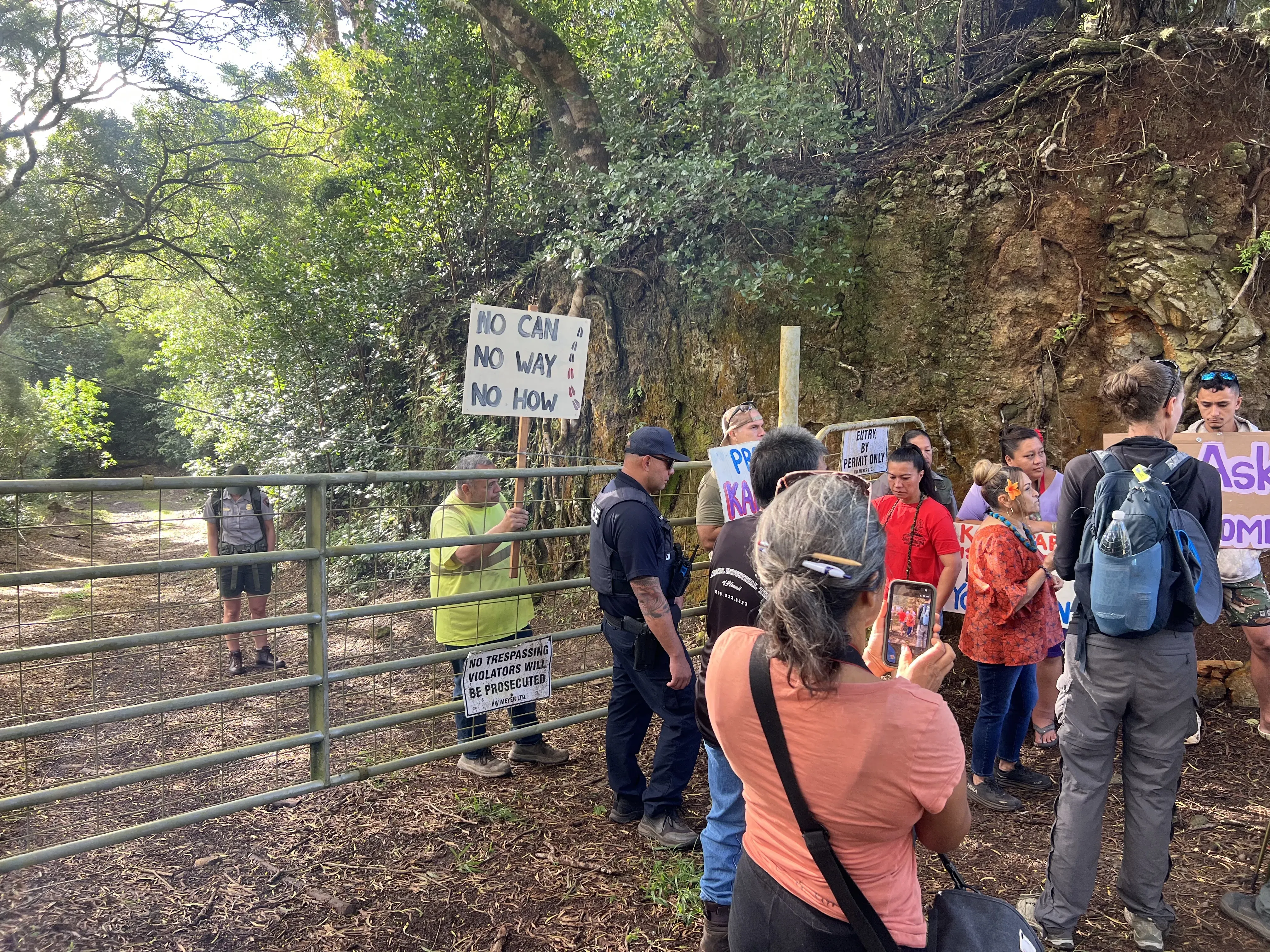
Thursday’s protest, led by activists Lori Buchanan and Walter Ritte, was in response to not only the lack of community engagement but also the use of Hawaiian lands by the federal government.
“That’s trespassing as far as I’m concerned because I have not been consulted as a (DHHL) beneficiary,” Buchanan told a Molokai police officer in front of the gate at the start of the trail.
The lease agreement between DHHL and NPS gives “Native Hawaiians” the second right of refusal of “revenue-producing visitor services” on the land after patients have exercised their first right of refusal, but it is unclear who or what entity represents Native Hawaiians in this situation.
In a July 10 letter obtained by Star-Advertiser addressed to state Rep. Mahina Poepoe (D, Molokai-Lanai-Hana), who raised concerns to DHHL about the NPS tours, Hawaiian Homes Commission Chair Kali Watson wrote that the tours “were not wholly unknown to DHHL” and that NPS discussed them during dual NPS-state agency conferences attended by DHHL line staff.
“While DHHL recognizes that broader internal notice would have been preferable in hindsight, the Department cannot say that NPS proceeded without any discussion with State agency representatives,” Watson wrote.
Because the tour accommodates a maximum of 10 visitors twice a week, Watson wrote they are considered noncommercial and in line with NPS’s legal use of the land, and therefore does not qualify for any rights of refusal to be made.
“The Department understands your concerns to focus not only on legal authority, but also on whether the tours have been rolled out with sufficient transparency and sensitivity to the unique circumstances of Kalaupapa,” the letter says. “Those are legitimate concerns, and DHHL supports continued communication among NPS, DHHL, the patient community and their descendants, Native Hawaiian stakeholders, and the Moloka‘i community as the program moves forward.”
A tour in the making
For decades, public access to Kalaupapa has been restricted to patient-sponsored guests or visitors with a permit from the state Department of Health. Since the 1950s, patients have sponsored private tours of Kalaupapa guiding visitors through the settlement and its history.
Holman said that about 15 years ago there were three patient-sponsored tours running simultaneously. Still, visitor access was limited and tightly controlled.
Kalaupapa became a national historical park in 1980 at the request of living patients at the time and was mandated by Congress to preserve the settlement, provide education to the public, and “provide for limited visitation by the general public.”
NPS has in the past sponsored volunteer groups to steward grave sites and engage in community work, but Holman said most of its educational mission has been fulfilled through its extensive website.
Holman said she began developing the current NPS tour shortly after she was assigned to Kalaupapa in 2021 in order to fulfill the agency’s mission of preserving cultural resources “for the enjoyment, education, and inspiration of this and future generations.”
“That providing ‘for the enjoyment’ is providing access, ways to learn and be inspired by the place, right? So that is baked into our mission,” Holman said. “It is our job to provide for that.”
Following a years-long halt to public access during the pandemic, patient Meli Watanuki’s Kalaupapa Saint Tour resumed in September. But when Watanuki died in May, the family ended the tours, once again halting any option for public access.
Holman said the remaining patients have expressed no interest in hosting tours.
On June 24 — two weeks after cancellation of the Kalaupapa Saints Tour — Kalaupapa National Historical Park posted an announcement of its new tour operations on its Facebook account, with tours launching July 9. Those dates had been discussed and settled on six months ago, according to Holman.
She stressed that the start of NPS tours of Kalaupapa does not mean the beginning of “capital-T tourism.”
“I think there are a lot of questions about whether our content will do the place justice, whether the visitor experience will be deemed exploited, but nobody wants big tourism,” said Holman, who served as chief of interpretation and education at Rocky Mountain National Park in Colorado before her current post. “This is a place of reverence. This is the place of inspiration. That in itself kind of sets the tone for how people will visit the site.”
Rawlins-Fernandez said she does not trust the federal government or its role at Kalaupapa.
“Because there was a level of discretion and respect, just honoring the patients for having to live through being separated from their families and that life of being isolated, folks wanted to give the patients that space. But once there are no patients, that protection kind of goes away and that’s what we’re seeing with this,” Rawlins-Fernandez said. “It’s testing the waters.”
First of its kind
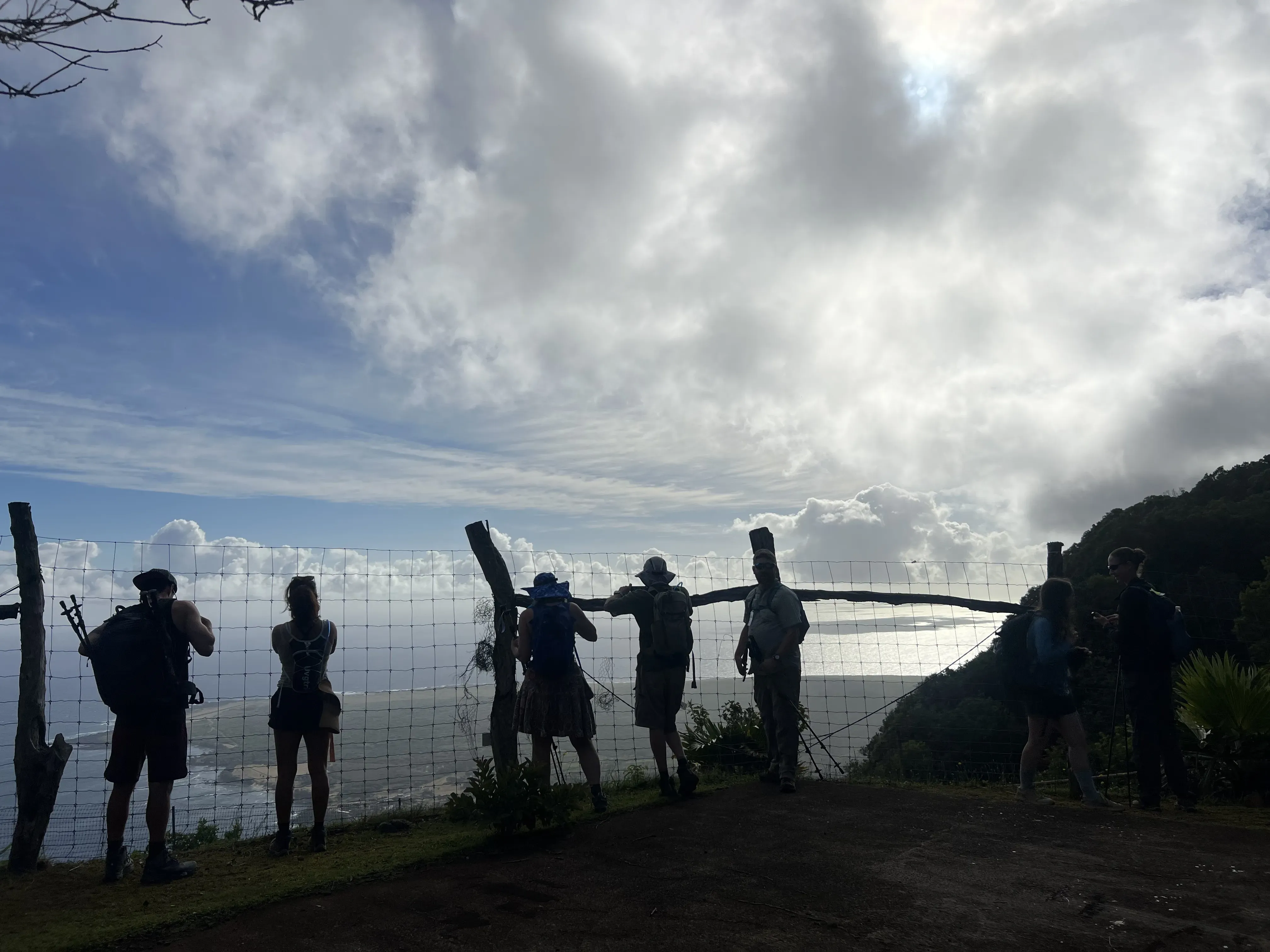
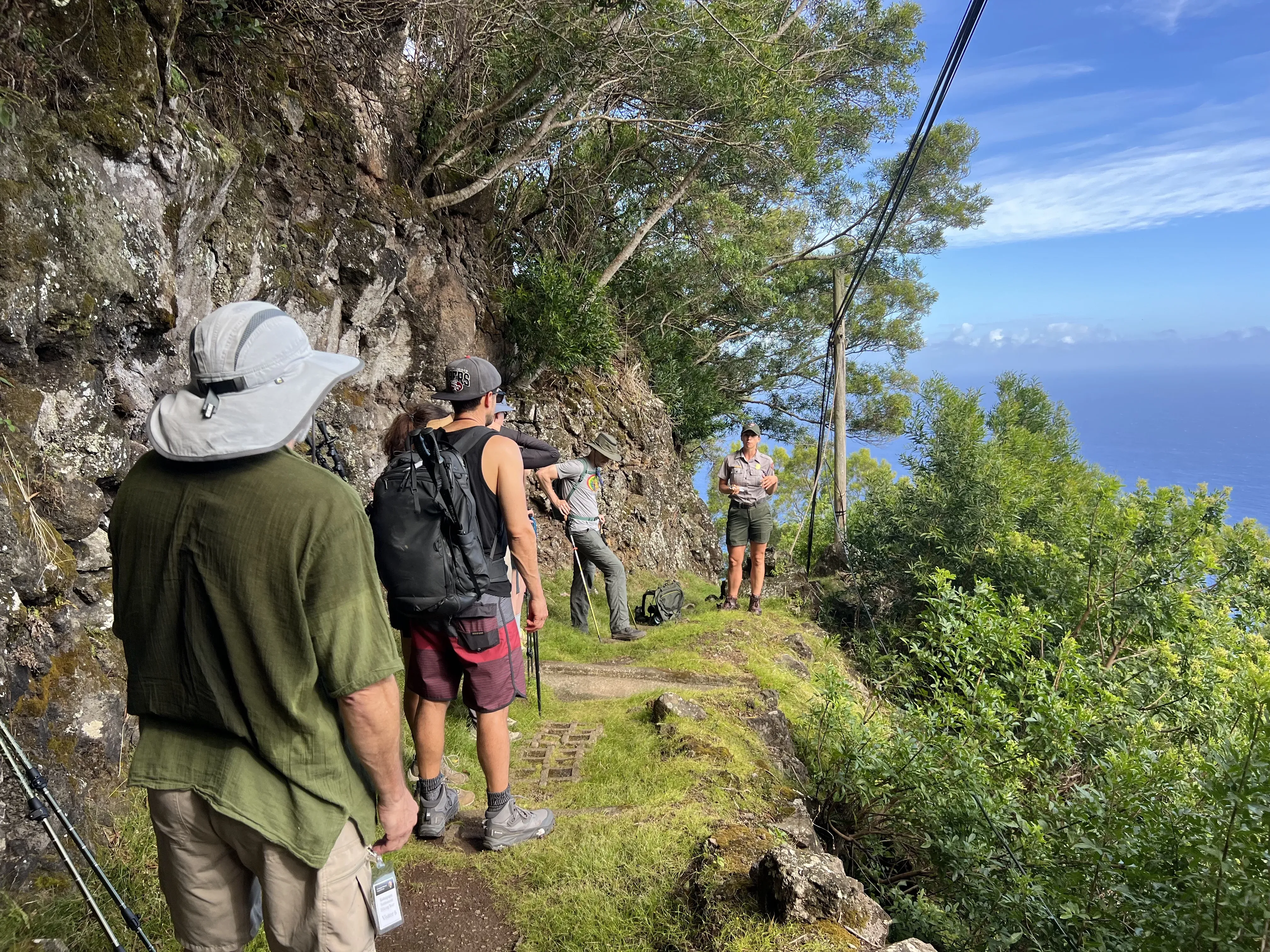
The Star-Advertiser joined the inaugural tour Thursday, a roughly 8-mile walking tour that included strenuous 7-mile round-trip hike on the Lower Pali Trail that descends nearly 2,000 feet from the Kalaupapa lookout to the historic settlement.
The tour was led by two seasonal rangers — Sarah Lent from Minnesota, who served as tour interpreter, and Emily Franco from Wisconsin, who accompanied the group for any emergency medical needs.
“A lot of the time we think of things like recreation for national parks, but it’s not really what we have here in Kalaupapa,” Lent told the group. “It is because of the story that we are here, and there are over 8,000 stories that exist in Kalaupapa, and we’re learning more about those today.”
During water breaks, visitors heard first-person historical accounts of Kalaupapa on an audio device read by NPS staff, many of whom are Native Hawaiian, longtime Molokai residents and descendants of patients. Stories included accounts of a mother with Hansen’s disease whose children were taken away at birth and a patient whose family disowned them.
The group consisted mainly of out-of-state visitors whose professions ranged from novelist to nurse, and who have been interested in touring Kalaupapa for years.
Two of the group’s visitors were scheduled to go on Watanuki’s tour this month but rescheduled their visit through the NPS tour. One of them, Ben Walsh, a 41-year-old environmental consultant from Maryland, said he has visited over 300 national parks and has wanted to visit Kalaupapa ever since he encountered a statue of Father Damien in Washington, D.C.
“I’m a father,” Walsh said, “and to try to imagine my child just being taken away from me right after they’re born because they’re worried about this disease — I am not sure how I would be able to deal with that and how folks were able to.”
Once in the settlement, the group visited a small house where patients were separated by a fence during family visits. Also on the itinerary were Damien’s monument and the Kalaupapa general store, where visitors are allowed to purchase only one candy bar and one soda per day. The group did not visit Papaloa Cemetery due to ongoing restoration of the electrical system that blocked access to grave sites.
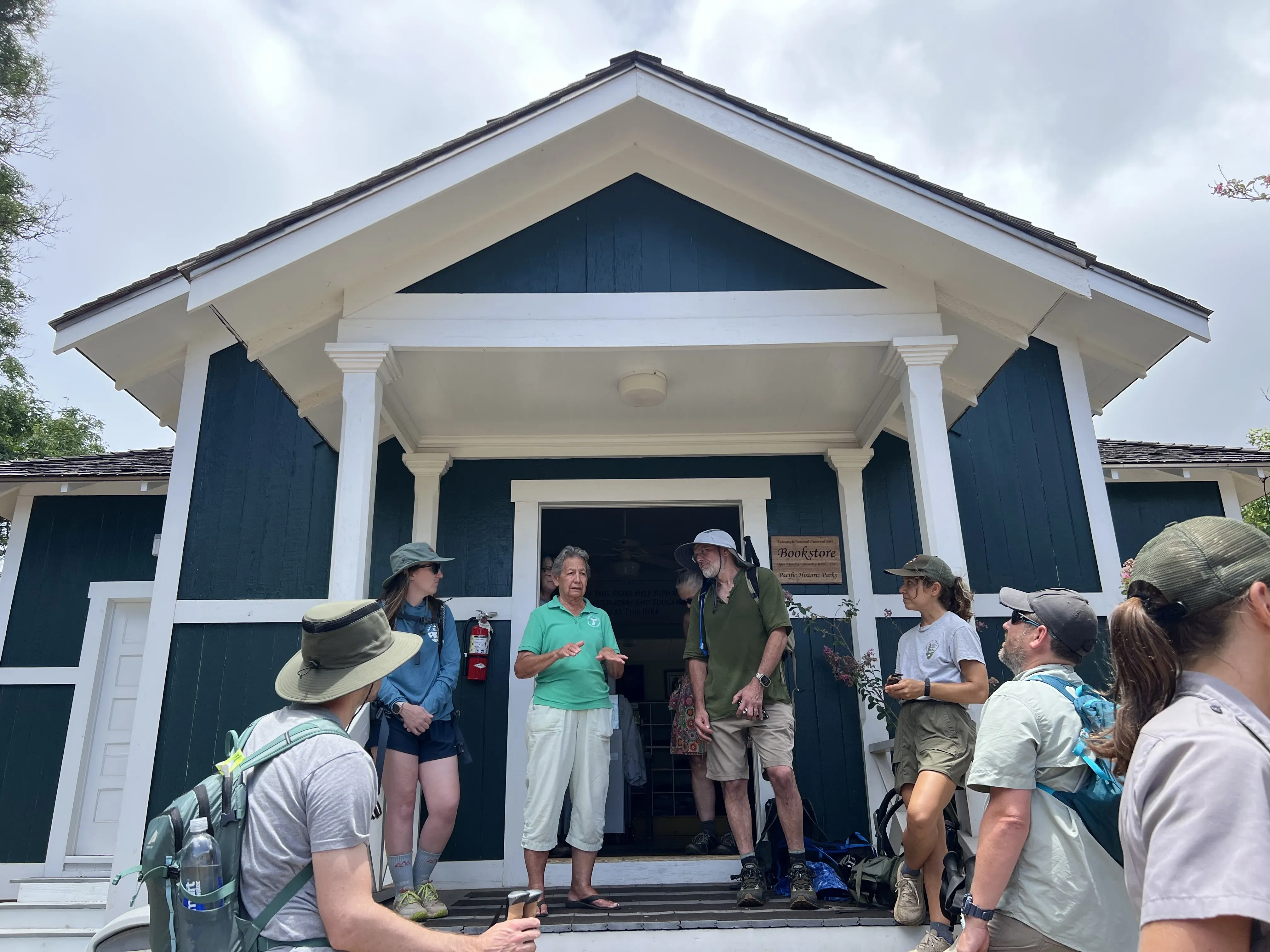
The tour also visited the Kalaupapa Bookstore, the house of longtime resident Kenso Seki, who died in 1998, and Peschoa Community Hall, where Shirley Temple and other celebrities visited patients in the 1940s and residents hosted community celebrations.
In conversations over the course of the day, members of the group suggested that the protests they encountered at the start of the trail were jarring yet crucial in understanding the site’s complex history and significance.
Following the tour’s completion, Gabriel Horton, a visitor from Oahu, picked up a guava on the road to snack on. Horton, a 40-year-old diving technician at an Oahu resort, had been waiting for the opportunity to visit the settlement after his father toured Kalaupapa years ago.
Earlier in the day, the protesters at the gate told him to “do the right thing.” Though Horton is not Hawaiian, he said many of his friends are, and they often engage in difficult conversations about sovereignty and land rights.
“I guess the way I felt for myself was that I was coming there to do nothing but take in the whole experience with respect and appreciation,” Horton said, reflecting on his decision to sign up for the tour. “I feel, for myself personally, if that’s the attitude that I have, then I’m not doing anything wrong.”