Story
 April 24, 2026
Opinion: It Was Once for Royalty. Now It’s in Your Pantry. How This Staple Tells the Story of How the World Feeds Itself
Country:

Basmati rice is a growing and crucial export crop for Pakistan, but it’s caught in the crossfire...
Out of a second-floor window in a farmhouse in Upper Punjab, Hassan Abbas shows me acres of basmati rice planted on his family farm. Stalks with golden tips that seemed to glow had just entered their weeklong window to be harvested, while half the fields were still green, expected to mature within weeks.
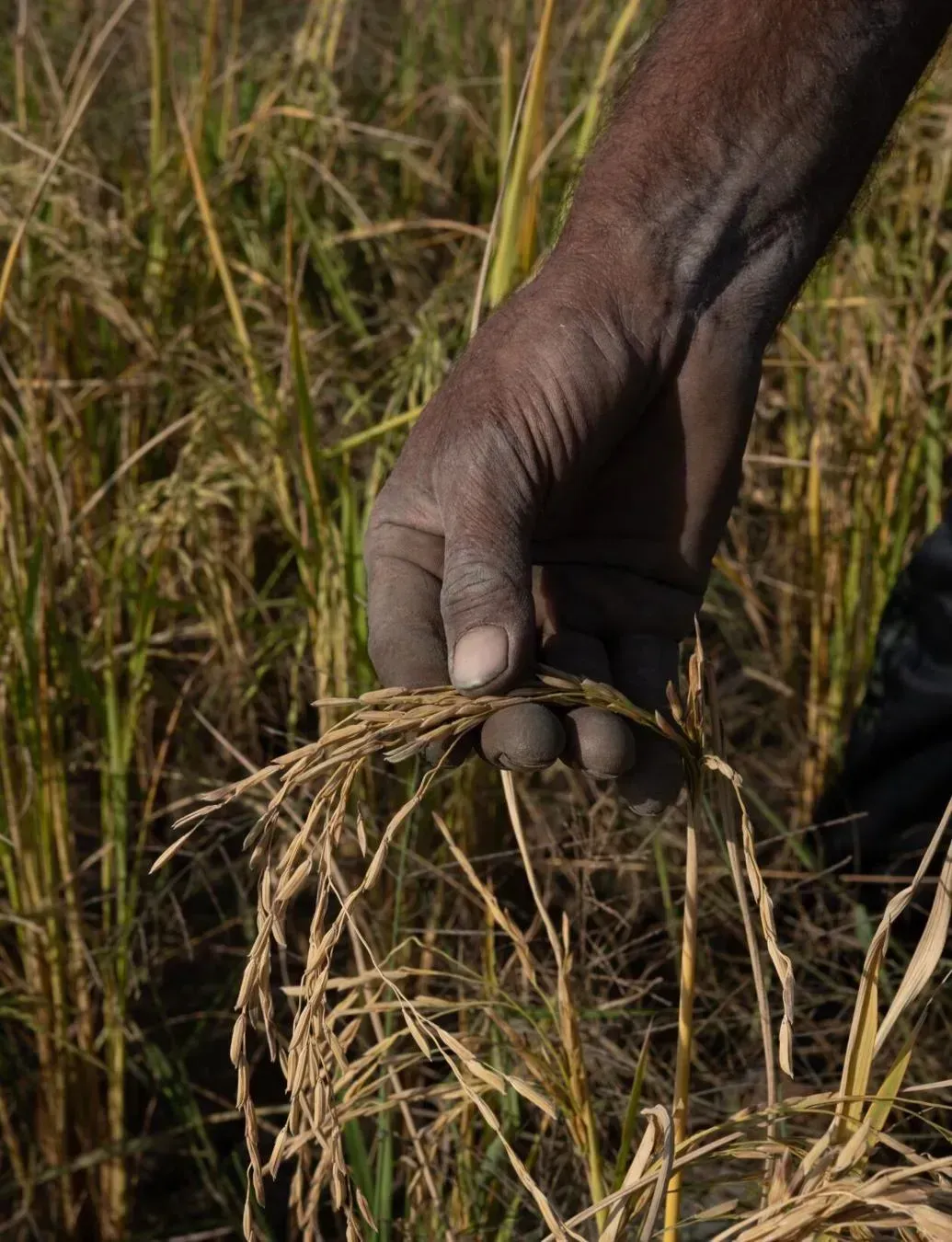
We descend the steps to examine the fields up-close, joined by Mohammad Nawaz, who manages day-to-day operations for the 250-acre farm. Nawaz stops to pluck an anemic stalk, showing me how just one grain remained, the rest shrivelled because of the heat. The ideal temperature during the growing season ranges from 32 to 34 degrees, he tells me, but in September, it far exceeded that: “It went up to 37.”
The Abbas farm is in Hafizabad, the region that’s known as the cradle of basmati. The long-grained, nutty variety of rice, now ubiquitous in restaurants and grocery stores across the world, was once a luxury favoured by Mughal courts and has a history going back four centuries.

As a nonprofit journalism organization, we depend on your support to fund more than 170 reporting projects every year on critical global and local issues. Donate any amount today to become a Pulitzer Center Champion and receive exclusive benefits!
It was nearing the end of October and, unusually, basmati season was at its peak. The harvest typically starts a month earlier, in late September. But shifting seasons are just one more consequence of erratic weather patterns in a region that’s experiencing the worst consequences of climate change.
Rising temperatures, unpredictable rain patterns and diminishing rivers have all impacted the sector at large. Agriculture is big business in the country of 255 million, employing more than a third of Pakistan’s working population. On top of a shifting climate are geopolitical challenges — a fight with India over who owns the right to basmati itself, and a more existential threat not just to basmati, but the whole sector. Last spring, India suspended the agreement that regulates the use of river water upon which 80 per cent of Pakistan’s agriculture relies.
I travelled to Pakistan last fall to understand how farmers were faring as the demand for this export-oriented crop rises but challenges to growing it mount. While basmati is an increasingly important export for Pakistan, the vast majority of Pakistanis can’t afford to buy it with nearly a quarter of the population living on less than $4 a day. And as more of us are buying basmati globally, the crop is depleting precious resources such as water that climate change is already making more scarce.
Other than at the cash register, these effects are mostly invisible to consumers like me who simply see neatly stacked bags of basmati in supermarkets. But ultimately, this demand is reshaping a fragile ecosystem already under a multitude of pressures. This is all happening in a country shipping out essential crops while 2.7 million children face severe malnutrition. While growing cash crops can boost incomes to improve this in the short run, this approach fails to take in the long view: draining diminishing resources won’t just imperil these crops, it may make it even more difficult for a country to feed itself.
Growing up in a Pakistani household in Markham, basmati was the only rice in our pantry. It’s still the only variety I buy. Learning to cook it properly is both an art and a science. My mother is often complimented for effortlessly producing mounds of fluffy, perfectly separated grains to accompany korma or daal.
I didn’t appreciate this mastery until I started attempting to cook basmati myself — vacillating between drowning grains in too much water or burning the bottom layer of rice. Using a rice cooker was out of the question. There were rules: rinse the rice until the water runs clear, soak it for 30 minutes, get the water-to-rice ratio correct, and when the water is almost cooked through, wrap the pot’s cover with a tea towel for the final five minutes to absorb condensation. I didn’t appreciate why such care was taken, or understand why basmati was more expensive than other rice until I started to dig into its history.
While basmati was only available in South Asian grocery stores when I was a child, it has now gone mainstream. Even at Loblaws, you’ll find at least a dozen brands to choose from: Tilda, Suraj, and a President’s Choice-branded version, just to name a few.
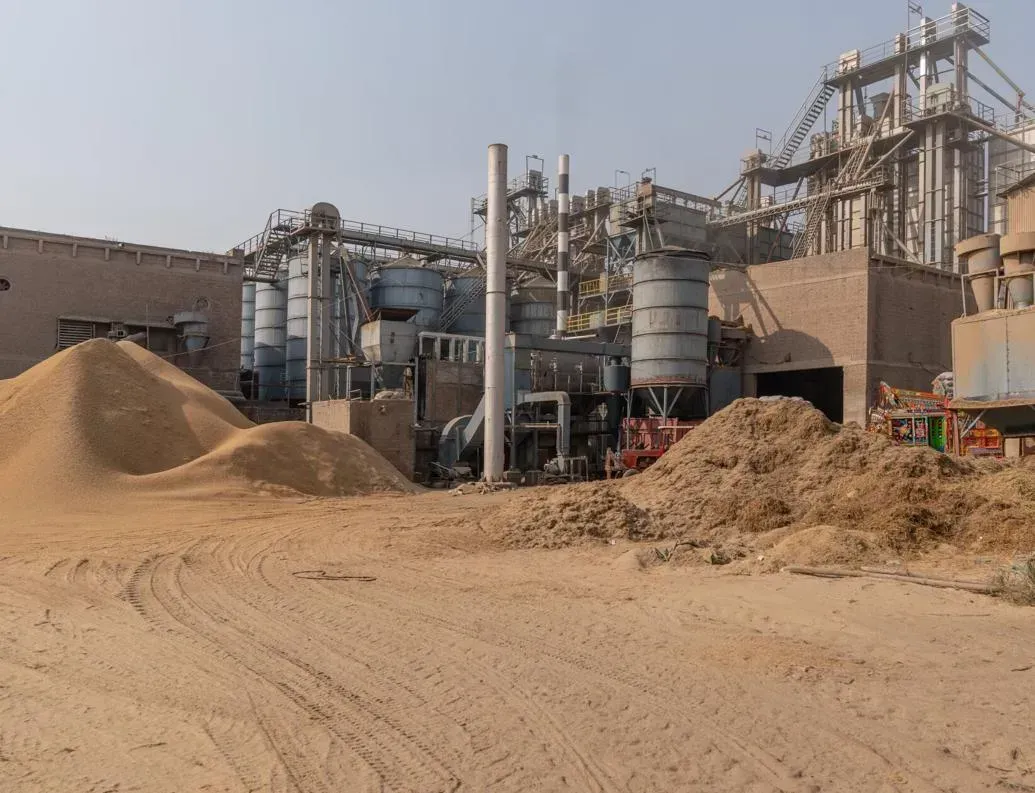
Ammar Aziz’s family has seen the hunger of the export market for basmati grow over three generations. I met with Aziz, 29, at Amir Rice Mills, the family business his grandfather founded. It’s located on a sprawling property in Kamoke, Punjab, that transforms grains still in their husks, known as paddy, to packaged rice, ready to be sent to Canada and beyond.
A growing international appetite for basmati — including from Canada, Europe and the Gulf states — is behind the projected growth of South Asia’s basmati rice industry to more than double over a decade to nearly $37 billion by 2032. Aziz helps his younger brother run an export office in Brampton, Ont., for their Safeena brand of rice when he isn’t needed at the mill. But during the intense harvest period, it’s an all-hands-on-deck, 24-hour operation to make the most of the brief season.
Aziz tells me about the singular virtues of basmati while showing me around the property, which also includes a small field for experimental cultivation. Basmati is a crop that’s more fragile than other types of rice; its long, slender grains are delicate and thus it yields lower quantities per acre. The length of the grain is part of what sets it apart — doubling in size if cooked with care — and it has a distinct flavour and aroma of its own. Most other rice varieties are simply fillers, Aziz adds. “But basmati itself, that’s a dish.”
One of the first appearances of the word basmati was in the 1766 Punjabi epic “Heer Ranjah” by poet Waris Shah, a Sufi saint still revered on both sides of the border. For centuries, the grain was considered so luxurious, it was a dish primarily served to nobility. It was particularly preferred for a Mughal dish that would become world-famous: biryani.
The elements that set basmati apart and make it a superior grain — its length, fragrance and nutty taste — are rooted in how it’s grown but more importantly, where it’s grown. These unique markers have been found only when cultivated in the northwestern foothills of the Himalayas, on land cradled by the rivers that flow from glaciers hundreds of kilometres away.
There used to be more than 300 aromatic varieties of the grain, before a focus on high-yielding varieties won out in the late 1980s. At the same time, South Asian migration was driving demand in Western countries, and creating new export markets beyond Iran and the Gulf states. The new-found global potential of the industry started to pique the interest of international players. In 1997, RiceTec, an American company out of Texas tried to patent a type of rice it claimed to be similar to basmati.
India and Pakistan swiftly put a stop to that, jointly fighting the company’s attempt to get a patent. This led to both countries attempting to secure a geographical indication tag, which proves certain products are unique to certain regions — think Champagne, Grana Padano cheese or Scotch, to name a few. It adds a burden of proof on exporters, but carries the allure of a premium product.
But a decade after the two countries banded together to protect basmati from outside encroachment, they were pitted against one another once again. In 2008, a Pakistan-based terror group attacked two hotels in Mumbai, killing more than 160 people. Since then, each country has fought for recognition of its basmati. India’s recent trade agreement negotiations with the EU were held up over this very issue, the giant that already holds 70 per cent of the market share arguing it’s the one true source of basmati.
But beyond this legal tussle that could decimate the industry in one of these countries, there lies a greater source of peril for farmers that transcends borders.
The basmati season typically begins in June. The crop takes about 120 days to mature, with the harvest wrapping up in October. This year’s harvest only started at the end of October.
Despite many farmers having generations of ancestral knowledge to draw from when considering optimal sowing season, the seasons now require a new, uncertain calculus. Pakistan is among the countries most affected by climate change, despite it having contributed less than one per cent of global greenhouse gas emissions. Last June, nearly every city across Punjab saw temperatures above 45 degrees during a heat wave. Two months later, floods put 4500 villages underwater, as the Sutlej, Ravi and Chenab rivers all flooded at the same time.
The higher temperatures and volatile monsoon season have led farmers to start experimenting with the typical sowing window. In 2023, Muhammad Usman Ali Khan planted a little early. “It was a very good experiment,” he said. He noted down the dates, and repeated his experiment in 2024. It turned out to be ruinous for him and many others. He ended up having to sell five acres of his land.
The 52-year-old invited me to visit one parcel of the 75 acres of land he manages with his three brothers. It’s in the heart of another basmati-growing district in Punjab, in Eminabad which is 70 kilometres north of Lahore. Khan lives in a Partition-era haveli, a large multi-generational home, where his family moved when they migrated from the Indian side of Punjab to Pakistan four generations ago.
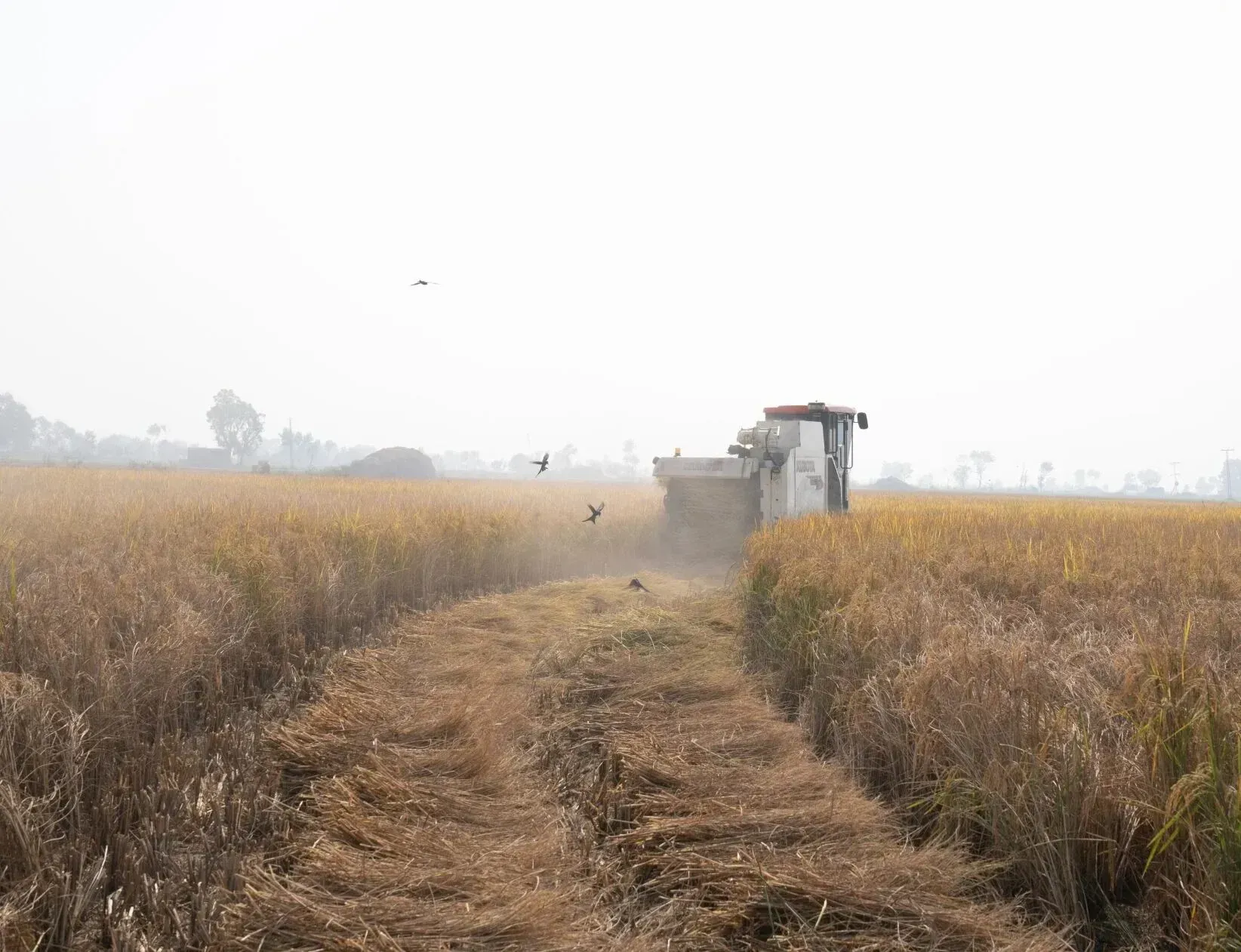
Khan points out fields in the distance that haven’t yet matured as a combine harvester hums nearby. A day labourer operates the machine as it cuts stalks in a neat line toward us, turning the corner at the edge of the field and working around the perimeter, like an agricultural Tetris.
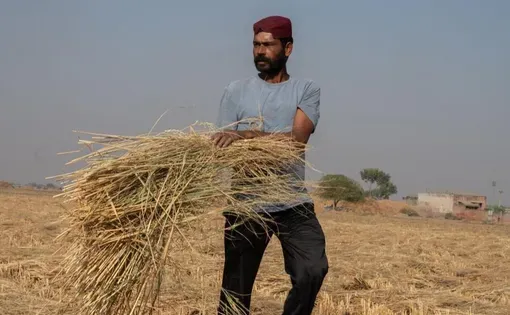
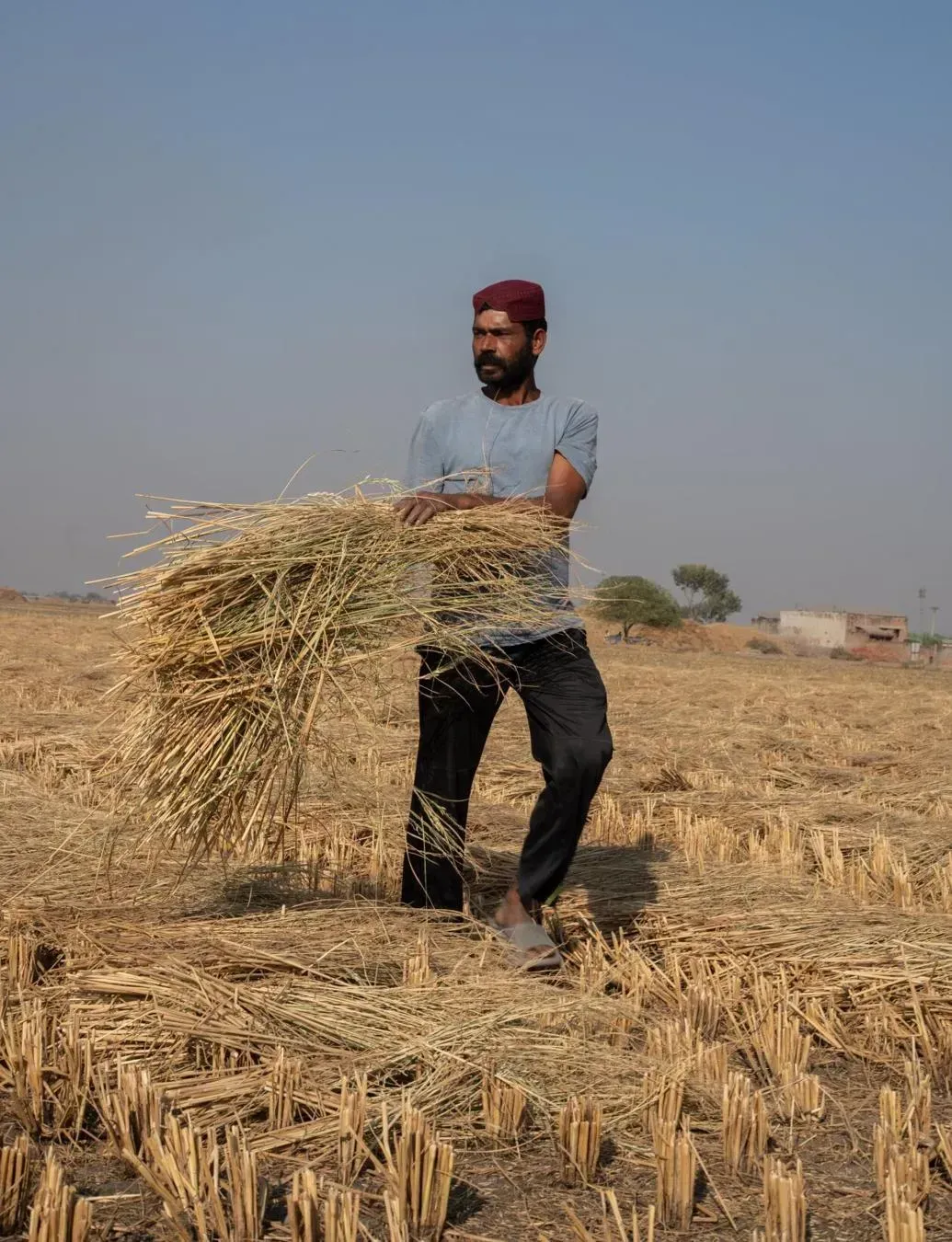
This year, Khan and many others planted their basmati later, in July. Planting is the most labour-intensive part of the season, and the crop is grown in nurseries until strong enough to be flooded in paddy fields. It’s back-breaking work, often done by women day labourers like Sukra Bibi. I met her in Hafizabad as she carried a bundle of basmati stalks wrapped in tarp, expertly balanced onto her back. She had just been in a freshly cut field, collecting leftover stalks before the field was set ablaze to turn around for the wheat season. Specialized equipment is prohibitively expensive to import, so most farms used the same machines that cut wheat for rice, which can leave behind as much as 30 per cent of the crop. Those who manage the farm allow her and other women to gather the remnants for personal use.
Under the shade of a large tree, Sukra Bibi threshes the stalks to separate the grains along with three other women. There are two charpoys to sit on during breaks, and a fan for the hottest part of the day. Later that afternoon, she sits on the charpoy opposite from me, telling me she has been working the sowing season since she was a child. She’s now 60 and it’s her only steady income from farming since the harvest was mechanized two decades ago. While most landholders complain there aren’t many casual labourers to rely on — young people are attracted to factory jobs or move to cities — those in the older generation like Sukra Bibi feel left behind. “Machines have replaced everything and changed everything,” she says.
Hotter temperatures have transformed the cadence of transplanting days, which start at dawn. Scorching afternoons mean a longer break, Sukra Bibi tells me, leaving her working late into the night. She can find this work two months of the year, and takes on other manual labour to make it through the year. But as the sowing season changes every year, it’s harder for labourers to take on other work in anticipation of it. Hassan Abbas has paid some labourers good faith advances for next season, to ensure they will be available.
Climate change has been toughest on the most precarious workers like Sukra Bibi, said peasants’ rights activist Qammar Abbas (no relation to Hassan). Most agricultural workers weren’t considered formal workers, left unprotected by the country’s labour laws until just two months ago when a new labour code was passed in Punjab. “It’s Pakistan, so it’s still paper — with many issues and gaps,” said Lahore-based Abbas who works with the Pakistan Peasants Coordination Committee.
Women are particularly vulnerable. Abbas tells me they are often paid 30 to 40 per cent less than their male counterparts, on top of being responsible for household labour.
Abbas now lives in Lahore, but grew up on his family farm in the district of Rahim Yar Khan further south in Punjab. He has been working on issues like food sovereignty for eight years. Added to the portfolio more recently is climate justice.
Speaking with 12 basmati farmers across Punjab, nearly every single one told me one of their major concerns was disease in their crop. Increases in disease and pests are a by-product of higher temperatures, and using more pesticide isn’t a solution because of the cost and potential toxicity. Small-scale farmers face further pressures — the price of fertilizer, pesticide and electricity have risen sharply over the last few years.
“I can’t sleep at night,” Allah Ditta told me, a basmati farmer in the Hafizabad district. “I have a lot of debt, and just keep thinking: how will I get rid of it?” He’s had to sell livestock and go into debt to pay for fertilizer and pesticide. He can’t afford to send his four children to school so they can learn a different trade and not be in the same trap he finds himself in. This type of debt trap is a common story, said Gul Ahmed from Pakistan Agriculture Research, sharing his initial findings of a survey of more than 700 rice farmers across Sindh and Punjab with me while in Hafizabad.
The near constant stress of rising expenses and managing unpredictable weather keeps farmers thinking season to season, with a hyper-focus on the state of their fields and the yields they hope for. It makes it harder to plan for a future — one where much larger problems loom.
Basmati is one of the most water-intensive crops you can grow. Rice — basmati included — is one of five major crops in Pakistan that uses 85 per cent of the country’s water. It’s a resource under increasing pressure.
Farmers count on the monsoon season to bring the five inches of rain needed to flood paddy fields to ensure a healthy harvest. This season saw a flood in August that affected about seven to eight per cent of the total harvest. That makes it difficult to think about the availability of water as a pressing concern. But the long-term forecast is grim.
There was record-low snowfall in the Himalayas last winter, which feeds into the Indus rivers, depleting groundwater. It is coupled with a volatile monsoon season that doesn’t always reliably deliver the deluge of water needed for a thirsty crop like basmati. On top of this is the stress on water resources from a growing population: each year, Pakistan grows by about 4 million, the size of Croatia’s population.
“Even though we have plenty of rain, we don’t have storage infrastructure to store that water,” explains Mohsin Hafeez, strategic director for Pakistan at the International Water Management Institute based in Lahore. Pakistan’s storage capacity could provide the country with 30 days of water, while the international benchmark is 120 days.
Shortages in surface water have led to overreliance on groundwater, especially in Punjab. Groundwater is essential for food security — deep underground, it’s naturally protected from extreme weather and also acts as an emergency supply in unpredictable seasons. But inefficient irrigation has become an increasingly urgent concern, since 90 per cent of water is dedicated to agriculture.
“The water system — the agricultural system in Pakistan — is pretty fragile,” said environmental historian Dan Haines, an associate professor at the University College London. “Resources are already massively overstretched.”
While climate change is a challenge being faced by farmers globally, a new threat emerged in Pakistan last year: the suspension of the Indus Waters Treaty, a 65-year-old water treaty with India.
The agreement covers six major rivers in the Indus Basin originating in the Himalayas. The mighty Indus emerges from Lake Manasarovar near Mount Kailash in Tibet, running 3200 kilometres through Kashmir, and into Pakistan, ultimately emptying into the Arabian Sea. Its annual flow of water is double the Nile River’s, and its widest point during the monsoon season, can swell to many kilometres wide. Its major tributaries emerge further south and give Punjab its name — literally meaning “five rivers.”
The border between the two nations was drawn in 1947 by a British civil servant, Cyril Radcliffe, who infamously had never been east of Paris before being assigned the task. Natural boundaries were not considered. This meant that the most vital water resources in the Indus Basin have their headwaters in India.
The canal irrigation system, which was integrated across Punjab, was split between the two new nations as a result of the then-new border. An agreement was drafted keeping canals open downstream, but on the first day after it expired in April 1948, India closed canals flowing into Pakistan. This lasted the whole month, until Pakistan agreed to pay for access to water. It was clear a better solution was needed.
Pakistan has only one major river basin to rely on, compared to India’s 12 — meaning, it’s vital for food security. “For us, it’s a life-and-death question,” said Shafqat Kakakhel, a former Pakistani diplomat and chair of the Islamabad-based Sustainable Development Policy Institute.
David Lilienthal, an American bureaucrat, took on the task of negotiating the treaty through the World Bank. It took nine years to land on the final treaty. Pakistan was granted use of the western rivers — the Indus, Jhelum and Chenab — while the eastern rivers were carved out for India’s use — the Ravi, Beas and Sutlej. Despite fighting multiple wars since the IWT was signed, the treaty has survived, lauded as an example of co-operation between bitter rivals. Pakistan’s interests as the downstream party are obvious. For India, though, the IWT became a way to show the country was a “trustworthy, responsible state” interested in peace and stability in the region, said Haines.
“That changed after 2014 when the BJP came to power,” he added. The Bharatiya Janata Party, known as the BJP, is the nationalist party led by Narendra Modi. It took a harder line against Pakistan, including repeatedly threatening the IWT. Then in 2023, India asked to renegotiate the treaty, claiming that the 60-year-old treaty did not reflect the contemporary pressure on water resources, including climate change. Pakistan refused to reopen the treaty.
But things unravelled in April 2025, after a terrorist attack in Indian-controlled Kashmir last year set back India-Pakistan relations to their worst in decades. In the scenic tourist town of Pahalgam, 26 people were killed by gunmen. India blamed Pakistan for the attack, while Pakistan denied any involvement. But the incident had two major consequences: a brief war that killed more than 70 people, and India suspending the IWT.
India has now made the first move to weaponize a natural resource vital to 268 million people, a move many in the region have long feared. And despite a ceasefire, Prime Minister Modi entrenched his position saying last May when addressing his nation that “water and blood cannot flow together.” Pakistan’s government responded saying any move to restrict water supply would be seen as an “act of war.”
India’s water resources minister, Chandrakant Raghunath Paatil, wrote he intended to make sure “no drop of the Indus River’s water reaches Pakistan” on X last year. But the reality is that a country cannot simply stop rivers from flowing across its border — dams can’t be built overnight. Flow can be reduced, however, and flash floods can be engineered.
Some experts say Pakistan’s anxieties are overstated. But within three weeks of the suspension of the IWT, India began to expand plans to draw water from rivers assigned to Pakistan. It also flushed out a major reservoir outside of the time frame set out by the agreement, sending water and sediment downstream, something Haines says may have been a “warning shot.”
For Kakakhel, the most serious consequence of the suspension of the IWT has been the “psychological effect” it has on farmers. The availability of water has a direct impact on yield. Having spent his whole life in the basmati industry, Mian Amir Aziz keeps an eye on the long view, including tightening water resources. He is the most senior family member running Amir Rice Mills, and at 62 is now concerned about succession as he grooms his sons to take over.
Access to water is at the fore of those concerns — the suspension of the IWT could be a potential “bottleneck” he says. If the treaty is withdrawn altogether, he expects there will be conflict, because ultimately, he says, “water is our lifeline.”
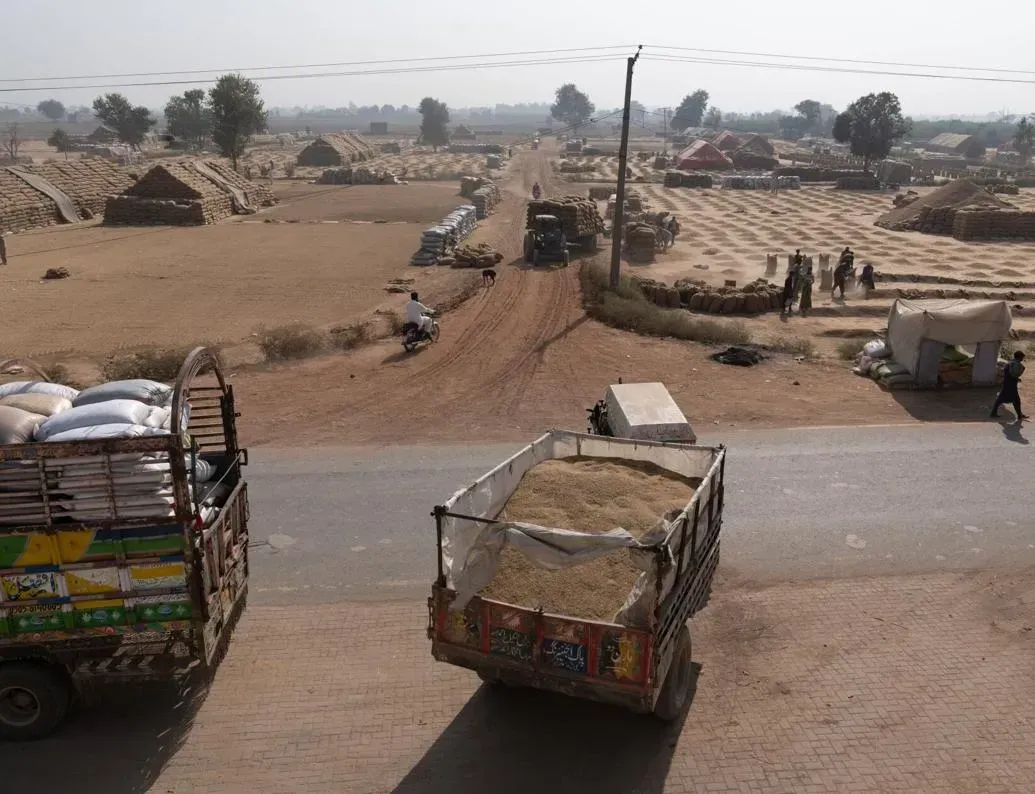
Despite all these challenges — or maybe because of them — there was a jubilant mood around the harvest this season. This year saw a bumper crop. One of Pakistan’s largest rice markets, mandis as they are known locally, is in Kamoke, a few kilometres up the road from Amir Rice Mills. The turnoff to the mandi was off Grand Trunk Road, one of the oldest highways on the continent, and one of the only roads that still runs from Pakistan into India.
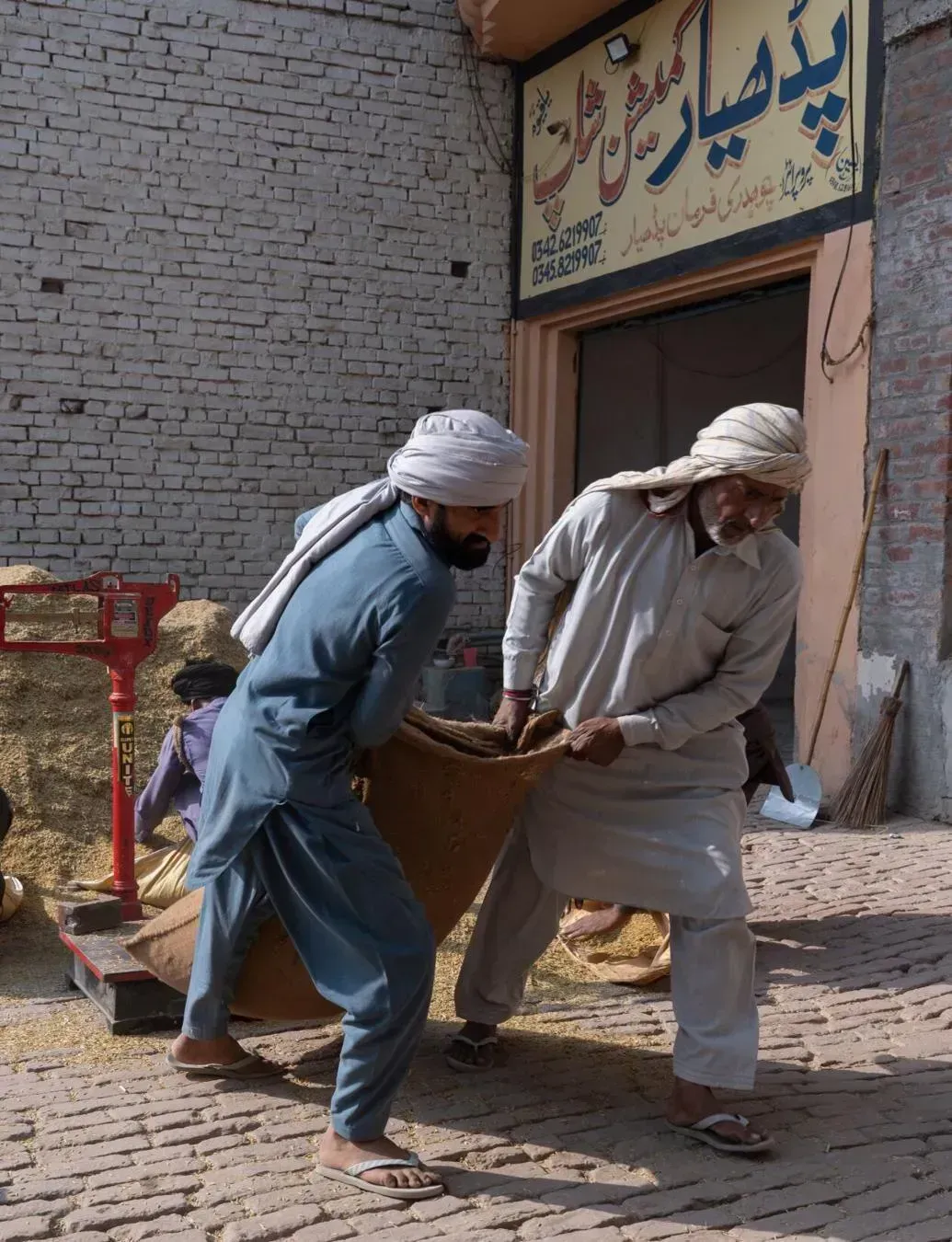
It was in peak form at the end of October, operating all day, seven days a week. Hundreds of kilograms of paddy was being unloaded by trucks, displayed in mounds for buyers, weighed and bagged, then loaded onto different trucks and driven away to mills to be processed.
Most of this paddy has been brought in by middlemen. That means that farmers — especially those like Allah Ditta who work the land, rather than those who manage large-scale farms — benefit the least from a good season or growing demand. There’s little negotiating power for a farmer who has the exact same crop as his neighbour. A good year means covering debts and perhaps having a little saved to invest in fertilizer for next season. A bad year means sinking further in the red, praying the next season will pull you out.
Season-to-season variations paper over the long-term forecast: increasingly hot summers threatening each stalk, and a monsoon season that can’t be relied on any longer to flood paddy fields, leading to overextraction of already dwindling rivers and groundwater. These realities have already stoked a water war with a hostile neighbour, a lesson for other countries with transboundary rivers, including Canada.
While farmers bear the brunt of all this uncertainty, consumers also need to educate themselves on the unsustainability of food systems that often now work to exponentially expand harvests of crops once considered delicacies. What basmati farmers face in Pakistan mirrors what farmers growing other cash crops face globally. Cocoa beans grown in Ivory Coast and Ghana, for instance, have been deeply impacted by climate change-induced heat and drought, while demand for cheap chocolate has driven deforestation. Avocados are another thirsty crop, with rising temperatures and droughts wreaking havoc on growing conditions on water-scarce regions in Peru and Chile. And if you’ve noticed the price of a cup of coffee creeping up, the reasons are all too similar.
There is a sense of helplessness in it all, as we all play a small part in this demand. But every time I read a study or article about food I love, it reminds me to at the very least read their origin stickers. It’s a nudge to take a minute to think about the true cost of these items on my plate, to consider it’s likely in my lifetime that some of these items will disappear from shelves — what was once made economically viable through scaling up production could lead to exhausting the resources needed for cultivation.
When I returned to my apartment in London from Pakistan, I craved a home-cooked meal. I began preparing my ultimate comfort food: daal and basmati. I tried a new Marks & Spencer-branded rice this time, the tiny print on the back of a one-kilogram bag indicating it was sourced in Pakistan. I reminded myself it was a luxury to be able to cook this rice. And thinking about Sukra Bibi working to coax kernels from leftover stalks, the mounds of paddy waiting to be sold at the mandi, the energy used to polish each granule at Amir Mills, I was careful not to waste a single grain.
This story is being copublished by the Toronto Star and Serviette magazine.