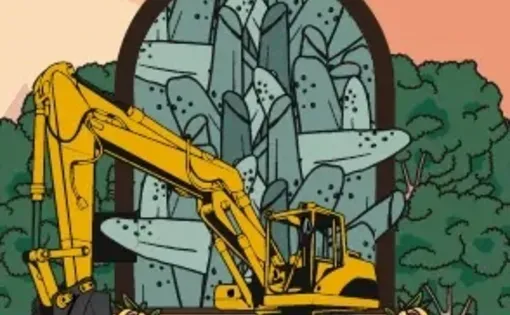
An Indonesian Indigenous tribe is threatened by large-scale nickel exploitation.

Deep within the rainforests of Halmahera lives the Indigenous O’Hongana Manyawa community—a people often known as the guardians of the forest. For generations, they have lived nomadically in small groups, sustained by the land through hunting and gathering, moving with the rhythms of nature rather than against them.
To the O’Hongana Manyawa, the forest is not merely territory. It is father. The river is mother, providing water, food, and life itself. Their bond with nature is sacred: Every child born into the community is welcomed by the planting of a tree.
Yet for decades, the people have faced persecution simply for choosing to live according to their own traditions. They have been branded backward, uncivilized, and “isolated,” as though their way of life were a problem to be corrected rather than a culture to be respected.

As a nonprofit journalism organization, we depend on your support to fund more than 170 reporting projects every year on critical global and local issues. Donate any amount today to become a Pulitzer Center Champion and receive exclusive benefits!
Since the 1970s, state policies under Indonesia’s New Order regime forced many O’Hongana Manyawa families out of the forest and into permanent village settlements through resettlement programs that sought to erase their nomadic existence.
Today, the threat to their survival is more urgent than ever. Survival International, a human rights group supporting Indigenous rights, estimates that fewer than 500 O’Hongana Manyawa people still remain living nomadically. At the same time, the rapid expansion of Indonesia’s nickel industry during the presidency of Joko Widodo has unleashed large-scale deforestation across Halmahera.
The forests that once sustained them are being torn apart. Their ancestral lands have been carved up by mining concessions. Their food sources are disappearing. Rivers that once gave life are now polluted.
According to Jaringan Advokasi Tambang (JATAM), at least 60 mining permits have been issued across Central Halmahera and East Halmahera—areas that overlap directly with the O’Hongana Manyawa’s traditional roaming territory.
Forced to flee encroaching mines, some families have retreated deeper into the forest to avoid contact, violence, and conflict. But even there, they are not safe.
As if dispossession were not enough, they have also faced criminalization. The O’Hongana Manyawa are repeatedly accused in deaths involving outsiders found in the forest. Over the past decade, three cases have led to the prosecution of 10 members of the community.
They have endured torture, wrongful convictions, and prison terms stretching for decades. One of them, Nuhu, died in detention after torture.
The tragedy of the O’Hongana Manyawa can be summed up in one phrase: Nanga Tau Hihangoka ("Our home has been lost").