Story
 February 11, 2026
Ugly Valentine: How ‘Fairtrade’ Roses Ravage Uganda’s Wetlands
Country:



Flower farms operate with little oversight.
An exclusive investigation reveals how flower farms in Uganda’s protected wetlands are shipping millions of stems to Europe— ending up in ALDI aisles and the vases of the Dutch royal family.
Lees het hier in het Nederlands.
Straddling three countries, Lake Victoria faces many threats. Encroachment along its shores in Uganda by greenhouses used by flower farms is among the most serious, as they erode the protected waterway and are subject to toxic pesticides that further degrade the area.
From these wetlands, the flowers are exported to the Netherlands and throughout Europe, potentially ending up in ALDI grocery stores and the Dutch Royal House, our investigation finds. The flower growers show little regard for the Fairtrade certificate requirements that allow them to export these flowers to premium markets in Europe.
The community around the wetland feels helpless and unable to stop the destruction, which has been an open secret for decades.

As a nonprofit journalism organization, we depend on your support to fund more than 170 reporting projects every year on critical global and local issues. Donate any amount today to become a Pulitzer Center Champion and receive exclusive benefits!
“Local leaders are powerless,” says Emmanuel Kavuma, 52, a political leader in Lutembe Bay, an area on the edge of Lake Victoria between Kampala, Uganda’s capital, and the primary airport, Entebbe International Airport.
He refers to others who have tried and failed. He says that Uganda’s high-ranking politicians travel daily along the road connecting the capital to the airport and, if they had wished, could have saved the wetlands from the encroachment of thousands of structures years ago.
The Lutembe wetland is one of Uganda’s most vital ecological regions, designated in 2006 as a site of international importance on the Ramsar site list under the auspices of UNESCO.
A key habitat for seasonal migratory birds from Europe, Lutembe serves as a natural water-purification system for Kampala and its surroundings, with a population of five million. It is a crucial breeding ground for fish, and a buffer that reduces flooding while supporting thousands of livelihoods through fishing and tourism.
The Africa Report investigation, published in conjunction with Nederlands Dagblad, a Dutch newspaper, draws on interviews with dozens of people from communities surrounding the wetland, many of whom expressed deep frustration at the lack of care and protection it has received.
The flower company culprits
Two flower farm companies operate inside the wetland: Rosebud Limited, registered in December 1999, and Premier Roses Limited, registered in April 2004, according to records from Uganda’s registrar of companies. They are owned by the family of Sudhir Ruparelia, one of the richest families in Uganda. We reached out to Ruparelia, but he did not respond to our invitation to comment.
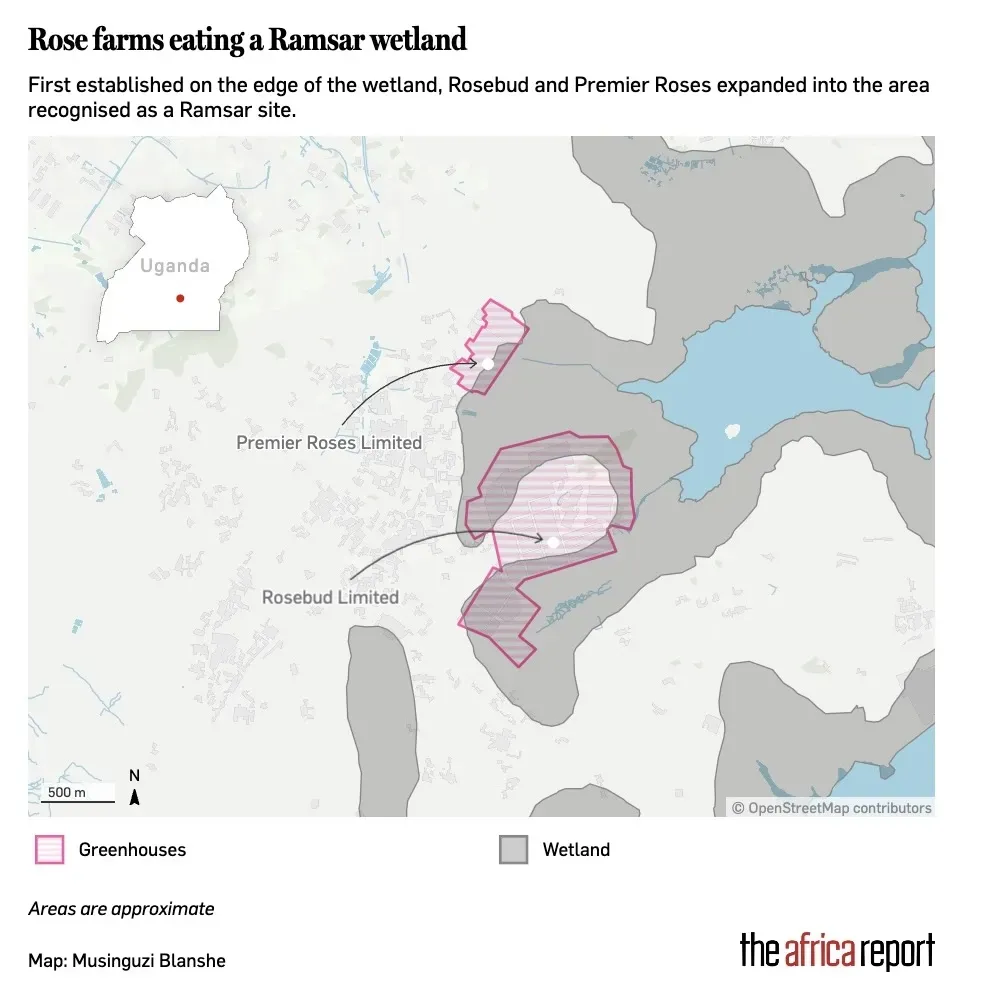
Rosebud describes itself as the largest exporter of cut roses from Uganda, accounting for 60% of the country’s flower exports. Uganda earned $65m from flower exports in 2024, according to Central Bank statistics.
Comprehensive data has been difficult to obtain, but trade data from market research company Volza indicates that nearly 70% of Rosebud’s shipments go to the Netherlands. The rest of its shipments go to Japan, the United Kingdom and other countries.
In 2005, Rosebud Limited — which has expanded aggressively — occupied 91 acres. By 2022, it had grown to more than 220 acres. Viewed from a boat on the lake, its greenhouses sit only a few meters from the water, which is illegal as Ugandan law prohibits building any structures within 200m from the shoreline.
Its sibling, Premier Roses, covered 24 acres in 2005 and expanded to 44 acres by 2022, according to analysis of Google Earth satellite imagery and Earth Genome, a satellite-based environmental investigation tool.
Looking at the satellite images, one can compare the years the companies expanded with soil being dumped in the wetland: for Rosebud in 2020-2022, 2014, 2012, 2008 and 2005; for Premier Roses between 2014 and 2017.
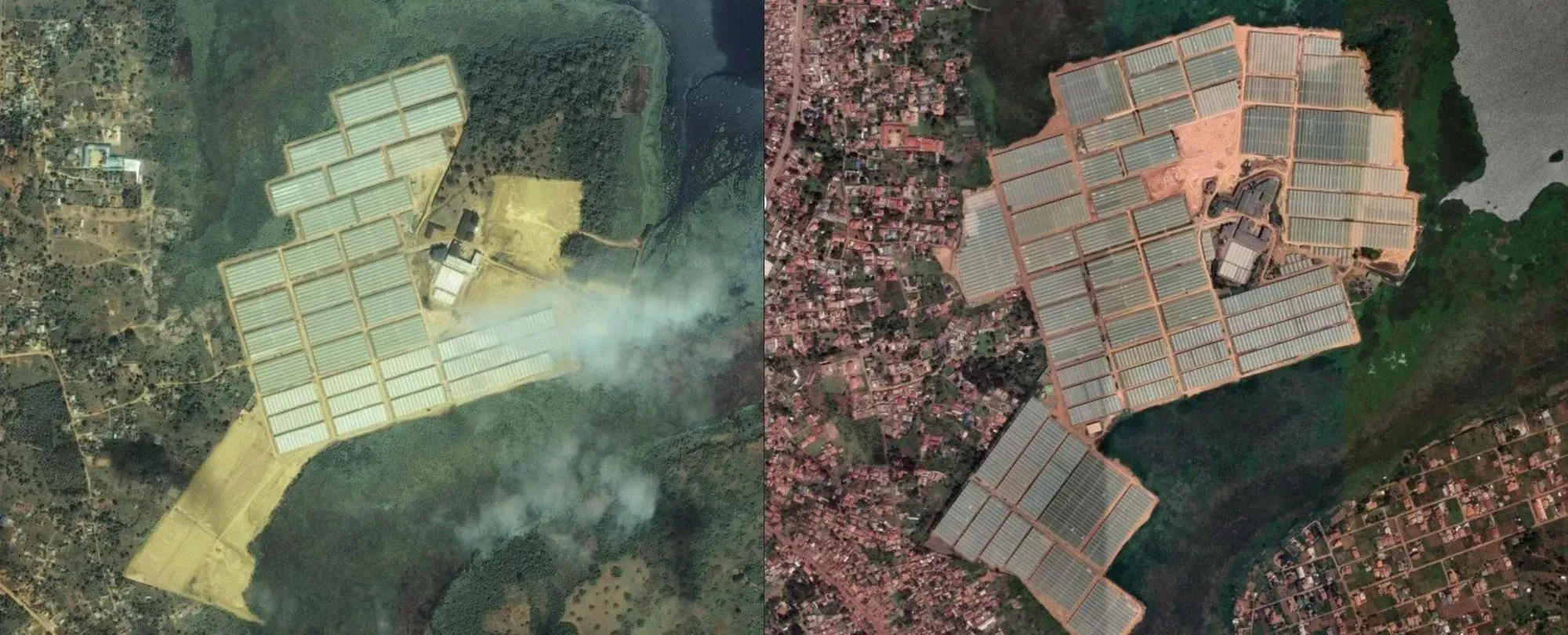
“That entire place was a wetland,” says Kavuma. Given the rate at which trucks ferry soil and dump it into the wetland, he adds, “you may come next month and find that the remaining section has been completely covered. Those people don’t joke.”
Dimple Mehta, manager of Rosebud, tells us that the company owns more than 300 acres of land within the wetlands, parts of which extend into Lake Victoria, and that its ownership predates the designation of the area as a Ramsar site – referring to the Ramsar Convention on wetlands signed in 1971 under the auspices of UNESCO. “The protected area [is] being imposed on our land,” he says.
Although Mehta said he does not know the exact boundaries of the Ramsar site and claims the company was not consulted during its designation, he argues that only parts of the Ramsar site are in the wetlands.
However, the entire wetland is designated as a Ramsar site and all stakeholders, including flower farm owners, were aware of this status, a representative from the Wetlands Management Department at Uganda’s Ministry of Water and Environment, who was interviewed for this article, tells us. He added that the Ramsar demarcations extend beyond the wetland itself.
Rosebud’s Mehta asked whether we were sponsored by individuals with malicious intent, claiming that certain actors have sought to undermine the flower farm for years.
A powerless community
Efforts to protect the wetlands over several decades have been hampered by corruption, weak enforcement and the growing influence of powerful investors, says Robert Kifano, chairman of the Lutembe Ramsar Site Local Management Committee, a local volunteer initiative.
Kifano says environmentalists and law enforcement often collaborate with flower farm owners and other developers, enabling illegal encroachment on protected areas.
Local government officials lack the resources to act, while national agencies — like the National Environmental Management Authority (NEMA), the country’s top environmental regulator — issue permits to developers without consulting local authorities, creating gaps in oversight.
Kifano recounts numerous distress calls that, if acted on, could have saved parts of the wetland, but most went unanswered. In one incident, a developer was carving out part of the wetland to set up a resort. When Kifano called an environmental officer, the official responded: “You know we are toothless.”
Calls to Uganda’s Ministry of Water and Environment also led nowhere; at the time of our interview, Kifano had waited five months without a response. “That’s the trouble we go through daily,” he says.
Mehta argues that other developers, and not his company, pose the greatest threat to the wetland and migratory birds. He says people who are “blind and don’t have a brain to think” focus on his company while ignoring others.
"There is a lot of rot in these farms."
David Kareeba, environmentalist
Kifano says environmentalists who try to inspect the flower farms often face hostility. Matia Lwanga, the district chairperson where the flower farm is located, was once roughed up while attempting to inspect the area. The company later sued him for trespassing, Kifano says.
Three government officials, from agencies including the Ministry of Gender, Labour and Social Development as well as NEMA, who spoke on condition of anonymity, say it is difficult to access the flower farms. When inspectors arrive without a pre-scheduled visit, they are typically denied entry. “Flower farms want to be given time so they can cover up their dirt,” one government environmentalist tells us.
David Kareeba, an environmentalist at the National Association of Professional Environmentalists (NAPE) shares this experience – flower farms have generally been unreceptive to environmentalists. “There is a lot of rot in these farms,” he says, adding that operators “fear being exposed.”
Kareeba says government agencies rarely side with them. He recalls an incident in which they mobilised residents to protest against dumping soil in the wetland. On the day of the demonstration, however, they were met by officers from the Environmental Protection Force — a unit of the Uganda Police Force that is meant to protect communities and natural resources.
“Instead of protecting the community, they were guarding the premises,” Kareeba says.
A deceptive expansion
Given their location in a wetland, the flower companies were affected by the rising water levels of Lake Victoria between 2018 and 2021. Several Rosebud flower farm structures flooded.
To maintain production capacity, the company sought permission to reconstruct the damaged greenhouses and to build an embankment around the farm to prevent future flooding, according to documents we accessed from the company’s submission to the environmental regulator.
"These titles are historical titles that were created a long time ago."
Barirega Akankwasah, executive director of the National Environmental Management Authority, on the controversy around the Lutembe wetland
Yet an analysis of satellite images shows that Rosebud was also aggressively expanding, constructing new greenhouses deep into the wetland. Around July 2021, the company dumped soil on about 17 acres of the wetland, pushing closer to the lake’s shoreline. By April 2022, it had reclaimed another 4.7 acres, placing greenhouses less than 100m from the water.
Yet the company is aware of the environmental implications. In a 2021 report, it noted that the development is close to the Lutembe wetland-river system, saying, “precautions are undertaken to ensure no injury is meted out on this ecosystem.” In a 2023 report, it acknowledged the “likelihood of encroaching on the Ramsar site” and the associated “negative attributes.”
We meet Barirega Akankwasah, the executive director of NEMA, who has spoken on how they protect wetlands — including this Ramsar wetland — since he came to office in 2021. No inch of the wetland had been encroached on in the years he was in office, he says. But when we used his computer to inspect satellite images of the wetland, he saw that there had been an expansion of the greenhouses.
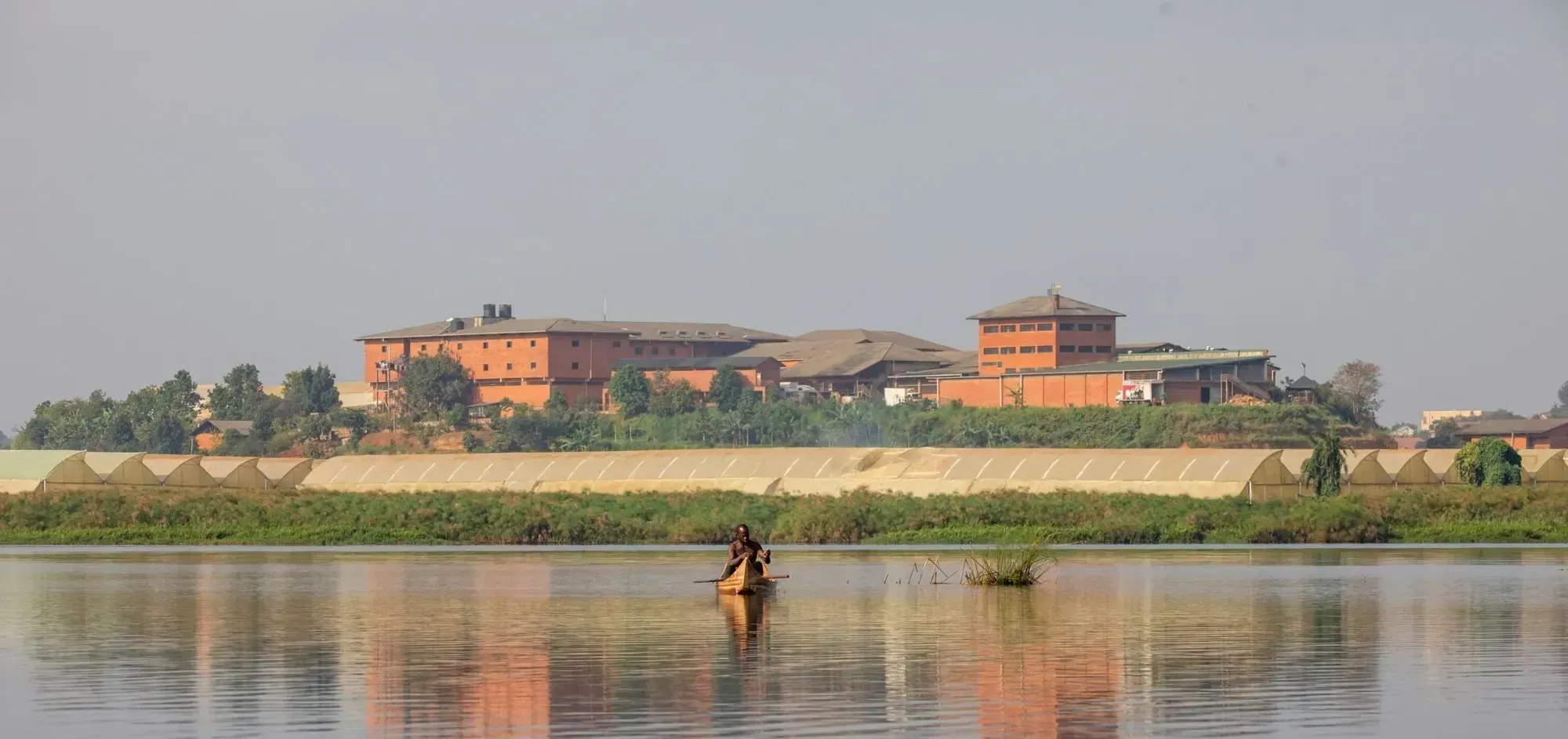
Akankwasah explains that the controversy around the Lutembe wetland is partly rooted in history, noting that sections of the wetland were already titled before its designation as a Ramsar site.
“These titles are historical titles that were created a long time ago,” he says. “Unless the government compensates the owners, people have taken advantage of that and established farms there. The farm is on a private land title, not government land,” he argues.
He says the company was expanding on land it had received permission to use long before he came to office. On whether the flower farm has expanded beyond what was approved, Akankwasah says that determining a breach requires a technical assessment.
“I would need to look at the coordinates in the certificate of approval to see whether the areas of expansion are within the approved coordinates or outside,” he adds.
He cautioned that satellite images alone are insufficient to confirm any violation. “Yes, they can indicate a change in the size of the farm, but cannot confirm a breach.” He added that he would schedule a visit with his team to make the technical assessment.
Even officials from the Ministry of Environment’s Wetlands Department could not explain why the company continues to be permitted to expand within the wetland, arguing that it is the responsibility of the regulatory authority to provide that explanation.
Deaths of fish, bees, livelihoods
Documents submitted by Rosebud to the environmental regulator in 2023 show the company was using chemicals such as Acrobat, Indoxacarb, Melody Duo, Meltatox and Rovral — pesticides banned in most parts of Europe.
Akankwasah acknowledged that oversight of agricultural chemicals has long been weak because Uganda lacked a proper regulatory framework. New chemical-control regulations were only enacted last year, he said, giving the agency its real enforcement tools.
"Why do you want to fish exactly outside the farm?"
Dimple Mehta, manager of Rosebud
“We previously couldn’t catch them because we didn’t have a law,” Akankwasah said. “Now we have a law, and we shall get them if they are using prohibited chemicals.”
Local communities and several officials we interviewed say the flower farms have had disastrous effects. They reported that the water often turns green, that fish sometimes die in the lake for undetermined reasons, and that fishing is restricted near the greenhouses.
Community members say chemicals used on the farms are killing bees, preventing them from pollinating fruit trees in the area. There have been no scientific studies to independently substantiate these claims.
On the issue of fishing restrictions, Mehta questioned the complaints, asking: “Why do you want to fish exactly outside the farm?”
Not rosy for workers earning only $65-$80
We interviewed around a dozen workers at a flower farm whose names we are withholding. None had rosy stories to tell.
One worker said he wakes up at 5.30am each day, prepares quickly, and rushes to work to meet the 6.59am clock-in deadline. He leaves the farm at 5pm, and sometimes as late as 6pm. After eight years of work, his monthly salary has risen only from USh200,000 (about $58) to USh280,000 (about $80). He is the highest-paid worker we found at the farm.
Other workers we spoke to earn between USh225,000 ($65) and USh250,000 ($72). The company does not provide breakfast or lunch, meaning workers must buy their own food — an added expense they say makes life even harder. All workers interviewed for this story said they do not have written employment contracts, a practice that contradicts the requirements of the farm’s certification.
One worker tells us he had heard that the flowers airlifted out of Uganda to “other countries” sell at high prices and questioned why, despite this, wages never increase.
Uganda has no national minimum wage, but Fairtrade certification sets wage standards. Farm managers say complying with these standards is challenging.
Mehta acknowledged that Fairtrade officials recently informed them that the World Bank had raised the global minimum wage benchmark from $2.15 to $3, meaning wages would need to increase accordingly. “But buyers don’t want to pay more. That’s not possible,” he says, adding that the company is negotiating with Fairtrade officials to raise wages in instalments.
Fairtrade officials say they were surprised by the findings of this investigation. They say the certification system relies heavily on national government regulations and standards and that the organisation “always seeks a constructive solution with its partners.”
Having a Fairtrade certificate satisfies buyers
Once flowers arrive in foreign markets, buyers largely rely on certification labels. For most importers and retailers, the presence of a Fairtrade certificate is considered sufficient assurance of ethical and environmental compliance.
The Royal Household would … wish to carry out further investigation
Secretariat of the Royal Household
One of those who places full trust in the label is Natalia Hoogenraad of De Bloemenmeisjes (‘The Flowergirls’) in Amsterdam. Like many Dutch flower traders, her company appears on Rosebud’s list of partners.
“I assume that the person who sells them to me has done their job properly. And if those roses carry a Fairtrade label, then I trust that,” Hoogenraad tells us, adding that, as a buyer, she has little control over what happens at the production sites on the other side of the world. De Bloemenmeisjes’ clients include the Dutch Royal House and the Senate.
ALDI, a popular discount supermarket in the Netherlands and across Europe, also buys flowers from Uganda.
A spokesperson in the Dutch Senate confirmed they used these flowers but did not want to comment more than that, while ALDI spokesperson Laetitia Gruwel confirms that the retailer does business with Rosebud Limited. “We take this report seriously and will share the information with our German colleagues, who are responsible for procurement,” Gruwel said.
In a written response, the Secretariat of the Royal Household said it attaches great importance to avoiding unnecessary uncertainty, particularly where the preservation of nature and respect for human rights may be at stake.
“Should there nevertheless be concrete indications that there is doubt about the origin of a product, the Royal Household would, in such cases and where possible, wish to carry out further investigation,” the statement said.