Story
 August 2, 2026
Sirte, the Former Gaddafi Stronghold in Libya, Has Become the Laboratory of a Fragile Reconciliation
Country:

How the Haftar clan polishes its image to build legitimacy
The historic city of Tripolitania, in the northwest of the country, last refuge of Muammar Gaddafi and then capital of the Islamic State organization in the country, now serves as a bridge to unite the rival governments of the East and West.
Hooded soldiers invaded Sirte. On this humid summer afternoon in 2026, soldiers of Marshal Haftar's Libyan National Army (LNA) stationed their sand-colored armored vehicles at all the key points of the coastal city in central Libya.
But its 150,000 inhabitants can rest assured, these men claim to be bringing peace. "A high-level meeting is scheduled here tomorrow between the military authorities of Tripoli and Benghazi," warns Abdullah Marei, the communications officer for the National Development Agency (NDA), the informal civilian arm of the LNA, responsible for carrying out infrastructure projects.

As a nonprofit journalism organization, we depend on your support to fund more than 170 reporting projects every year on critical global and local issues. Donate any amount today to become a Pulitzer Center Champion and receive exclusive benefits!
Capital of consensus?
Such a show of force had become unusual in this strategic location since its capture six years ago by Marshal Haftar's forces from Benghazi. This was the last conquest of the strongman of Cyrenaica, in the east, before the signing a few months later of a ceasefire agreement with his adversaries in Tripoli, in the west. Since then, the fragile demarcation line separating the territories of the rival governments begins 25 kilometers from Sirte and divides the country into two antagonistic entities.
But now, this once peaceful Mediterranean city could become a crucible of reconciliation. Formerly a stronghold of the dictator Muammar Gaddafi before becoming the capital of the Islamic State in Libya, the city, devastated by two civil wars, now serves as a bridge between East and West. And why not, in the future, a capital of consensus? This is an idea being promoted by the American administration, which is working to reunify the country. The diplomatic tour of Massad Boulos, Donald Trump's special advisor for Africa, between Tripoli, Misrata, and Benghazi, is certainly related to the summit meeting organized in Sirte.
One revolution and two civil wars
February 17, 2011: First demonstration against Muammar Gaddafi in Benghazi.
October 20, 2011: Death of Muammar Gaddafi in Sirte, lynched by rebels.
February 2015: Capture of Sirte by the Islamic State group, which made it its capital.
December 2016: The Islamic State group is driven out of the city by Misrata forces.
January 2020: Capture of Sirte by Marshal Haftar's Libyan National Army and de facto division of the country between East and West.
February 3, 2026: Assassination of Saif Al Islam Gaddafi.
April 2026: Flintlock 26 military exercise, led by the United States. The first joint exercise between the two rival Libyan armies.
The Convention Centre, a symbol of the old regime
The military meeting is to be held at the Ouagadougou Convention Center. Or rather, what's left of it. "The building has suffered extensive damage and sabotage, first in 2011 during the revolution, and especially during the war against the Islamic State," explains Abdullah Marei as he passes through the gates of the monument, whose renovation his organization began just over a year ago. Hidden behind a veil of cranes and scaffolding, not a single section of the luxurious five-hectare complex seems to have escaped bullet and shell impacts.
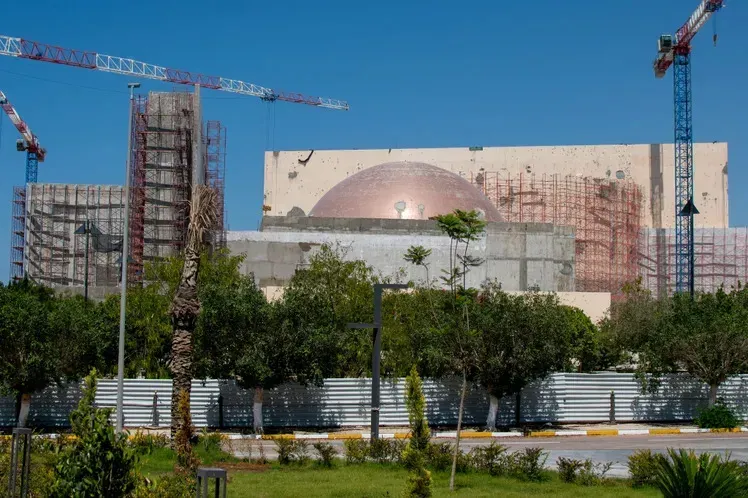
Built by Muammar Gaddafi, who at the time saw himself as the champion of Pan-Africanism, the building's gilded halls witnessed the birth of the African Union in 1999, the year of its inauguration. The copper dome, under which the deposed autocrat received all the continent's leaders with great pomp, is a survivor. ISIS had made this place its headquarters before being driven out in December 2016, after six months of fierce fighting. "They had even transformed this amphitheater into a place for preaching and indoctrination," the NDA employee continued, as he entered the vast main auditorium.
On the concrete floor, feet stumble against relics of the plush carpet that once adorned the opulent green marble partitions. In the center of the stage, rock wool debris forms a growing pile as a worker throws it from a hole in the ceiling. All that remains of the place's former glory is a glass elevator scarred by a burst of Kalashnikov fire and, here and there, period brochures touting "one of the greatest achievements of the Al-Fateh Revolution," the name given to the coup that brought Muammar Gaddafi to power on September 1, 1969.
It is in one of the brand-new ceremonial halls, with its panoramic view of this monument to Gaddafi's regime, that the two delegations of high-ranking officials are expected: Khaled Haftar, son of the field marshal and chief of staff of the LNA for the Benghazi authorities; and Salah Eddine Al Namroush, his counterpart from the army of the internationally recognized government based in Tripoli. A symbol of the old regime, which the chief engineer of the works refuses to acknowledge. "Once the renovation is finished, the name of the building will be changed," dismisses the man in the NDA-branded construction vest.



“Al-Fateh” versus “February 17th”
Sirte, Muammar Gaddafi's favorite city during his forty-two-year reign. He was born not far from there in 1942 and grew up in the city, which remained loyal to the "Guide of the Revolution" until his death in 2011. Fifteen years later, the attachment to the colonel overthrown during the Arab Spring is almost still intact, but is only expressed discreetly in public.
Like other young people his age, Mohamed Selim chose to wear a short-sleeved khaki safari jacket, a nod to one of the former dictator's favorite outfits. "Here, 80% of the population supports Al-Fateh," says the man in his thirties, in contrast to the supporters of "February 17th ," the day of the first demonstration in 2011 against the former tyrant.
“After the assassination of Saif al-Islam (the former leader’s second son, editor’s note) last February, his family initially wanted him buried here, but the authorities ultimately refused, fearing unrest,” Mohamed Selim remarked, seemingly with regret, from the terrace of a seaside café. The man long considered his father’s potential successor was finally buried 200 kilometers away, in the family stronghold of Beni Walid.
But for Soraya Rahem, a doctoral candidate in geography and political science at the University of Tours, “while Gaddafi’s supporters are still numerous, the Gaddafists as a political force do not represent a threat because there is no longer a figure capable of representing them.” For this researcher, a specialist in the Libyan elites of the former regime, the challenge today lies rather in recruiting those who were once close to Muammar Gaddafi: “Many technocrats have left for the West, while elements of the armed forces and the security apparatus have been integrated by Marshal Haftar into the LNA.”
“Two years ago, there was nothing here.”
Moreover, in Sirte, no one would dare question the reconstruction efforts undertaken by the army and the NDA, which is simultaneously building road infrastructure, water networks, schools, hospitals, and even an international airport. "When we arrived in 2020, we found a city devastated both materially and psychologically," recounts Mahmoud Al Farjani, director of the agency, a close associate of Saddam Haftar, deputy commander-in-chief of the LNA, the youngest son and designated successor of the field marshal.
“The Daesh terrorists practiced a scorched-earth policy, which the three governments that succeeded them did nothing about despite their promises,” the official asserts from his air-conditioned office, in a pointed remark aimed at the rival political authorities who administered the city from 2016 to 2020. On the Corniche, Mohamed Selim can only agree. “Just two years ago, there was nothing here: a road, some rocks, and then the sea,” he recalls, his gaze sweeping over the string of cafes and restaurants that line the promenade overlooking the Mediterranean.
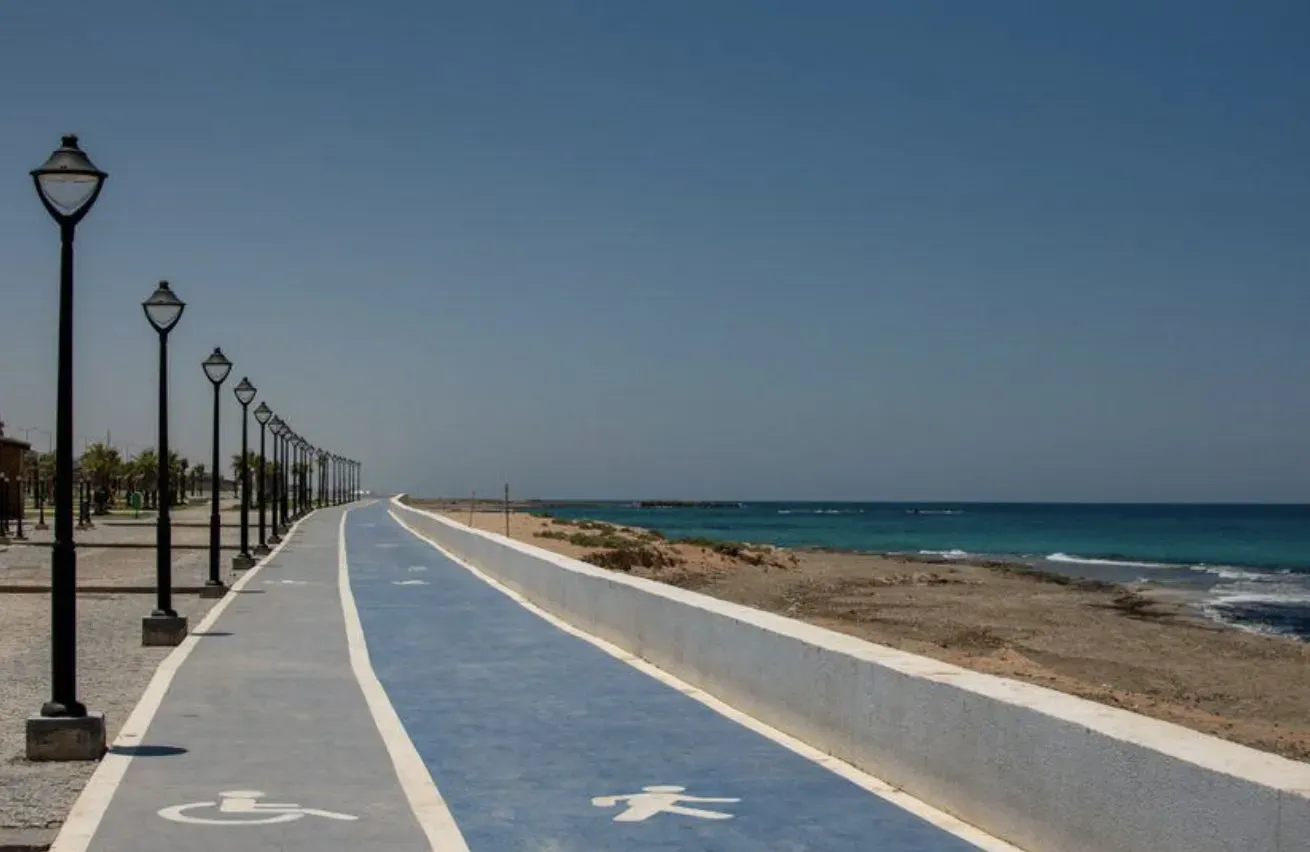
Sirte has even been given a new nickname, "the city of lights," which is displayed throughout the public space among propaganda posters glorifying the Haftar family and his army. "Before these works, there was no public lighting and the city was plunged into darkness most of the time," explains Mohamed Selim.
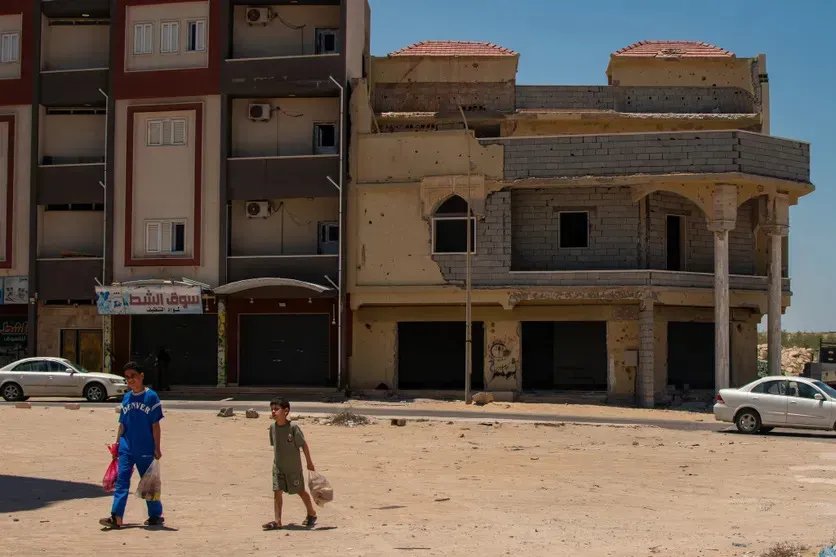
All that remains of those dark days are the bullet fragments that still litter the facades of many buildings, and the vast vacant lot in the city center, a scar left by the devastation of the Al-Jizah district, the last stronghold of the jihadists during the battle of Sirte in 2016.
Ideal narrative
The stage is set, meticulously orchestrated by Haftar's clan to appear in a position of strength in negotiations with the West, where the government led by Abdel Hamid Dbeibah is forced into inaction in the face of militia rule.
The financing of these impressive cosmetic renovations remains completely opaque. No one seems to mind, least of all the US president's envoy, who is prepared to do anything to achieve a historic handshake between the leaders of the two sides. He is even willing to bypass the United Nations Mission in Libya (UNSMIL), which is advocating for elections in 2027, elections that the Trump administration seems to disregard.
The American plan, championed by Massad Boulos, would instead aim to arbitrarily place Saddam Haftar, the marshal's youngest son, at the head of the Presidential Council while maintaining Abdel Hamid Dbeibah in his position as prime minister in a new unified executive.
With a relocation of institutions to Sirte? "It seems that this has been mentioned. Given its recent history and geographical location, Sirte offers an ideal narrative for rapprochement. It was also there that the United States organized the Flintlock military exercise last April, a joint exercise between the two armies. But until a concrete agreement is signed between the two parties, all of this remains completely unrealistic," cautions Soraya Rahem.
An image of very fragile stability
The only downside for the authorities in Benghazi was the attack, which occurred on the same day as the meeting between the general staffs, on a strategic control post held by the LNA in the far south of Fezzan, near the Niger and Chadian borders.
Claimed on social media by the Operations Chamber for the Liberation of the South – a recently formed paramilitary group – this offensive, presented as "a first step on the road to Benghazi," undermines the image of stability that the Haftar family claims to guarantee in this region.
"The current priority of the Haftar clan is clear: to consolidate its hold on these vast southern territories where, until his death, Saif al-Islam Gaddafi retained significant influence."
Soraya Rahem, doctoral student in geography and political science at the University of Tours
"Their current priority is clear: to consolidate their hold on these vast southern territories where, until his death, Saif al-Islam Gaddafi retained significant influence," the researcher explains.
While Benghazi seems to welcome the American diplomatic offensive, the Tripoli government, on the contrary, is reluctant to engage in an initiative deemed too favorable to Haftar's clan. In Sirte, the hooded soldiers have already returned to their barracks as the sun sets, casting a red halo over the Mediterranean, on the evening of the meeting from which no conclusions have been leaked.
The inhabitants are rediscovering the calm of a peace they know better than anyone is precious. Perhaps before the small coastal town becomes the capital of a new, unified Libya after fifteen years of division. An old, unfulfilled dream of a famous native of the region: Muammar Gaddafi.