

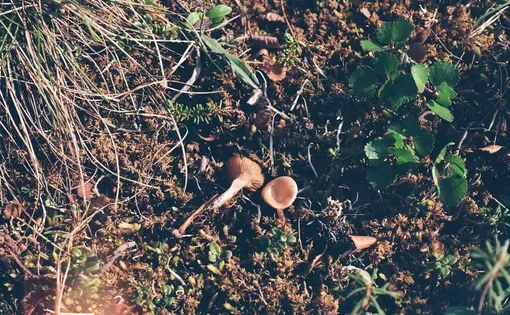
Fungi have traded nutrients with plant roots for half a billion years in an ancient symbiosis. But...
Kelcie Walther’s unconventional path into fungus research and science communication
In high school, Kelcie Walther never thought she’d wind up working in science. “I found STEM challenging,” she said. “I just assumed that I couldn’t do it.” She spent about seven years in and out of community college in the Los Angeles area, exploring many different avenues of study—until one day, she learned about fungi.
More specifically, Walther learned about a theory that symbiotic fungi, known as mycorrhiza, connect to plant roots and work in tandem in vast underground exchanges of carbon, nutrients and water.
“I was so delighted,” Walther said. “I loved learning about it, and I decided to go back to school full-time.” Walther transferred from Pasadena City College in California to Columbia University in New York, dead set on studying environmental biology.

As a nonprofit journalism organization, we depend on your support to fund more than 170 reporting projects every year on critical global and local issues. Donate any amount today to become a Pulitzer Center Champion and receive exclusive benefits!
Yet that was hardly the end of her self-starter ambitions. When she realized that her college didn’t offer mycorrhizal fungal research for undergraduates, she emailed professors elsewhere. Three wrote back immediately. One invited her for a 10-day research experience in Minnesota.
Walther learned how scientists collect environmental samples (known as cores), then conduct all sorts of chemistry experiments. Guided by her passion and curiosity, Walther accepted the challenges head-on. She found a job after college writing about the wonders of new scientific discoveries for the academic journal Cell Press, and now the Nature Trust of British Columbia.
Prior to the Nature Trust, however, Walther joined a nonprofit, the Society for the Protection of Underground Networks (SPUN), to write about fungal research. She traveled the world collecting soil samples to learn more about rare and important species of fungi. In June 2025, that work took her to the Arctic on Alaska’s northernmost coast. While there, Walther spoke with ChemMatters about finding her passion later in life and how she motivates herself to pursue her ambitions.
The interview was edited for length and clarity.
What’s been special about this trip to Alaska?
It’s certainly farther north than I thought I would ever be! It’s unique to get to go to a place where climate change is so evident; a place that’s changing so, so rapidly. At SPUN, we have this little feeling in us that we want to try to help save the world. I know I can’t stop climate change by myself, so I feel grateful to be part of a team that’s trying to understand it.
What was your first experience with field work like as a student?
The field work was a lot like what we just did in Alaska. We were taking cores, but this time, we were looking for roots rather than soil. We looked specifically at which ectomycorrhizal fungi were colonizing root tips of different plant species, with the idea that perhaps they had some shared partners.
I did the field work, and then I did all the lab work. Honestly, my chemistry was a little bit lacking. It was my first time. My thesis mentor said “OK, make this buffer,” and I didn’t know what to do. He showed me how to do things. But it was summer and no one was there, so I spent hours and hours in the lab by myself, extracting DNA, making the buffers, running PCR (poly-merase chain reaction for making more DNA for analysis), and doing gel electrophoresis (using electricity to separate pieces of proteins or DNA by size).
You are now working in communications for the Nature Trust of British Columbia. How did you get into that?
During my undergrad, I started writing for Columbia’s Climate School’s environmental news platform. That was a super fun job. I got to write about all kinds of stuff that I never imagined that I would learn about, like how bloodworms use chemical reactions on their copper teeth. I wrote a press release for that. It got picked up by The New York Times.
I highly recommend looking at your university if you’re interested in science writing. It might be the blog for your chemistry department. I published about 25 articles, and having those clips opened doors. This experience and the number of clips I had helped me land my job at Cell Press.
Then I found out about SPUN. I just emailed the head of the organization and said, “I’m a science writer. If you need anything, I could do some stuff for you.” She wrote me back right away.
Where do you find the motivation to be such a self-starter?
I just kind of have to be. I feel like a bit of an underdog in that I came late to post-secondary education. I dropped out of high school and moved out of my house when I was 17. I really had to be scrappy to take care of myself for a long time.
That big spark of passion and intrigue that I felt when I learned about mycorrhizal fungi—those moments are really, really special. Some people never get that moment in their life, so if you get it, it’s important to chase it.
What’s a strength that you recognize now that you didn’t realize you had when you were younger?
I wish that I knew that everything is interesting, and you can just figure anything out. It’s not a “math person” or “science person” thing—you just haven’t found your entry point. If you study enough, if you find the right people to help you, you can definitely do it. You can also do things that you’re not good at: Just try.