Story
 October 21, 2026
Playing Politics With Lives: The AI-Assisted Drone Wars Under Mali’s Junta
Country:

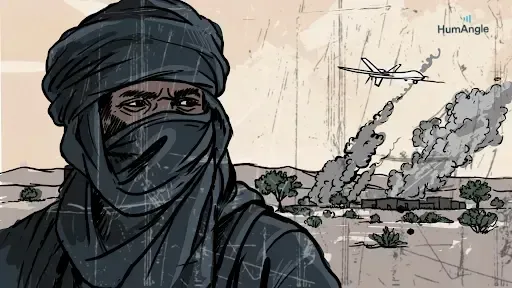
After drone misfires, pro-regime national broadcast stations often air high-altitude, black-and-white infrared footage of airstrikes to showcase the military’s victories. On the ground, civilians going about their lives, including children, get killed during drone strikes in Mali—under a military rulership that decries public outcries.
Life is a boring place for Ahmadu Bayou*.
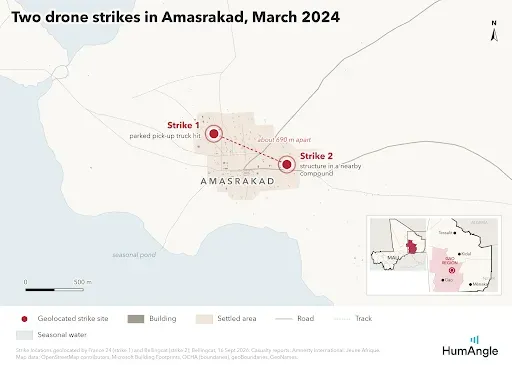
He’s alone and lonely after losing his wife and six children to a remote-controlled drone strike in the village of Amasrakad in Mali’s Gao region. That evening, on March 17, 2024, children’s laughter had dissolved the neighbourhood’s serenity. The villagers had retired into their clustered homes when the country’s air raiders struck, turning the civilian settlement into a kill zone.
“No one saw it coming,” Ahmadu told HumAngle curtly in a hushed tone as if someone else were listening. Surviving under Mali’s junta is to live in denial of your emotional state and exist in performance, he says. The heavy fog of dictatorship hanging over the Republic of Mali began in 2020 following a military coup led by Colonel Assimi Goïta, who ousted a democratically elected president, Ibrahim Boubacar Keïta. The country has since become unlivable for citizens caught between insurgency and state repression.

As a nonprofit journalism organization, we depend on your support to fund more than 170 reporting projects every year on critical global and local issues. Donate any amount today to become a Pulitzer Center Champion and receive exclusive benefits!
When the state’s uncrewed aerial vehicle (UAV) emitted fire from the sky during a counterterrorism operation in Gao, it killed Ahmadu’s entire family and seven other unarmed locals. The bombing was delivered summarily; only that it fell on the wrong targets, survivors say, noting that the incident has reduced the settlement to a ghost of itself. Two years later, only human wreckage is left in the village of Amasrakad, bombarded by the Malian junta in the name of destroying terrorists.
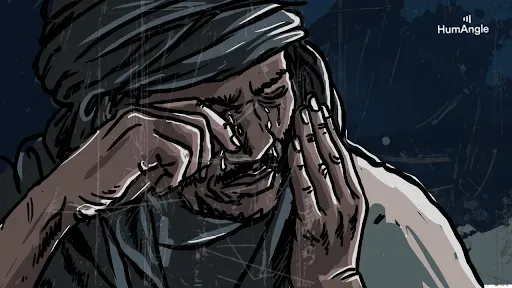
“My wife and six of my children thought they were safe. They posed no threat and had no connection to any armed group,” Ahmadu sobs, wiping away his tears. “Since that day, I have lived with constant pain and deep anger toward the Malian military. My heart is broken.” The woes that befell the Amasrakad village were compounded by the state-backed narrative that followed. After the deadly drone strike, the official media narrative seemed skewed, claiming victory over “terrorist elements” without acknowledging that defenceless civilians, including children, were indeed incinerated during the bombing.
As AI-powered drone systems are increasingly deployed in war theatres across Sub-Saharan Africa, people already terrorised take the fall for terrorists amid a growing trend of military misfires. HumAngle has travelled across Nigeria, Mali, and Ethiopia to document how AI systems are being integrated into defence and national security. The curious cases of drone misfires are worse in Mali, where a military government enforces an eerie, heavy silence on civilians caught up in the crossfire of the state’s flawed intelligence during air raids. The oppressive atmosphere stands against dissent from victims and survivors of erroneous air strikes, with the regime isolating affected communities and preventing them from organising or expressing themselves.
Since at least 2023, the Malian military has changed the face of its war against insurgency, deploying armed drones where terrorists used to engage soldiers in physical ground combat. In the Kidal, Gao, and Timbuktu regions of the country, civilians pay the price for the Malian military’s drone warfare, but officials insist during media parleys that they are winning the war against terror. The ongoing insurgency in these Malian regions is cemented on the deadly foundation of political and ethnic marginalisation. The violent wave began in 2012 when the Tuareg separatist group, the National Movement for the Liberation of Azawad (NMLA), sought independence for the northern region of Mali. A turnaround occurred when menacing extremists outpaced the separatist group, subjugating towns and villages in the region under their control. In 2013, French-led military forces pushed the insurgents, including affiliates of Al-Qaeda, into surrounding rural areas and deserted terrain.
Many communities became ungovernable, and security situations in these regions deteriorated into a complex war involving ethnic militias, rival insurgent groups, and foreign forces. Over the past decade, Mali’s political landscape has shifted dramatically following consecutive coups d’état that have only worsened the country’s security crisis. As terrorists established persistent strongholds that prevented state governance, the Mali junta turned to air warfare to conquer them. Drone strikes in Mali increased sharply after 2021, accelerating again from mid-2023 as the junta turned to aerial surveillance and remote strikes to offset battlefield losses against insurgent groups. Although Turkish‑supplied drones were credited with helping government forces recapture the northern city of Kidal from Tuareg rebels in November 2023, officials failed to acknowledge civilian casualties in their state broadcasts.
HumAngle has interviewed survivors of drone attacks in the junta-led state, where affected locals are forced to mourn in silence. Under tense, militarised conditions, the locals we spoke to asked that we leave their images out of this report for fear of retribution. HumAngle conducted audio interviews with the victims in hushed tones, mostly in places out of sight, to avoid subjecting them to punishment for speaking to a journalist. After a misfire, pro-regime national broadcast stations often air high-altitude, black-and-white infrared footage of airstrikes to show the public the military’s victories. On the ground, civilians going about their lives, including women and children, get killed during drone-led strikes in Mali – under military authorities that decry public outcry.


Mourning in silence
Less than seven days after the March 17, 2024, terror bombing in Amasrakad, another drone strike targeted a residential compound within the village of Douna in the Mopti region. Following the operation, the Malian army immediately claimed that a precision air strike had “neutralised an active insurgent training camp and eliminated a high-priority cell of Islamist fighters”. But HumAngle found that the drone had only struck an Islamic school building, killing fourteen people, including ten children, and severely wounding more than a dozen other students, witnesses say.
The same pattern was established when the Malian military mistook a civilian community for a terrorist enclave during an air campaign in the Ségou region. Around 3:00 p.m. on February 16, 2024, a combat military drone dropped a bomb directly onto an outdoor civilian wedding celebration in the village of Konokassi. The following day, another drone hit the survivors while they were burying their dead. The military kept a dangerous silence over the attack, which human rights organisations described as a reckless bombing of civilian settlements. The first aerial strike killed five men and two young boys instantly while wounding three others. The second killed an additional five men and two boys and injured six more locals.
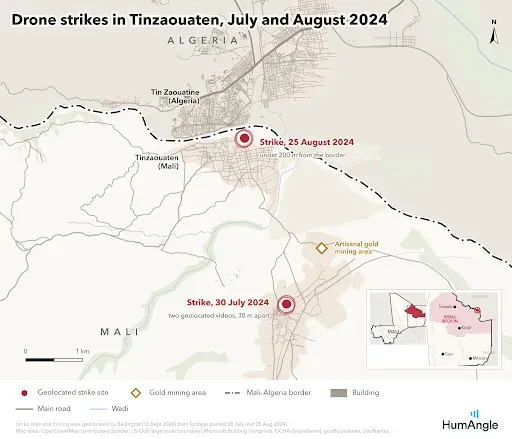
Northern Mali now bears the scars of a ruthless pogrom, locals told HumAngle. In Tinzaouatène, just a few kilometres from the Algerian border, the killer drone portends death that takes villagers by shock. In August 2024, Siddi Mohammed and other villagers saw a drone hovering in the sky and thought it was a regular military helicopter on a surveillance routine. Since at least November 2023, the community had witnessed air patrols by the Forces Armées Maliennes (FAMa), the French name for the Malian armed forces. Many considered the surveillance routine necessary to protect them from armed criminals, until it became a death sentence for civilians.
“Suddenly, we heard a loud voice that first sounded like a whistle, followed by the massive explosion,” Sidi recalls precisely. The Tinzaouatène civilian settlement was quiet until the strike disrupted everything, killing seven unarmed villagers indiscriminately, including five children. “None of those killed was a fighter; we’re all villagers going about our lives here, yet they targeted and killed us with no remorse.”
In Inadiatafane, a crowded market in the Timbuktu region, a strike hit in broad daylight on October 21, 2024. Attaher Ag, a villager caught in it, said he was in his compound when the first strike happened. The consecutive bombings killed eight people, including a four-month-old baby and a six-year-old girl, sources said. The drone’s shrapnel also injured 15 traders and hit at least five motorcycles parked in the market. “Many of the traders who got injured from the drone strike fled into the bush, with some refusing treatment at the health centre,” Mohamed Ag, another resident of Inadiatafane, told HumAngle. “We leave ourselves in God’s hands, because no one came to help us.”
Amnesty International, a global human rights organisation, says these repeated attacks on civilian settlements by Malian forces constitute a violation of international humanitarian law. Several other non-governmental organisations, including Human Rights Watch, have called for an independent investigation into the repeated killing of civilians in place of terrorists. But the Malian authorities have failed to initiate any public proceedings to that effect. Instead, survivors of drone attacks are tagged “terrorists” within the corridors of power in Bamako, the country’s capital. Driven by the intensifying drone strikes, several nomadic families have fled their communities. They now seek refuge in Gao, Mopti, or Timbuktu at internally displaced persons (IDP) sites.
Fatoumata Keita, a displaced woman in her fifties, told HumAngle how her husband, a nomadic herder, was mistaken for a terrorist during a drone strike in Kidal. Now living in a displacement camp in the Gao region, Fatoumata wonders if her husband’s soul will ever get justice. “He didn’t deserve such a death. He wasn’t a rebel,” she weeps. “He was a simple man, devoted to his livestock and his farm. We lived peacefully.”
The race for Turkish drone systems
After a successful military coup in Mali, the new military junta immediately pivoted away from decades of security cooperation with Western partners. Facing international sanctions and arms restrictions, Mali’s military rulers turned to defence acquisitions with fewer human rights compliance mandates. At the centre of this shift is the Bayraktar TB2, a medium-altitude, long-endurance unmanned drone manufactured by the Turkish defence firm Baykar Makina. The transitional military authorities quickly realised their conventional ground infantry could not hold the vast, open desert plains of the north and central delta regions. This vulnerability drove the regime to negotiate directly with the Turkish defence company.
The first batch of Bayraktar TB2 combat drones arrived in Mali in December 2022. Another delivery was reported in March 2023, and another shipment arrived in January 2024. In November of the same year, the junta acquired even more advanced Turkish-made UAVs: the Bayraktar Akinci, a new-generation, high-altitude, long-endurance (HALE) combat and reconnaissance drone. The Akinci is designed for surveillance, intelligence, and precision air-strike missions, with high-intensity strike capability. In June 2026, the country received additional batches of Akinci drones at its air base. The Akinci drones would soon become the symbol of the FAMa amid the escalating war against jihadist groups in the country.
In a 2025 report, the Malian authorities were accused of procuring the Turkish Akinci drone systems for over $200 million using “opaque financial structures to hide the true terms of the deal from the public”. The mad rush for AI-powered drone systems in Mali has led military ethicists to question whether well-trained operators are handling these emerging technologies. On at least three occasions, the Turkish drones have crashed in ways that suggest technical failure or improper operator handling. In May 2023, a Bayraktar TB2 suddenly crashed at the Gao Airport during low-speed ground manoeuvring. The crash-landing incident was traced to a collision during taxiing on the tarmac. Following a surveillance mission in January 2025, a newly deployed Akinci drone was destroyed on landing after a technical failure, according to reports. Another serious case happened in March 2025, when an Akinci drone deployed to fight the Tuareg fighters was shot down by the Algerian air defence forces for crossing into their airspace without permission.
Baykar, the Turkish defence technology company producing TB2 and Akinci drone systems, has not responded to HumAngle’s inquiries into its operations in Africa, especially regarding post-sale and end-user monitoring of UAVs supplied to junta-led countries like Mali. We asked whether African countries patronising Baykar comply with human rights standards and whether the UAVs’ payload and auto-navigation systems integrate technical safeguard protocols. HumAngle has not received a response since it made these public-interest inquiries in the first week of October 2026.
Civil-military relations under Mali junta
As armed violence and insurgency continue to escalate in Mali, military analysts suggest that the acquisition of advanced drones like the TB2 and the Akinci serves as a means to exert control over terrorist groups threatening the country, but authorities must maintain civil-military relations by avoiding systemic collateral damage. A security policy report by West African Maps, a Sub-Saharan intelligence firm, says the large number of collateral incidents and operational losses stems from hasty drone deployments, poor operator targeting, and critical errors of judgement by ground forces.
In the context of integrating high-grade technology in defence and national security, Elke Schwarz, a professor of political theory at Queen Mary University London, stated during an exclusive online roundtable on ethics and international affairs that state authorities must take responsibility for technical flaws in AI-assisted military operations, noting that the creators of these technologies must also consider human rights.
“A responsible state actor is one who considers the use of military AI targeting tools with conscientiousness and care, although this is often a vague normative claim,” Elke says. “A responsible producer of AI is one who takes good care to make AI-weapon systems compliant with existing procedures and design principles across the system lifecycle, even though it stands to reason that their primary incentive will be to meet business development goals.”
When the Malian government acquired the Turkish drones, authorities promulgated in many broadcasts that the AI-assisted systems would end insurgency in no time. However, the unchecked air campaigns using these systems have created a dangerous disconnect between the junta and the local population. The high number of civilian casualties seems to be driving ordinary people into the dangerous arms of the armed groups, sources say.
Raphael Parens, a senior fellow at Delphi Global Research Centre and a fellow at the Foreign Policy Research Institute, told HumAngle during a virtual interview that many locals find it difficult to help the Malian military in its ground-level intelligence gathering because the country’s civil-military relations bond has been ruptured due to persistent trust breaches from the government.
“I don’t think the government really cares about whether they’re hitting civilians or jihadist forces, because in a lot of cases, I think they’re conflating the two,” says Raphael, who has researched the deployment of drones and civilian protection in Africa for years. “They [the government in Mali] are saying that, hey, if you’re aiding and abetting, if you are living in the same area as jihadist forces, if you’re the same religion as jihadist forces or the same ethnic group, then you’re complicit in their activities.”
Ensuring civilian protection should be the primary concern of states integrating AI-assisted drone programmes into counterterrorism efforts, Raphael says, urging the Malian government to strengthen its relationship with the civilian population. “And until the government is willing to take responsibility for issues, it’s just going to continue this cycle of violence, jihadist recruitment, more violence, and so it continues. And again, that just comes back to kind of the collapse of any sort of civil-military relationship that works in the country, unfortunately.”
Mohamed Allassane, a local researcher in Mali, corroborated Raphael, after witnessing numerous strikes and interacting with many survivors in the Ménaka region. “The military strikes have disturbingly targeted civilian rural people, destroying lives, livestock, and property and worsening the existing humanitarian crisis,” Mohamed says. “Women, children, and herders appear to be the primary victims of drone strikes in the border areas of the Ménaka region.”
The names marked with asterisks (*) are pseudonyms used to protect the identities of the sources.