Story
 May 28, 2026
Illinois' Top DUI Cop Still on Medical Leave Months After Being Accused of ‘Fabricating Evidence’
Country:

Project
Brady Cops
Illinois officers with histories of misconduct move from one department to another.
CHICAGO — An Illinois State Police trooper who won “top cop” honors three years running for leading the state in DUI arrests has been on medical leave for more than six months since facing accusations from defense attorneys of systematically “fabricating evidence” to rack up arrests and earn more overtime pay.
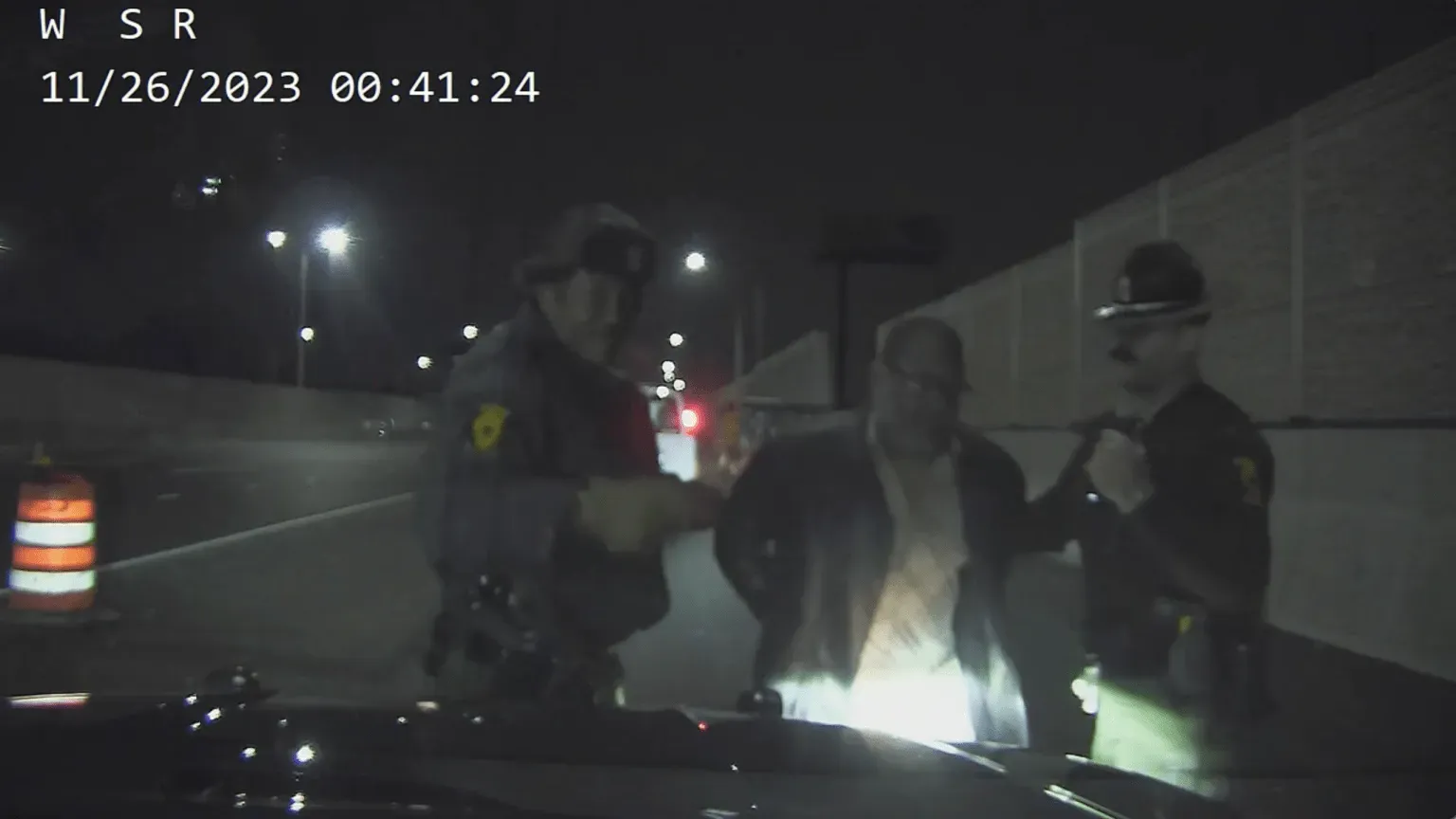
Among the cases at the center of those accusations is that of Raymond Theus. Late one night in November 2023, Theus was driving home northbound on Interstate 294 in the southwest suburbs with his wife from a party at his mother-in-law’s house when Trooper Kevin Bradley pulled him over for making a “single alleged lane violation.”
According to court documents, Bradley wrote in his arrest report that he smelled a “strong odor of an alcoholic beverage emitting from the vehicle” upon first speaking with Theus. Bradley reported that he observed Theus’ “eyes to be bloodshot and glassy and [for him] to have slurred speech” and that Theus stumbled upon exiting the vehicle — elements that could establish probable cause for asking a driver to submit to a sobriety test.
As a nonprofit journalism organization, we depend on your support to fund more than 170 reporting projects every year on critical global and local issues. Donate any amount today to become a Pulitzer Center Champion and receive exclusive benefits!
But a video of their interaction showed that Bradley only mentioned noticing Theus’ “bloodshot glassy eyes” and smelling “the odor of alcoholic beverage” on his breath after Theus admitted to having “a little bit” to drink but refusing to submit to a field sobriety test.
Shortly after saying that to Theus, Bradley is seen handcuffing and arresting him in the video.
As a result of the DUI arrest and the charges filed against Theus — dismissed only last month — he lost his job as a truck driver. Theus and his wife have lived on her income since 2023, he said.
“Thank God we in this together,” Theus said. “She was at my back 100 percent.”
Theus’ attorneys alleged that his arrest was part of a larger “scheme” of Bradley’s to arrest people “without probable cause and later justify the arrests with cookie-cutter field reports which contained copied and pasted observations of fact” to benefit financially from overtime that resulted from the cases.
Bradley did not respond to requests for comment, nor did his lawyer.
The Alliance Against Intoxicated Motorists, a “grassroots citizen group incorporated in Illinois to combat impaired driving,” named Bradley the state’s “top cop” in 2022, 2023 and 2024 for recording the most DUI arrests in the state. Bradley made 528 arrests across those three years, roughly 150 more arrests than the nearest officer, Chicago police officer Michael Phillips.
Because of all the overtime Bradley accrued by testifying for cases that stemmed from the DUI arrests, he collected nearly $250,000 in 2024. According to court filings, he was on track to make more than $270,000 in 2025 before going on extended medical leave for undisclosed injuries after a driver hit his squad car. Bradley’s 2024 and 2025 total pay are more than 250 percent of his base salary of $97,200 in 2024 and tens of thousands of dollars more than Illinois State Police Director Brendan Kelly makes, according to the Illinois State Comptroller’s database.
While it is not a total anomaly for state troopers to double their salaries from overtime, the average amount of overtime they accrue is roughly $42,000, according to the database.
Andrew Segal, an assistant public defender who represented Theus, said in a recent interview that he was surprised Bradley’s overtime pay hasn’t raised eyebrows with Illinois State Police leadership.
“One would assume … there would be some material safeguards,” Segal said. But “maybe the ISP brass sees a trooper who’s increasing his DUI totals year after year after year, he’s winning the award for the most DUI arrests in the state, and that’s a shiny star for them. … And if it comes at the cost of the civil rights of drivers like Mr. Theus, so what? It’s good for us. We’re not going to upset the apple cart.”
Cases Fall Apart
DUI cases hinge on officer testimony in the absence of physical evidence, such as a breathalyzer test. In those situations, defense attorneys often try to impugn the credibility of an officer’s account by pointing out discrepancies between the reports they write around the time of an arrest and body-camera and dashcam video that is typically available since use of such devices became mandatory under the SAFE-T Act enacted in 2021.
Given how many of the prosecutions stemming from Bradley’s arrests heavily rely on the trooper’s field reports, his in-court testimony is imperative toward winning a conviction. But while Bradley has been away on medical leave, courts have had to dismiss some DUI cases on procedural grounds because prosecutors are unable to go to trial without their key witness. It is unclear what the merits of those cases were because they were not adjudicated by a judge or jury.
The Cook County State’s Attorney’s Office would not comment on the dismissals, citing “pending litigation.”
“Witness credibility is an important factor, and we take it very seriously,” Tandra Simonton, an office spokesperson, said in an emailed statement. “As we do in all cases, the CCSAO continues to evaluate witnesses under our Brady/Giglio policy.”
Bradley’s name did not appear in a database prosecutors maintain to track witnesses with credibility issues in accordance with that policy, according to records obtained via a public records request.
Of the more than 300 DUI prosecutions that list Bradley as the arresting officer since 2023, roughly a third of the defendants were found guilty, while more than half were found not guilty at trial or had their cases dismissed before trial, according to an investigation by ABC7.
Asked whether the State’s Attorney’s Office is concerned that cases like Theus’ are being dismissed because Bradley remains on medical leave and is not testifying, Simonton said “questions regarding the trooper’s status should be directed to ISP.”
The Illinois State Police did not offer a date by which Bradley would return from medical leave in response to a reporter’s emailed questions, nor would the agency “comment about possible internal investigations” into Bradley.
“ISP prides itself on integrity, respect and fairness,” Melanie Arnold, an Illinois State Police spokesperson, said in an emailed statement. “ISP has strong [oversight] of all officers and addresses any discrepancies or complaints when they are identified.”
‘It’s a Free-For-All’
A court filing by Theus’ attorneys alleged that Bradley’s arrest reports “all appear similar in organization and often include identical language, turns of phrases, and mistakes across all reports.” While their filing conceded that use of “procedural words and phrases … is perhaps understandable,” they allege to show that the “reports also contain copied and pasted observations of alleged facts.”
In one case cited in court documents, Bradley included language in a report stating that he conducted a “horizontal gaze nystagmus” sobriety test during a September 2023 Markham traffic stop — which looks for involuntary jerking of the eyes — even though the man arrested refused to take that test. Under oath during cross examination at the trial, Bradley admitted to the error, claiming it was a “typo” but did not directly answer whether he copied and pasted information when writing his reports.
In a March 2022 Chicago Ridge case cited in court documents, Bradley described the arrestee as “Thomas C. James” in his field report narrative even though the man’s name, Gehad Othman, is clearly listed in a designated field above. He also misstated Othman as having driven a gray 2015 Dodge Charger, despite listing elsewhere a different registration, car make and model, as well as an incorrect time and location for the arrest.
Field reports also show Bradley arrested a man named James C. Thomas in Markham, the day before arresting Othman. The narrative sections of the field reports, including the misordering of “Thomas C. James,” were verbatim copies of each other. Bradley signed the narratives as complete and accurate, and both were approved by the same supervisor, Lt. Adam Miklaszewski, who did not catch the error.
“There’s no control over him. It’s a free-for-all,” Segal said.
Theus’ lawyers also alleged that Bradley had a “disciplinary history and prior dishonesty on the record which establishes [his] motive to be untruthful in this case.” Court documents show that Bradley’s disciplinary history includes an incident in which he took a laptop from the car of someone who was driving under the influence, keeping it in his home supposedly for safekeeping, and another incident in which he drove an intoxicated woman to her home at more than 100 mph on Interstate 90 after arresting her boyfriend for drunken driving.
Prosecutors defended Bradley in court filings and in oral arguments last fall, arguing that his disciplinary history was irrelevant to Theus’ case and that typos “do not equate to fabrication.”
“You just sat through countless arguments, a lot of bold allegations with absolutely no hard facts to back up what they’re saying,” Assistant State’s Attorney Toni Giancola told the court.
Prosecutors said that no prior judge had cited Bradley as dishonest in their rulings even if they had found the defendant not guilty, and they said that, in 2024, all 124 Bradley arrestees who took a breathalyzer test blew over a 0.00 percent blood alcohol content. However, prosecutors did not cite how many of those blows were under the legal limit of 0.08 percent.
Cook County Judge Linzey Jones ultimately ruled that Theus’ lawyers could introduce evidence about Bradley receiving multiple “top cop” awards and significant overtime pay, but not about his prior field reports or disciplinary cases. However, the ruling became moot as the case never reached trial.
After pending for more than two years, the case against Theus was dismissed April 7 due to Bradley’s failure to appear.
Civil Lawsuit Tied to Another Arrest
Rachel Sansonetti, an assistant public defender who also defended Theus, said in a recent interview that because the majority of Bradley’s arrests didn’t have breath samples, much of prosecutors’ cases relied on the veracity of Bradley’s reports and testimony.
“Once reports start to unravel or start raising red flags, it becomes, how do we know that these are DUIs?” she said. “All we had to go on was his word. And if we can’t trust what you are saying, then it’s nothing.”
Theus is not the only person to believe Bradley arrested them under false pretenses. In August 2024, a Cook County man filed a civil lawsuit in federal court accusing Bradley of illegally arresting him for driving under the influence and child endangerment, charges that ultimately cost him his job and limited his ability to see his son because a Department of Children and Family Services investigation was initiated against him. The man was found not guilty of all charges in his criminal trial.
The Illinois Attorney General’s Office, representing Bradley in the civil case, denied the claim of false arrest in a court filing. The case remains pending, with settlement negotiations ongoing.
Despite the charges being thrown out against him, Theus has a notation on his driver’s record listing his DUI arrest. Because Theus didn’t have a lawyer to challenge it within four months of the arrest, it will likely remain on his record for years to come. The notation has made it difficult for him to return to work, Theus said.
“They say, ‘Clean your record.’ I already cleared that up,” he said.
Many employers refuse to call Theus back when he applies for jobs, he said.
“I look forward to getting back pretty soon to doing what I used to do,” he said.
Theus said he worries other drivers could face similar ordeals if Bradley returns to duty.
“Hopefully it’s going to be stopped soon,” he said. “If you’re not doing the job responsibly, you shouldn’t continue.”