Story
 June 19, 2026
Brass Rooster Stands at the Center of Debate over Benin Bronzes
Country:

Students report on various issues around the world.

High-value artifacts from the Kingdom of Benin in Nigeria are scattered across the world’s museums and private collections. Their return home is a highly contested subject.
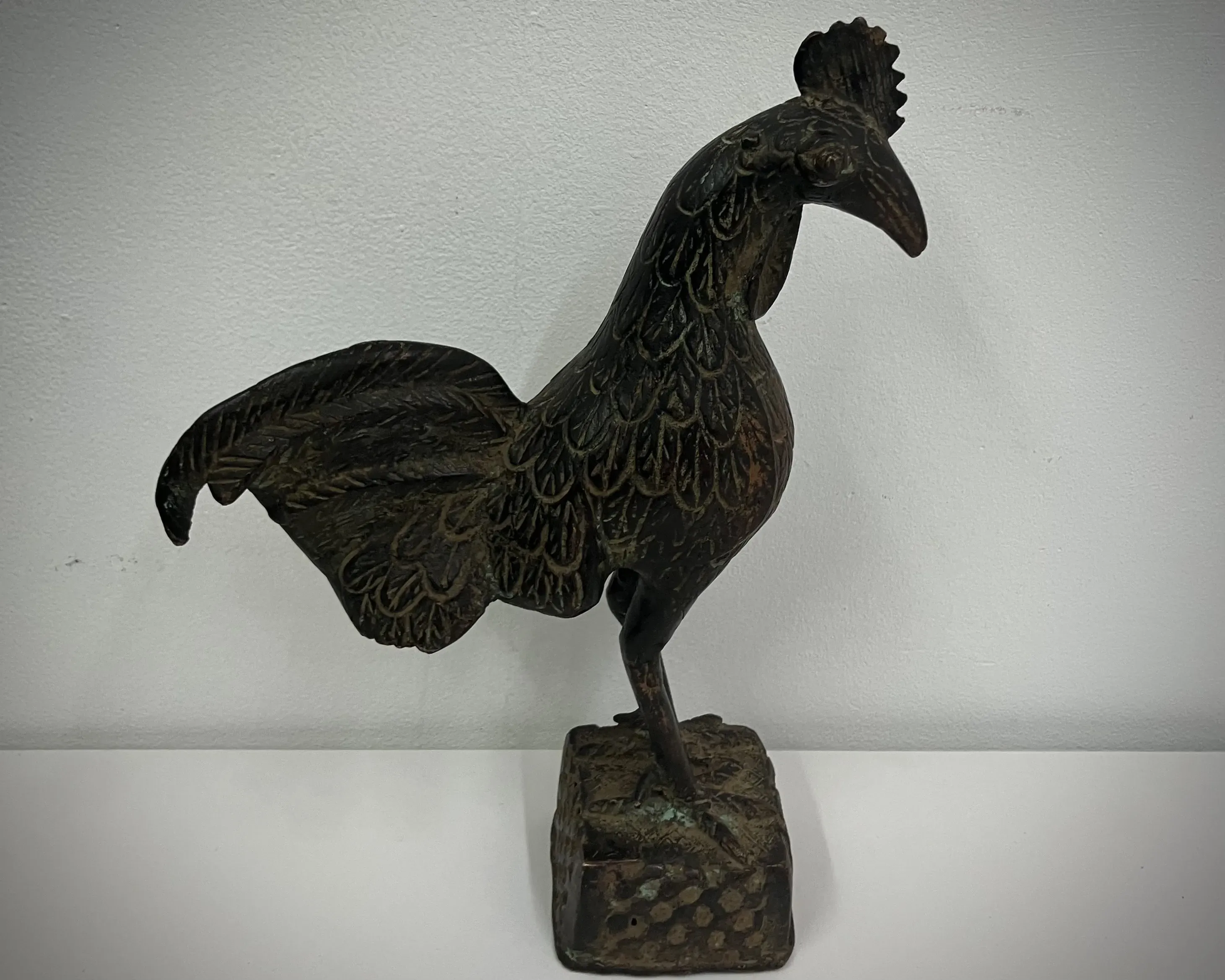
NEW YORK CITY—Tucked away on a corner table inside a small Brooklyn art studio, the brass rooster sits comfortably next to cardboard boxes and plastic water bottles. There is no plexiglass encasing it, no white shelf for it to sit on. This artifact is a Benin Bronze—one of many highly contested, historically significant, and high-value artifacts from the Benin Kingdom of Nigeria. According to the Bronze’s owner, this object has the potential to be worth upward of $3 million.
For several decades, advocates and academics have been pushing to return these artifacts back to Nigeria. Right now, the majority of Benin Bronzes are still scattered across the world’s museums and private collections. Most have been away from home for over a century.
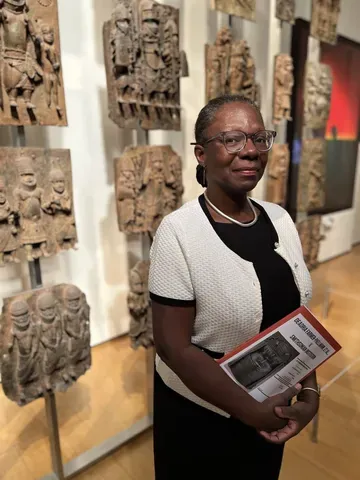
This brass rooster, for example, still remains across the world in New York City. The Bronze’s owner is Deadria Farmer-Paellmann. She is a Brooklyn native and the founder of Restitution Study Group, a New York-based advocacy organization focused primarily on securing reparations for Afro-descendants.

As a nonprofit journalism organization, we depend on your support to fund more than 170 reporting projects every year on critical global and local issues. Donate any amount today to become a Pulitzer Center Champion and receive exclusive benefits!
Farmer-Paellmann doesn’t intend to return this Bronze to Nigeria. Instead, she wants it to remain right here in New York, where descendants of the transatlantic slave trade will be able to view it. But despite her hopes for the future of her Benin Bronze, few restitution advocates would be inclined to agree with her choices.
One of the most significant questions in any restitution debate is how an artifact got to where it is now. For the Benin Bronzes, most were taken from Nigeria forcefully.
In 1897, a British punitive expedition sent thousands of soldiers into the Benin Kingdom’s royal palace. For several weeks, they burned villages to the ground, massacred families, destroyed sacred sites, and art was looted. The Benin Bronzes were divided up among colonial forces and sent to London. Many were locked away inside the British Museum or sold through the art market. Today, the vast majority of the Benin Bronzes are located outside of Nigeria. They’re scattered across museums and private collections all over the world.
For many Nigerian activists, the loss of the Benin Bronzes represents a continuation of the legacy of imperialism. After decades of fighting, many museums have returned individual Bronzes and even entire collections. At times, activists were aided by the willingness of certain museums. In February 2026, the University of Cambridge transferred legal ownership of 116 artifacts to Nigeria’s National Commission for Museums and Monuments. Still, the majority of these objects have yet to make their way back home.
In 2022, Farmer-Paellmann filed a class action lawsuit against the Smithsonian. The goal was to prevent 29 Benin Bronzes from being repatriated to Nigeria. After decades of fighting for Edo cultural history to be returned, she was threatening to undo another milestone in the progress of restitution.
Farmer-Paellmann is an advocate for descendants of slavery. Early in her career, she looked at the ties between American corporations and the institution of slavery. In 2000,
Farmer-Paellmann prompted the U.S. healthcare company Aetna to formally apologize for its role in insuring slave-holders. Two years later, she sued Aetna, FleetBoston Financial, and CSX Transportation on the grounds that these corporations had unjustly profited from the slave trade. The case was eventually dismissed in 2004, but Farmer-Paellmann hasn’t slowed her efforts.
“When I approached the Smithsonian from the very beginning, it was to explain to them why these Bronzes should not be transferred,” Farmer-Paellmann said. “Because they essentially are laundered slave-trade properties.”
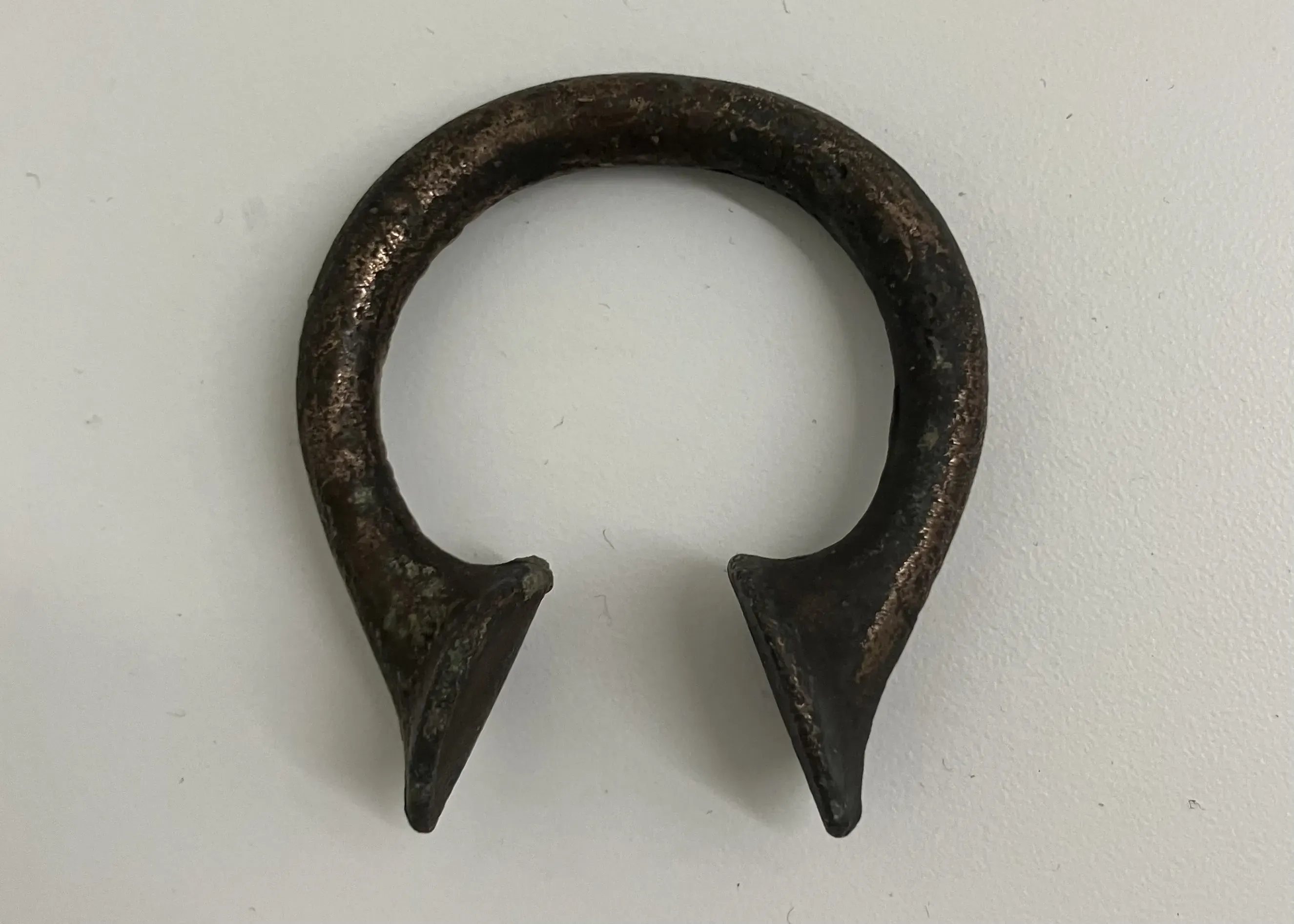
Benin Bronzes were created using a melted brass currency called manillas, Farmer-Paellmann said. From the 15th century onward, these horseshoe-shaped objects were used throughout West Africa. Manilla currency arrived through Portuguese traders, who exchanged it for a variety of goods. Manilla coins could be traded for gold, ivory, and, most significantly, for human property. In the Edo Kingdom of Benin City, manillas were the currency of the slave trade. The manillas were then melted down and recast into royal artwork. Manilla coins were reshaped into oba (or king) heads, ceremonial plaques, and, of course, brass roosters.
Farmer-Paellmann believes that in returning these objects without question, advocates are continuing a legacy of slavery.
“They’re made with manilla currency that was exchanged for humans. And they’re going right back to their slave-trader heirs,” Farmer-Paellmann said.
Ultimately, the District Court of Columbia denied the motion based on lack of standing, and the 29 Benin Bronzes were returned to the Nigerian government.
Farmer-Paellmann, however, has found new avenues to continue her cause.
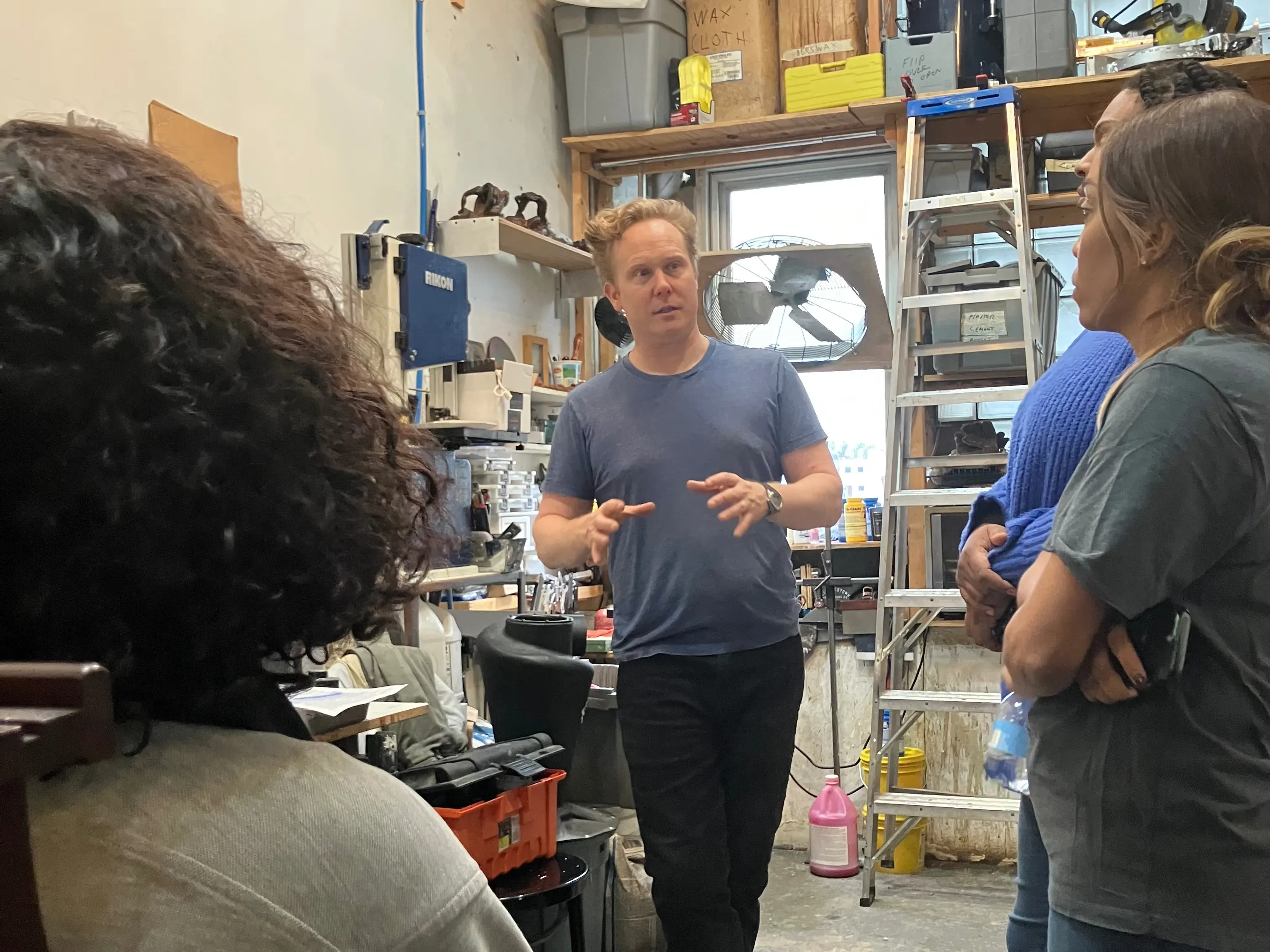
Standing in a cramped room of artists and community leaders, Farmer-Paellmann holds a small brass object with both hands. The rooster is entirely metal, maybe a foot tall.
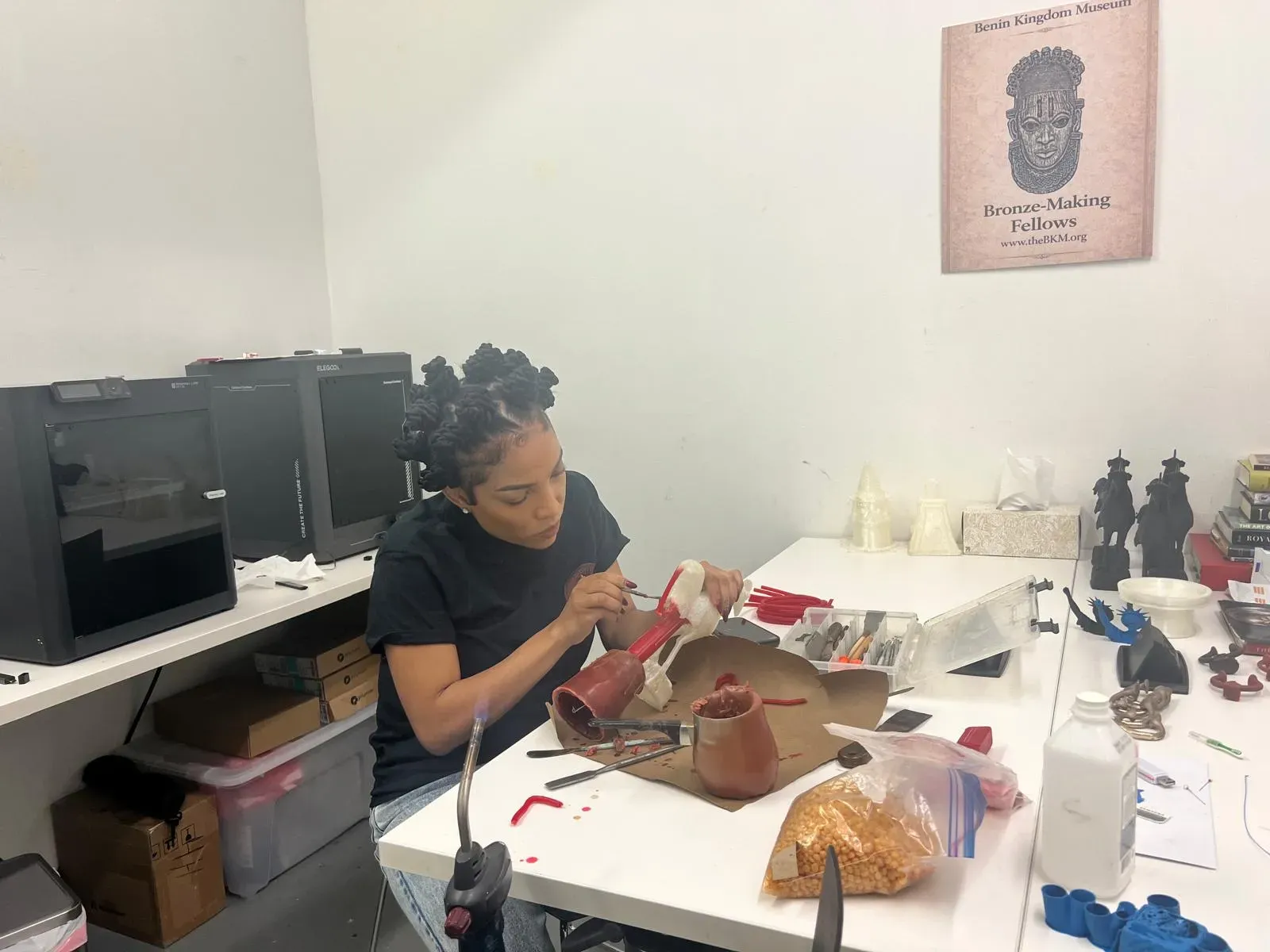
A small crowd of artists, gathered during Restitution Study Group’s Bronze-Making Fellowship in New York City, watch, enraptured, as she reveals that this is an authentic Benin Bronze.
The Bronze is passed between the hands of several art fellows. Despite being told that it’s essentially unbreakable, each fellow holds the object carefully. As if it were made of glass.
According to Farmer-Paellmann, she discovered the Benin Bronze completely by coincidence in May 2025 at a neighborhood thrift shop in Manhattan, New York City. She purchased it for $350. How the Bronze made its way from auction houses, art collectors, and museums to a thrift shop is still unknown.
When Farmer-Paellmann first encountered the Bronze, she had no way of knowing it was even authentic. Still, she was willing to take the risk. The brass rooster, small and unassuming inside a New York antique shop, had the potential to be the very object she had advocated to see reimagined. This was her chance.
“She came to me this summer and said, ‘This could be something, it could be nothing,’” said Blake Hiltunen, a Pratt Institute professor and longtime colleague of Farmer-Paellmann.
Farmer-Paellmann had approached Hiltunen for help in determining the piece’s authenticity. Together, they extracted a small sample of metal from the underside of the Bronze and sent it to a lab in Germany.
Tobias Skowronek, a German scientist who has been studying the Benin Bronzes for several years, is fairly sure that the Bronze is authentic. Based on the tests that he was able to complete, the object appears to be exactly what Restitution Study Group had hoped.
“That particular object that they have, this cockerel,” said Skowronek, “it has around 24% of zinc, and that’s roughly the same amount that the manillas had.”
Without testing the isotopes of the metal, it’s impossible to know anything with certainty. But Skowronek believes that further testing would confirm his assumptions about the statue.
“With the cockerel, we cannot be sure yet because we do not have the isotopes,” Skowronek said. “But at the moment, it looks to me like a common Benin Bronze that was made from a manilla.”
Another unknown is the exact provenance of the object. It’s possible that this particular Bronze was taken during the 1897 British colonial expedition. But Restitution Study Group is struggling to determine anything for sure.
Ayodokun Osuolale, a Nigerian heritage specialist, believes that providence should be a determining factor in the question of restitution.
“Not all the objects got to where they are positioned by forced extraction. Some were through trading, and at that point they end up being donated into the archives or museums where we now see them,” Osuolale said. “And for those objects that weren't forcefully taken, that were traded, what should happen to them?”
If this Bronze is determined to have been unethically removed from Nigeria, advocates may start asking to see the cockerel’s return.
Farmer-Paellmann doesn’t intend to repatriate her Bronze back to Nigeria. But she doesn’t want to keep the Bronze to herself, either.
She is in the process of developing a museum. Her vision for this space is a gallery in Harlem, New York. Somewhere to display both authentic and replica Benin Bronzes, as well as a space dedicated to genealogical and ancestral research. At its core, Farmer-Paellmann hopes to build a place for Afro-descendants to learn about their heritage. The brass cockerel would be a central figure in this museum.
“I would love to keep it for myself,” Farmer-Paellmann joked. “But I know that it doesn’t belong to just me, it belongs to all of us. It has to go somewhere where we can own it equally.”
Farmer-Paellmann has been in communication with the Nigerian government regarding her Benin Bronze. She hopes to come to some kind of agreement regarding the object.
“This needs to travel within the Diaspora,” she said. “And we need to have an agreement over all of the Bronzes. We need to engage in good stewardship. And that is what we have been asking for, for a while now.”
Many advocates for the repatriation of the Benin Bronzes are familiar with how these objects connect to the slave trade. Yet most are unconvinced that a tarnished history is enough to justify retaining the objects in the Western world.
“If you ask me as someone who is studying culture, heritage, things like that, I think I can have my own opinion,” anthropologist Osuolale said. “I think associating artifacts and heritages that are taken out of Africa with the slave trade is definitely a wrong conception.”
“I am not for the forceful return of objects. I don't buy into that,” Osuolale said. “But I want there to be detailed research and detailed engagement, so that we know exactly what we are doing and why.”
Hiltunen, for his part, makes no comment on the debate between retention and restitution. Still, he admires Farmer-Paellmann’s dedication to telling a more accurate history of these objects.
“As an artist, I am someone who believes in the metaphoric ability of materials to convey different messages,” Hiltunen said. “The reason that I got interested in the RSG [Restitution Study Group] project is that it’s all about material. Her whole argument is material, that the poetry of this piece exists in the metal that was used to make them.”
Metal currency was traded for human property. The manillas were melted and recast into art. For Restitution Study Group, the history of how this art was created holds just as much importance as the history of how it was stolen.
Farmer-Paellmann’s own brass cockerel is unlikely to ever be repatriated. But her plans for this object have the potential to open a door for new conversations surrounding the purpose of restitution.
“From our perspective, making the punitive expedition the big issue around the Bronzes erases the fact that for over 300 years we were stolen out of our homelands by the Benin Kingdom, in order for them to get the metal to make the Bronzes,” Farmer-Paellmann said. “And we feel that is where the story starts.”