Story
 December 1, 2025
Between Borders: The Hidden Journey of North Korean Migrant Women
Country:

Many North Korean women who migrate face dangers, surveillance, and a second escape.
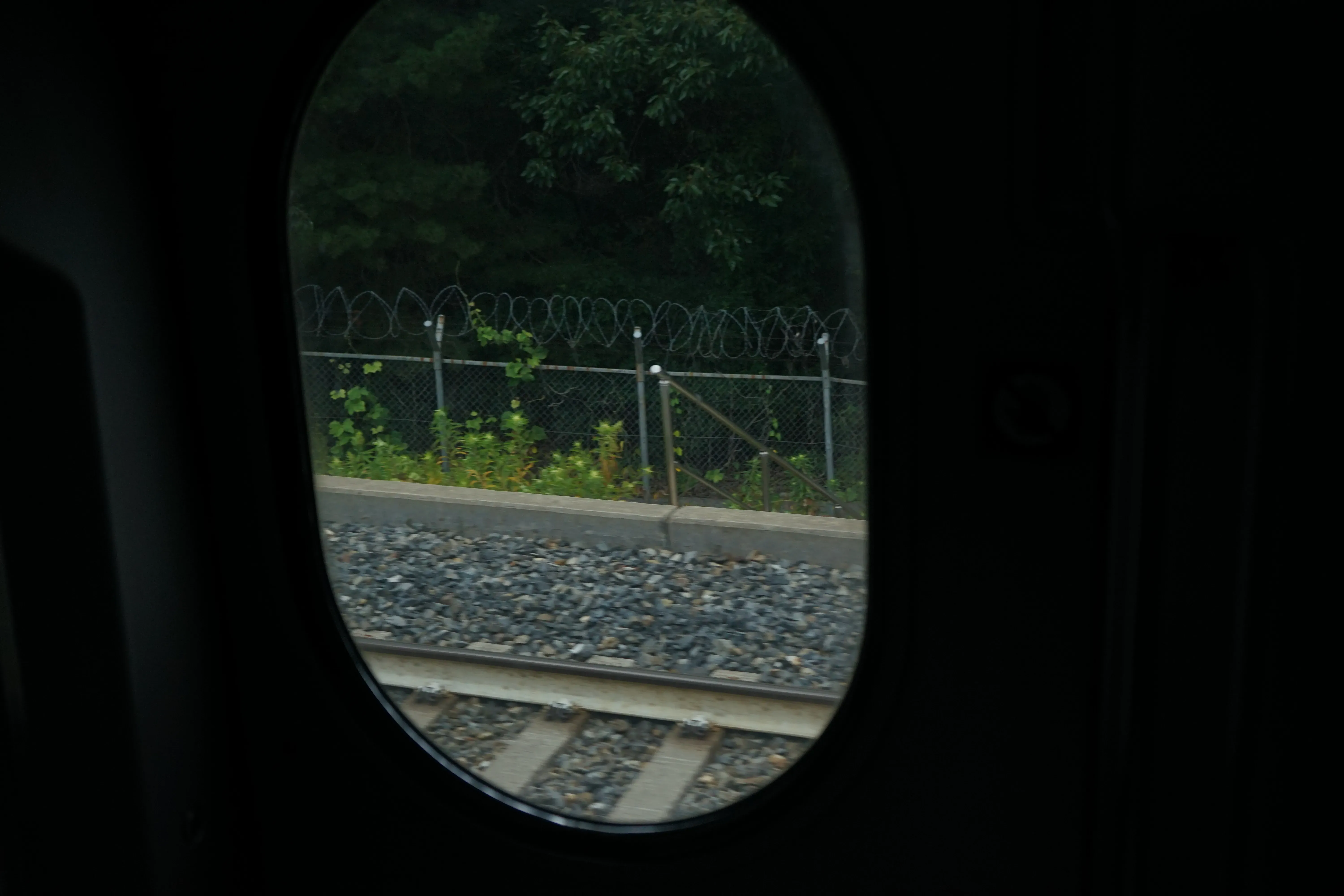
The women’s migration journey to South Korea is never one step. Crossing rivers and countries, they face forced marriage, gender-based violence, and the constant risk of forced repatriation.
* Pseudonyms are being used because of security concerns for the North Korean women and their families.
Sheer darkness surrounded her. The cold Tumen River, on the border between China and North Korea, rose up to her waist. Dead silence—except for the swashing water. She crossed the Tumen River on December 31 along with four other people.
Even before she smelled the sweet scent of freedom, she was put into a dilemma.
“They [the brokers] said if you want to escape, you must have a marriage. Not just you—it’s just how everyone crosses the border.”
Facing the cold Tumen River behind her, she was sold for 50,000 yuan (approximately $6,980 USD), striving for her eventual freedom. *Jihye was only 20 years old when she was sold to a Chinese family, she said.
Jihye, from North Korea, stares out the window of a café in South Korea, where she talked about her journey. She said the reason she left North Korea was to sacrifice for her family. Working as a train station employee, she met a broker who told her she could make more money for her family if she went to work in China, she said.

As a nonprofit journalism organization, we depend on your support to fund more than 170 reporting projects every year on critical global and local issues. Donate any amount today to become a Pulitzer Center Champion and receive exclusive benefits!
Jihye is one of thousands of women who crossed the freezing Tumen River in darkness for myriad reasons, yet for most, the journey doesn’t end after crossing the river—it is only the beginning of their pursuit of freedom. And most of their stories still remain unseen.
Human trafficking is one of the most pressing challenges facing North Korean migrant women. After crossing the river, many are sold into forced marriage or exploitative labor, facing dangers including gender-based violence, lack of legal protection, and the constant threat of deportation. North Korea is classified as a Tier 3 country in the U.S. government’s 2024 Trafficking in Persons Report, reflecting its failure to address these abuses.
'Like a prison, rather than a protection'
Jihye said she was “fortunate” to be sold to a warm, welcoming family, although she struggled the first three months. The thought of the family she had left behind in North Korea—whom she would never be able to see again—haunted her.
“It was also hard to even think about my family back in North Korea and how starving they must be, while I’m in China and have food every day.”
Her in-laws in China welcomed her, she said. She recalled that her mother-in-law was very fond of her and bought medicine when she fell ill with a fever.
Others were not so fortunate. *Ga-Eun was sold to a 30-year-old Chinese man when she was 18 years old. Her price was 30,000 yuan (about $4,190 USD).
“I detested the marriage. I didn’t know that I would have to get married. I told the brokers and my mom, who escaped along with me, that I wanted to go back to North Korea, to cross back over the Tumen River. Everyone came to convince me not to.”
“It was like a prison, rather than a protection,” she said.
Sold for less than 30,000 yuan
As these women were traded for money, families in China were eager for children, sons who could continue their family line, the women said.
*Sun-Ja also had a rough marriage. Sold for less than 30,000 yuan, she was 24 when her husband, 40, bought her. Afraid of public security officers who often capture North Koreans and return them to their homeland, she said, she kept herself locked in the house for one year. She heard people talking outside, giggling, living their lives, while she isolated herself in a small square room.
“During my pregnancy, he [her husband] couldn’t spend a night with me, so he brought girls—18 and 19 years old—to our place and spent nights with them, while I was in the next room, listening to everything that was going on,” Sun-Ja recalled.
Her married life was not as fortunate as Jihye’s. Everyone in the family had given up on her husband, Sun-Ja said, which made him abuse her physically and mentally.
“Rather than love, he thought of my body like an old rag shoe—used and discarded,” she said.
These forced marriages—according to Jeong-Ah Kim, director of Rights for Female North Koreans (RFNK), a non-governmental organization supporting North Korean women—have been created for many reasons. Due to China's one-child policy, implemented from 1979 through 2015 to control excessive population growth, the female-to-male ratio shifted dramatically. Couples could only register one child. In China, where patriarchal culture and Confucian traditions remain strong, only a male child can carry on the family name, and men are considered the breadwinners for their entire families.
The intersection of culture and policy created a preference for sons over daughters, often leading to female infanticide, sex-selective abortions, and eventually a skewed male-to-female ratio. Due to the shortage of women, men in rural areas or those who are not financially stable struggle to find brides, increasing demand for North Korean brides.
Brokers in both North Korea and China also prefer women over men, as women tend to be more profitable, Kim added. According to Kim, many defectors he have met have said that they never knew they would be forced into marriage.
“These women are often tricked into crossing the river, believing that in China, they could earn money for their families and eat white rice every day,” Kim said.
Seo-Youn Jung, a mental health therapist volunteering in Hanawon (a resettlement facility in South Korea), who herself defected in 2017, said that there is now a higher number of women who are aware of the forced marriage beforehand and are able to negotiate their price. Women now have a very clear vision of South Korea as their final destination.
“These recent defectors know that they are getting trafficked and will get married. That’s why they put on long-acting reversible contraceptives (LARC), like IUDs, in the DPRK [Democratic People's Republic of Korea] before crossing the river,” Jung commented.
Fear of Retaliation and Deportation
Even after the marriage, Jihye said, she and other women were far from freedom. They were always under constant fear of police raids and forced repatriation.
Sun-Ja recalled, “There were some North Korean women in our village, but we never had conversations because we hid our own identities. Everyone was afraid of retaliation and being forcibly deported back to North Korea when we were exposed.”
As the DPRK and China had formed a bilateral border agreement, these women, considered “economic migrants” by the Chinese state, lacked valid identity papers and were subject to repatriation. Even after marrying into Chinese families, they were not granted residency cards, forcing them to hide from police, limiting their access to health care and transportation.
When caught, they are sent back to North Korea, where many face detention centers, severe punishments, torture, and even death.
Jihye remarked that one of the biggest challenges of forced marriage was securing legal status. “One thing I hated the most was that I had no nationality, and I was always nervous because I was never registered in the Chinese family nor through my marriage.”
As she had no status, her child would automatically also be an illegal immigrant, so Jihye had to register her own child under her aunt-in-law’s name.
“I was heartbroken to declare my own child through my aunt-in-law,” Jihye said. “I bore my own child through my own suffering, but it almost felt like I was stripped of my child.”
Similarly, *Eun-Suk says that one of the biggest reasons she escaped China was the lack of identity.
“One of the cousins from my Chinese family was a police officer, so he told me beforehand, but during inspections, I was still scared.”
The lack of legal status, combined with the language barrier, pushes women further into isolation and fear, according to mental health therapist Seo-Youn.
Memories of the children left in China
Eventually, Jihye decided to run away after five years of marriage, once again for a better life. At the time, she already had two children in China. Unable to escape with both, she took her younger child with her and left her firstborn with the family in China.
“It was the hardest moment, to leave my own child behind. I couldn’t even tell him everything—that I was leaving forever. I will never forget the last moment when he called, ‘Mom!’ before I left.”
Ga-Eun’s child was only 2 years old when she decided to escape. Telling her husband that she was going to visit her mother nearby for two days, she left the house with her baby.
Eun-Suk left behind two children.
“By the time I fled, I had a 5-year-old and a baby. One thing I still remember is the lie I told them—I said, ‘Mommy’s going somewhere, but I will come back soon.’”
Moving across neighboring countries via brokers—such as in Laos, Thailand, and Vietnam—is a sheer struggle for migrants headed to South Korea.
Jihye had to cross a mountain with her newborn. Walking at night and hiding during the day, she and her group traveled through Thailand, and after three months undercover, she and her child finally reached South Korea.
Eun-Suk traveled from China to Laos to Thailand to South Korea through a broker. Crossing the Mekong River, also known as a crocodile river, in 2017, she felt death was near, she said.
The pain of separating from their children lingers. The women said they miss their children in China. While pregnant in Korea, Ga-Eun said, she was reminded of her elder child's movements in her womb.
“I miss him so much, and I’ll never forget him,” Ga-Eun said. “Once I got pregnant again, I still remembered him and kept comparing him with my child in Korea.”
Eun-Suk also thinks about her child from time to time. “It’s frustrating that there’s nothing I can do for my child. Maybe it’s just a mother’s love.”
Struggling in South Korea
Jihye recalled that settling in Korea was one of the most challenging parts of her journey. “Living in Korea alone, I struggled a lot. The first two years were so rough.”
Jihye said freedom was nice, but the language barrier—despite using the same alphabet (Hangul)—made her feel like she was learning a new language. She said she didn’t have anyone to ask for help with paying utilities, bank transfers, or health insurance.
Sun-Ja said that when she first settled in Busan, South Korea, she was alone, and everyone treated her like she was a North Korean spy.
“I drank a lot, cried a lot, and I almost missed being in China,” she said.
After many North Korean defectors land in South Korea, they arrive at the resettlement facility Hanawon, which provides career support and language classes for three months.
Many women, though they aspire to study and earn certifications, are soon struck by financial reality after leaving Hanawon. Some land in part-time jobs in restaurants or even sex work, Jung said.
Furthermore, they are on their own when dealing with everyday tasks like paying for electricity, buying kitchenware, or getting insurance. Jung added that even though social welfare policies exist for North Korean defectors, many face barriers—such as discrimination, psychological stress, and systemic limitations—that prevent them from fully enjoying aid.
Kim says that when North Korean women are in China, they accept loneliness because it is a foreign country with a different language and alphabet. However, once they enter South Korea, they expect to adapt more easily.
Lingering Trauma
Along with Jihye, who has now settled in South Korea, many of the women who endured the migration journey live in South Korea. But in their hearts, they still carry the children and memories they left behind in China, and the family members they left in North Korea.
Even now, Jihye said, she sometimes has trouble falling asleep or wakes from nightmares of being captured by police officers.