By Luluh Hussam Al Saleh
8th grade | Makers Learning School | Riyadh, Saudi Arabia
Finalist in the K–11 contest, Human Rights category
With lines from “Afghanistan in a New Light: Women, Erased” by Elena Becatoros and Rodrigo Abd, a Pulitzer Center-supported story
Morning does not arrive in Afghanistan —
it enters like something being watched.
The air tastes of wool and dust and closed rooms.
It sits heavy in the mouth,
like breathing that has learned to be careful.
Fear is the first sense of the day.
Sight: walls too close to forget.
Windows that show a world she is not allowed to step into.
Distance that feels punished for existing.
There were schools once.
Now there are mornings that remember them.
Anger does not rise loudly —
it settles under the skin and stays.
She sits before the loom.
Her hands move before permissing exists,
fast, practiced, automatic.
Not gentle. Not slow.
As if speed is the only thing keeping time from pressing too hard against her.
Thread flies between her fingers.
Pull, catch, tighten, release.
So quick it stops feeling like action
and starts feeling like soothing the body remembers on its own.
Touch becomes urgency disguised as routine.
Wrists ache without pause.
Fingers learn patterns faster than thought can interrupt them.
There is not stillness here —
not color — pressure behind the eyes.
Everything she cannot say
forced into visibility through thread.
Blue follows.
Cold on the tongue —
like a sky she can still see
but is no longer allowed to enter.
Yellow flickers briefly —
sunlight remembered through taste,
arriving too late to warm.
Sound is reduced to wool against wool.
A rhythm that replaces school bells,
footsteps, voices of girls learning.
It fills silence so completely
that silence begins to feel heavy.
Even silence has weight here.
It presses into corners.
It does not leave.
Anxiety lives in repetition.
Every knot feels like it might be wrong.
Every thread feels like it might tighten into something irreversible.
The article speaks of what changed:
girls removed from education,
women pushed out of public life,
movement narrowed until life must stay indoors to be allowed at all.
And this is what that becomes:
not one loss -
but constant shrinking.
Taste becomes memory that cannot settle,
tea gone cold before it is shared,
bread eaten without talking,
meals that feel like they are missing their reason.
Smell is wool, dust, closed air —
the scent of days repeating until they stop being noticed.
Touch is repetition itself.
Thread. Knot. Pull. Tighten. Repeat.
Until even the hands begin to forget what else they were meant to hold.
This is not dramatic suffering.
This is daily suffering.
The kind that becomes normal before it becomes understood.
And still —
a thread slips.
Not escape. Not rebellion.
Just a mistake the pattern cannot correct.
For one breath, the carpet forgets her —
and she remembers herself without reduction.
Because nothing here is fully erased.
It is compressed into survival.
Held too tightly.
And that is what makes it unbearable.
So do not read this from a distance.
Do not turn into something soft enough to ignore.
This is fear that returns every morning.
Anxiety that never leaves the room.
Anger that has nowhere to go.
A life measured in what is not permitted.
This is about human lives being restricted —
girls removed from education,
women pushed from public space,
voices reduced until silence becomes expected.
And that is not safe.
It is controlled.
And control repeated long enough begins to look like a normal life —
even when it is not.
Because she was never only a thread.
She was a human,
forced into something smaller than she was meant to become.
And no life like that
should remain contained.
So if you are reading this —
feel it.
Do not look away quickly.
Do not soften it into distance.
Let it stay uncomfortable.
Let it become awareness.
Let it become refusal.
And let refusal become change
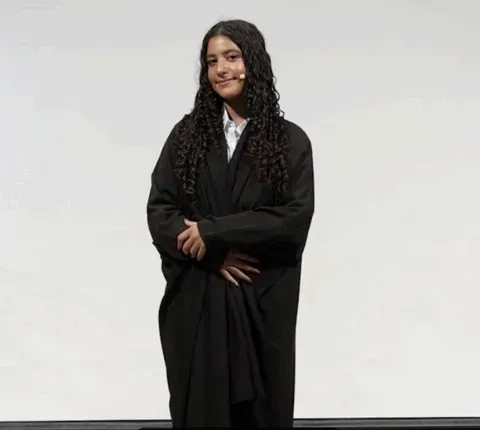
Luluh Al Saleh is a fourteen-year-old rising ninth grader with a passion for psychology, Pilates, writing, reading, and drawing. Through her writing, she hopes to raise awareness about important social and humanitarian issues. She wrote “She Was Never Only Thread” to advocate for the rights of Afghan women and girls, highlighting the devastating impact of being denied education, freedom, and opportunities. As a Muslim, Luluh also wanted to emphasize that such oppression is not representative of the true teachings of Islam, which uphold justice, dignity, and the pursuit of knowledge for both women and men.
Read more winning entries from the 2026 Fighting Words Poetry Contest.