Journalist Resource October 26, 2026
How I Mapped a $250 Million Data Center Across Two Jurisdictions
Country:


How the UAE’s AI powerhouse gained access to Egypt’s digital health systems
In May 2023, Egypt announced plans for what was described as the country's first hyperscale data center: a 25-megawatt, $250 million project at Maadi Technology Park in Cairo, backed by Egyptian infrastructure group Benya and UAE-based Khazna Data Centers.
The numbers were precise. Almost everything else was not. The announcement did not name the company that would own the project, the entity that would operate it in Egypt, the partners' shares, or the licenses it would run under.
My investigation, published by Al-Pheratz Magazine with the support of the Pulitzer Center's AI Accountability Fellowship, followed the project across two jurisdictions—from Egyptian corporate records to special purpose vehicles registered in the Abu Dhabi Global Market. This piece is about how I did that, and about a harder problem: how to report on missing information.
The hypothesis
I started with a broader question: whether Abu Dhabi technology group G42, whose businesses span AI, cloud computing, health technology, and data centers, was building a connected infrastructure across Egypt. The hypothesis seemed plausible because several parts of the same corporate ecosystem appeared in Egypt around the same time: G42 invested in Benya and took a board seat, Khazna was developing a major data center with Benya, and G42’s healthcare arm was separately discussing health and genomic projects with Egyptian authorities.
Parts of that hypothesis did not survive scrutiny. Rather than stretch the evidence to save the original thesis, I narrowed it. The new question was specific: Could I reconstruct the legal structure behind the Maadi data center, identify who would own and operate it in Egypt, and determine what role—if any—G42 played?
I focused on the Maadi project not simply because it produced the clearest documentary trail, but because it sat at the intersection of the broader question I was investigating: how a network of closely connected Emirati and Egyptian companies was entering Egypt’s digital and data infrastructure through partnerships whose ownership, operating roles, and lines of control were not always publicly clear.
The data center offered a concrete way to test that larger hypothesis. It brought together Benya, Khazna, G42’s wider corporate relationships, cross-border legal structures, and a piece of infrastructure capable of underpinning large-scale cloud and data services. At the same time, G42’s healthcare arm was separately discussing health and genomic projects with Egyptian authorities. I wanted to know whether these were independent business tracks or parts of a more connected infrastructure strategy. The reporting ultimately established some corporate relationships, but not an operational link between the Maadi data center and the health or genomics projects.
That failure of the broader hypothesis narrowed the investigation to a more specific question: What could the corporate records actually prove—and, just as importantly, what could they not establish?
Map brand names and their legal entities
Companies communicate through brand names. Registries, contracts, lawyers, and regulators work with legal entities. A search for "Benya" will not necessarily surface records filed under Fiber Misr for Telecommunications and Information Technology—one of the legal entities operating under the Benya brand.
So I built an entity map in a spreadsheet. For every organization that appeared, I recorded its exact legal name, jurisdiction, visible shareholders and directors, incorporation and ownership-change dates, the role attributed to it, and a final column—what the document did not prove.
That last column turned out to be the most important.
A record showing Company A is a shareholder in Company B does not prove Company B owns the project. A board seat establishes a relationship, not operational control. An email address establishes an administrative link, not ownership. Writing those limits down, entity by entity, stopped a chain of individually accurate facts from becoming an unsupported conclusion.
Build a timeline
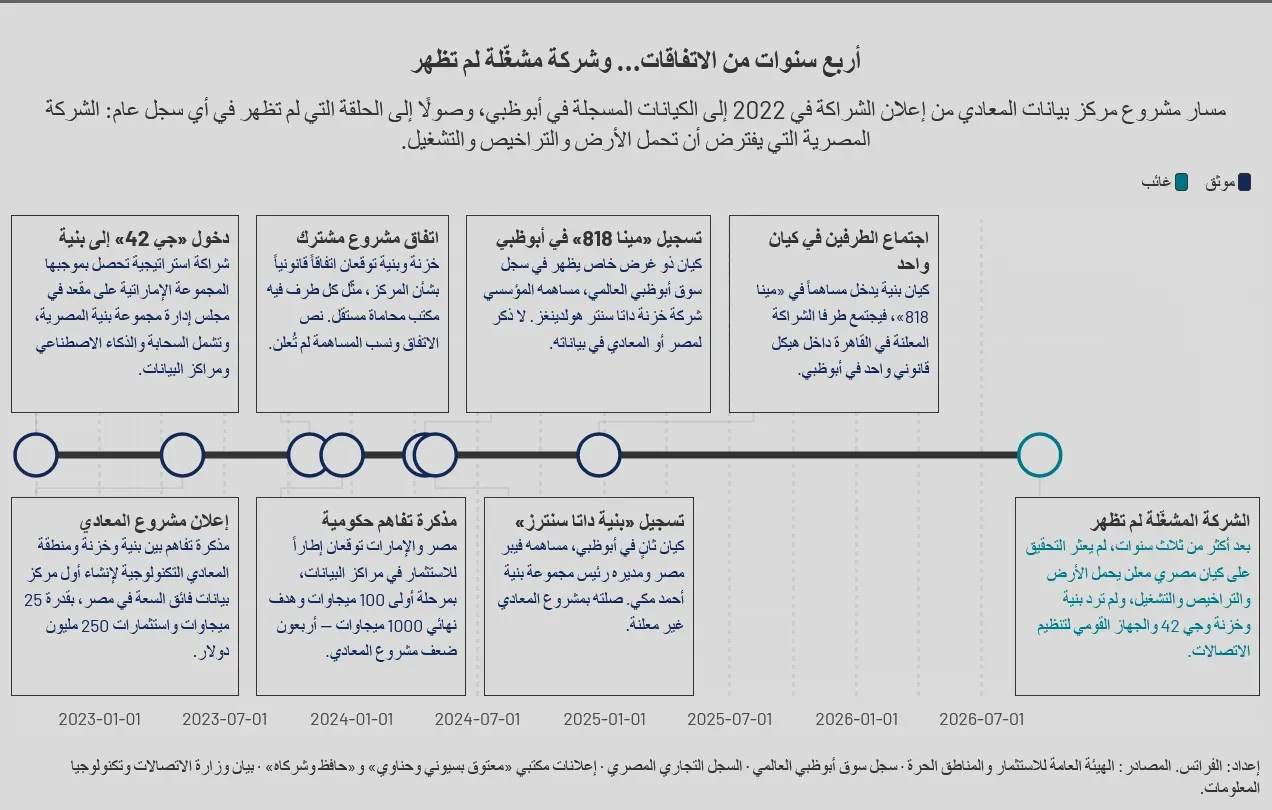
I put every event in date order: announcements, agreements, government memoranda, registrations, ownership changes.
Seen one at a time, these were routine corporate events. In sequence, they showed something none of them showed alone—that the relationship between the two partners continued well past the press release and moved into a shared legal structure offshore.
Search announcements from law firms, not just the companies
Press releases told part of the story. The law firms told more.
The firms that advised each side published short announcements of their work on the deal. Those disclosures named the exact legal entities involved—names that corporate communications left out—and gave me the search keys for everything that followed.
They also exposed a gap. The companies described their agreement one way; the lawyers described it another. The two terms can refer to the same document or to separate agreements within a larger package. Without the contracts, I couldn't tell which. So the story leaves that question open rather than resolving it by assumption.
Know what corporate records can—and cannot—tell you
Corporate registries were central to the investigation, but they were not equally searchable, and they did not answer the same kinds of questions.
The Abu Dhabi Global Market registry is searchable online by anyone. Egypt's commercial records can be obtained for a fee, but there is no comparable public search tool—in practice, you need a company's legal name before you can request its file. That asymmetry shaped how I could report negative findings.
I could say: "I could not identify the publicly disclosed Egyptian operating company."
I could not say: "No Egyptian operating company exists."
In an investigation built partly around missing information, that distinction was fundamental.
That same discipline applied to what the records showed. Egyptian records showed large capital increases at the Benya entity involved in the deal, but the registry extract did not identify who funded each increase. An accountant helped me identify the next documents to pursue—general assembly minutes and amendment agreements—which could show who subscribed to the increases and on what terms.
Understand the roles of different corporate structures
The strongest document finding came from Abu Dhabi: two special purpose vehicles, one linked to each partner, the second later becoming a shareholder in the first.
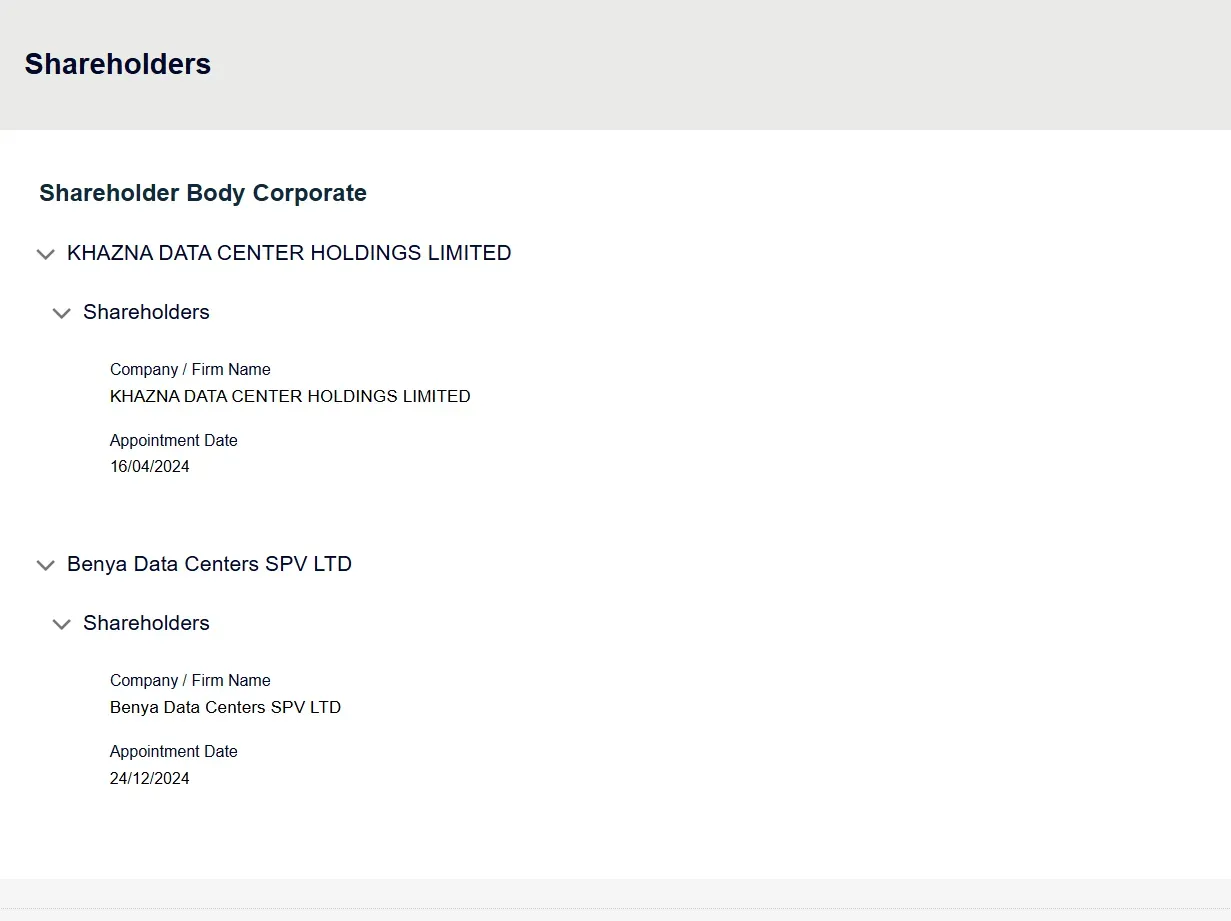
An SPV can serve many purposes, and the public record didn't tie this one to Egypt. So I treated it as evidence of a relationship, not of project ownership.
What changed the reporting was a regulation. ADGM's published rules define SPVs as passive holding vehicles that cannot conduct operational business or employ staff. A lawyer familiar with both systems confirmed the practical consequence: Offshore holding layers are ordinary, but operating activity in Egypt would ordinarily require a local entity to handle licensing, staffing, contracts, and other local obligations.
That reframed the whole inquiry. The question was no longer, why is this in Abu Dhabi? It became: If the offshore entity cannot operate the data center, which Egyptian entity would operate it locally—and why has that entity not been publicly identified?
A rule like this turns "I couldn't find it" into a legitimate accountability question.
Look behind the registry page—and document it
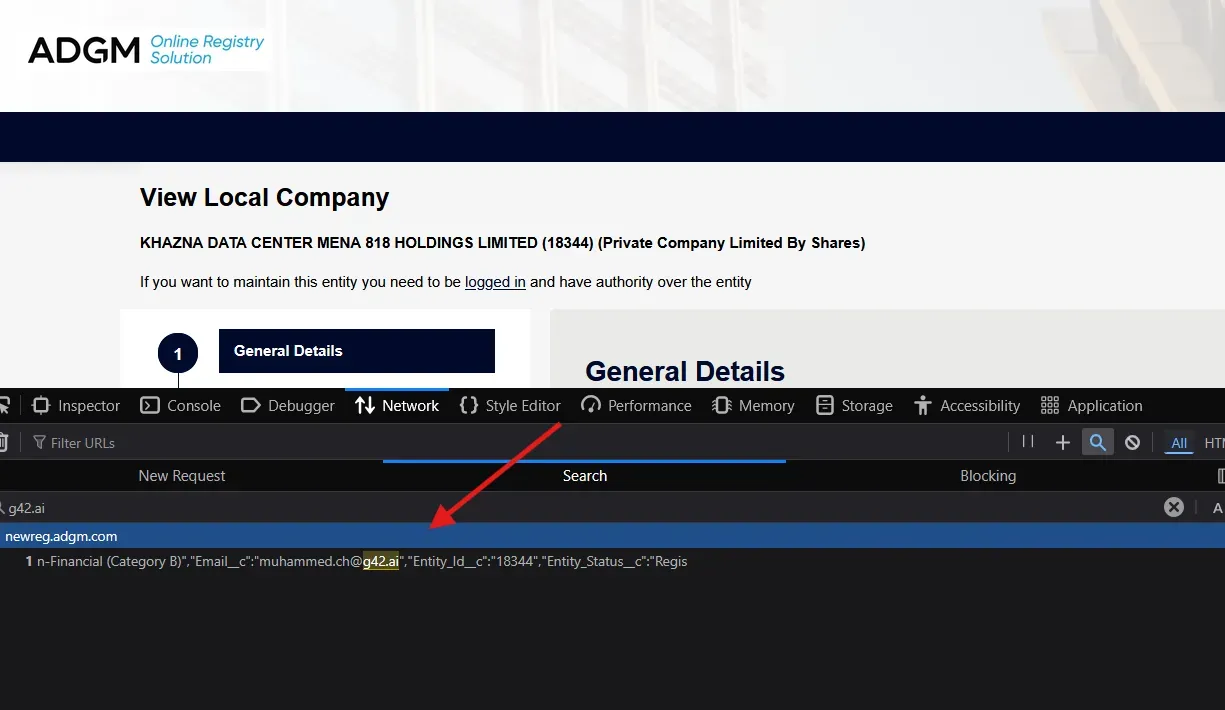
In the registry data for one SPV, I found a contact email on the g42.ai domain.
It was a striking clue given G42's documented ties to both partners. It was also exactly the kind of clue that invites overclaiming. An administrative contact address does not prove shareholding, control, operation, or access to data. We described it only as an administrative link in the entity's contact data.
Verifying it raised a practical problem. The field doesn't appear on the public page. The portal loads each entity's data in a background request, and that response contains fields the interface never displays. Viewing the page source doesn't help—it's an empty template.
My editor and fact-checker are journalists, not programmers. So we kept the raw data unmodified, recorded the evidentiary limits of the finding in our evidence log, and captured a screenshot from the live registry request so my editor and fact-checker could independently verify where the email appeared.
Use interviews and requests for comment to contextualize the documents
Interviews explained the documents. An infrastructure specialist explained what 25 megawatts means in Egypt's market. A corporate lawyer explained the operating-company requirement. An accountant explained what capital records can and can't show. A former manager inside the group said the project was still active but delayed by permits and disagreements between the parties.
Requests for comment worked the same way. When I reached the chief executive of the partner's data center arm, he described the project as being in a "critical phase" connected to "the government," "the ministry," and "the foreign partner"—without saying which ministry or what phase. That sentence became part of the story precisely because of what it left unspecified.
The questions I sent were deliberately narrow: ownership shares, the Egyptian operating company, licensing, the link to the offshore entities. If a company could resolve an ambiguity, I gave it the chance to. None of the four parties I approached did.
What’s next
I did not identify the Egyptian operating company, obtain the underlying agreements, or independently confirm construction. A commercial database lists the project as under construction; I found no Egyptian public record among the sources I reviewed confirming construction.
These limits aren't footnotes. An investigation doesn't get stronger by converting unanswered questions into conclusions. Sometimes the accountability finding is that a project involving hundreds of millions of dollars in strategic digital infrastructure has advanced through agreements and cross-border structures. At the same time, basic facts about local ownership, operation, licensing, and responsibility remained unclear or could not be identified in the public record I reviewed.
The same approach travels well beyond Egypt and data centers: wherever physical infrastructure sits in one country, its clearest corporate footprint sits in another.
For this story, the next step is clear—finding the missing Egyptian layer: Who holds the project locally, what licenses apply, and how far it has progressed on the ground?
Those questions remain open. But we now have a documented map showing where to look.