Engagement Resource August 14, 2026
How Can We Govern AI Infrastructure Collectively? Chile May Have Some Answers
Country:

Project
The Backyard of AI
The boom of generative AI has launched tech giants into a race to increase their computing...


This article summarizes one of the activities supported by the Pulitzer Center’s Outreach Engagement Fund and is part of The Backyard of AI, a cross-border investigation into the local impacts of data centers. You can also read about the other two activities of the same initiative carried out in Mexico and in Spain.
Before generative AI brought data centers into the public spotlight, Chile witnessed several surprising stories. In the municipality of Cerrillos, in the Santiago metropolitan area, a group of residents organized and launched a campaign that succeeded in halting a Google complex that planned to use a massive amount of water.
A few years later, a resistance movement was formed in the municipality of Quilicura—home to one of the city’s largest wetlands and the multinational’s first complex in Latin America (Quilicura is considered by many to be the data center capital of the region). The group has already achieved significant victories.
More recently, in the neighboring municipality of Huechuraba, a large-scale Amazon project has put an entire community on alert. Since 2023, local residents have been monitoring the company’s actions, trying to shed light on the lack of transparency that often surrounds these developments.
The arrival of large data centers in Chile has not only mobilized civil society. Chilean and international researchers have also been investigating the impact of these investments on the country for years. In 2024, academics Marina Otero, Nicolás Díaz, Serena Dambrosio, and Linda Schilling launched a project to find answers to some difficult questions: How can we collectively govern this infrastructure? And above all, how can we include local communities directly impacted by data centers in this dialogue?
In 2025, this group presented Inteligencias Reflexivas at the Venice Biennale, an installation that referred to the National Data Center Plan approved that same year by the Chilean government. This plan was a pioneering initiative on a global scale, but its final outcome has been criticized by many, including the very communities that were invited to several meetings to discuss it.
While we were reporting in Chile, we interviewed Díaz, and even before that, I already knew Otero and her work. So in late 2025 I contacted the group to propose an event in Santiago that would also align with their own investigative and artistic projects. In March of this year, the group organized a gathering in the Chilean capital titled Infrastructures Under Debate: Data, Territories, and Governance in Chile.
Díaz, Dambrosio, and Schilling proposed this roundtable as a forum for discussion among multiple stakeholders to “map out scenarios for governance, design, and evaluation in the short and medium term.” But also to identify “tensions, opportunities, and shared criteria to guide future decisions” regarding the governance of the country’s digital infrastructure.
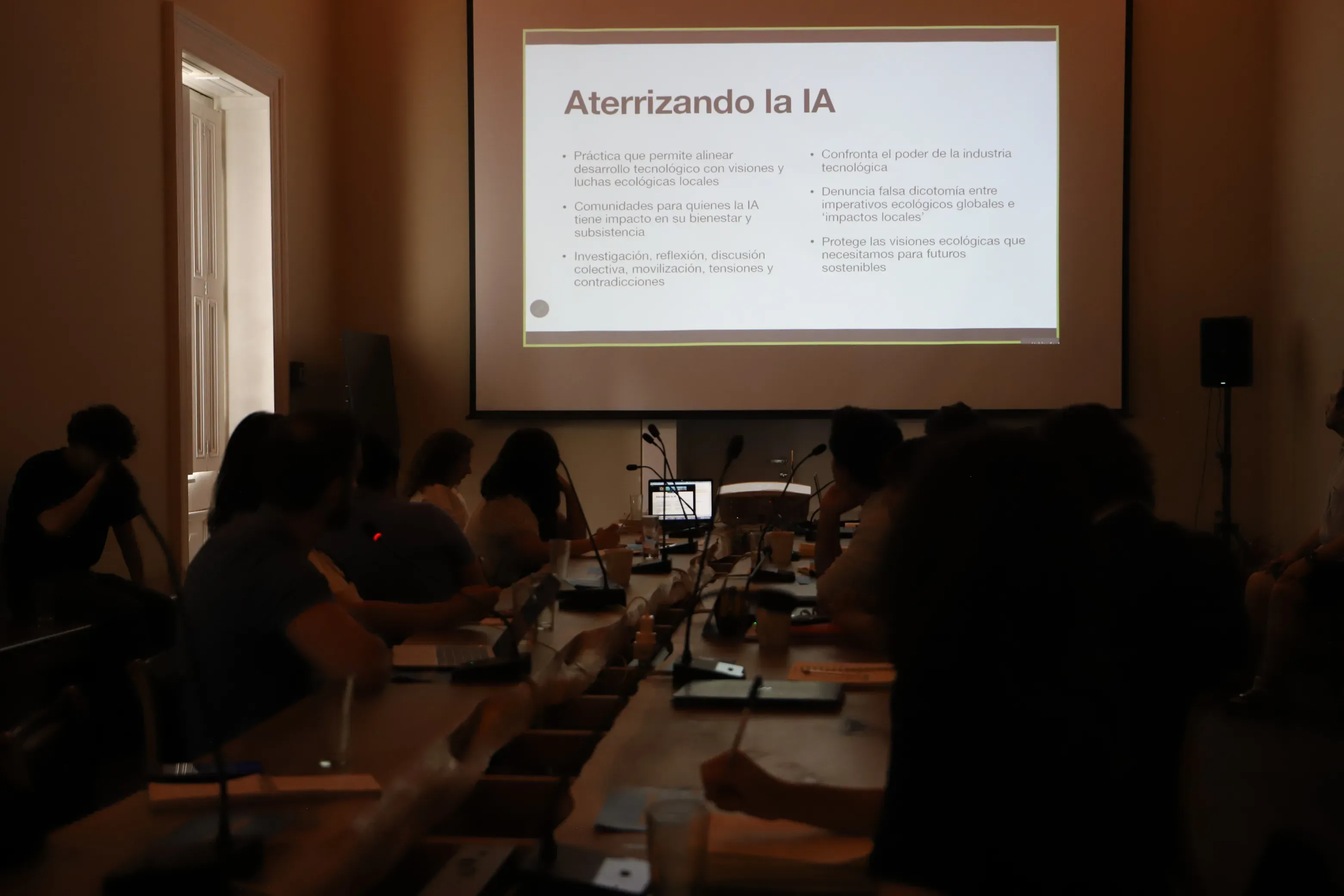
The meeting brought together representatives from civil society (Jorge López and Tania Rodríguez of MOSACAT; Lorena Antiman and Germán López of Corporación NGEN; Alexandra Arancibia of Resistencia Socioambiental Quilicura; and Ricardo Carter of No Amazon en Huechuraba), academia (Carolina Gainza of Universidad Diego Portales; Mónica Humeres, Universidad de Chile; Sebastian Leuhede, King’s College London), and the private sector (Javier Moya, from the architecture firm Hyphen; Cristóbal Lea Plaza, from Google). A representative of the Chilean government—which at the time was in the midst of a transition to a new administration—declined our invitation.
The Palacio Pereira in Santiago hosted an event that addressed a variety of topics over the course of nearly three hours, in a format consisting of presentations followed by a discussion. One of these topics was the process of developing the national data center plan, in which several citizen groups were invited to participate. The final outcome of this policy initiative, however, has drawn harsh criticism from civil society organizations.
Alexandra Arancibia noted that this plan emerged “in response to pressure from communities,” but criticized the lack of both funding and the political will to promote truly responsible policies regarding this industry and its impacts. “There is a lack of dialogue, and the climate crisis is not being taken seriously,” she said during the meeting in Santiago.
Several other participants highlighted the potential of citizens to influence both public policy and private-sector developments. Among them were Jorge López and Tania Rodríguez, members of the neighborhood movement that brought Google’s Cerrillos center to a standstill. “The strength of the neighbors allowed us to make our voices heard and defend our territory,” López said.

After scrapping the initial project, the company is now proposing a change in the type of server cooling system that uses significantly less water than the original plan. “This change didn’t come from the company; it was the result of a four-year struggle,” Rodríguez recalled.
Cristóbal Lea Plaza, Google’s head of government relations in the country, expressed his openness to engaging in dialogue with local communities and said he was aware of their concerns. “We are aware of the criticism surrounding water use,” Lea Plaza stated.
The evolution of the public debate in the country surrounding this issue in recent years was also evident during the roundtable. Sociologist Mónica Humeres emphasized that “the environmental footprint of data centers is already on the minds of lawmakers.” However, she cautioned that when it comes down to it, the “economic perspective” on these infrastructures continues to prevail.

Another issue discussed was a regulatory change, revealed by LaBot, that would eliminate the requirement for most data center projects in the country to go through the Environmental Assessment Service (SEA). The reports that developers have been required to publish on the SEA’s website have been crucial in ensuring that communities were aware of these projects and their anticipated impacts. “This is a tremendous mistake that runs counter to the principles set forth in the national data center plan,” said Carolina Gainza, former undersecretary of the Chilean Ministry of Science.
One of the final speakers was Sebastián Lehuedé, a researcher who has spent years investigating how to involve communities in the development of more responsible AI. He emphasized the need to view the local population not only as victims, but also as “generators of knowledge” for designing a different kind of technology.
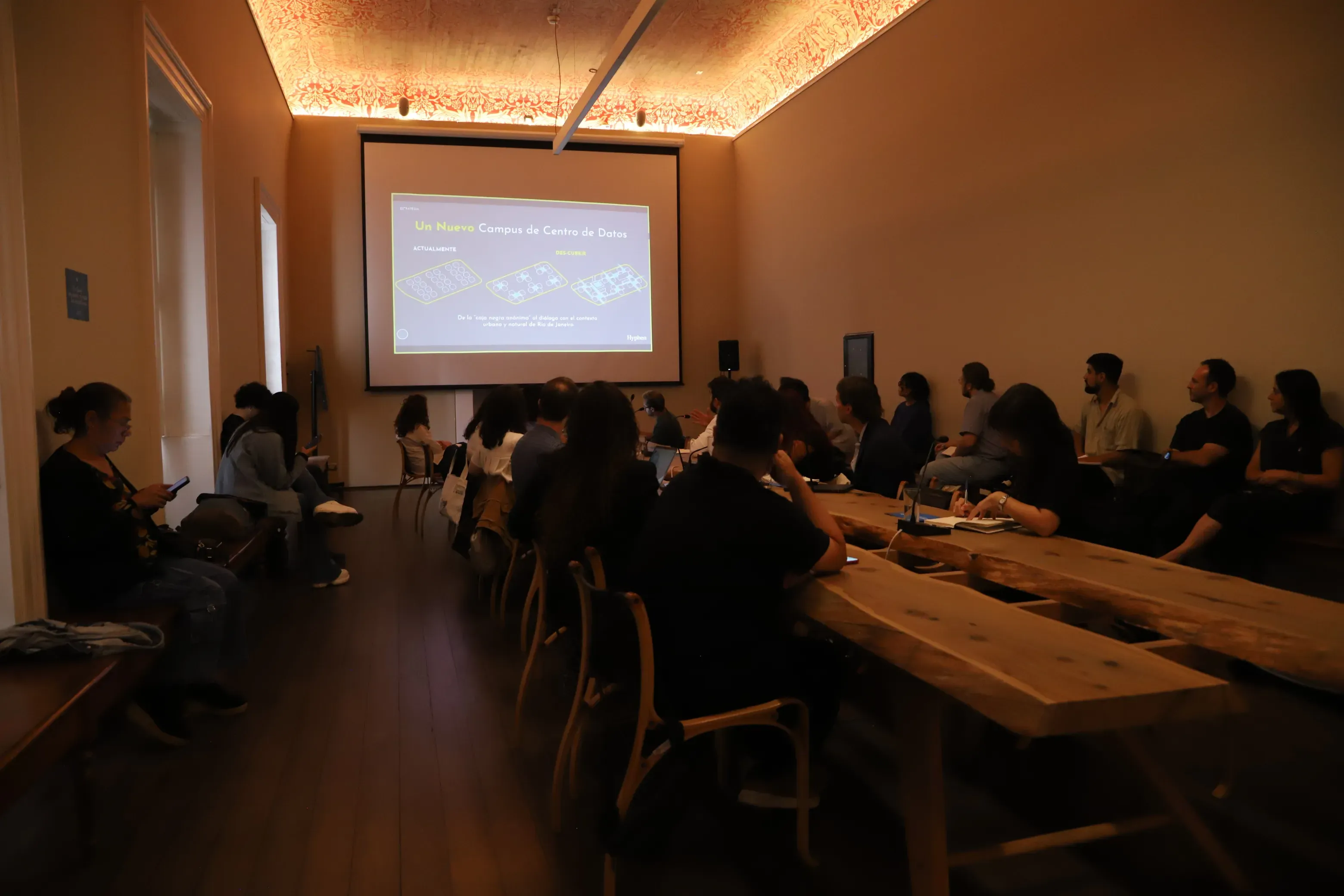
To close the event, Nicolás Díaz emphasized the importance of forums like this one, where the various stakeholders involved in digital infrastructure can engage in dialogue around the same table. “That was the spirit of our pavilion,” he said.
In October 2026, this same team will organize a digital infrastructure tour in Santiago, along with other activities, including several roundtable discussions and public lectures by renowned international researchers, as part of the Digital Vertigo program (you can follow here all the latest news about this project).