Story
 November 3, 2026
When the State Takes the Farm: Ghana’s Compulsory Land Acquisitions Threaten Livelihoods and Food Security
Country:


Project
Ghana's Lost Forests
The alarming impact of illegal gold mining on Ghana’s vital forest ecosystems

Losing 10 acres of productive farmland cannot necessarily be remedied by providing another 10 acres elsewhere because farmers often choose where to cultivate based on a terrain's agricultural qualities.
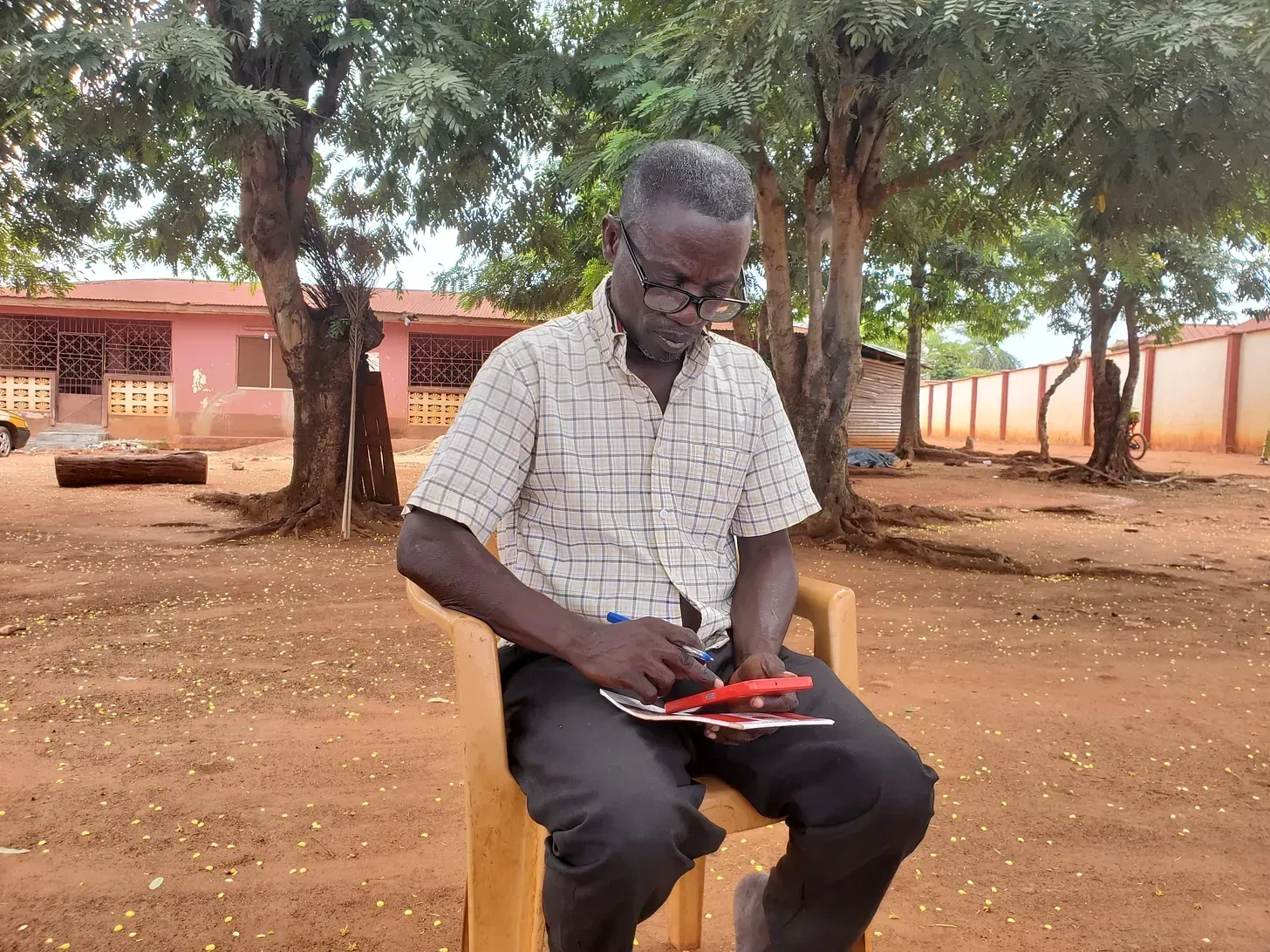
TERCHIRE, Ahafo Region — Seated on a yellow plastic chair, Joseph Adu Yaw, in his late 50s, holds his phone loosely. Its red case catches the light as he scrolls through photographs of what used to be his life’s work.
His eyes fill with tears.
The screen shows the farmland he says sustained him and his family for years: 22 acres in Terchire, a farming community in Ghana’s Ahafo Region.

As a nonprofit journalism organization, we depend on your support to fund more than 170 reporting projects every year on critical global and local issues. Donate any amount today to become a Pulitzer Center Champion and receive exclusive benefits!
The farm is gone.
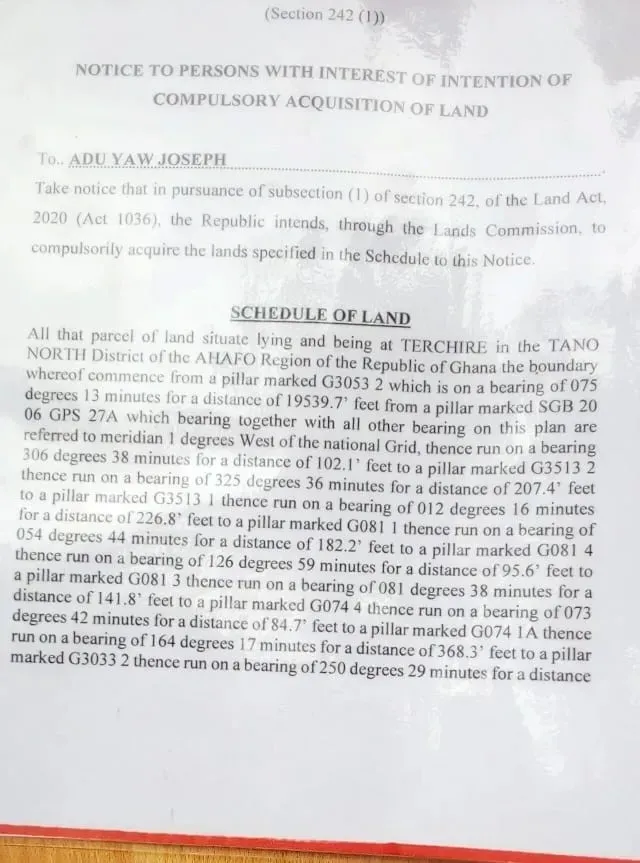
“First, the government posted a notice that we should vacate our farms. Within days they stormed in with heavily armed men, destroying everything,” Adu said. “I could not save anything.”
His voice breaks.
Adu is among farmers in Terchire whose land became caught up in a compulsory acquisition by the Ghanaian government for mineral development. About 59 other farmers were also affected after a long-running disagreement over access to their land.
Their experience raises a wider question about Ghana’s pursuit of mineral wealth: what happens when the state takes productive farmland for development in a country where millions of people already struggle to access enough food?
Across Ghana’s farming communities, land is more than an asset that can be valued by the acre. It provides food, income, and employment. It is also where knowledge accumulated over generations – about soils, crops, seasons, trees, and water – is put into practice.
When that land disappears, farmers such as Adu argue that compensation alone cannot easily recreate what has been lost.
The power to take land
Compulsory acquisition gives the Ghanaian state considerable power over private and customary land.
Article 20 of Ghana’s 1992 Constitution allows the state to compulsorily take possession of property under specified conditions. The Land Act 2020 further provides for compulsory acquisition where land is required for a public purpose or where its development or use promotes a public benefit.
But that power comes with obligations.
The Land Act requires the necessity for an acquisition to be clearly stated and reasonable justification provided for any hardship caused to people with interests or rights in the property. It also provides for prompt payment of fair and adequate compensation.
For farmers in Terchire, however, the dispute goes beyond whether the state possesses the legal power to acquire land. It concerns how that power was exercised and what happened to people who depended on the land.
Kwaku Afari, a legal practitioner and technical director at Wacam, a Ghanaian community-based human rights and environmental mining advocacy organisation, says a process existed for identifying farmers whose lands would be required before further engagement took place.
According to Afari, disagreement arose over how that process should proceed.
“The mining company involved came and wanted to go and do a survey and assessment of all the farmers, of their lands and their properties,” Afari said.
He said the farmers wanted those whose land would actually be affected to be identified first.
“First of all, let’s identify who will be affected by your activity, and then we can proceed from there,” he recalled their position.
Afari says the state subsequently relied on its compulsory acquisition powers.
That sequence is central to his criticism. He distinguishes between authorising the occupation of land under Ghana’s mining legislation and subsequently acquiring land compulsorily under land legislation.
“Can you come and give one an authorisation to use a certain place for mining, and then when the entity finds it difficult, the state comes to its aid and says, ‘I’ll use my eminent domain power to acquire it compulsorily for you’?” he asked.
Afari argues that the state’s intervention raises questions about whose interests were being protected.
“Immediately you do this, that is when we begin to say that the state is acting in the interest of the private investor and then to the detriment of its people,” he said.
Farmland is more than land
According to Sulemana Issifu, director of research at the Centre of Climate Change and Food Security, losing 10 acres of productive farmland cannot necessarily be remedied by providing another 10 acres elsewhere because farmers often choose where to cultivate because of the agricultural qualities of particular land.
“If you are going to make a decision to farm, you would obviously find lands that are fertile,” he said. “So it means that the initial decision to farm by the farmers was taken based on the fertility of the lands on which they farm.”
When productive land is converted to another use, he says, displaced farmers may struggle to find land with comparable fertility.
“And then when farmers have to relocate, or people have to relocate to different areas or other areas to farm, they may not get lands that are as rich or fertile as the previous lands that were taken initially from them,” Issifu said.
The consequences can extend beyond the individual farmer.
The Ghana Statistical Service estimated that 12.5 million people, or 38.1% of the population measured in its survey, experienced food insecurity in the third quarter of 2025. Compulsory acquisition of farmland cannot by itself explain food insecurity at a national level: food prices, incomes, climate shocks and other economic factors all influence whether households can obtain sufficient food.
But taking productive land permanently out of agriculture adds another pressure.
“If these lands are later acquired for mining, it means the most fertile lands are going to be lost,” Issifu said. “And even when farmers willingly give up their lands, it is going to affect the production of food.”
There is another loss that is harder to measure.
Garba Muntawakili, co-founder of the Agro Leadership Centre, says displacement can push smallholder farmers into occupations far removed from the work they know.
Alternative livelihood programmes have often encouraged affected farmers to pursue other income-generating activities. Muntawakili argues that programmes for displaced farmers should instead recognise the skills they have accumulated through agriculture.
The agricultural value chain offers opportunities in seed production, farm machinery services, transportation, processing and other businesses, he says, allowing farmers to adapt without abandoning decades of practical knowledge.
That matters because farming knowledge does not exist separately from the landscape in which it developed.
Farmers learn how particular soils respond to rain, which crops grow together, where water collects, when conditions are right for planting and which trees should remain on farms. Some of that knowledge passes between generations.
Moving a farmer to unfamiliar land does not automatically transfer those ecological relationships. The loss, therefore, is not simply measured in acres. It can mean the disruption of a livelihood system built around land, knowledge, labour and the local environment.
Farms, forests and a changing climate
The consequences of changing land use become clearer when Terchire is placed within the wider Ahafo landscape.
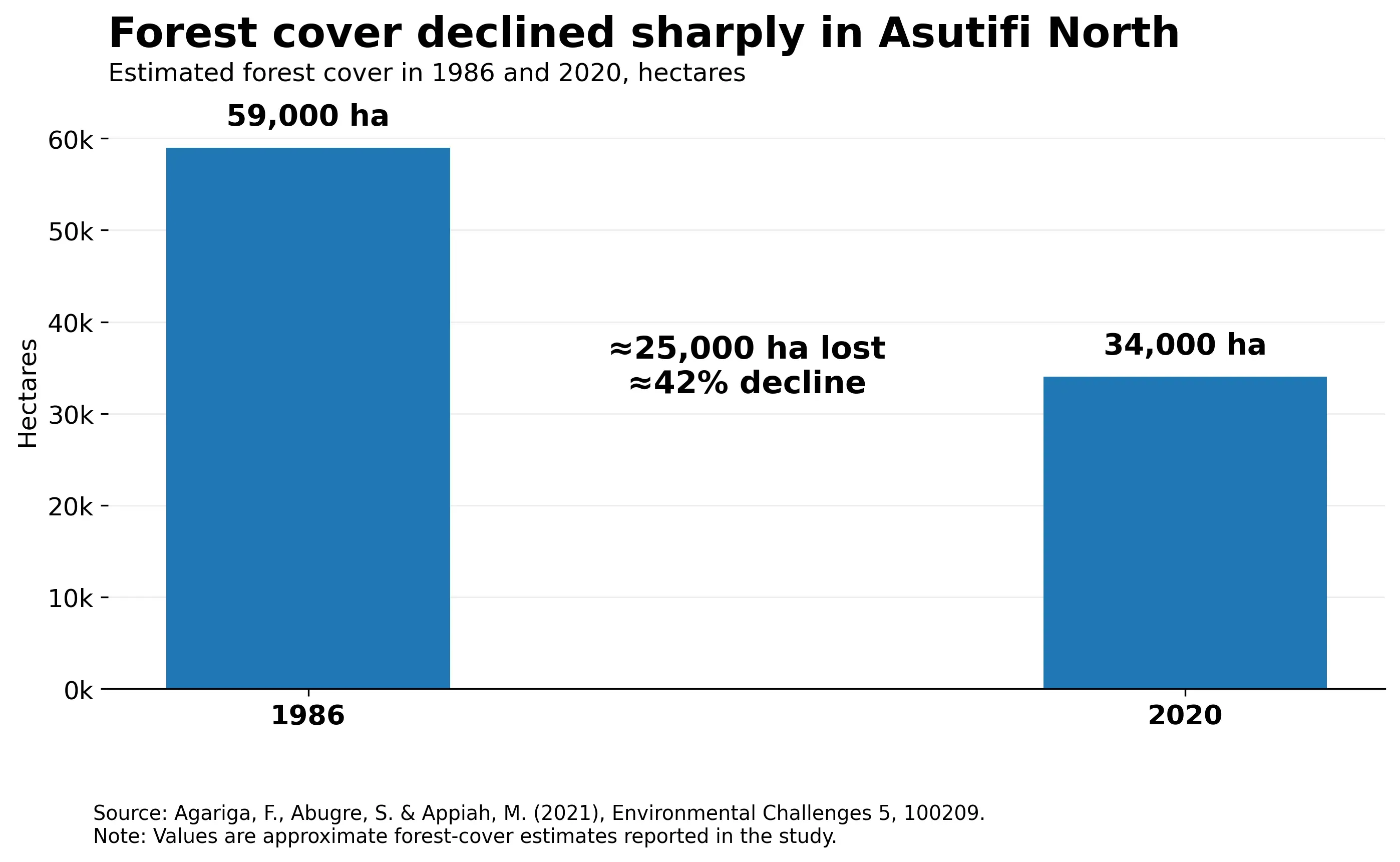
A study of land-use and forest-cover change in the Asutifi North district of the Ahafo Region found that forest cover declined from about 59,000 hectares in 1986 to about 34,000 hectares in 2020, a loss of roughly 25,000 hectares, about the size of Bamako, Mali’s capital district.
The researchers identified expanding agriculture as an important driver of the change, alongside mining and built-up areas.
The findings do not establish how much forest was lost specifically because of the compulsory acquisition in Terchire. Nor do they mean mining alone caused Ahafo’s forest decline. But they show what happens when several competing demands, agriculture, settlements, and mineral extraction, converge on the same finite landscape.
For farmers, forests and trees are also part of the productive environment.
Issifu says removing trees to make way for mining can create another chain of environmental consequences.
“We are talking here about irresponsible mining, which comes with deforestation, felling of trees or hacking of trees,” he said.
Trees absorb and store carbon. Removing them releases some stored carbon and reduces the landscape’s future capacity to remove carbon dioxide from the atmosphere.
“If trees are going to be fallen or trees are going to be felled to mine, then the ecosystem or the environment is going to be carbonised,” Issifu said.
His terminology is imprecise, but the underlying mechanism is well established: clearing vegetation reduces carbon storage and, depending on what happens to the biomass and soil, can result in greenhouse gas emissions.
Issifu also points to biodiversity.
“Mining also leads to, for example, loss of biodiversity, important biodiversity that is part of the climate change mitigation process,” he said.
The relationship between forests and agriculture makes that loss particularly important for farming communities. Trees and surrounding vegetation can help protect soils, regulate water, provide habitat and contribute organic matter to agricultural landscapes. Degrading those systems can make farming more difficult, particularly as farmers contend with changing rainfall and rising temperatures.
Muntawakili argues that conversion of productive agricultural land into mining areas is therefore more than a question of changing ownership.
“Productive agricultural lands are increasingly being converted into mining fields – often irreversibly,” he said.
For him, the result is a collision between two competing uses of Ghana’s land: extracting mineral wealth from beneath it and maintaining the agricultural systems operating above it.
“The growing encroachment of mining into agricultural lands is not only a land use issue,” Muntawakili said. “It is a direct threat to national food security, rural livelihoods, and economic stability.”
There are important qualifications. The environmental consequences of regulated large-scale mining are not identical to those of illegal mining, and reclamation can restore vegetation to disturbed areas over time. The extent to which reclaimed land can reproduce the agricultural productivity, biodiversity and ecological relationships that existed before disturbance depends on local conditions and how restoration is carried out.
What the Ahafo evidence demonstrates more clearly is the pressure being placed on a landscape expected to perform several functions at once: produce food, support rural livelihoods, retain forests and biodiversity, store carbon – and yield gold.
For Adu, those competing national priorities ultimately arrived on the 22 acres he called his farm.
The photographs on his phone show what stood there before.
As Ghana confronts food insecurity while trying to protect its forests and develop its mineral resources, his experience raises a question that compensation figures alone cannot answer: when the state takes productive farmland, how does it account for everything that disappears with it?
We reached out to the Ministry of Lands and Natural Resources through its Public Relations Officer. The Ministry said its officials are new following the change in government and are unable to trace any information regarding the compulsory acquisition, and therefore cannot comment.