Story
 October 8, 2026
Working in Narragansett Bay’s Shellfish Labs: Disease, Pollution and PFAS
Country:

Are pollutants impacting shellfisheries?
Rhode Island shellfishers rely on Roger Williams University and University of Rhode Island scientists' research
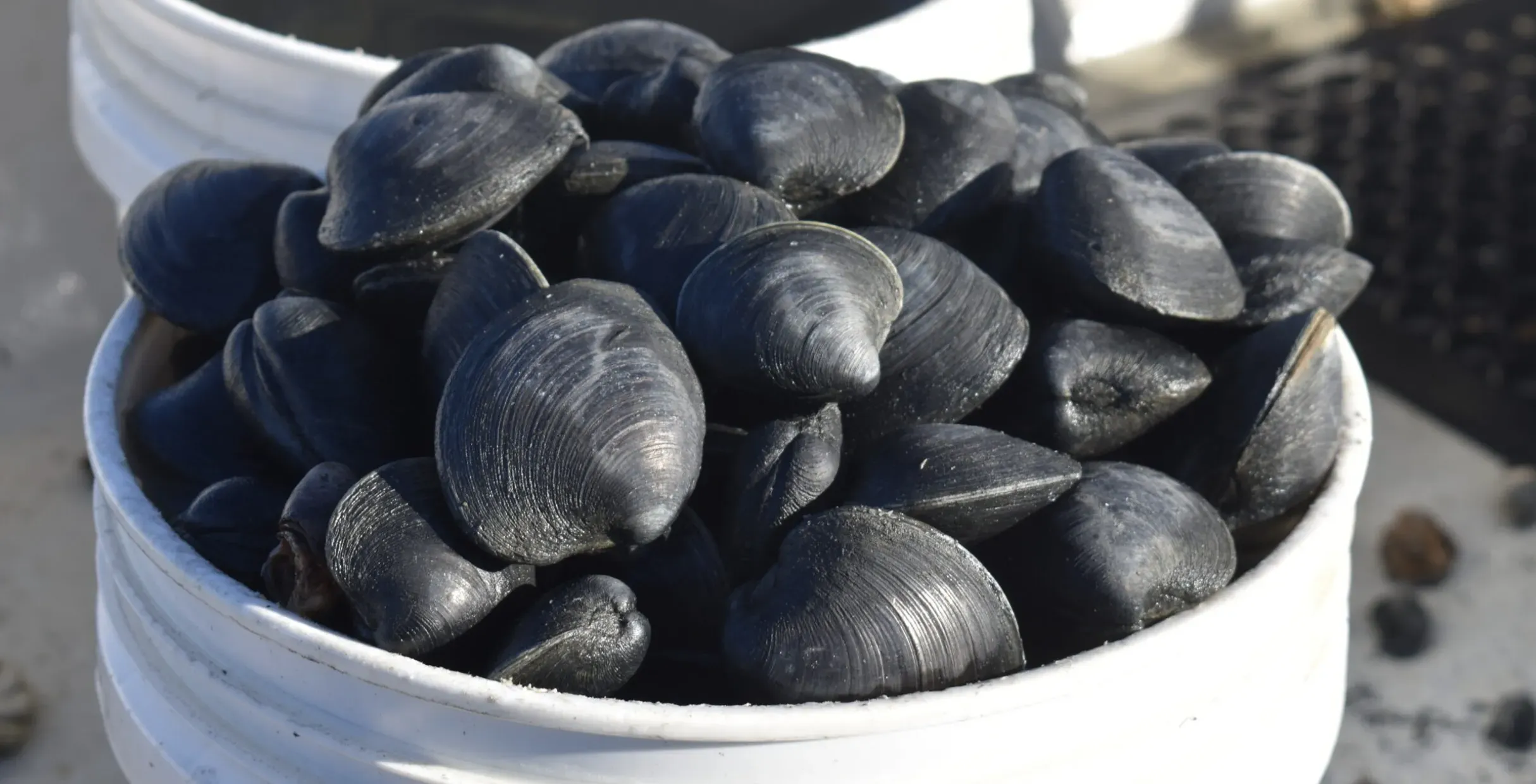
BRISTOL, R.I. — In a basement marine laboratory at Roger Williams University, hundreds of quahogs sit in burbling tanks both large and small. Although the clams don’t look like they’re doing much, they are at the center of a question quahoggers in Rhode Island have been asking for years: Why are there fewer of them in Narragansett Bay than there used to be?
The numbers back up what harvesters see on their rakes. In 2022, Rhode Island quahoggers landed 397,442 pounds of quahog meat, according to NOAA Fisheries data. That’s less than half of the more than 900,000 pounds harvested in 2012. The problem has become concerning enough that state lawmakers created a study commission in 2023 to look into possible causes. Predation, disease, reproductive problems, and bay nitrogen levels are all suspects, but not every factor is known.
At the same time, shellfish farming in the state is booming. Rhode Island’s aquaculture harvest was worth about $8.8 million in 2024, up 9% from the previous year and the highest total since 1995, according to the Coastal Resources Management Council.

As a nonprofit journalism organization, we depend on your support to fund more than 170 reporting projects every year on critical global and local issues. Donate any amount today to become a Pulitzer Center Champion and receive exclusive benefits!
That continuing growth puts new weight on questions that are hard for any single shellfish grower or harvester to answer: Which diseases are moving through the bay? What’s in the water? And are “forever chemicals” turning up in the seafood people eat?
Much of the work to answer those questions happens at two Rhode Island institutions a short drive apart. At RWU’s Center for Economic and Environmental Development (CEED), researchers raise shellfish, diagnose their diseases, and study how farming practices affect the bacteria oysters carry.


At the University of Rhode Island, the Graduate School of Oceanography (GSO) in Narragansett and a URI-led PFAS research center called STEEP track what’s happening in the water and in the food web. Together, they form a research network that Rhode Island’s shellfish industry increasingly leans on.
Putting numbers to the quahog decline
The clams in the RWU basement are part of a research program studying the health and reproduction of the bay’s wild hard clams, and testing whether hatchery-raised clams can help rebuild the population.
The work at CEED is funded through a Partnership for Research Excellence in Sustainable Seafood (PRESS) grant from URI, supported by the National Oceanic and Atmospheric Administration.
“We’re working with the state to provide data on isolated populations and their ability to reproduce, and also what diseases or pathogens they might face in these specific areas,” said Malcolm Bowen, RWU’s aquaculture extension specialist and manager of the university’s marine aquaculture farm.
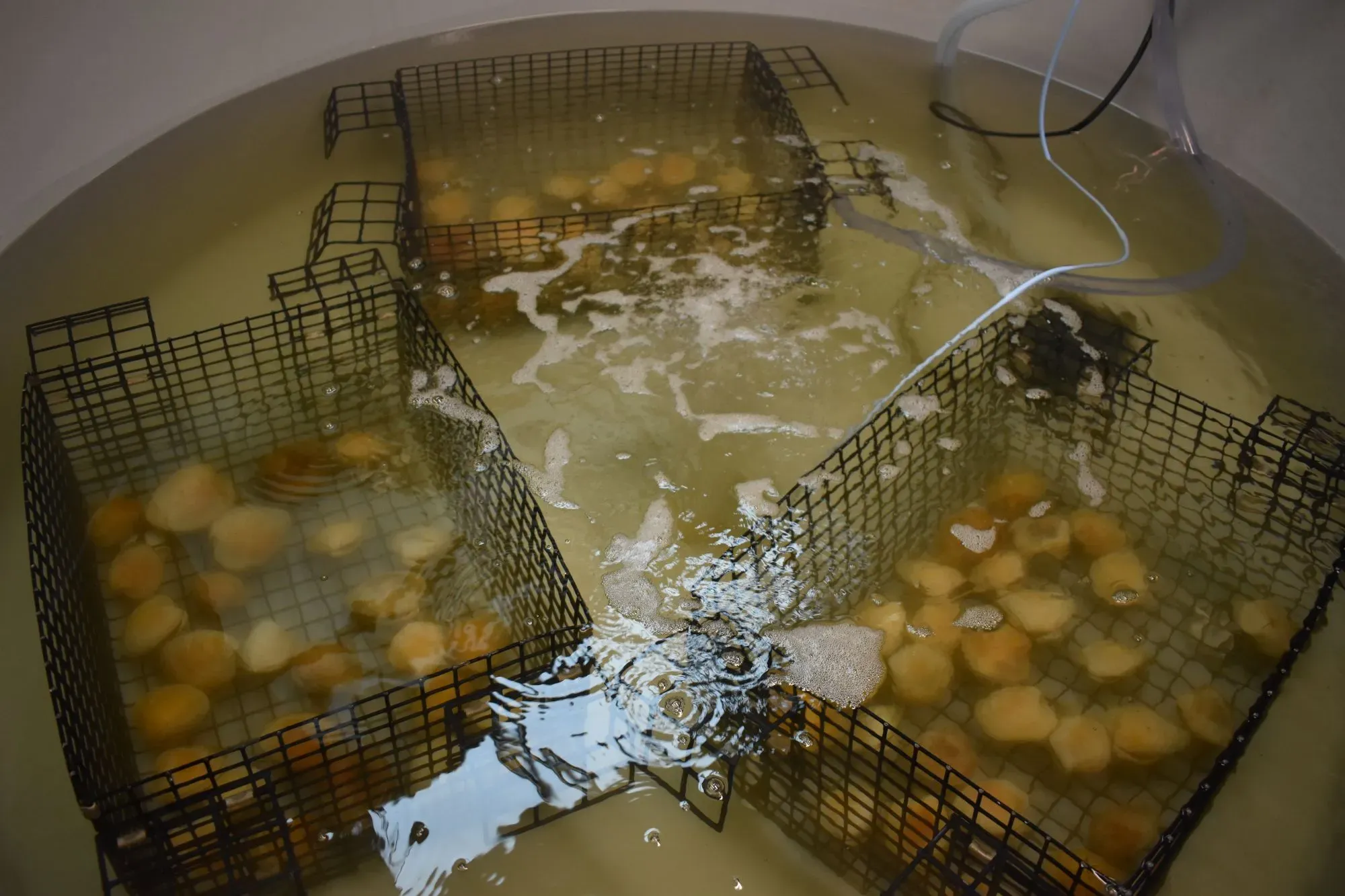
“The aim of this work is to address commercial and recreational harvester concerns about the declining clam population in Narragansett Bay,” said Robert J. Holmberg, RWU assistant professor of marine biology and CEED’s shellfish aquaculture and hatchery specialist.
CEED, which is based in RWU’s Marine and Natural Sciences building, yards from Mount Hope Bay, describes its mission as preserving the health of coastal and ocean ecosystems while supporting economic growth. The center has a 7,200-square-foot wet lab with flowing seawater, a commercial-scale shellfish hatchery and farm, and a diagnostic laboratory.
The researchers started with quahogs collected from four locations in and around Narragansett Bay, split into two groups.
Half went to CEED’s Luther H. Blount Shellfish Hatchery to become brood stock, the parents of the next generation. The other half went to CEED’s Aquatic Diagnostic Laboratory, where they were tested for two major shellfish diseases: quahog parasite unknown, or QPX, and hemocytic neoplasia, a contagious cancer that affects the clam’s equivalent of blood. Neither disease is dangerous to people, but both can weaken or kill clams.
The testing serves a practical purpose: to learn whether quahogs can be safely moved from one area to another without spreading illness.
One of the project’s central questions is how wild clams compare with ones given a head start in the hatchery.
“We’re looking at wild populations and a hatchery population. One of the various things we hope to come out of it is to make a comparison between them,” said Kimberly Soule, RWU hatchery technician.
After studying the hatchery-spawned clams, the team will “go back and collect more clams from those same four [wild] populations and go, ‘OK, what do their reproductive organs look like having been left in the wild, versus us actually kind of helping them in a hatchery,'” Soule said.
In the hatchery, brood stock are slowly warmed from cold ocean temperatures to about 60 degrees Fahrenheit and fed microalgae grown at the university. After five to six weeks, they’re moved to shallow trays of water warmed to about 80 degrees, which tricks them into spawning.
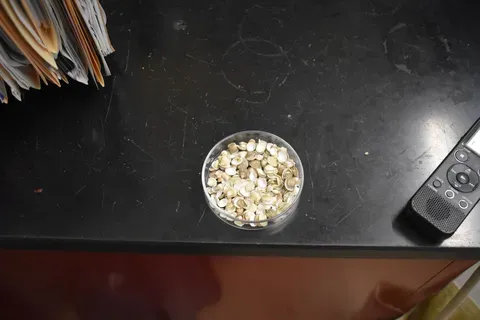
“It’s a numbers game,” Holmberg said. “In the wild, a very small proportion of those end up developing, but in the hatchery, we try to maximize the percentage of them that are turned into seed.”
The young clams went to the Rhode Island Shellfisherman’s Association’s floating upweller nursery in Warwick, where CEED’s FerryCliffe Shellfish Farm team cares for them. Baby clams start out about the size of a grain of sand, and grow by consuming nutrients from the water, filtering it in the process. Upweller systems accelerate growth by storing the young quahogs in containers and pumping water through, delivering constant food and oxygen, which increases growth rates and survival. As they grow, the quahogs are sorted into different containers by size so that they grow and consume nutrients at similar rates.
RWU worked with RISA and the Department of Environmental Management to plant the quahogs in state waters once they were ready.
The goal is at least 100,000 young quahogs from each of the four populations. Because the brood stock are genetically diverse and screened for disease, the clams should have a better chance of breeding successfully over the long term.
A disease lab for the Northeast
The quahog testing runs through a lab that has become a regional resource. Roxanna Smolowitz founded the Aquatic Diagnostic Laboratory in 2009 with $1.69 million in federal funding. It diagnoses diseases in shellfish and finfish for aquaculture businesses, extension agents, and regulators in Rhode Island and other Northeast states. Galit Sharon, an aquatic veterinarian and associate professor of marine biology, now directs it, and RWU marine biology students work alongside its staff.
The lab has developed a new way to detect hemocytic neoplasia, a form of cancer. The standard method is to examine tissue under a microscope, which can take up to six weeks and always kills the clam. RWU’s genetic test doesn’t harm the quahog, takes about two weeks, costs less, and is better at catching low levels of the disease.
There’s no firm data yet on whether the cancer is significantly affecting wild quahogs in Rhode Island. But it has hit some Massachusetts populations hard.
“The shellfish team here at CEED is applying research to gain data so we can tackle questions about disease in this important species,” said Koty Sharp, CEED director and associate professor of biology, marine biology and environmental science at RWU.
How farming methods affect bacteria
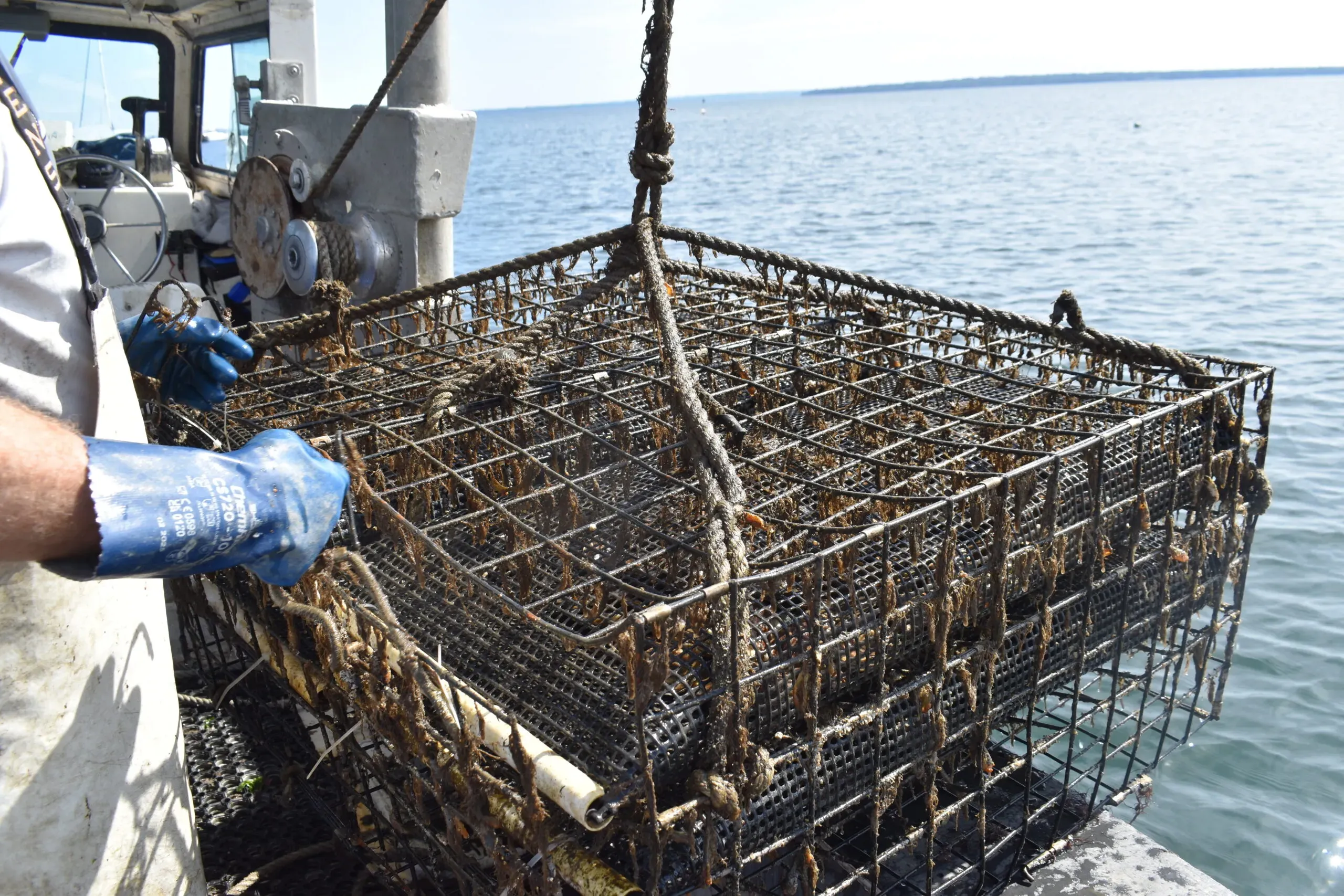
The lab also studies bacteria that can make people sick. Vibrio parahaemolyticus and V. vulnificus can cause illness in people who eat raw oysters, and V. vulnificus can also infect open wounds.
In a 2022 study, lab manager Abigail Scro, James Westphalen, and Smolowitz teamed with Hauke Kite-Powell of the Woods Hole Oceanographic Institution in Massachusetts and John Brawley of Sweet Sound Aquaculture, an indoor saltwater farm in Vermont. They asked whether growing oysters on the bottom of waterways or in raised trays changes how much Vibrio they carry.
The team sampled oysters at two Massachusetts farms every two weeks from April to October 2015. At Duxbury Bay, where oysters stay underwater, bottom-grown oysters that were dredged carried more total and disease-causing V. parahaemolyticus than tray-grown oysters. Tray-grown oysters had more V. vulnificus.
At Wellfleet Bay, where oysters sit out of the water for up to four hours each tide, the pattern partly flipped. Tray-grown oysters there carried more V. parahaemolyticus. The study’s authors think the warming oysters get at low tide is a likely factor.
At both farms, warmer water meant more Vibrio. The authors tie that to climate change: as northern waters warm, Vibrio could become a bigger concern. They suggest that Vibrio control plans in Northeast states account for oysters left exposed by long low tides.
The study covered one season at two farms. In Duxbury, the bottom oysters were dredged and the tray oysters were picked by hand, so the growing method and the harvest method were mixed together, a limit the authors acknowledged.
What lives inside an oyster
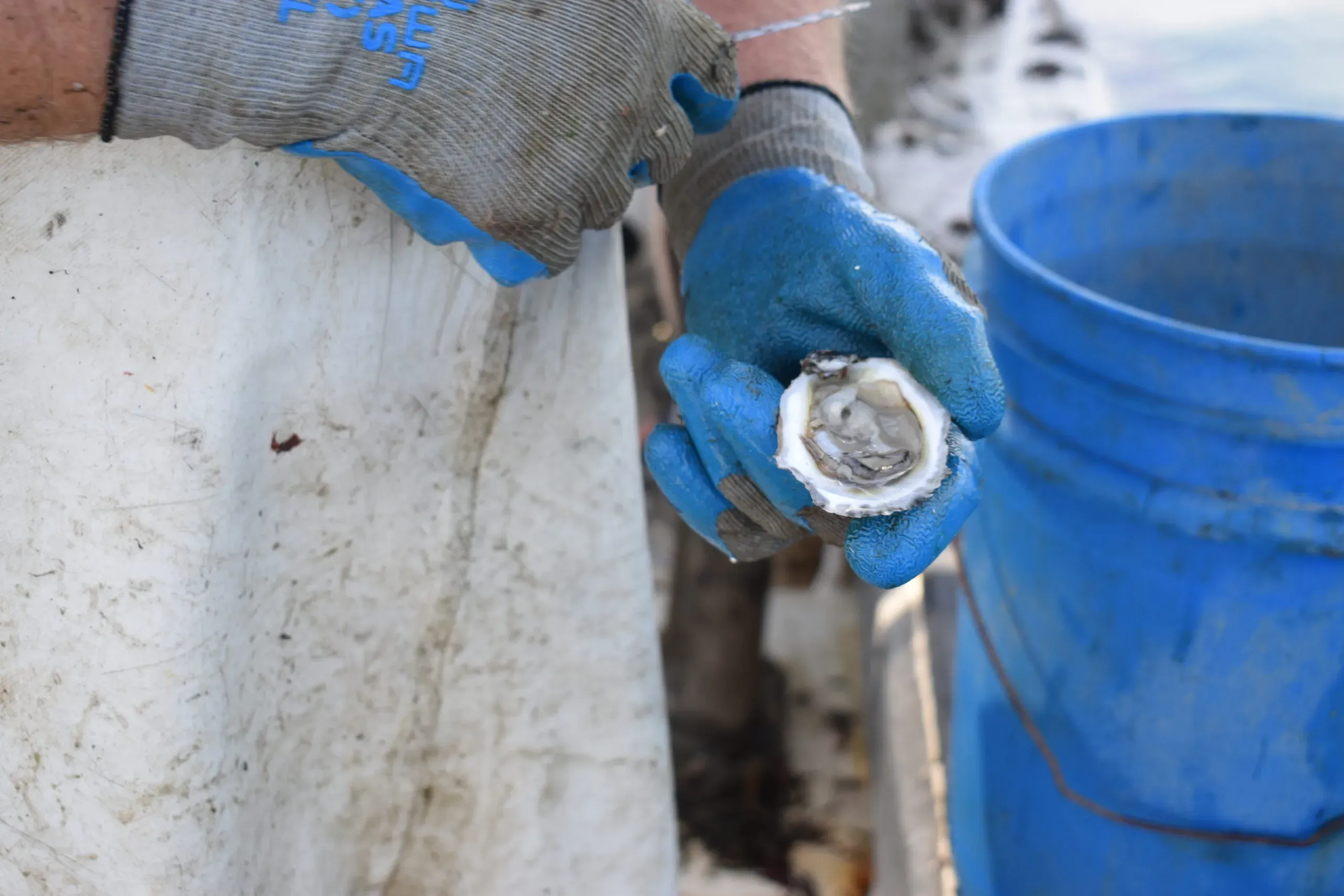
Other work looks at the microbes that help keep shellfish healthy. In a 2021 study, researchers from URI and RWU, including Smolowitz and Scro, mapped the bacteria living in different parts of the eastern oyster.
They collected 29 farmed oysters from Ninigret Pond in Charlestown in August 2017 and split each into six tissue types, each with its own microbial community. The oysters’ guts were dominated by Mollicutes, small bacteria without a cell wall. The oyster versions carry genes that let them break down chitin and get energy from the amino acid arginine, which suggests they’re adapted to life in the oyster gut.
About half the oysters, 14 of 29, were infected with Perkinsus marinus, a parasite that causes Dermo disease, symptoms of which include slow growth, pale digestive glands, thin meat, mantle recession, and gaping shells. The disease thrives in waters warmer than 68 degrees and chiefly impacts eastern oysters, causing mortality rates between 50% and 75%. Infected oysters had less diverse microbes, but only on the inner shell. The authors said the study lays the groundwork for understanding how microbes affect oyster health and disease resistance.
When oil and dispersant meet oysters
Pollution’s effects on aquaculture is part of the lab’s study area, also. Smolowitz was a co-author on a 2018 University of Connecticut-led study that tested how oil and the dispersant Corexit 9500 affect eastern oysters. About 1.8 million gallons of Corexit were used after the 2010 Deepwater Horizon spill.
In the study, oysters were exposed to the dispersant alone, crude oil alone, and a mix of the two, at levels below what would kill them. All three treatments cut how fast the oysters fed. The oil-dispersant mix did the most harm to feeding, and Corexit alone weakened one of the oysters’ immune defenses.
The effects were subtle, but they changed how the oysters ate and fought infection. The authors say the results can improve decisions about how to respond to future spills.
What’s in the water
Across Narragansett Bay, URI’s Graduate School of Oceanography has been studying the area since before oyster farming took off. The school was formally established in 1961 on the shore of the West Passage, though URI’s marine science work dates to the 1930s.
One of its longest-running projects is the Narragansett Bay Long-Term Plankton Time Series, which has sampled the bay weekly since 1957. Samples are collected once per week to test for temperature, salinity, turbidity, chlorophyll, and nutrients. That research is important for shellfish, which eat by filtering plankton from the water. A 2024 study found that phytoplankton biomass in the bay fell 49% between 1968 and 2019.
“Phytoplankton are a key food source, so this decrease we’re seeing is important,” said Tatiana Rynearson, the URI oceanography professor who supervises the time series.
Watching conditions on oyster farms
GSO researchers are also working directly on oyster farms. Jacqueline Rosa, a biological science laboratory technician at the USDA Agricultural Research Service, received her master’s degree in chemical oceanography from the Graduate School of Oceanography and has studied how water quality and farming practices impact the oysters in the lower West Passage of Narragansett Bay, an area that hosts 48 acres of oyster farms.
Rosa installed sensors at Wickford Oyster Company’s farm near Fox Island in June 2024. They log temperature, salinity, pH, and dissolved oxygen every 30 minutes. She also analyzed more than 200 water samples in the lab.
One concern going in was ocean acidification, which can make it harder for oysters to build shells. But the carbonate chemistry at the farms stayed favorable for shell building most of the time. Rosa concluded acidification was not a major stressor for farmed oysters there, at least for now. She noted that conditions will keep changing as carbon dioxide levels rise.
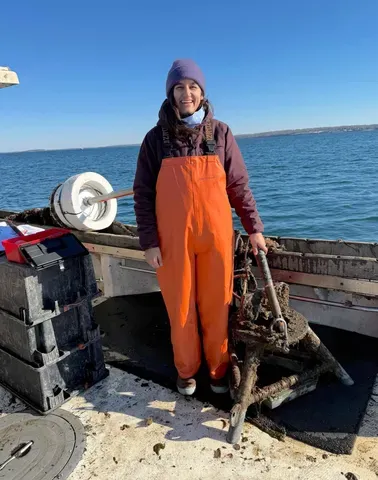
“We were specifically interested in the carbonate chemistry in the water column, which allows us to better understand things like acidification and if that is potential stressor to shellfish,” Rosa said. “From our data, we did not see that acidification was a stressor for oysters over that year and a half period.”
Rosa explained that ocean acidification, or coastal acidification, refers to the water column becoming more acidic, which makes it more difficult for shellfish to form their shells, which are made up of calcium carbonate.
“That was a focus of our water quality study to monitor pH over time and see if there were any concerning trends, and we didn’t see any periods of concerning pH, which was really positive,” she said.
Low oxygen was a more pressing issue. Bottom waters at Rome Point dropped to hypoxic levels on one day in August and nine days in September 2025, Rosa’s study found. The Wickford site recorded none in those months.
“We did see some periods of lower dissolved oxygen in the bottom of the water column near Rome Point,” Rosa said.
The timing matters: seed oysters planted in late spring go through a critical growth period in summer, when hypoxic conditions are most likely.
Rosa said oyster farmers are aware of this issue, and don’t tend to put young oysters in bottom cages, instead waiting until “they’re much larger and they’re likely to not be as stressed by things like dissolved oxygen, low dissolved oxygen.”
“I think it’s a great pairing to have that continuous water quality monitoring alongside oyster farms,” she added. “It’s definitely helpful for the farmers to get a better understanding of what’s happening seasonally and annually at their site.”
Tracking forever chemicals in seafood
A newer worry for shellfish eaters is PFAS, the “forever chemicals” used in fast-food packaging, nonstick cookware, cosmetics, and firefighting foam. They’re linked to higher cholesterol, liver damage, immune system effects, and cancer risk. Some 99% of Americans have PFAS in their blood, studies have shown.
URI leads one of the country’s main research efforts on PFAS. STEEP, short for Sources, Transport, Exposure & Effects of PFAS, is funded by the federal Superfund Research Program through the National Institute of Environmental Health Sciences. Its partners include Harvard University and Silent Spring Institute.
STEEP is directed by Rainer Lohmann, a GSO professor of oceanography, and Philippe Grandjean, an adjunct professor in URI’s college of pharmacy. In 2022 the program was renewed for $8.1 million over five years.
“Program renewal means STEEP can continue to produce the solid science needed to respond to PFAS problems,” Lohmann said at the time.
Quahogs come out on top
Some of STEEP’s clearest seafood findings come from Cape Cod. In an April 2024 fact sheet produced with the Mashpee Wampanoag Tribe and the town of Mashpee, researchers reported testing 114 fish and shellfish samples, covering 24 common species, for 37 PFAS chemicals. The samples came from six spots in the Mashpee and Falmouth area, including Waquoit Bay, Moody Pond, and the Quashnet and Santuit rivers.
PFAS showed up in every sample. Levels were highest closest to Joint Base Cape Cod, a known PFAS source because of firefighting foam. Every species tested from Moody Pond and the upper Quashnet River was above Massachusetts’ advisory level for eating one meal a month for PFOS, one of the main PFAS chemicals.
Most finfish exceeded the state’s PFOS advisories. American eels, bluegill, redear sunfish, and white suckers were the most contaminated.
Shellfish were lower than finfish, and quahogs were lowest of all. They were the only species sampled at more than one location that stayed under the state’s one-meal-a-week guideline. The fact sheet advised anglers to fish away from the base, eat fillets rather than whole fish, and choose shellfish, especially quahogs.
The STEEP lab has also outlined a project to screen fish and shellfish collected from Rhode Island shellfishing grounds. In March 2025, Lohmann convened more than 30 science and health experts at the URI Bay Campus to develop regional guidance on eating wild-caught fish and shellfish that may be contaminated.
Important work
The work being done at RWU and URI is important not only to science, but to the people who rely on shellfishing for their livelihoods.
At the Oct. 7 meeting of the Rhode Island Marine Fisheries Council’s Shellfish Advisory Panel, when the subject turned to the decline of quahog landings in Narragansett Bay, one concerned quahogger asked, “Is there enough food for them? Or are they starving?”
Then, he praised both universities for their work and expressed hope that it will yield answers to the question everyone’s asking.