Pulitzer Center Update September 4, 2026
Ghanaian Youth Are Challenging the Systems Behind Plastic Pollution
Country:

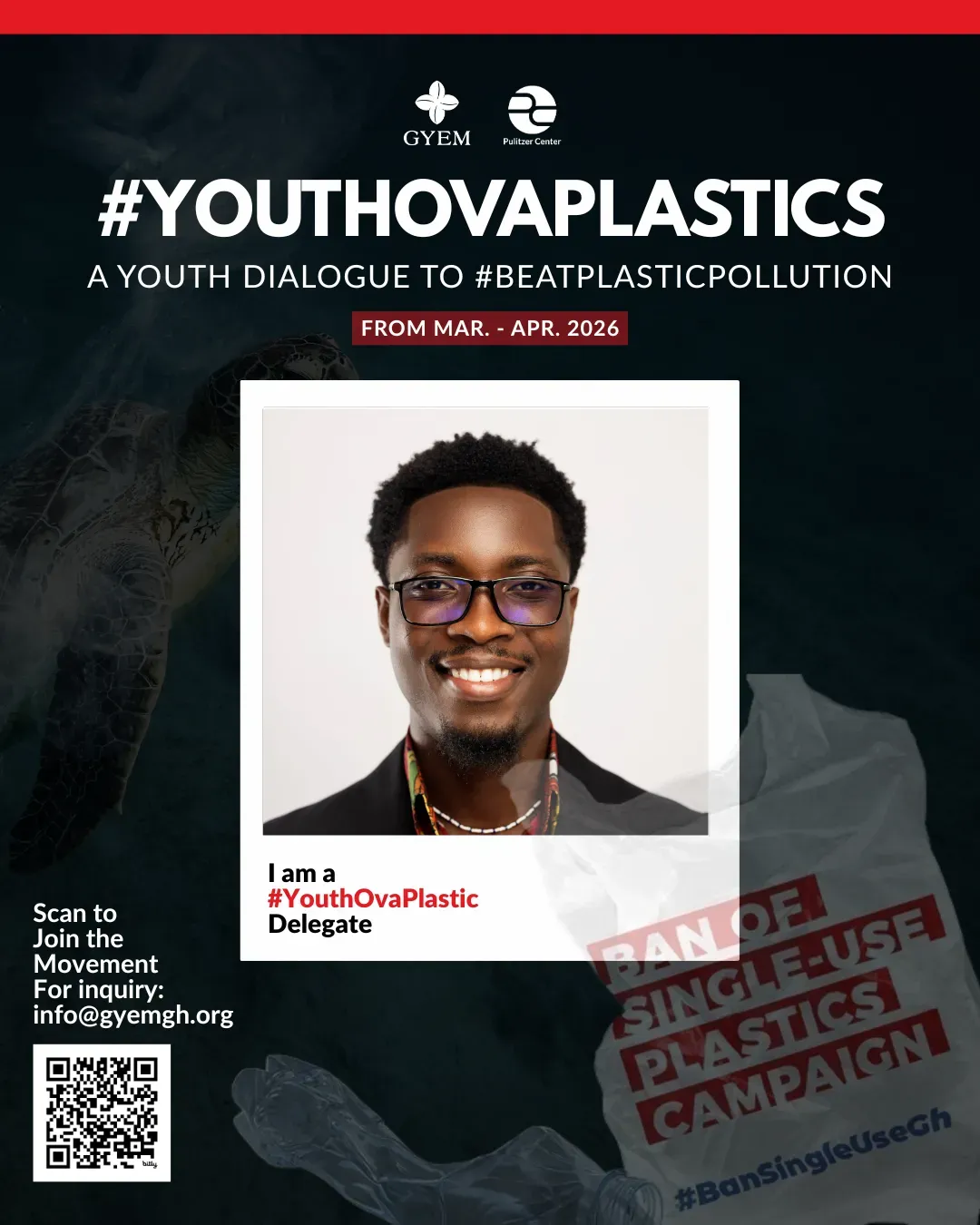
In Ghana, the plastic crisis is often visible everywhere, from clogged drains and polluted beaches to the sachets that line streets and waterways. But for young people participating in the #YouthOvaPlastic Webinar and Digital Contest Series, the question was not simply how to clean up plastic waste. It was how Ghana arrived at a system so dependent on it in the first place, and what it would take to change it.
Organized by the Ghana Youth Environmental Movement (GYEM) between March and April 2026, the initiative brought together 418 young people through three interactive webinars and a digital contest focused on single-use plastics, environmental justice, public policy, and sustainable alternatives.
At the heart of the initiative was “Knot Trash,” a Pulitzer Center-supported investigation by journalist Anne Whiting. Rather than treating plastic pollution as a problem of individual behavior or poor waste management, the reporting provided participants with a broader lens: one that connected Ghana’s plastic crisis to global waste trade, historical policy decisions, the fast-fashion industry, and the displacement of Indigenous systems.
From 'waste management' to systemic change
The #YouthOvaPlastic series was designed to challenge a familiar narrative: that plastic pollution is primarily the result of people failing to dispose of their waste properly. Through discussions grounded in "Knot Trash," participants explored the concept of “waste colonialism” and the ways in which countries in the Global South bear the environmental consequences of consumption patterns originating elsewhere.
The conversation connected the plastic waste surrounding Accra to the huge volumes of secondhand clothing and associated plastic packaging entering markets such as Kantamanto. It also examined the history of Ghana’s sachet water economy and the relationship between public infrastructure, economic policy, and plastic dependency.
Three conversations, three perspectives
The initiative unfolded through three webinars held between March 18 and April 15, 2026, each examining the plastic crisis from a different perspective. The first session, “The Foundations of Waste Colonialism,” explored Ghana’s history of plastic use, the global scale of plastic production, and the transition from traditional water systems to today’s sachet economy. Participants from Ghana were joined by young people from Senegal, Namibia, and Nigeria, creating a wider Pan-African conversation about the ways African countries experience the environmental consequences of global consumption.
The second session turned to policy and governance. It examined Ghana’s policy landscape, the Global Plastics Treaty, and the challenges surrounding a proposed phased ban on single-use plastics. Participants debated who should carry the greatest responsibility for plastic waste, governments, industries or consumers, and what effective regulation should look like.
The third webinar, “Community Innovations,” shifted attention toward the people already creating alternatives. Discussions highlighted informal waste workers, community innovators and traditional practices, including the use of natural materials such as leaves and the potential of refill systems to reduce dependence on sachet water.
Turning journalism into action
The project didn't stop at conversation. Following the webinars, GYEM launched the #YouthOvaPlastic Digital Contest, challenging young people to show practical changes they could make in their own lives and communities.
Participants submitted short videos showing actions such as refusing single-use plastics, practicing waste segregation, reusing plastic materials, and adopting sustainable alternatives.
Ten young people submitted entries, generating a combined reach of more than 21,000 across platforms. The winning submissions showed how relatively simple behavioral changes can become powerful tools for public education.
Nana Ama Okyerebea Abedi, the first-place winner, documented how she prepares for class with reusable items, including an upcycled tote bag, reusable coffee cup, and water bottle.
Joy Jackson, the second-place winner, highlighted a broader community approach through her work with Enactus, including upcycling single-use plastics into bags, promoting waste segregation among students, and building partnerships to encourage sustainable practices.
Fareeda Amankwa-Gabbey, who placed third, showed how discarded pure-water sachets can be transformed into eco-friendly bags, while also passing the skill on to her sibling. Together, the submissions demonstrated the central idea behind the initiative: Behavioral change becomes more powerful when people can see practical alternatives that are accessible in their own communities.
Rediscovering solutions that already exist
One of the most important themes to emerge from the project was the value of Indigenous knowledge. The initiative introduced participants to Ahaban, a traditional leaf-based packaging practice, alongside other historical alternatives, such as clay pots, plantain leaves, husks, and bamboo.
These examples challenged the assumption that sustainability always requires a new technological invention. In some cases, the solution may involve recovering knowledge and systems that already existed before single-use plastics became dominant.
The collaboration with Plastic Punch reinforced this idea through a demonstration of its “Nsuo Pa” Water Refilling Station, offering participants a practical example of how modern refill infrastructure can provide an alternative to sachet dependency while drawing on the communal logic of traditional water systems.
From individual habits to collective advocacy
The #YouthOvaPlastic initiative also reinforced an important lesson for GYEM: Sustainable behavioral change doesn't happen through a single conversation.
During a “Habit Audit,” participants identified plastic-related habits they wanted to change and committed to specific actions, including carrying reusable water bottles and bags and encouraging others to do the same.
At the same time, the discussions pushed beyond individual responsibility toward questions of policy and accountability. Participants debated Ghana’s proposed phased ban on single-use plastics, the role of the Extended Producer Responsibility framework, the influence of the petrochemical industry on global plastics negotiations, and the need to recognize and integrate informal waste workers into national waste-management systems.
The result was a conversation that moved in two directions at once: changing individual behavior while demanding structural change.
A Pan-African conversation on environmental justice
Although the initiative was rooted in Ghana, its digital format allowed the conversation to extend beyond national borders. Youth from Senegal, Namibia, and Nigeria participated in the discussions, creating space for a broader conversation about how African countries can respond collectively to waste flows and consumption patterns originating in the Global North.
For GYEM, this regional dimension is important. Plastic pollution doesn't respect national borders, and neither does the global trade in waste. The initiative became not only a campaign about Ghana’s plastic crisis, but also a conversation about environmental justice, sovereignty, and the right of African communities to shape the systems that affect their environment and public health.
What comes next?
The #YouthOvaPlastic series has become part of GYEM’s broader campaign for a phased ban on single-use plastics and stronger policy action. The organization plans to continue sharing the behavioral changes documented through the digital contest, repurpose webinar discussions into podcast-style content, and sustain engagement with stakeholders working on Ghana’s Extended Producer Responsibility framework.
The project also generated an important operational lesson: digital campaigns need strong systems for preserving their own history. After losing access to the recording of the third webinar because of a technical issue on X, GYEM identified the need to record future sessions locally and across multiple platforms. But perhaps the most important lesson was simpler.
Behavioral change is not a one-time event.
It requires sustained action, visible alternatives, and communities willing to challenge the systems that make harmful practices seem inevitable.Through #YouthOvaPlastic, Ghanaian youth were given the opportunity to do exactly that: Take investigative journalism, connect it to their own realities, question the systems behind plastic pollution, and begin turning knowledge into action. As one participant put it: “If you look around and you are not a solution, you are definitely a problem.”
For the young people who took part, the challenge is no longer simply to manage Ghana’s plastic waste. It is to imagine—and help build—a different system.