Story
 July 15, 2026
Cincinnati Arts Survive and Thrive a Year After Budget Cuts
Country:

Students report on various issues around the world.


With a robust network of art institutions and supporters, Cincinnati has become a model for locally led resilience in the arts from its unexpected seat in the middle of the country.
CINCINNATI—When Rick Michelman, board of trustees co-president of the Contemporary Arts Center (CAC), asked an out-of-town visitor at an FC Cincinnati soccer game what he’d enjoyed seeing in the city, the answer surprised him. It wasn’t the city’s sports teams, its Kentucky-facing riverfront, or its notorious chili recipe.
“He went to the Contemporary Arts Center,” Michelman said. “The punchline is, he enjoyed it so much that, even though he’s not from Cincinnati, he joined as a member, and he went back the second day.”
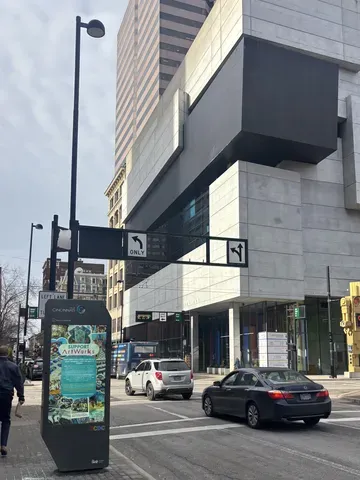
Michelman said Cincinnati has a gift: high-quality art institutions that give the quiet Midwestern city a “hip” edge. The CAC is one of these gems that sets the city apart, with its rotating display of emerging artists in a Zaha Hadid-designed building.

As a nonprofit journalism organization, we depend on your support to fund more than 170 reporting projects every year on critical global and local issues. Donate any amount today to become a Pulitzer Center Champion and receive exclusive benefits!
“There [are] cities that are bigger than us that don’t have this,” Michelman said. “That puts us on the leading edge. I think that gives us a chance to be a highly educated arts community, but I think for me, it’s just one of the many things that makes Cincinnati unique, awesome, and a great place to live.”
Last year, cuts in federal funding threatened that edge. An executive order in March 2025 cut grants from the Institute of Museum and Library Services (IMLS). The Trump administration then began cutting grants issued by the National Endowment for the Arts (NEA) in May 2025, citing new funding priorities. A U.S. District Court ruling reinstated IMLS grants in November 2025, and organizations that faced NEA cuts have been able to appeal their grant applications.
But Cincinnati’s robust network of art institutions and supporters has allowed the city’s arts community to continue thriving despite these funding cuts, making the Queen City a model for locally led resilience in the arts from its potentially unexpected seat in the middle of the country.
“How people feel about the arts in Cincinnati is that they are so incredibly important to everyone here that no matter what side of a political party you’re a part of in Cincinnati, you value the arts,” said Carolyn Hefner, CAC chief of external affairs.
Funding cuts hit Cincy’s young artists
For almost 10 years, the IMLS’s Museums for America grant funded the CAC’s teen programs. The organization most recently earned a $175,000, three-year grant that covered 30% of the programs’ cost.
CAC’s teen programs include a teen council, which plans young adult museum events, and paid teen fellowships, often recipients’ first paid work experience.
University of Cincinnati student Khara Rosebrook got her part-time education assistant position at the CAC after three summers as a teen fellow. She said the fellowship helped her network in the Cincinnati arts scene, supporting her career aspirations as an artist and singer-songwriter.
When the government terminated the museum’s IMLS grant in April 2025, programmers had to reduce teen programs by one-third, in proportion to the lost funding. Teen Programs Manager Shawn Braley emphasized the museum’s focus on streamlining, not cancelling, these beneficial programs. Seven rather than 10 teens received fellowships, and the teen council’s overnight arts field trip became a day trip.
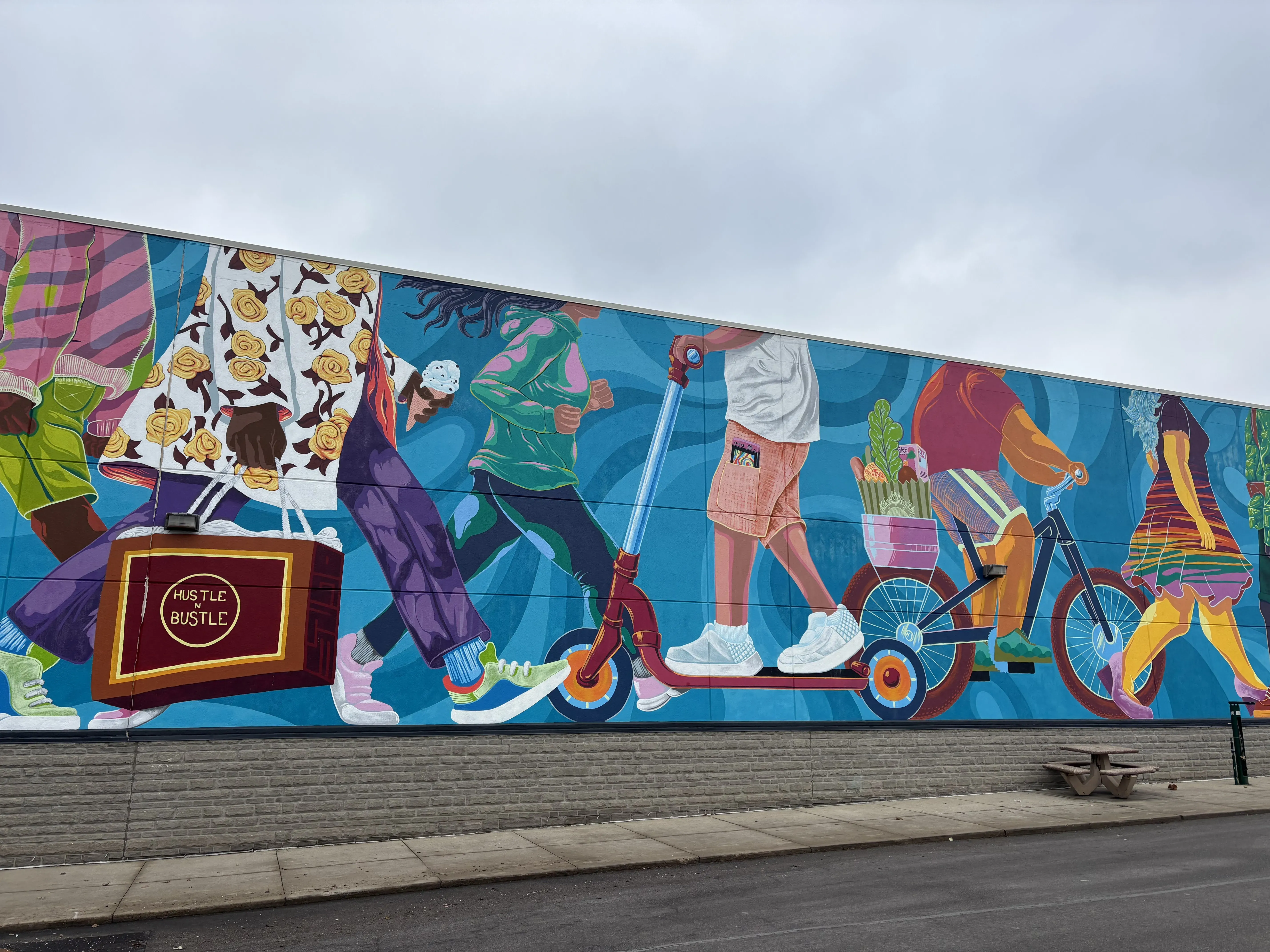
NEA funding cuts likewise disrupted youth outreach for ArtWorks, a Cincinnati nonprofit that creates public art projects. ArtWorks employs local artists, mostly teens and young adults, to paint murals around Cincinnati each summer. ArtWorks CEO Colleen Houston said these projects create civic pride and meaningful work for urban youth facing adversity, and even deter graffiti on the decorated blocks.
The NEA awarded, and subsequently cancelled, a $100,000 Our Town grant to ArtWorks for a mural in the historically African-American neighborhood of Avondale. The mural would have adorned and highlighted a new biking and walking trail.
Houston was particularly disappointed to cancel a project in a historically underserved minority community. ArtWorks’ “creative place-making” projects have been part of redevelopment projects in other historically Black Cincinnati neighborhoods. She added that ArtWorks prioritizes hiring local Black youth in these communities to ensure an honest artistic representation of a neighborhood’s history and future.
Funding recovery and community support
IMLS funding cuts came as nationwide economic strain was already reducing private donations to the CAC. To sustain their operating budget, the museum began charging general admission, something they hadn’t done for a decade.
Rosebrook was disappointed that funding cuts forced the CAC to add further barriers to the often exclusive art world—a world she longs to make more accessible for marginalized communities.
“The people that we want to be there for are not being provided for, and that’s something that’s really unfortunate,” Rosebrook said. “It puts us in this helpless position of, we want to be able to do everything we can to bring people in and to inspire people, but when we aren’t given the resources by which to do that, we kind of fall short time and time again.”
This admission fee, a clear consequence of funding cuts, reversed the downward trend in donations. The Patricia Kisker Foundation and the Haile Foundation, two local nonprofits, made sizeable one-time gifts to the CAC. Cincinnati’s Fifth-Third Bank launched a Rapid Response Fund to support 57 local organizations facing federal funding cuts, including the CAC and ArtWorks.
Many individuals also made first-time donations specifically to support CAC’s teen programs.
“They were saying, ‘I had no idea that this many kids were being served. Who would want to take away programs for kids?’” Hefner said.
But Hefner was most pleasantly surprised by how many new memberships the museum gained.
“For years, folks would say, ‘Well, why should I get a membership when it’s already free to come?’ Then there was more of this acknowledgement of what their dollars help make happen,” Hefner said.
Though the Cincinnati community stepped up, federal funding cuts have permanently changed how the city’s arts groups approach fundraising. Houston said ArtWorks is hesitant to apply for federal funding going forward, especially since the NEA denied their grant appeal following the initial cuts. ArtWorks, which has since rebranded as 1001 Colors, instead plans to scale back and hire fewer artists for mural projects this summer.
Houston is also fearful of a trickle-down effect from funding cuts in the coming years, as losing federal dollars may force state and local governments to reduce funding for community programs.
Meanwhile, thanks to the November 2025 ruling, the CAC can expect its IMLS funding back. Nonetheless, its staff is proceeding with caution regarding federal money and proactively prioritizing other fundraising sources.
Art’s Queen of the West
One unique resource that helps Cincinnati artists thrive with or without federal funding is ArtsWave. An umbrella fundraising organization, ArtsWave collects individual donations to support over 150 arts organizations in the Cincinnati area.
Thanks to support from ArtsWave and other donors and foundations, the Cincinnati Art Museum (CAM) remains free for all patrons. EJ Kuhnell, a fine arts and education student at Mount St. Joseph University in Cincinnati, appreciates the museum’s accessibility through free admission and programs like the CAM Cruiser van, which brings art activities to schools.
“Just trying to keep that so that people can still come and look at stuff, and kind of help keep it alive, is important, and not making it feel like a closed-off space that nobody can reach,” Kuhnell said.
Cincinnati museum-goers can discover debuting artists at the CAC or see iconic works from Van Gogh and Monet in the CAM’s collection. When it comes to the performing arts, The Children’s Theatre of Cincinnati (TCT) helps put the city on the map.
After a high-tech renovation of the historic Emery Theater in 2023, CEO Kim Kern is proud to call hers one of the top children’s theaters in the country, alongside peers in Minneapolis, Seattle, and Charlotte, N.C.
“None of us are where you would think,” Kern said.
Local fundraising mainly funded the Emery renovation. Though the NEA cancelled a grant for a TCT touring production, Kern is glad her organization isn’t heavily reliant on federal funding. Rather, she thinks the community will always support children’s theater as a meaningful educational activity.
Meanwhile, hosting the 2025 Americans for the Arts Conference (AFTACON) put Cincinnati at the center of political conversations in the arts. Artists at the conference planned to protest Project 2025 and NEA cuts through simultaneous demonstrations across the country. The Greater Cincinnati Homeless Coalition participated in one of these creative demonstrations in September, joining groups in San Francisco and Oakland, California.
Andrew Wood, the executive director of the San Francisco International Arts Festival, attended AFTACON and supported these protests. He said liberal hubs like the Bay Area can serve as cheerleaders in this movement, but cities like Cincinnati are where fighting for the arts matters most.
“Cincinnati’s a democratic city in a red state, but it’s still a swing state,” Wood said. “It’s a place where votes matter, and the direction of the country is gonna be decided in places like that. Those are the places that we need to be inspiring to take leadership.”