Story
 July 6, 2026
Telegram Trap: How Hidden Networks Exploit Children and Their Families
Country:


This investigation exposes a growing digital exploitation network operating on Telegram, where...
Luring Children for Sexual Exploitation and Selling Their Recorded Materials for Money
Based on documented testimonies, monitoring of Telegram groups and channels, and interviews with relevant institutions
Over several months, we gathered scattered threads revealing the dark side of Telegram, where children's photos are exploited and sold to hundreds or thousands of subscribers
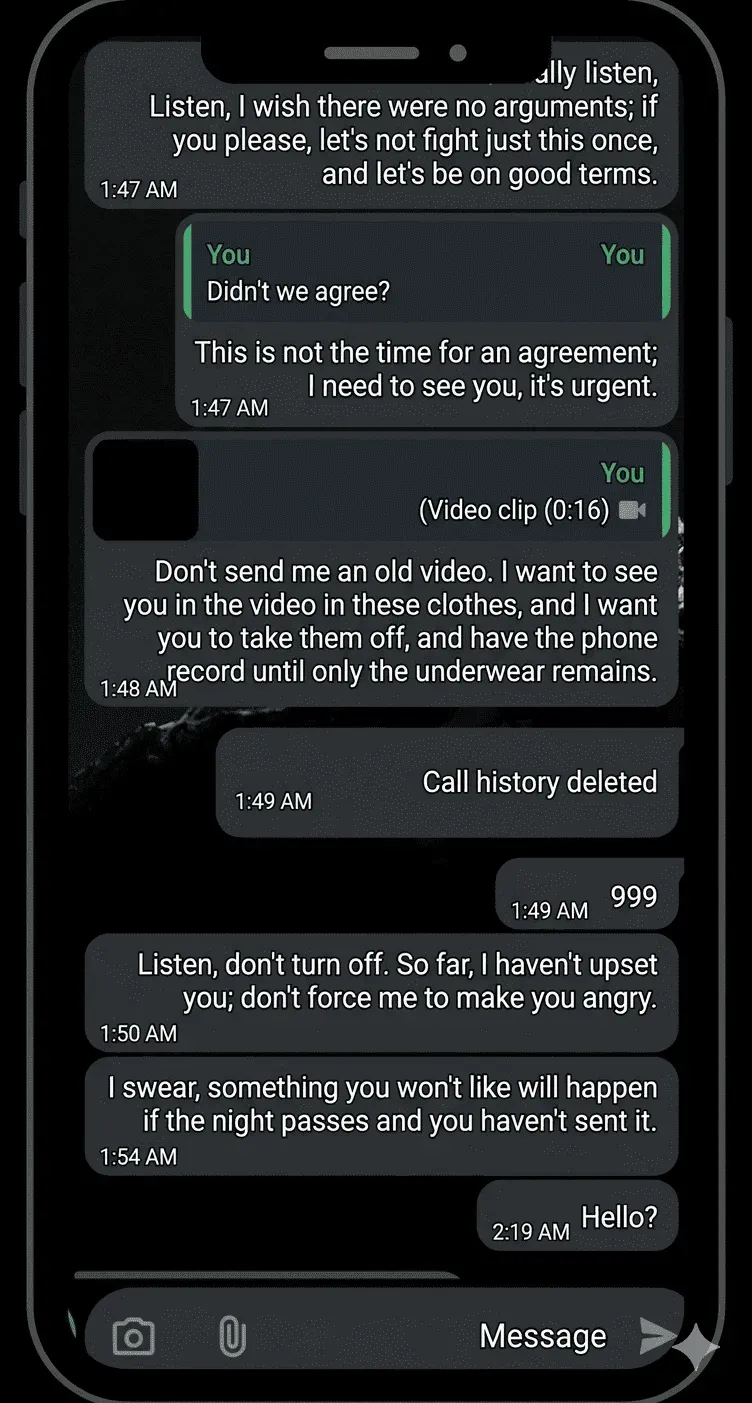
It was nine o'clock in the evening when Ali's (15 years old) phone rang, alerting him to an unread message. He opened it, then quickly left the family gathering and entered his room. He appeared tense, his hands shaking as he held his phone and read it for the second time: "Don't force me to hurt you. Something you won't like will happen if the night passes and you don't send."
With a similar message Salma's phone rang. She was about the same age as Ali. She closed the door to her room, staring at the screen in panic: "As long as you resist me, I will send what I have to your father."
This was followed by another message to both of them: "Tonight... before 12 o'clock!"
The sender, using an "unknown name," was dispatching his messages one after another, warning them that if they did not carry out specific tasks, he would act. Then he would wait for their turn. On his screen, both now showed the "typing" indicator in the chat interface.

As a nonprofit journalism organization, we depend on your support to fund more than 170 reporting projects every year on critical global and local issues. Donate any amount today to become a Pulitzer Center Champion and receive exclusive benefits!
The Starting Point
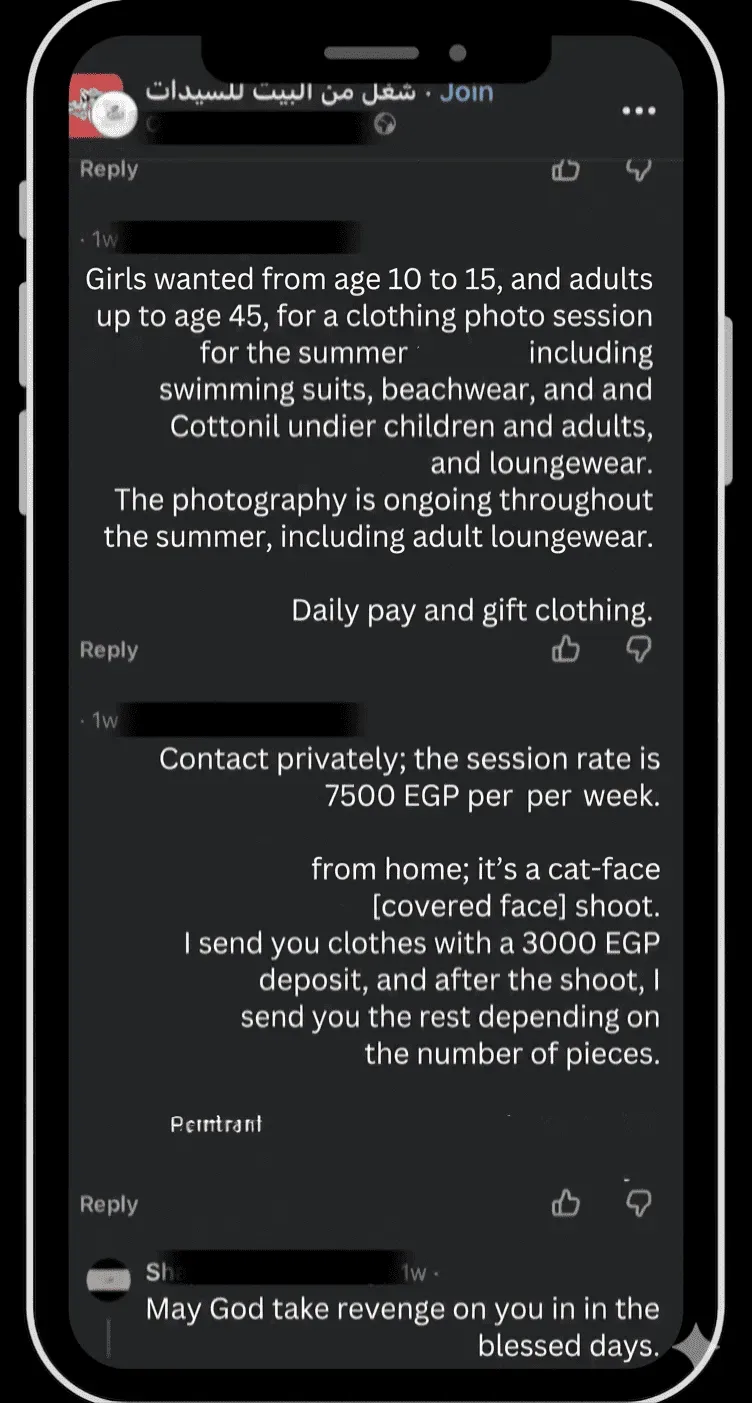
Three months ago — In a room whose walls were marked by peeling paint, Salma rested her head against the back of her bed, scrolling through social media on her phone, always drawn to whatever influencers happened to be posting. She usually isolated herself like this, spending long hours away from her family. Then she came across posts that had spread widely across the groups she followed—“Work from Home – Girls Only – Model Egypt”—all carrying the same message: “Work from home, quick and generous pay, contact via Telegram.”
The idea tempted her: “Why not earn money without going anywhere, buy whatever you want, and help your father with his medical expenses?” She decided to ask, and the other party replied in a written message that she would be working as a model for summer and lingerie clothing.
She hesitated for a moment, but he quickly cut in and reassured her that “her face would not appear in any photos”—or, in the common term used in this kind of advertising, “cut face.”

On the other side, “Cox”—a fictional name—had prepared his tools to begin a new mission. This time, it involved multiple fake Facebook accounts, all private, each bearing a female name and a profile picture. Through them, he posted those same messages and waited for the first target to enter his sphere of influence, and it was Salma. To him, she was an ideal profile. He set a trap for her, and she fell into it easily, after which things escalated further.
Cox briefly paused his conversation with her when a new message notification popped up in a PUBG chat room. It was Ali’s reply, after he had written “Hello.” Cox began by getting to know him and asking about his age.

Question after another, he understood Ali's personality: bold in gaming and on the internet only, but naive and shy outside this world, obsessed with games, and not sharing with his family what he does. Here, he spotted his vulnerability. He made a deal with him that "if he sent photos and videos of himself so he could see him and get to know him better, he would give him in-game currency and charging."
Setting the Trap
Salma complied and sent her photos and videos in the way he requested, under the assumption that she was working as a “model.” Their conversations grew longer and their relationship developed further, when he confessed to her that he wanted to be in a relationship with her, even though she did not receive any financial gain from him. She even welcomed sending him her father's and brother's phone numbers.
She says with a confident tone: "I never doubted that he loved me, so I responded to everything he asked for—photos and videos, some of which showed my face.” This was despite his consistent refusal to speak with her over video calls.

Over the following weeks, she wanted to out an end to all of that and stop sending him any more photos. Cox changed his strategy with her and revealed his different face, more threatening side—one that he had been waiting to show. He quickly turned her images into a means of pressure.
His daily messages to her fluctuated between insistence and intimidation, maneuvering in an attempt to convince her to return to him, or else he would expose her to everyone. His plan succeeded. The situation was then repeated in all its details a second time: whenever she tried to withdraw and distance herself, he pressed the threat button, and she would find herself forced to return to the same point.
Salma saw all of this as "him threatening her so she would return to him, because he loves her." She says: "He won't do anything with my photos, I'm sure of that"... Then the third time was decisive for her: she blocked his account and ignored his threat. She never expected his next move.
Meanwhile, his bet succeeded on someone like Ali.

Ali did not think twice before sending him his photos and videos. He recorded them secretly without anyone in his family noticing, in exchange for a virtual reward—charging in PUBG. Cox then threw him another bait, just a link, through which he was able to hack his phone and obtain the numbers of his family, teachers, and friends. He became more frank and bold in revealing his intentions, and asked Ali for photos and videos without clothes.
Ali was shocked and confused, saying: "I trusted him and talked to him openly about everything. I don't know what to do now? Is what he is asking normal?"
The Closed Circle
Cox's next step with Salma, which she had not calculated, was reaching her father. She was sitting next to him when the first message came: "As long as you resist me, I will send what I have to your father." Then he told her that he had already sent it, and that he would follow up with everything related to her unless she complied. What he meant was videos of her performing movements and behaviors of a sexual nature.
He set a final deadline for her: midnight.
Salma wished the earth would swallow her at that moment, as she describes. She ran to delete the message from her father's phone before he saw it, and kept the screenshots of Cox's conversations and his threats to her—something she had not thought of doing before this time.
She says in despair: "If my mother finds out, she might die, and my father will kill me."

As for Ali, who received the same warning message, he quickly complied with his demands before midnight, not wanting to provoke him by wasting more time. He sent him photos without clothes, which made the idea of backing down or informing his family seem impossible as well.
He says: "I don't want to continue with this, but the matter must not reach my family in any way!"
Every phone ring terrified them and announced a new demand. At this time, Cox had taken both Salma and Ali to the final level and cornered them.
On the Telegram messaging application, designed by the Russian brothers Nikolai and Pavel Durov, Cox was exchanging messages with them and working, exploiting the feature of his encrypted conversations to collect all these recorded materials and then publish them on his private closed channel—meaning it is not visible to everyone like public channels, and cannot be accessed except through an invitation link and addition by him.
In this channel, there were dozens of videos and photos of children other than Salma and Ali, including Shaza and Ahmed, who had fallen into the same predicament before them. Cox had tightened the noose on them in the same way.
The Counterattack
By midnight, Salma had sent him what he requested, but she launched a similar attack: she threatened him that she kept his messages and would report him if he thought of talking to her or her father again. On the other hand, she thought: "It is possible that she could tell one of her relatives as evidence of her family's knowledge" so that he would stop using this weapon against her. Meanwhile, Ali carried out everything he dictated to him.
Shaza, who shared the same age with them, had preceded them in all these stages until she felt helpless to fight the battle alone. She took a different path and confessed to her mother.
The mother froze in place when she heard how the story began and how it had reached this point. It was a moment she said she will never forget. When her daughter told her “that she had photographed herself naked for someone she thought loved her and who was several years older than her, then this person handed her over to Cox and disappeared suddenly; he was nothing but a mediator."

The mother realized that her daughter was just a teenager, and because she had a full figure, she lacked self-confidence, and that may have been her weakness at this age and the reason for her rushing after the first person who made her believe he was interested in her, as she says.
The mother prevented herself from collapsing to hide the matter from her husband and deal with it alone. When she confronted “Cox” and demanded that he stay away from her daughter, he gave her two choices: “Either your daughter’s photos, or yours.”

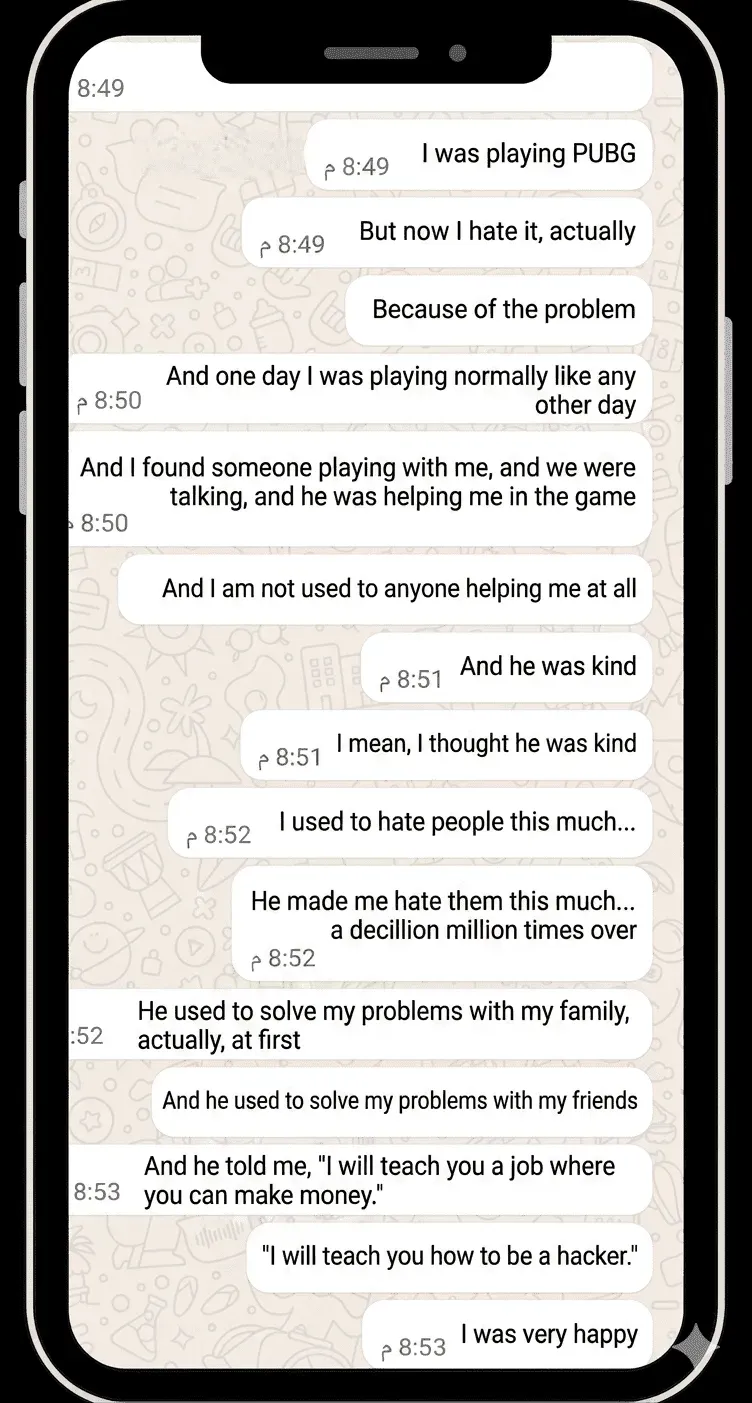
At that time, his round with Ahmed was nearing its end. Ahmed is one of the PUBG game community like Ali. But unlike Ali, he is rather fearful and hesitant. Cox tried the same scenario with him, but he did not rush in asking for anything. Instead, he built a close relationship with him slowly. They became friends, as Ahmed believed without doubt. He says: "I was not used to anyone helping me in the game, and he did, and not just the game, but he was advising me on solving problems with my family and my friends. Then he told me that he would teach me something that I would earn a lot from; he would teach me how to be a hacker (account hacker)."

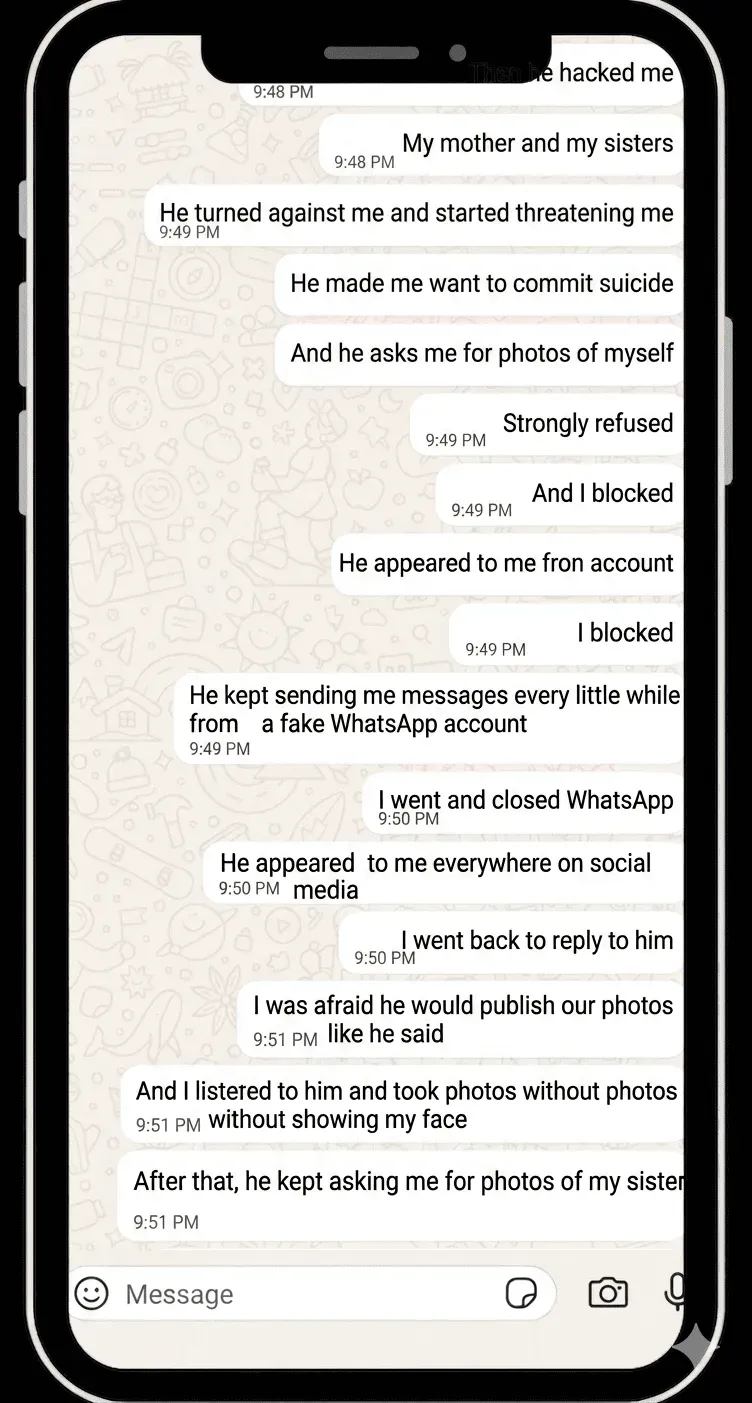
Instead of teaching him, he hacked Ahmed’s phone through the programs he sent him and extracted photos of his sisters and mother. Then he imposed his conditions: "You will photograph yourself in a certain position, next to your sister," indicating that he should make explicit sexual innuendos, with his sister appearing next to him while sleeping.
During that period, the idea of suicide became very close to Ahmed, as he recounts. He says: "He kept threatening me. Whenever I closed an account, he would reach me from another place on social media... And out of fear, I photographed what he requested without showing my face or hers."
But Ahmed continued searching for someone to help him away from his family. He searched social media sites until he found lawyer Yahya Radwan, a specialist in this type of cases and owner of the group "Together Against Internet Crimes and Electronic Extortion."

Ahmed's case is familiar to Yahya. He surprised Cox with a threatening message: "That he would reach him and take legal measures against him." Cox retreated in a tactical withdrawal and stopped messaging Ahmed. Despite his confidence in fortifying himself and using encrypted messages and sites that show fake numbers and spoofing the IP address from which his messages are sent, he did not want under any circumstances to enter this stage.
Yahya resorts to this method in most cases, especially those related to the extortion of children. From the dozens of cases he has handled, “children are often unable to pursue legal channels because they fear telling their parents, so this approach is usually the best way to reassure them and bring the blackmail to an end,” he explains. Sometimes, if he reaches the person—if his identity is known—he makes him delete the photos in front of him.
This is what he says, and he quickly adds: "But in reality, we are not sure of the fate of the photos and videos and whether there are other copies being circulated, especially on Telegram, where it is difficult to find materials inside its secret channels."

Therefore, Salma, Ali, and Ahmed do not realize the path their recorded materials took, unlike Shaza, who knew and entered a state of hysteria when she saw the video of herself posted on his channel, as her mother says.
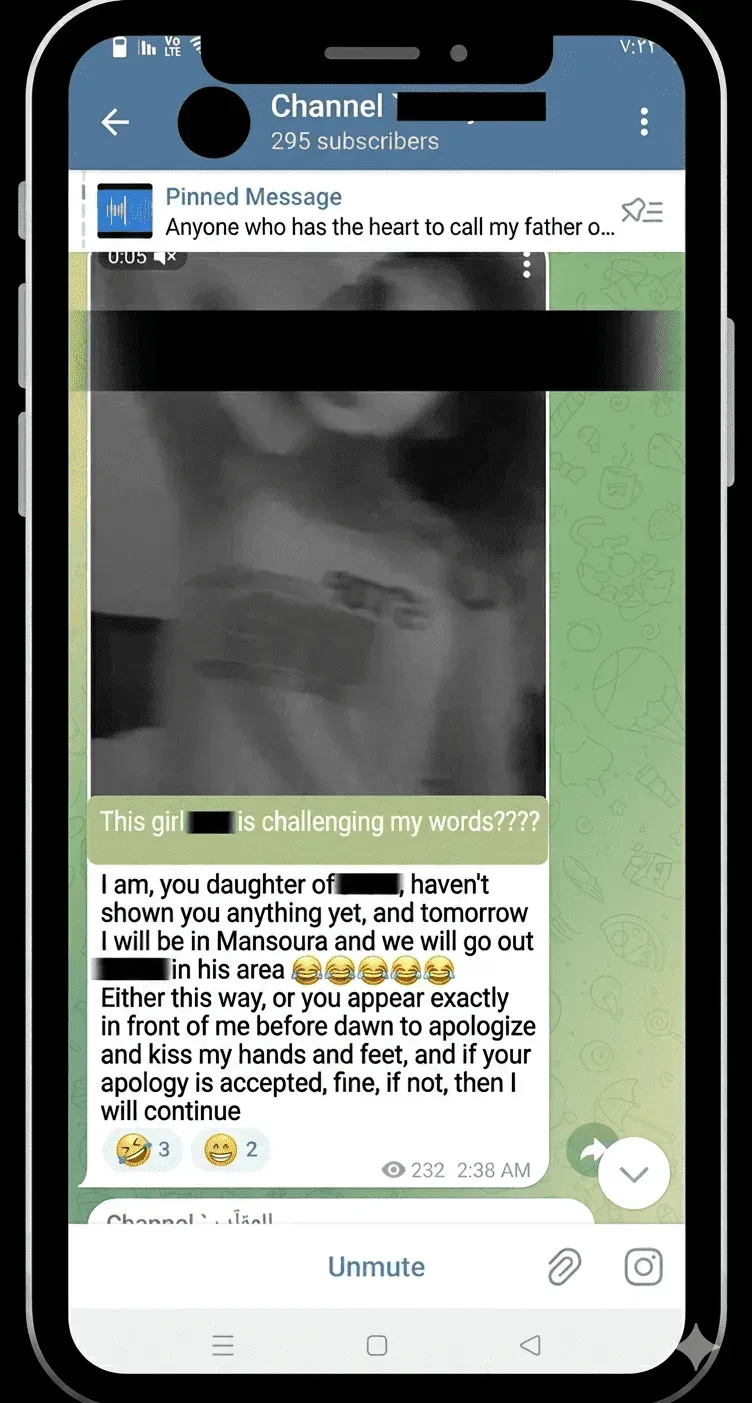
After her mother continued to stall him, offering one excuse after another, he published a video of her daughter. During those nights, Shaza could no longer focus on her studies or sleep. "She went to her exams feeling that everyone was looking at her and knew the truth. Her grade suffered, as did her psychological condition," her mother recalls.
Nevertheless, the mother feared reporting, as he had always told her: "No one can reach me. All my data is hidden."
She says about one of the many difficult aspects of her ordeal: "I felt I was trapped between two fires. I didn't know who to tell? The whole issue is new to us." Then by chance she came across a solution on social media. She reached to the Qawem organization (Resist organization), which specializes in these incidents and provides psychological and legal assistance to victims. Its director encouraged her to report to the Internet Investigations and ignore all the young man's threats.
At that time, Cox became tense—perhaps for the first time—when he felt her indifference to his threats, whose tone had risen, and her response to him "to do whatever he could." He lost control and took a reckless step: he called her on the phone for the first time.
That single call cost him everything after it revealed his location to the Internet Investigations.


The Secret Market
Cox's discovered channel was not an exception. There are dozens of channels and groups on Telegram that circulate sexual content of children, most of which their owners did not know anything about. Cox is part of this a broader online network driven by a single goal: selling these materials as commodities. We observed this pattern in three channels we monitored, which together had more than 5,000 subscribers from various Arab countries waiting for photos and videos of Salma, Ali, Ahmed, Shaza, and others, provided they pay the price for joining the group or channel to its owner.
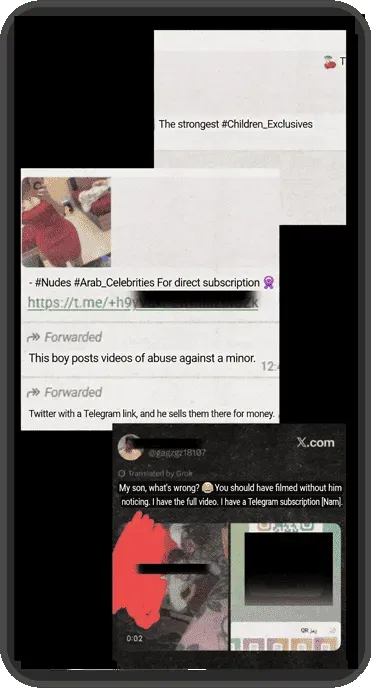
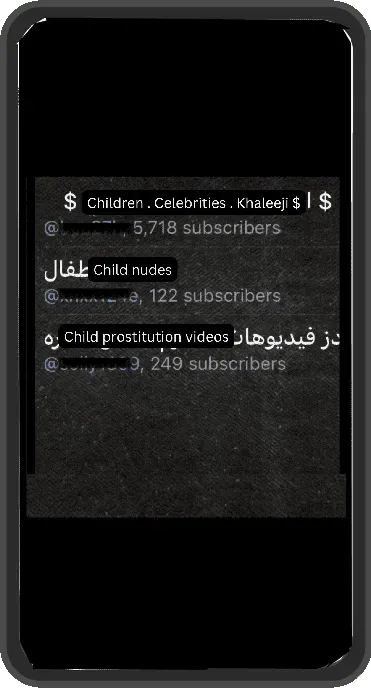
This price is either the price set by its owner, which may start from 200 or 300 Egyptian pounds, and in some channels the pricing is in dollars starting from 10 to 100 dollars, or as an alternative to payment, they can offer something else instead such as sending photos of their mothers or wives.
In two separate instances, using fake accounts, we spoke with two owners of those channels to request joining. Both were in their early twenties like Cox. The first asked abruptly to "open the camera directly on the person speaking to him and on the mother." As for the second, who was posting part of photos or a few seconds of video clips on platform X to market his Telegram channel, he requested 300 Egyptian pounds as a first package, meaning there are other higher-priced packages that include, as he claims, "exclusive content."
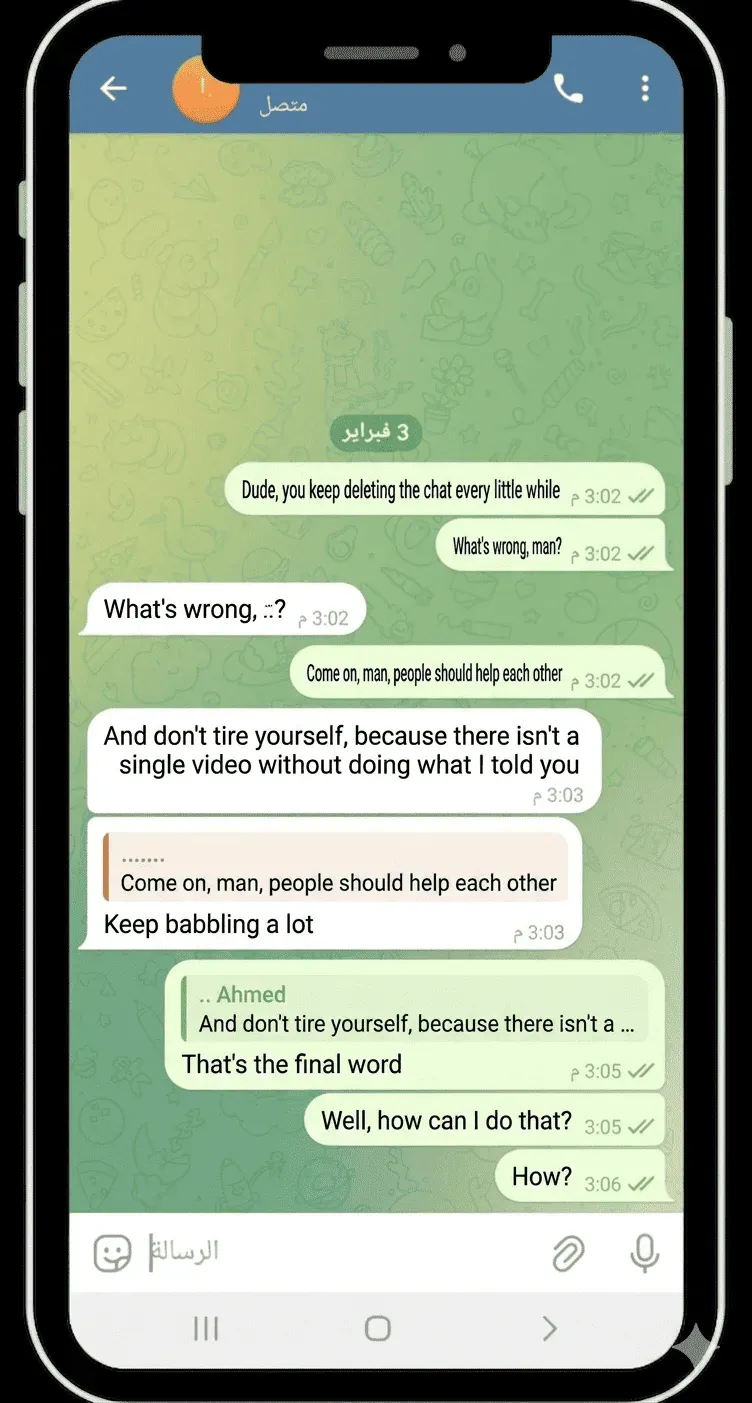
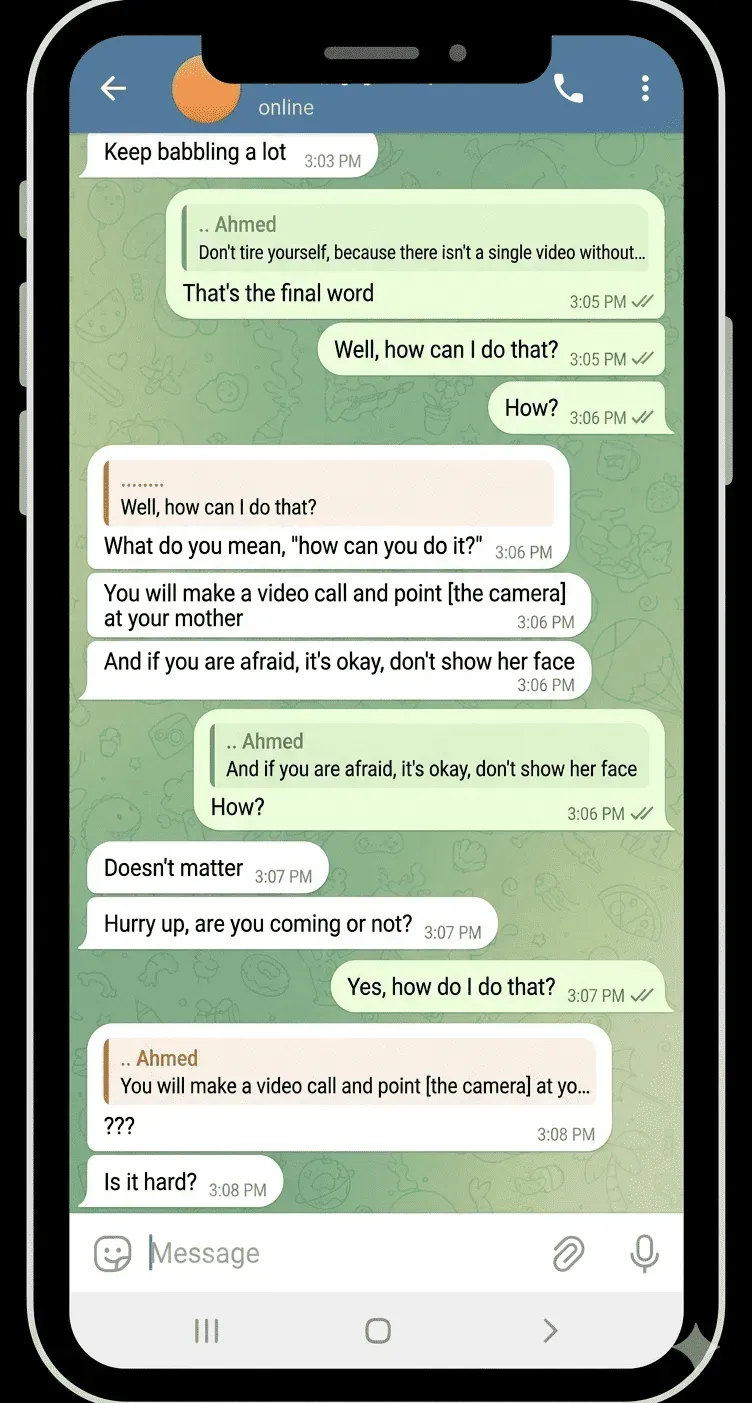
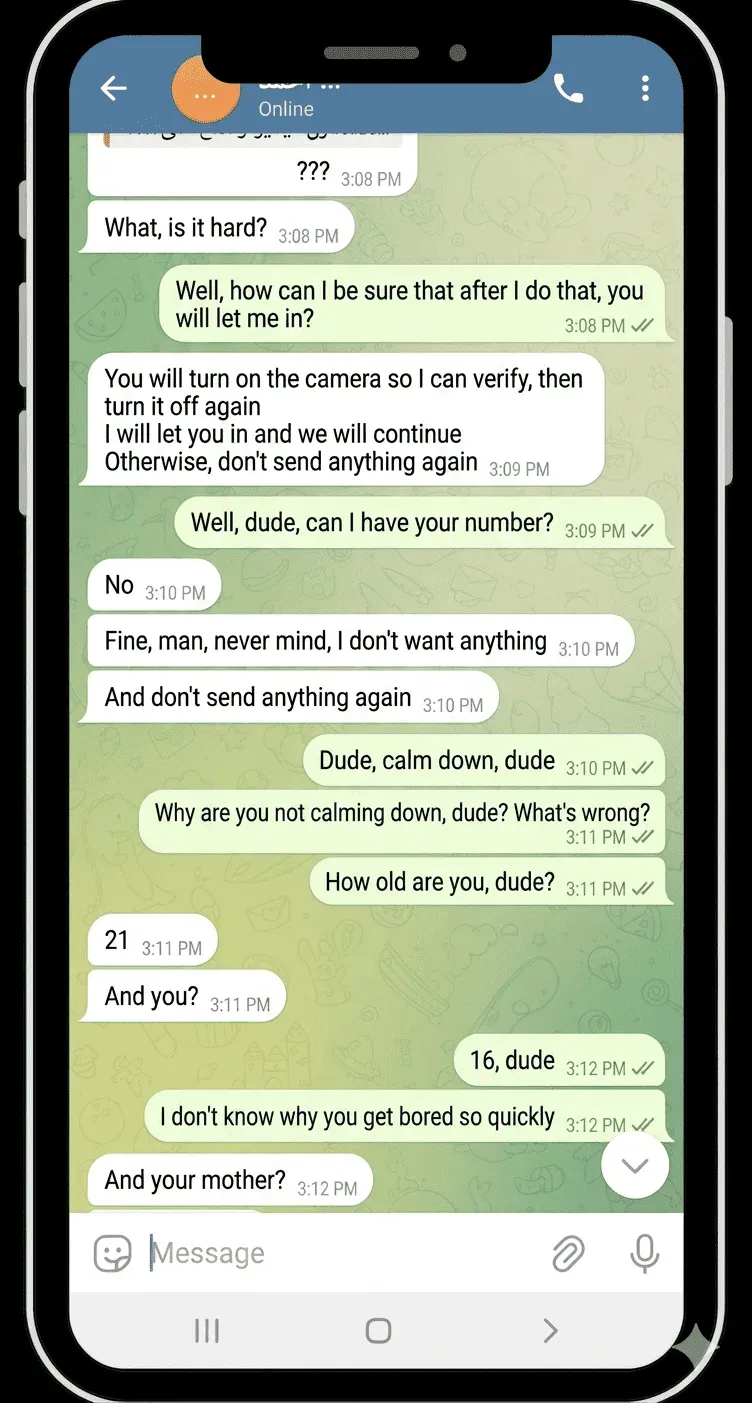
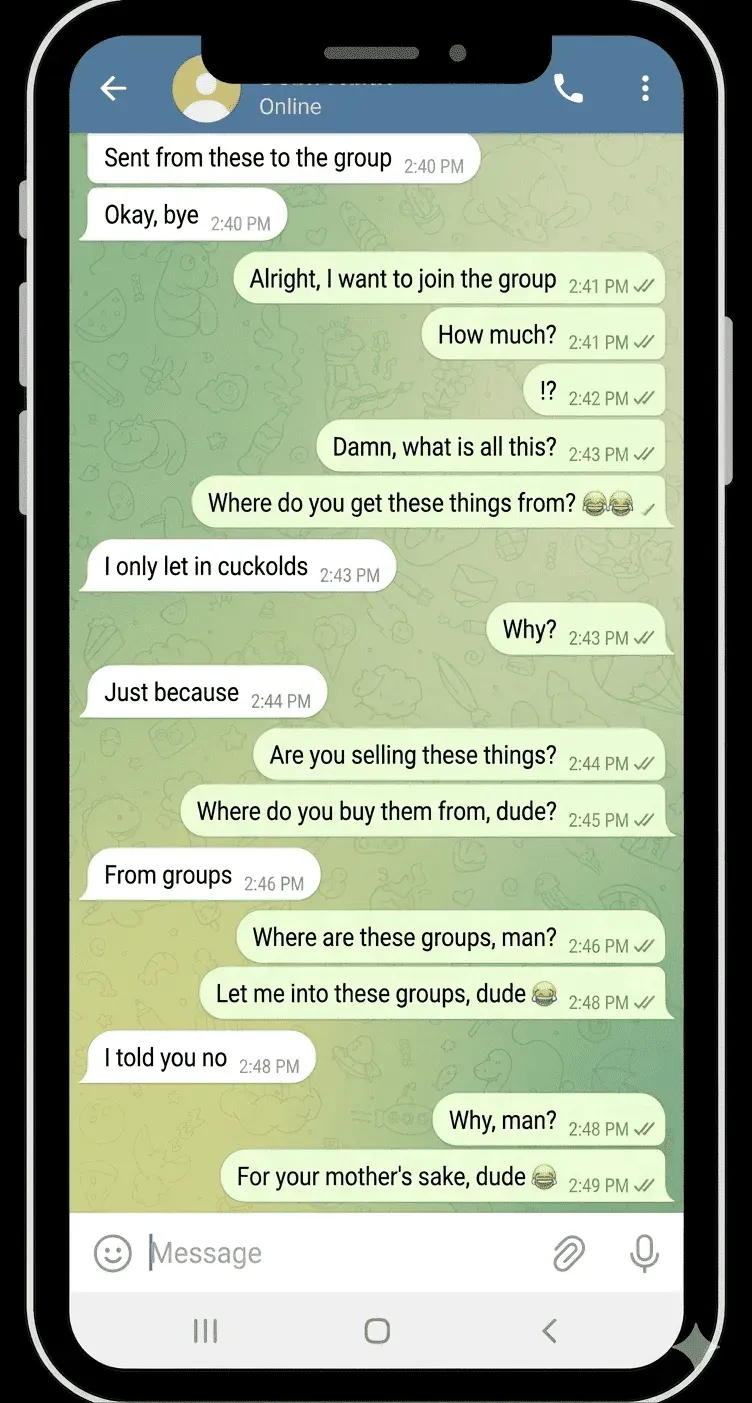
As soon as the amount reached the number he specified on "Vodafone Cash electronic wallet service," the channel was opened. It contained no less than 50 videos or photos of children of various ages, mostly males, around 10 years old.
The children appearing in this material are typically captured in one of two ways: either they are speaking with the other party over a video call without realizing the conversation is being recorded, or they are filming themselves while being directed to perform sexually suggestive or explicit acts—exactly as Cox instructed Ali, Ahmed, Salma and Shaza to do.
This type of content is sold "to those who feel aroused when seeing recorded materials of the most vulnerable and controlled groups, such as children, and this may not necessarily be a psychological illness," according to the opinion of Iman Gaber (Director of the Department of Child and Adolescent Psychiatry at the General Secretariat of Mental Health).
As for the methods of payment to access this content, in all cases they were largely similar and limited to two methods: using many numbers that differ each time, with electronic wallets registered with data that do not belong to the channel owners themselves, or through Razer Gold cards, a virtual credit system dedicated to gamers to charge electronic game balances. The user buys "digital codes" from outlets such as game stores at prices starting from 80 up to 13 thousand Egyptian pounds, and sends them to the channel owner wishing to join it. The other party—if he wants—can also sell them in player groups via Telegram as well, in exchange for transferring money to his wallet.
It turned out that the number to which the 300-pound amount was sent belongs to a woman in Alexandria, who denied knowing or being connected to the channel owner. The Child Rescue Line of the National Council for Motherhood and Childhood is following this story and the channel in an attempt to reach the child victims and help them, but nothing indicated their identities, as Sabry Osman (Director of the Child Rescue Line) mentions.
It is difficult to track Telegram content, as Osman sees. Any trace on it can be erased. Therefore, he says: "In all the reports we have submitted, we do not reach anything except in cases where we know the extortionist personally."
In one of the few times when evidence was available, there were about 70,000 photos of male and female victims saved on the phone of a young man no older than 19 years old, residing in Dakahlia Governorate. This is his arsenal that he exchanges and sells on Telegram channels and uses to threaten their owners, while his family knows nothing about what he does "except that he works alongside his university studies, on the internet, and earns from it." His father, who works as a "security guard," does not seem interested in verifying what he tells them. That was one of the incidents documented by the Qawem Organization, which specializes in psychological and legal support for victims, and it did not report it at the time.
Mohamed Al-Yamani (the organization founder) is accustomed to receiving such disturbing stories, perhaps more than a hundred. He describes Cox and young men like him as "networks that operate with terrifying intelligence on new generations. They are addicted to spying and hunting, turning children and youth into traders of intimate material. There are other groups based on photographing incest, and everyone is interconnected."
Despite sometimes having to communicate with the group or channel owner to stop the threat, he realizes that "this harms the victims in many cases," as he mentions, and says: "Communication is a warning to him. Then he can simply close the channel, open another, and post the materials on it, and this happens a lot."
Revealing the identity of these people does not seem like a complex puzzle even if it is difficult, in Al-Yamani's opinion. He says: "In most cases, it is easy to track the source of money withdrawal and reach them."
The General Administration of Information Technology in Interior Ministry is now better equipped to deal with such cases more than ever, as Major General Ali Abaza (former director of Internet Investigations) sees. He tells Masrawy that the administration has become stronger, with more numbers, higher capabilities, and trained cadres. It sends officers for fellowships and training in China and Europe, and they now have advanced expertise in monitoring and tracking even encrypted content and proxy to hide the IP address, which requires complex techniques.
“There is no application that is completely immune anymore,” he said.
Telegram company, headquartered in Dubai, responded to the issue of publishing pornographic materials on its platform by saying that "we will never tolerate child sexual exploitation materials. Since 2018, public photos are automatically scanned, and the application publishes daily transparent reports on content removal, which reached about 207 thousand groups and channels related to child pornographic materials in 2026." However, these numbers are likely more related to public content, not private.
Its founder, Pavel Durov, was previously arrested in France in August 2024 as part of an investigation into crimes related to child pornographic materials, drug trafficking, and fraudulent transactions on the platform, then released on bail. The accusations were renewed last April after the British Communications Regulatory Authority opened an investigation regarding the application following evidence indicating the circulation of materials involving sexual assault on children on the platform, which Telegram "categorically denied."
However, the Internet Watch Foundation, a British non-profit organization that works with Telegram to help it identify and remove harmful materials, said in a statement: "We agree with the concerns that networks of bad actors operate across the Telegram ecosystem, and that not enough is being done to prevent the distribution of known and discovered images that involve the sexual exploitation of children."

The Final Round
Cox was not one person. In fact, the four children—Salma, Shatha, Ali, and Ahmed—didn’t face the same opponent. One of them was of Yemeni nationality according to his dialect and apparent number, another of unknown identity, and another residing in Fayoum Governorate, managing a Telegram channel named "Al-Basha" for several years, which has now been deleted.
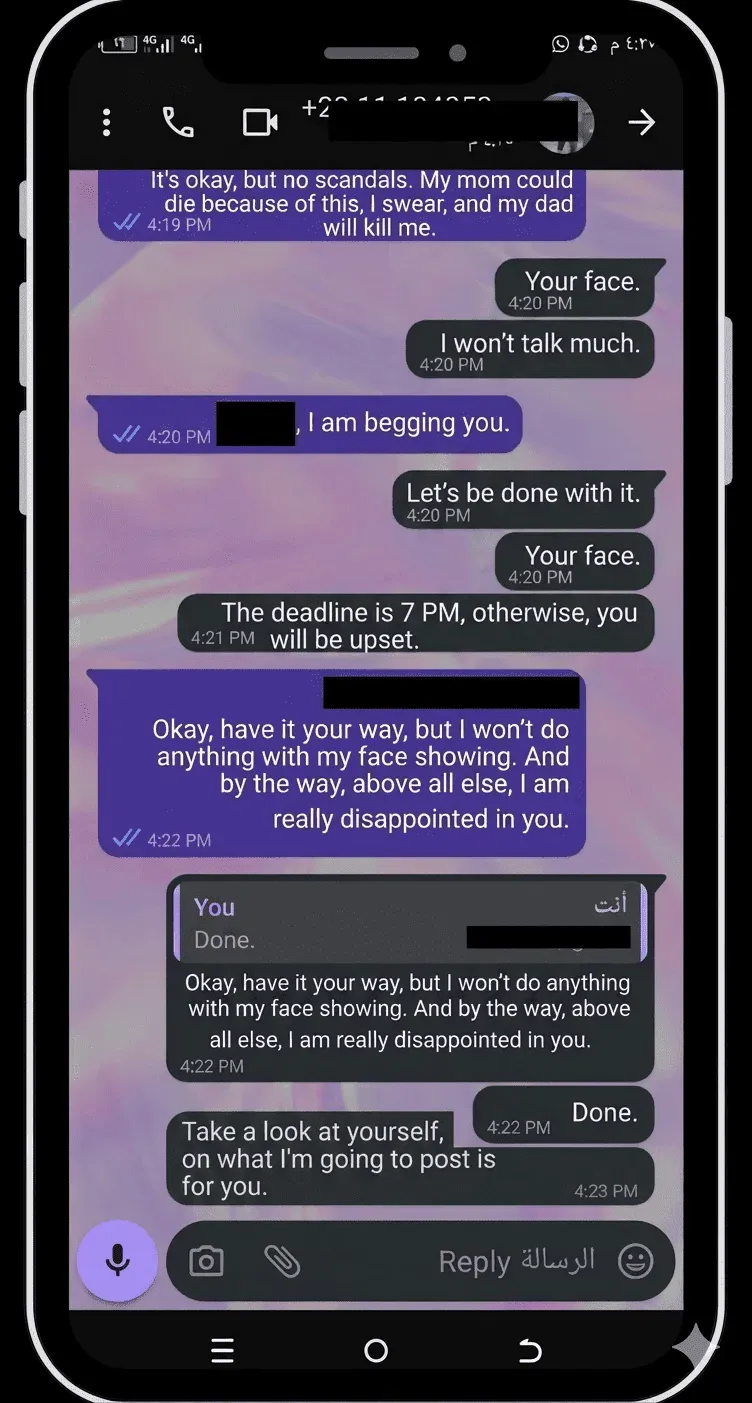
Salma and Ali are still trapped in the circle of exploitation, neither of them appear among the official figures or reported cases, having chosen not to come forward out of fear of their families’ reactions and the stigma they believe would follow them, as both mentioned. All the lawyers and institutions we spoke with agreed that "this increases their losses and extortion even more."
"The longer their exposure to exploitation lasts, the greater the pressures become and the more difficult it is to overcome the matter later," according to Iman Gaber (Director of the Department of Child and Adolescent Psychiatry at the General Secretariat of Mental Health). She adds another risk, in her opinion: "Their habituation to certain wrong sexual behaviors."
As for Ahmed, whom lawyer Yahya Radwan succeeded in shielding him from his blackmailer for nearly two years, he still searches every day for his photos on Telegram and social media sites using words such as "children nudes, children's photos and videos, minors, and others," to make sure that his photos and videos are not posted in any group or channel, at least public ones. Every time he does that and remembers what he went through, he is struck by a severe crying and panic attack. He says: "He made me not trust anyone, and hate all humans, and games."
The three do not guarantee that their families will take a position in their favor as Shaza's mother did nearly four years ago, to the extent that she now wants to educate other parents in any way so they pay attention to what their children do on phones and not neglect their rights.
She remembers the moment of the suspect was arrested the very next day after his call to her, and the negotiations that the suspect's lawyer and family were conducting with her for reconciliation, and that she almost responded to their pleading before the lawyer and Qawem Organization dissuaded her. She witnessed legal procedures that lasted about three months, during which she did not meet him face to face, as the applicable laws, such as the Combating Information Technology Crimes Law of 2018, stipulate penalties in this regard in three articles.
"Shall be punished by imprisonment for a period of not less than six months and a fine of not less than 50 thousand pounds and not exceeding 100 thousand pounds or one of the two penalties, whoever assaults family values in Egyptian society or violates the sanctity of private life or sends electronic messages in bulk to a specific person without his consent or publishes photos or information that violates a person's privacy without his consent, whether true or false."
Article 25 - Combating Information Technology Crimes Law of 2018
The young man accused in Shaza's case was subjected to the provisions of this law, but he was released after a short period pending the case, according to the latest information that reached the mother and Qawem Organization. She did not follow up on the developments of the case after that.
Hamdi Rizk, one of the lawyers cooperating with Qawem Organization, says that there are many loopholes that the defense lawyer can exploit and push, such as the child's conflicting statements, who does not remember the details and is in a disturbed state, or that he deleted the evidence as the perpetrator ordered him at the time, or the multiplicity of numbers used, some of which appear to be outside Egypt, or the absence of the original conversations, which is the most difficult point in cases related to "Telegram," where conversations are encrypted and automatically deleted.

Whatever happened, Shaza's mother feels that she is "completely satisfied with what she did." Every time she looks at her daughter's face, she is reassured of this. She says: "If I had conceded, I would not only have wasted the effort of everyone who helped me, but also my daughter's right and the right of others who are still going through this."
As for her daughter, who has now turned 18, she walks in her college isolated from everyone, contrary to what is expected of first-year university students. She attracts attention with her little speech and constant gloom. She does not trust anyone, or more precisely—this is how she became, after she was always a mischievous and sociable girl. The crisis left its mark on her until today, as if that person remained as a ghost haunting her. Her mother says: "She no longer has friends like in the past. She is afraid that anyone will know or that these materials will appear again in any way. She wished to be an ordinary girl like those her age, and not to have gone through everything she went through."
We have hidden the real names of the children to preserve their privacy and psychological safety.
AI tools were used in the production of the story's illustrations.
What you should do if you are exposed to similar experiences:
Reporting and requesting support:
National Council for Motherhood and Childhood - Child Rescue Line: 16000
- Official reporting: General Administration of Information Technology: 0224065052 - 0224065051
- Cybercrime Combating Department: Hotline 108
Institutions that support victims by providing psychological and legal consultations and content removal:
• Speak Up Foundation – Helpline: [email protected]
• Lawyer Yahya Radwan, Together Against Extortion page
• For awareness and more information: The Ministry of Communications launched the "Wa3i.net" platform www.wa3i.net since February 2026, with the aim of supporting the state's efforts to build a safe digital society, especially for children.
Story: Marina Milad
Graphic: Michael Adel
Design & Development: Mohamed Ezzat