Journalist Resource
 July 2, 2026
How To Investigate Data Centers’ Impacts


Data centers are the physical infrastructure that underpins the current AI boom. Regardless of your region, in the last few years you’ve probably heard about a new data center planned in your country or even in your municipality. The richest companies in the world are pouring money at crazy speed into what Sam Altman, OpenAI’s CEO, has dubbed as “the biggest joint industrial project in history”. Market estimates as of May 2026 point to a $4 trillion to $8 trillion total capital investment over the next five years on this massive AI build-out.
Based on our own experience reporting on data centers and the groundbreaking investigations done by many colleagues worldwide, this toolkit aims to give inspiration, tools and practical resources to any reporter interested in covering AI infrastructure.
As AI data centers scale, investigating their impacts is becoming its own beat. That is why we firmly believe this is a story for all kinds of journalists, regardless of your usual reporting topics and skills. In fact, expertise outside of “tech journalism” is more than welcome and needed at this moment to help us make sense of what this buildout means.

As a nonprofit journalism organization, we depend on your support to fund more than 170 reporting projects every year on critical global and local issues. Donate any amount today to become a Pulitzer Center Champion and receive exclusive benefits!
What is a data center and why are we covering them now?
In a nutshell, data centers are buildings—or a set of them—filled with computers storing and processing large amounts of data. Although data centers have existed roughly since the 1990s, the explosion of generative AI after the release of ChatGPT in 2022 has completely changed how these facilities are designed.
Modern data centers are multiple times larger in size than their predecessors, but also in their consumption of energy, land and water to generate the electricity for and to cool down the servers they have inside. This increasing need of resources is mainly due to the extraordinary computing capacities they are designed for, which are served in most cases through microchips called Graphical Processing Units (GPUs).
We can talk about many data center types today, but let’s stick to two big categories. On one hand we have colocation facilities that lease their servers to third parties. And on the other we have the hyperscalers, much bigger complexes designed to scale and to meet a rapidly growing computing demand. These centers are very often owned, directly or indirectly, by Big Tech companies offering cloud and AI services.
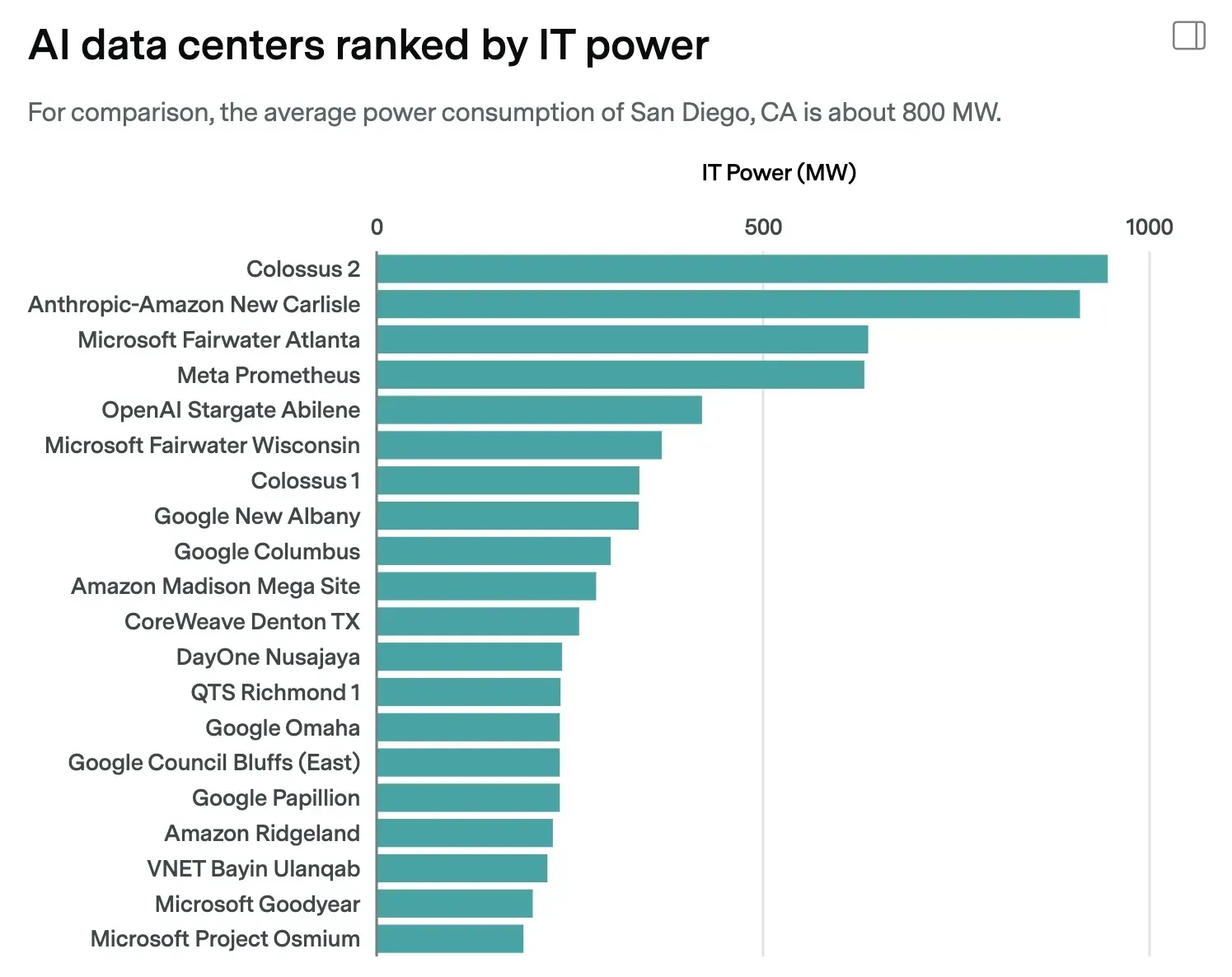
Keeping up to date with how these infrastructures are growing in size and computing capacity is no easy task. There are no international standards defining what a large or small data center is and countries have been adopting their own classifications. In 2024 the power used by the computing equipment inside a data center (IT power) of the most powerful hyperscale centers tended to be in the region of 100 MW.
However, things are moving very quickly in this industry. The most powerful AI data centers currently based in the US are close to, or even exceed, 1,000 MW, according to Epoch AI. These complexes are used by some of the best-known companies in the AI industry, such as Atrophic, Microsoft, Meta, xAI, OpenAI, Amazon and Google.
Common industry narratives
Because they have become a controversial topic, data centers are also in the middle of a narrative dispute. While companies are making efforts to control the narrative, particularly around the alleged sustainability of these infrastructures, investigative journalism plays a crucial role in surfacing information that companies and governments would otherwise like to keep away from public eyes.
Companies’ promises or narratives are changing all the time, but these are some common industry narratives that you are likely to come across in your reporting:
- Sustainable data centers: As the backlash against data centers grows, companies have been resorting to the term “sustainable data centers” to refer to infrastructures that are less resource-intensive or that use cleaner forms of energy. While it is true that some data centers can be less damaging than others, sustainable data centers are by nature, extractive given that they are so resource-intensive. Although developers can attempt to reduce the water footprint, for instance, this means increasing the energy footprint. If developers aim for renewable energy as a means to become more sustainable, that brings on other impacts. That is to say, regardless of efforts, data centers will always have an impact on their communities or environments.
- Water use: Most of the communication coming from companies around water use only focuses on the on-site water consumption. But this fails to acknowledge that a data center’s water footprint also includes the water consumed to generate the electricity it uses. According to independent researchers like VU Amsterdam’s Alex de Vries-Gao, this typically accounts for the majority of a data center’s total water consumption and is not accounted for in most calculations.
- Closed loop systems: Regarding on-site water consumption, companies have recently begun adopting closed-loop systems, in which water or a coolant circulates around the servers in low temperatures to refrigerate, absorbs the heat and is then re-cooled. While it is true that closed-loop systems can reduce water consumption severely, it doesn’t mean water is never consumed because there is always a need to replenish some amount. It is also important to say that these systems tend to be compensational. This means that, although the water footprint is small, energy use tends to spike because of the alternative cooling methods. This is why it is crucial to examine companies’ allegations deeply and not take them at face value.
- Strictly renewable data centers: We are seeing companies announce data centers that are supplied 100% with renewable energy. Although it is true that the data centers’ primary sources of energy can be renewable power plants, when we examine the documentation, we find out that many of these supposedly renewable data centers have gas or diesel-based generators as backups. If there is any cut or interruption in the energy supply, the generators will kick in, emitting air pollution. Data centers cannot afford to have power cuts, as that could mean million-dollar business losses. Generators are a crucial part of this infrastructure.
- Job generation: There are many myths around the economics of data centers. When developers come to towns, they promise jobs and revenue to local mayors and councilpeople. But records show that these jobs tend to exist during construction and are eliminated or shrink significantly once a data center is operational. To keep one running, few workers are needed, and they are often high-skilled workers, which often means hiring workers from larger cities as opposed to local residents.
- Economic promises: Developers, companies and some politicians propose that data centers will bring prosperity and development to the locations where they will be installed. This argument hardly stands when we examine the economic conditions under which these infrastructures are being installed. In many geographies, governments are giving tax breaks and exemptions to attract data center investments. This means municipalities, states and countries are subsidizing development for an industry that is among the richest in the world while giving up valuable income that could be re-invested into education, health and public security.
Potential story angles
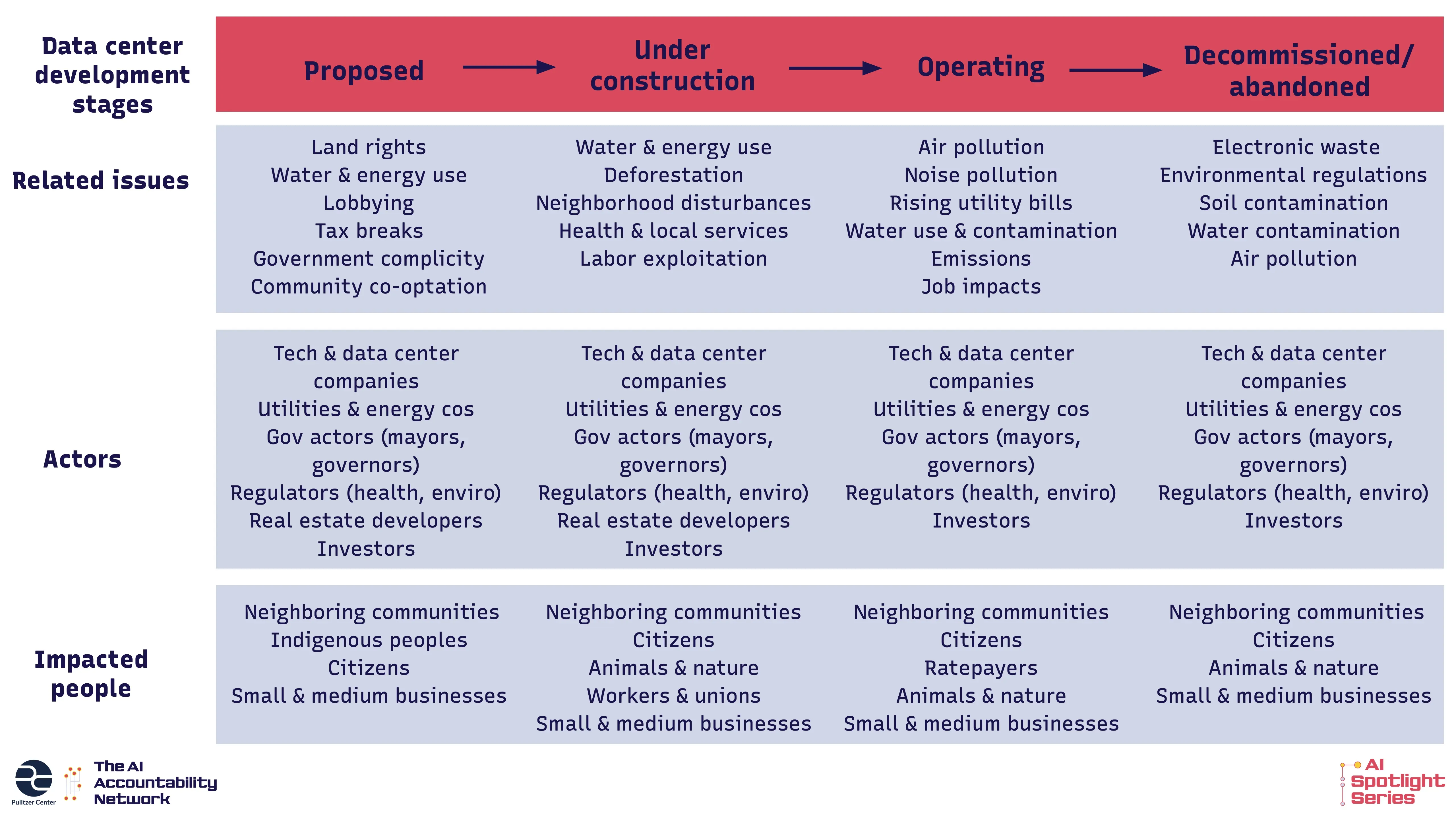
There are many ways to approach stories about data centers, but we believe a helpful approach is breaking them down by development stage. There are issues that are specific to each of the stages, although there are some overlaps, and the type of resources we seek for each of the stages varies.
A good exercise is also mapping out who are the involved actors for each of the stages. Again, while there are overlaps, some are very specific.
1. Proposed
In the “proposed” group we consider those data centers that have been announced by governments, companies or that have been identified by activists and advocacy groups, but where construction has not yet begun.
Reporting resources
- Freedom of Information Act requests to government entities working on related issues.
- Government transparency platforms where you can find meeting logs and other reporting leads
- Industry publications such as Data Center Dynamics and reports from market intelligence firms such as DC Byte. Also check what real estate consultancies are working in this field in your region (e.g. Colliers in the US and some parts of Europe) and the data they made public.
- Financial and security filings from publicly traded companies
- Activist and community watchdog groups
- Satellite imagery
- Academic sources
This story I (Laís Martins) worked on for Intercept Brasil in 2025 with my colleague Francisco Amorim is an example of the reporting that can be done at the proposed stage. Combining different data sources -from meeting logs to government sources and extensive field work- we were able to expose how Chinese giant TikTok plans to build a massive center in a city heavily affected by droughts. In this methodology piece you can read more on how we worked on this story.
2. Under construction
The under construction phase includes those data centers that have received the greenlight from regulators and government entities to start being built. This phase could last for months or even years, depending on the dimensions of the data center and the developers.
Reporting resources
- Freedom of Information Act requests to government entities
- Meeting logs between government agencies and companies
- Publicly available datasets like those offered by Data Center Map and Baxtel. But be aware this data is not always up to date, especially among data centers proposed or under construction
- Consumer/civilian complaints
- Satellite imagery
- Activist and community watchdog groups
- Academic sources
A couple of recent stories focused on the massive buildout happening in the US show interesting approaches at this stage. Bloomberg reported in early 2026 on the carbon emissions coming from the concrete and other materials needed for building out these immense facilities. More recently Quartz analysed how a center in the state of Michigan went from a $7 billion price tag to $16 billion, exposing an industry-wise pattern with severe fallouts both for developers and local communities.
3. Operating
Moving on to the operating phase, we think of data centers that are up and running. That means they have cleared the bureaucratic hurdles at the permitting phase, have concluded construction, and are in operation.
Reporting resources
- Consumer/civilian complaints
- Interviews/data with and from local businesses and residents regarding demographic changes
- Crowd-sourced data from neighbors: noise pollution, for example
- Activist and community watchdog groups
- Financial and security filings from publicly traded companies
- Academic sources
While there are a lot of great investigations out there focused on the operating stage, we would like to highlight two coming from India and Uruguay. This story by Luke Barratt, Atika Rehman and Sushmita at The Guardian explains how the growing energy demand by data centers in the city of Mumbai, already heavily polluted, is reversing the energy transition plans of local authorities.
Gabriel Farías and Miguel Ángel Dobrich from Amenaza Roboto used twenty-five years of satellite imagery to show how an old computing facility -much less resource-intensive than a coming Google data center in the same area- generates a heat island that can be seen from space.
4. Decommissioned/abandoned
Stories around decommissioning or abandonment of data centers are still very uncommon (if you have seen a good one and would like to share, please reach out to us). But given the expansion of data centers around the world, particularly driven by the popularization of generative AI, this is certainly an issue tech journalists will be covering in the coming years.
Reporting resources
- Companies and developers’ sustainability reports: is there anything about decommissioning?
- Documents filed by developers with government agencies for permitting: is there anything about decommissioning?
- Academic papers and research on co-related issues, such as electronic waste
Although AI data centers are still young infrastructures, considering their size and the life cycle of many of its components we will soon have to report on how companies and regulators tackle the many challenges that come when a facility is decommissioned or abandoned. As the study featured in this MIT Technology Review piece points out, the computing hardware they have inside will generate millions of tons of new electronic waste.
Common mistakes to avoid
Reporting on data centers is tough and requires patience, learning, and a bit of stubbornness. But it is not impossible and more and more reporters are jumping onboard. As you venture out into your own investigations, here are some common mistakes we’d recommend being aware of.
- Reporting only on the promises made by data center operators without any fact-checking process
- Taking the numbers provided by companies at face value and not trying to independently verify them
- Considering public authorities as an independent and always reliable information source
- Assuming your audience knows what lies behind new generative AI tools and the infrastructure that underpins this business
- Not connecting the data center expansion in your context to the global AI frenzy
- Using too many technical terms that do not engage your readers