
What a sanctuary city looks like and what it asks of neighbors, communities, and politicians
I plucked the Mirabelle plum from Amir’s outstretched palm, popping it in my mouth. Sweet, with a subtle tang. Savoring the aftertaste, I set the pit down beside the slaw, shepherd's pie, and curry heaped on my paper plate by members of the Open Kitchen Social Club—a group that cooked and served free meals at Sheffield’s Sanctuary Center each Tuesday this summer.
After rustling in his front pocket, Amir’s hand returned with another offering. (Amir’s name, like several others in this story, has been changed to protect privacy.) I objected, not wanting to deplete his supply, but he laughingly recalled a time earlier in the month when he had brought boxes filled with the sweet fruit to the Sanctuary, which delighted the community for weeks. These plums, he promised me, hung from every tree in Crookes Valley—the park ensconcing the council housing which was his assigned temporary residence.
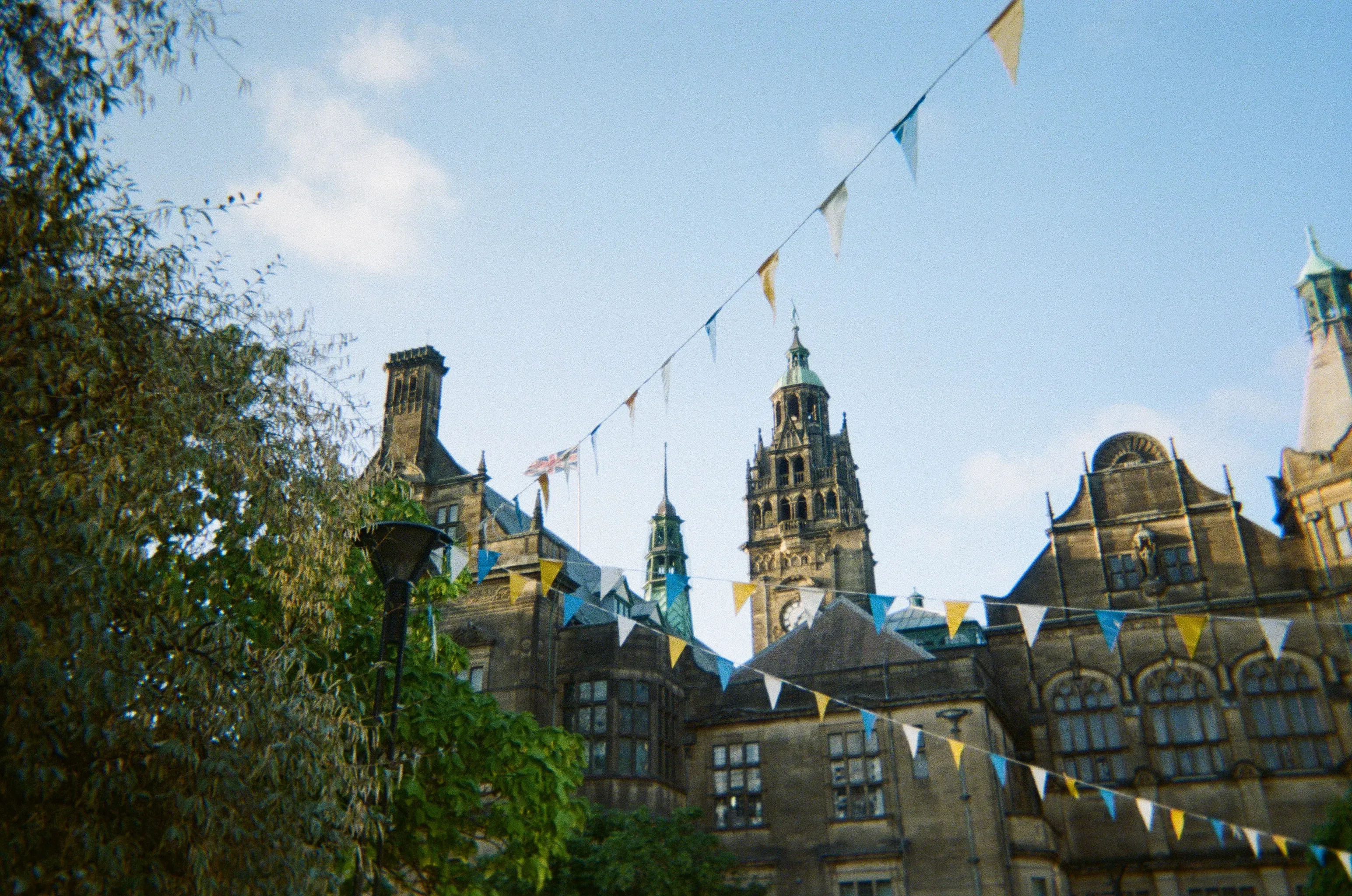
The United States Sanctuary City movement was front of mind as I walked through the main square of Sheffield to The Sanctuary—a center run by community leaders in the U.K.’s first City of Sanctuary. I had spent the last four years in Chicago, working alongside and learning from community leaders who had devoted their lives to creating a supportive sanctuary for new arrivals in the US. One of my mentors in Chicago was Caroline, a volunteer who ran a legal clinic for asylum seekers, dedicating her time, energy, home and money to turning her neighborhood into Chicago’s sanctuary ideal. I quickly learned that the Sanctuary City policies Chicago espoused did not always, or perhaps even often, correspond to the ideologies behind the movement.

As a nonprofit journalism organization, we depend on your support to fund more than 170 reporting projects every year on critical global and local issues. Donate any amount today to become a Pulitzer Center Champion and receive exclusive benefits!
On the first crisp day of Autumn 2024, I biked to Caroline’s home for coffee and conversation. It was 7 a.m., as the early morning hours were the only ones she kept for herself. I found her amid multiple phone calls and emails, brushing her teeth while sorting her son’s medication. I asked how she retained hope in a Sanctuary City coming apart before our eyes. She told me, “Chicago, the Sanctuary City, won’t get you very far.” Rather, it is the role of civil society to create sanctuary for ourselves. It is this sentiment, this sentence, that brought me to Sheffield.

Though the U.S. and U.K. share similar ideologies behind their parallel Sanctuary City/City of Sanctuary movements, activists and leaders in the two countries have taken drastically disparate approaches. I arrived in Sheffield believing that the U.S. movement focused on formal legal changemaking, which has allowed for arguably greater tangible change, but has exposed the movement to demolition when a disapproving political party inevitably takes office. I wanted to learn about what I saw as the primary contrast between the U.S. and the U.K—that the U.K.’s City of Sanctuary movement remains stalwart in its independence from politics. Their hyperlocal and personal focus lends their work greater durability. This emphasis on community work means that these groups forego political advocacy efforts, which some deem more tangible and important.
I came to Sheffield to understand how parallel intentions developed into such diverse movements. I wanted to understand a new perspective on and thereby learn how to harness Sanctuary ideology and the corresponding networks of community care, seeking a middle ground mode of implementation that might allow both countries to better support new arrivals. I began my search in the California Migration Museum’s archives.
The term “Sanctuary City” first surfaced in the U.S. in 1971, when Berkeley, California offered sanctuary to soldiers refusing to return to duty in the Vietnam War. Professor Lloyd Barba, a religion and Latinx studies professor at Amherst College, and a curious, generous thinker with a wide breadth of expertise regarding American Sanctuary Cities, agreed to discuss this history with me. Barba cited a leader of this first movement—the Reverend Gustav Schultz, of Berkeley University’s Lutheran Chapel, quoting his claim “that Sanctuary needs to stand apart from the state, so that they can critique the state.” Barba noted, “those sorts of clear definitions of standing apart from the state or being within the state have become a little bit muddled.”
From the start, the Sanctuary City movement was rooted in acts of faith. Referencing the church’s role, the Reverend and leader in the Sanctuary City movement John Elliot said, “Little did we know at the time of our decision that what began as the conscientious act of one Christian congregation would soon infect an entire city. But so it is with acts of holy contagion.”

The 1980’s Sanctuary Trials
In the early 1980s, the term Sanctuary City and corresponding political movement resurfaced as hundreds of thousands of Central Americans fled civil wars. As evidenced by University of Chicago Professor Susan Gzesh’s article for the Migration Policy Institute, Central Americans and Asylum Policy in the Reagan Era, the Ronald Reagan Administration denied its responsibility in the violence that instigated this mass exodus and claimed that those seeking to enter the U.S. were economic migrants without just cause. Many Americans called out this behavior as not just injustice but explicitly counter to the 1980 Refugee Act, which had passed in response to heightened levels of migration after the Vietnam War. Faith leaders and religious communities were at the forefront of the Sanctuary City movement, helping new arrivals to find safety and community in the US. In doing so, they drew on a tradition of American churches offering refuge, specifically referencing their role in the Underground Railroad.
Sanctuary leaders hoped that their actions would inspire religious supporters of Ronald Reagan to question their government’s conflict with the church. They hoped the fact that faith served as their impetus to action would at least shield them from political punishment. They were wrong.
Operation Sojourner, a 10-month government investigation under Reagan, cracked down on the sanctuary movement. Undercover agents entered sanctuary communities without warrants, embedding at every level. Most posed as sanctuary workers or parishioners; one even wore clerical garments.
In Phoenix, Arizona, the movement quickly embraced an FBI informant named Jesus Cruz. After being implicated in a smuggling ring, he agreed to work for the FBI in exchange for immunity. He built a close relationship with a Salvadoran family. During the holidays, he asked for their address under the pretext that he hoped to send Christmas presents to the children. On January 14, 1985, agents arrived at their front door. The U.S. government paid Cruz $18,000.
The Sanctuary Trials charged dozens in federal court with alien smuggling. A federal grand jury indicted 16 defendants, naming 74 unindicted conspirators. The defense counsel, planning to argue First Amendment rights using religious evidence, saw its strategy gutted when the U.S. District Judge Earl Caroll barred any religious evidence. They were barred from mentioning violence in Central America, international law, or religious motivation. This meant the right of churches to declare sanctuary remained unsettled.
The trials concluded with the conviction of eight faith leaders and activists. Nonetheless, Operation Sojourner failed to upend the movement. Instead, it increased public awareness and support. The Sanctuary Trials laid the groundwork for Sanctuary City jurisdictions and a more sympathetic policy framework.
Sanctuary Cities arose across the country in the 1980s—New York City in 1989, with Philadelphia and Chicago quick to follow. The U.S. government threatened to cut their federal funding repeatedly for a lack of civic and federal cooperation with immigration services, but these cities persist in their efforts to actualize the meaning of sanctuary—cultivating a space of safety for themselves and their neighbors.
In 2025, several major cases revived the still open question that had lain latent since the Sanctuary Trials—a question whose answer is being re-written and expanded every day: what does it mean for churches to provide sanctuary?
The Imagination of People
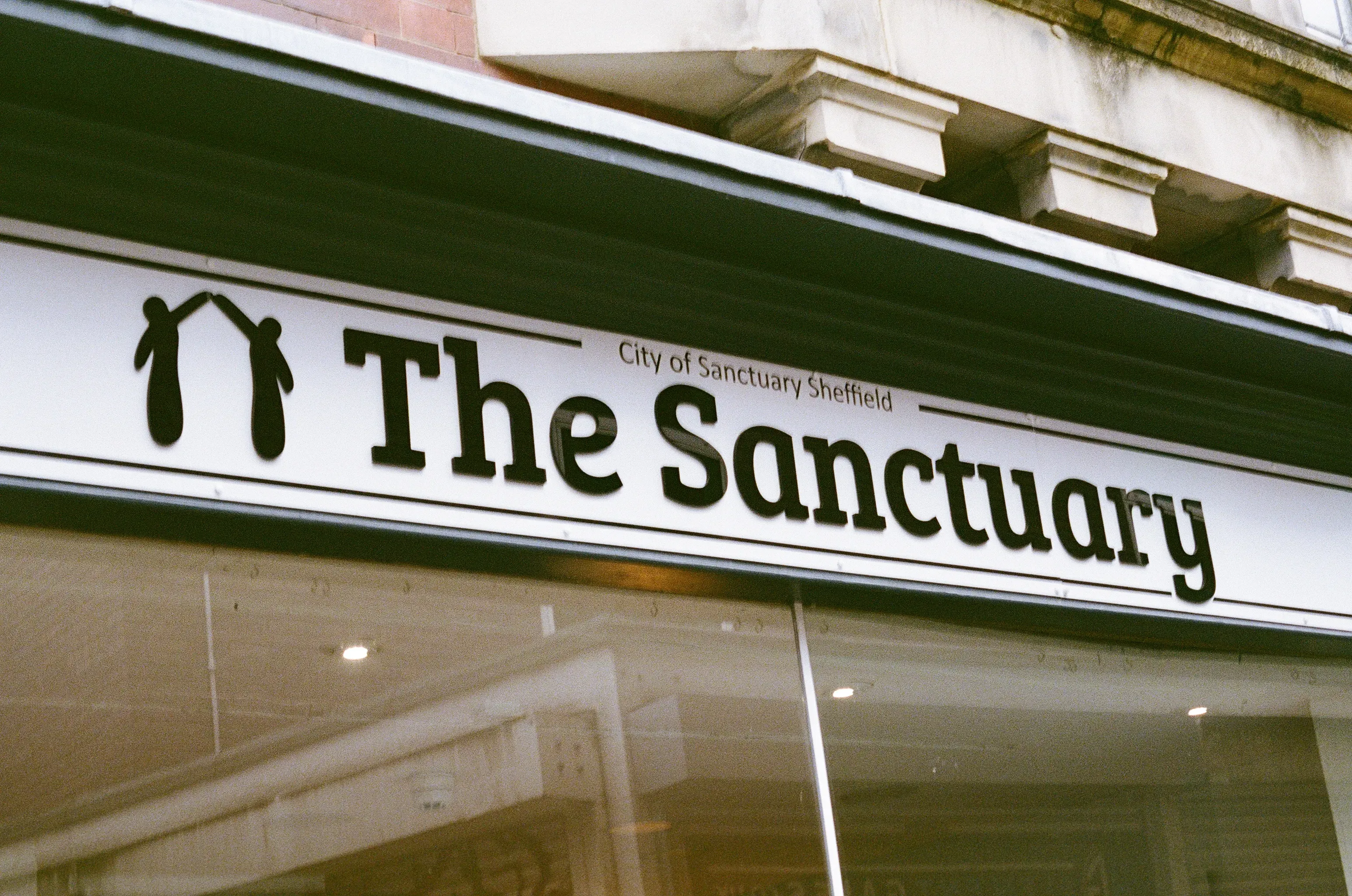
When I first stepped into Sheffield’s Sanctuary Center, the room glowed golden, afternoon sun soaking the weathered wood of scattered cafeteria tables and chairs. A shelf by the front desk held books in Persian, French, Spanish and Arabic. A neon red banner proclaimed the space one of welcome and sanctuary. Beside it, a calendar listed events: Drama Club, Conversation Club, Cooking Club. A line of people snaked through the room toward the kitchen serving chicken pot pie and cole slaw cafeteria style.
I found Tom Martin, director of City of Sanctuary Sheffield, by the door, juggling three conversations. “Grab some lunch,” he urged me. One of the only free seats was next to Amir, who warmly invited me to join him.
Amir, I learned, was from Iran. He had lived with his mother there, whom he loved dearly. He shared beautiful pictures of them smiling atop a mountain. Next to his love for his mother was his love for mountains. When I told him about my appreciation for U.S. mountains, having spent some time living near the Rockies, he leaned back and closed his eyes, imagining their enormity, overlaying remembered past and imagined future. He missed home, where evenings and weekends meant cooking with friends and family.
Tom Martin appeared behind Amir’s chair, ready for our meeting. Amiable in an umber wool sweater and round brown glasses, he pointed me in the direction of his favorite coffee shop, speaking as we walked about his family’s organizing history, how he was destined to spend his life supporting his community.
“Essentially, the City of Sanctuary Movement started as a Comms exercise,” Tom said. It depicted a community’s shared conviction and vision. Soon, they felt a call to tie these claims to action.
“The challenge the movement has always had,” said Tom, “is when you claim to be a City of Sanctuary, that can be used either to galvanize action or to whitewash inaction.” As they incorporated support services, they held themselves to a high standard of advocacy.
“We cannot just deliver services and do some woolly lobbying,” he said. We have to engage in hard-nosed systemic change. Because the system is brutal and brutalizing. And if you just deliver services within that system, you are papering over the cracks of dehumanizing policy. You are legitimizing dehumanizing policy.”
To Tom, campaigning for systemic change and ensuring community care are inextricably intertwined.
“If you are just doing campaigning and advocacy, and a member of your community tells you they can’t find a house, you can’t in good conscience keep your focus on the communications and macro-level politics element of your work,” he said.
In what I’m told is classic Sheffield style, just as Tom began discussing the movement’s roots, its founder appeared through the window. Tom waved Inderjit over, who adjusted his wire-framed glasses and ambled across the street to meet us.
The co-founders of the City of Sanctuary movement are religious men. Craig Barnett is a Quaker, and Inderjit Bhogal is a Methodist. Sanctuary work feels like ministry to Bhogal.
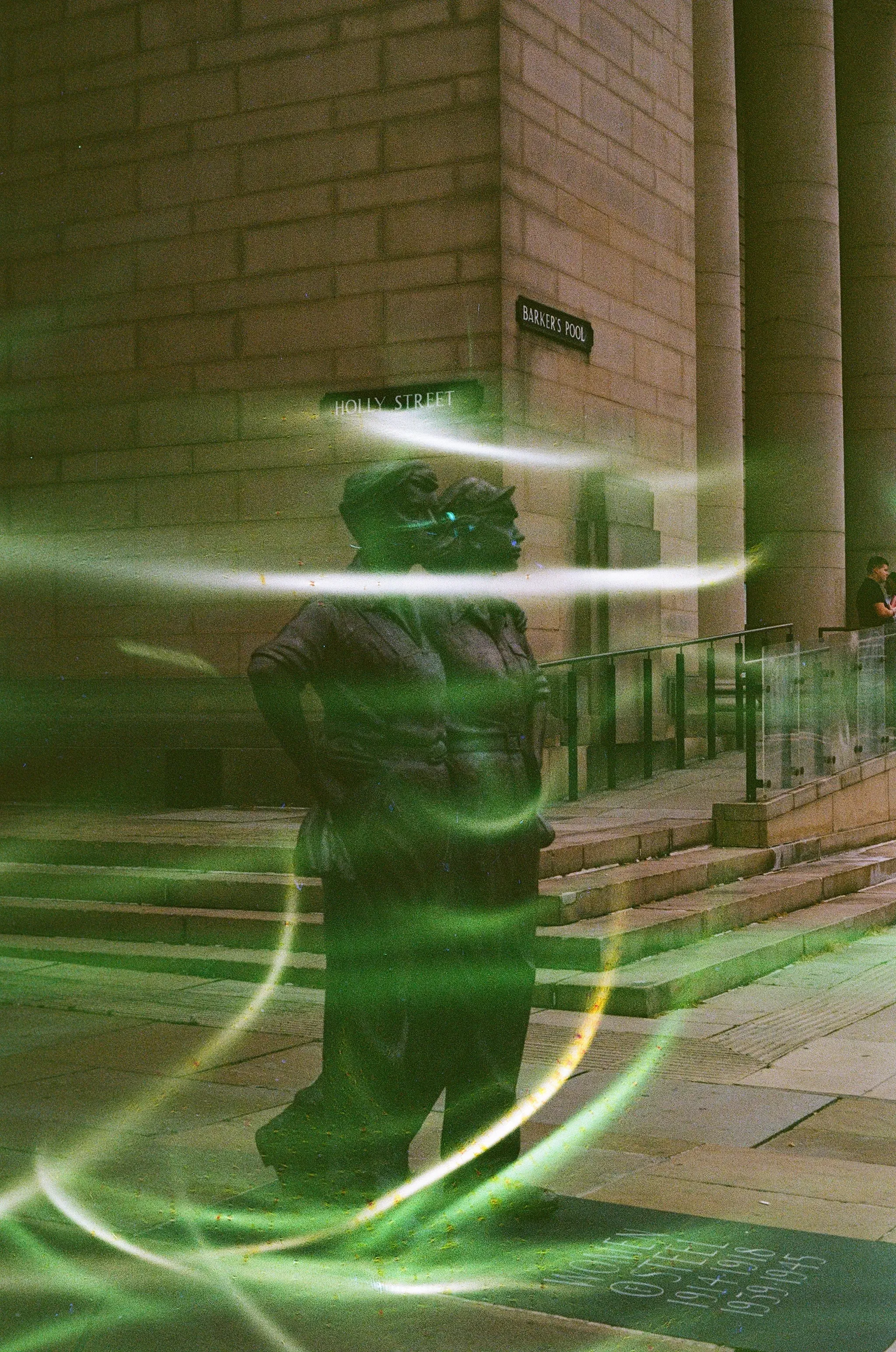
Sheffield, Bhogal told me, has a long history of immigration. Sheffield’s economy is built on steel, which encouraged migration to its industrial areas from workers in the U.K. and worldwide. The majority of the migration to Sheffield took place during post-war labor shortages, and continued even as the steel industry declined in the early 1980s and 1990s. Many newer arrivals have come seeking refuge from war and political instability in their homes. People in Sheffield have been learning, since the Industrial Revolution, to sustain community across cultural differences.
Inderjit himself arrived from an immigrant family 40 years ago. His first contribution was helping build frameworks for the unhoused. Soon after, he engaged in interfaith work, bringing people together over food to discuss shared values. He noticed many organizations supporting refugees and convened a meeting to unite their efforts, hoping to create greater community impact through collaboration.
“There was no thought that it was going to go anywhere else,” he said. “We were just doing the right thing for our city… But obviously there is a vision here, which is called the imagination of people.”
The coalition rooted their work in the Hebrew concept of Cities of Refuge, focused on safety while awaiting case decisions. Their aim was “not to avoid or evade law in any way, to challenge law when that is necessary,” but mostly to provide solidarity and safety.
Inderjit believes that in America, aspirations for political codification and protection have co-opted what should be a people’s movement, dangerously tying the success of the Sanctuary City movement to the party in power. The U.K.’s City of Sanctuary “is not an immigration policy, it’s not a political campaign … political messages don’t have a place here,” he added. Instead, it helps people question and interrogate information, seeing each other as people.
“My son got married recently. Connection is the message of marriage, and if two people can connect in this way, it's a subversive act in our world.,” he said. “It is possible to connect in this way. We have to start from there, from two people coming together, to be able to bring more and more and more people, to increase the ripple,” Bhogal said.
I asked Martin if he thought the U.K. City of Sanctuary movement had anything to learn from the U.S. “The main difference that always struck me,” he said, “was the noncompliance.” This wasn’t really an option in the U.K., without the federal/national structure. Instead, in Sheffield, Martin focuses on “what …within the national framework… do we have agency over?”
Finding Sanctuary
The City of Sanctuary Sheffield does believe in working to “change the [immigration] system,” but they clearly prioritize their desire to “create a world outside that system, proving its possibility,” Martin said. “There’s a storm going on outside, but we are going to find sanctuary within it, and hold this place for safety.” He asks City Councils and political groups, in the meantime, to act with agency in their sectors. One day, he hopes, those leaders will slow the storm down, and entire cities can be sanctuary centers, places of safety.
At the end of my conversation with Barba, I asked if he felt that codifying the Sanctuary principles in America legally had done a disservice to the movement, threatening its durability by further politicizing its principles. Perhaps, I wondered, the British City of Sanctuary movement’s allegiance to its grassroots foundations would allow it to sustain inevitable political shifts. The same might rob the American Sanctuary Cities of their power entirely.
“There are certain administrations more likely to give rise to Sanctuary declarations” Barba conceded, whereas others are actively antagonistic to it. This perpetual upheaval is a staple of the American present. But as an ideology and an aspiration, “Sanctuary has shown itself to be consistent, irrespective of administration or political party.”
He referenced an 80s interview where a Republican church member declared his allegiance to the Sanctuary City movement, regardless of his politics, simply “because we are facing a moral catastrophe.”
Since leaving Iran, Amir has moved between many countries—Turkey, Italy, France. Istanbul was his favorite city. I watched videos of markets, mosques, and waves slapping sandy beaches from his Snapchat camera roll. Wherever he went, he sought nature. He loved Sheffield’s parks and showed me swimming and walking spots. He planned a trip to the Peaks, the U.K.’s first national park district.
Amir’s mother, still in Iran, was quite sick. He waved away my words of sympathy, assuring me that everything was within God’s plan. He hadn’t made friends in Sheffield yet but liked the Sanctuary’s community feel. He spent much of his time on WhatsApp, showing groups for English practice and Persian speakers seeking comfort. He held the phone to my ear, and played for me an English speaker’s invitation to join the conversation.
Amir locates sanctuary here: in conversation, in relation.
Across the U.S. and the U.K. this must remain the primary mode of Sanctuary City work, its grounding center. Without it, he thinks, worries, plans, twisting his mind into knots about things over which he has no control. “Too much thinking,” he winced. “It’s bad for the brain.”