Journalist Resource
 April 3, 2026
How I Investigated the Use of Facial Recognition in India’s Flagship Welfare Program
Country:

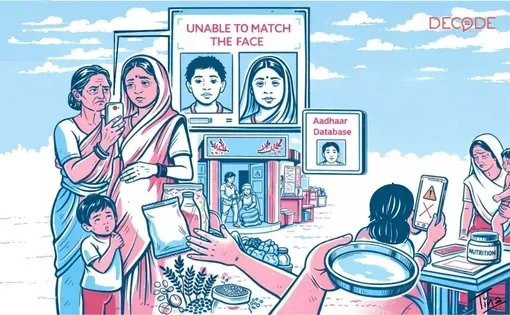
AI-driven facial recognition is denying food to some of India's most vulnerable.
I first learned about the Indian government’s decision to introduce facial recognition for welfare delivery in late June 2025. The mandate, issued by the Ministry of Women and Child Development, required that rights-holders of Integrated Child Development Services (ICDS), India’s flagship nutrition and early-childhood welfare program, verify their identity using facial recognition technology starting in July 2025.
ICDS provides supplementary nutrition, health, and preschool services to pregnant women, lactating mothers, and children under age 6 through a vast network of local Anganwadi centers, staffed by female front-line workers. These Anganwadi workers are responsible for enrolling beneficiaries, maintaining records, and ensuring supplementary ration and services reach households.
My immediate reaction to the mandate was concern, not only for rights-holders, but for Anganwadi workers themselves. In 2023, I had reported on the rollout of the Poshan Tracker, a government mobile application used to digitize ICDS records, and documented how frequent app crashes, poor internet connectivity, and increased administrative burden were already overwhelming workers. Adding facial recognition, I suspected, would compound these problems.

As a nonprofit journalism organization, we depend on your support to fund more than 170 reporting projects every year on critical global and local issues. Donate any amount today to become a Pulitzer Center Champion and receive exclusive benefits!
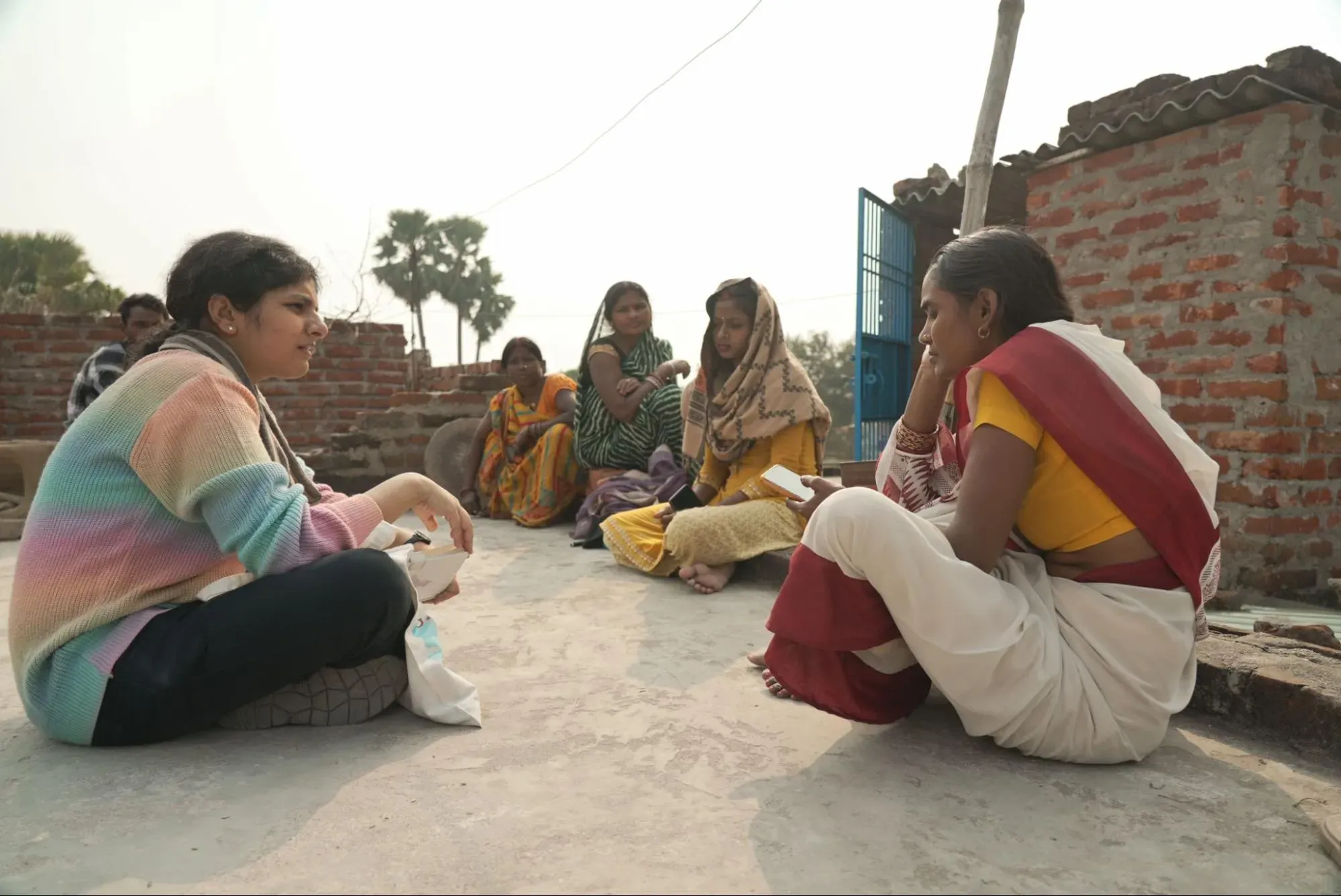
Early ground reporting in Delhi
To understand how the mandate was playing out, I began ground reporting in the first week of July 2025, shortly after facial recognition was introduced. I visited multiple Anganwadi centers across Delhi, India’s national capital.
What I witnessed went beyond technical inconvenience. While I expected workers to struggle with the technology, I found that rights-holders were being subjected to repeated identity checks, often failing authentication because the system could not match their live photograph with a static image stored in the database. In several cases, women were denied rations because of age-related changes in their faces, poor camera quality, or lighting conditions.
This initial story focused on Delhi, but during the editing process, my editors and I felt the issue warranted a deeper investigation. If implementation failures were this stark in the capital—where connectivity and administrative capacity are relatively better—what would the system look like in rural and remote regions?
I subsequently applied for and received a reporting grant from the Pulitzer Center, which allowed me to expand the scope of the investigation.
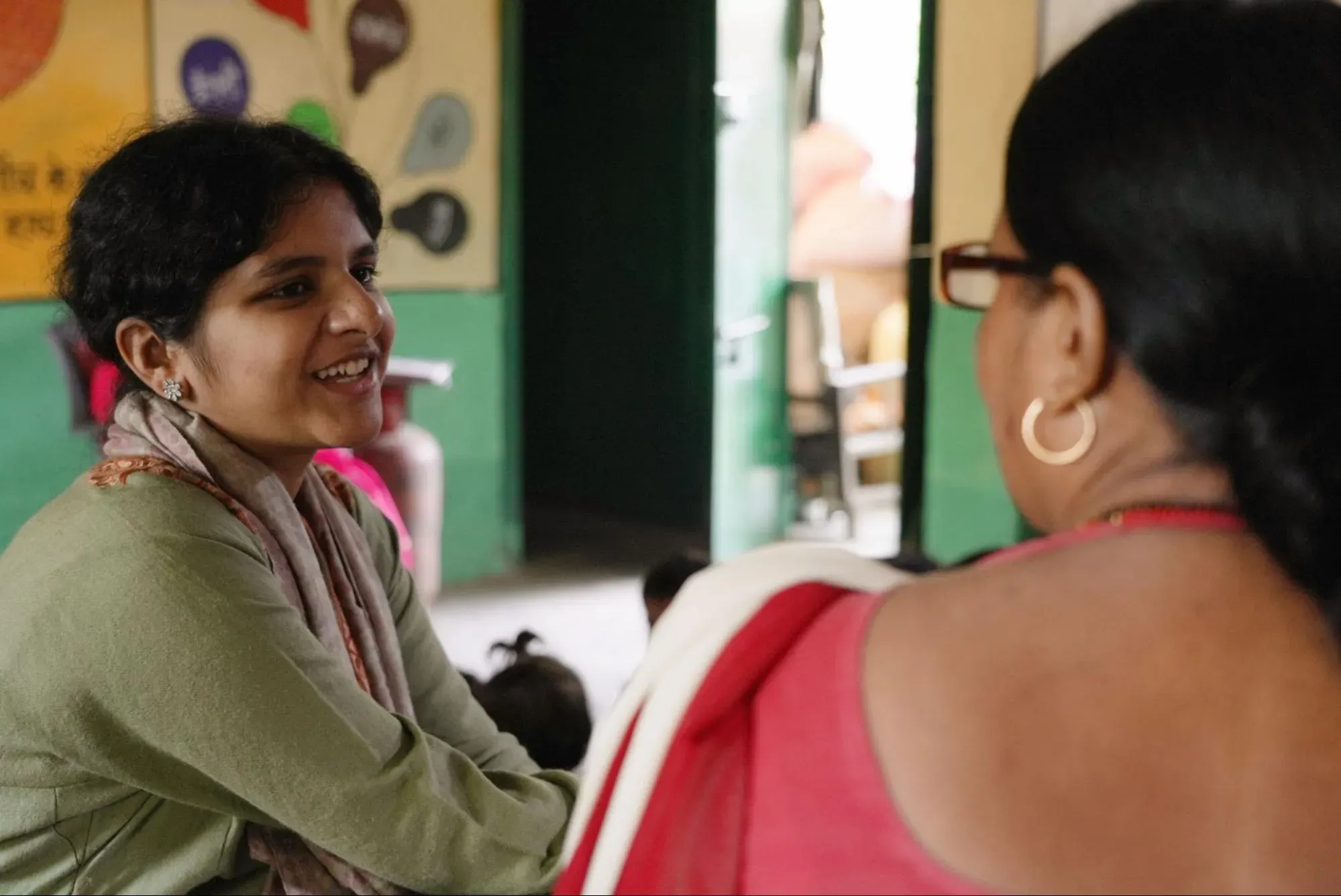
Examining the technology itself
With additional resources, I began examining how the facial recognition system actually worked.
I was connected to Anoop, a technology researcher at Aalto University in Finland, through a friend, who recommended him for his work in analyzing digital systems. Anoop worked with me for over a month to study the Poshan Tracker app.
He conducted a static analysis of the app, essentially examining how it is built and what it does behind the scenes, without needing access to government servers.
This involved closely studying the app’s code, permissions, and internal structure after installation. By unpacking the application file, he was able to trace how different components interact, what data the app collects, identify embedded SDKs (software development kits), and map the external services it connects to.
Examining the app also looked into:
- how data moved between the device and central servers
- whether third-party services or external application programming interfaces (APIs) were involved
- What safeguards, if any, were visible in the app’s functioning
This step was crucial to ground the reporting not just in lived experiences, but in the technical design choices underpinning the system.
Reporting across three states
Simultaneously, I started preparing for field reporting. I narrowed the investigation to three states in India: Bihar, Jharkhand, and Karnataka.
Bihar and Jharkhand were selected because they are among India’s poorest states, with high dependency on ICDS services and weak digital infrastructure. Karnataka, by contrast, was included because it was the only state where Anganwadi workers had publicly protested against the facial recognition mandate, offering an opportunity to examine organized resistance and official responses.
Before reporting, I began reaching out to Anganwadi workers. Some were hesitant to speak, fearing repercussions from local authorities or the administration.
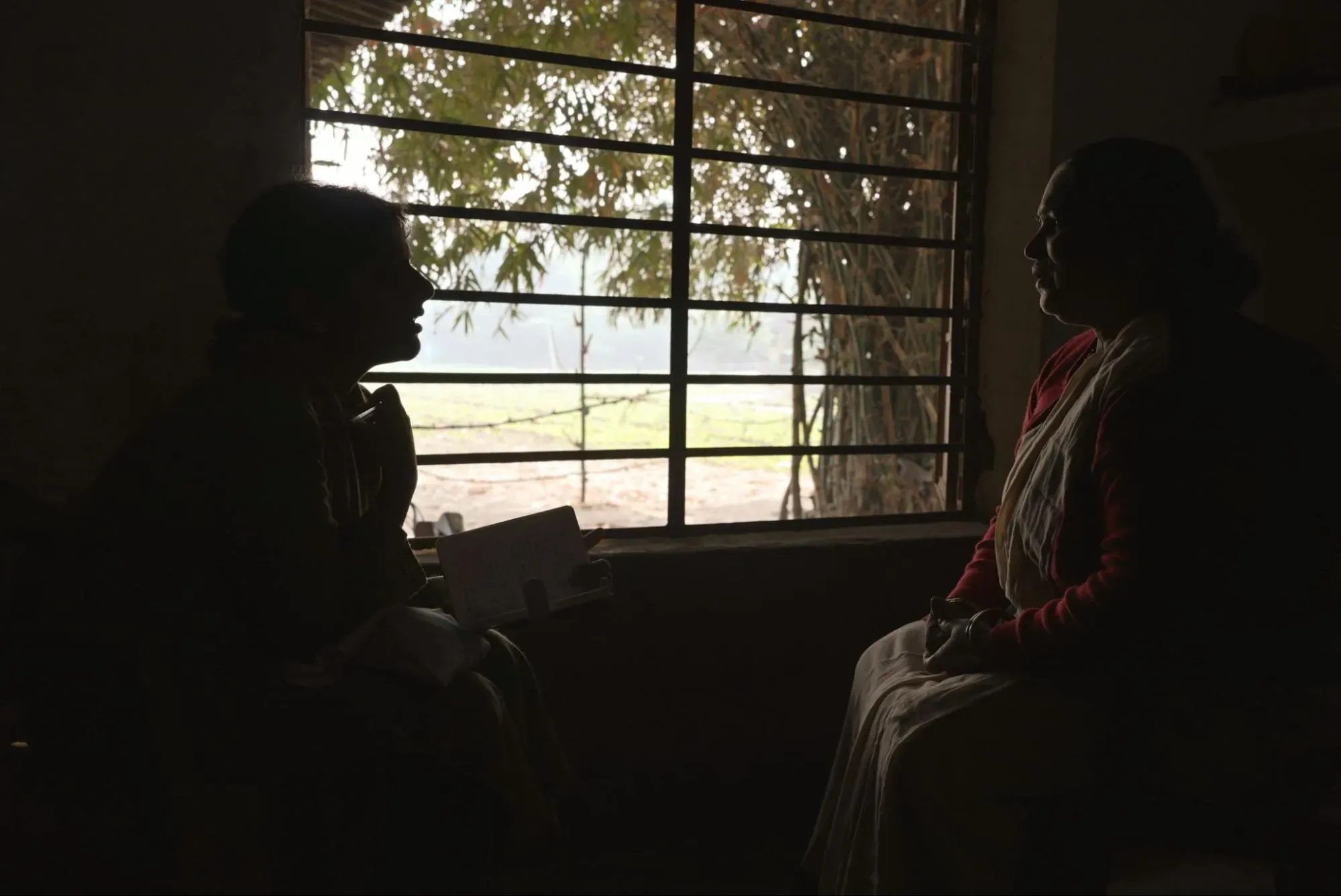
Across these states, I visited Anganwadi centers, spoke to workers, rights-holders, and union representatives, and documented how facial recognition affected daily operations, ration distribution, and worker–rights-holder relationships.
Workers' survey
Alongside qualitative reporting, I conducted a structured survey of Anganwadi workers to capture the impact of facial recognition on their work.
The survey asked workers about:
- the amount of additional time spent daily on facial recognition and the Poshan Tracker app
- changes in workload after the introduction of facial recognition
- the number of rights-holders denied or delayed services due to authentication failures
- availability of grievance redressal mechanisms when the system failed
- instances of warnings or pressure from supervisors
- whether workers believed facial recognition should continue in ICDS
- demographic details, such as years of work experience
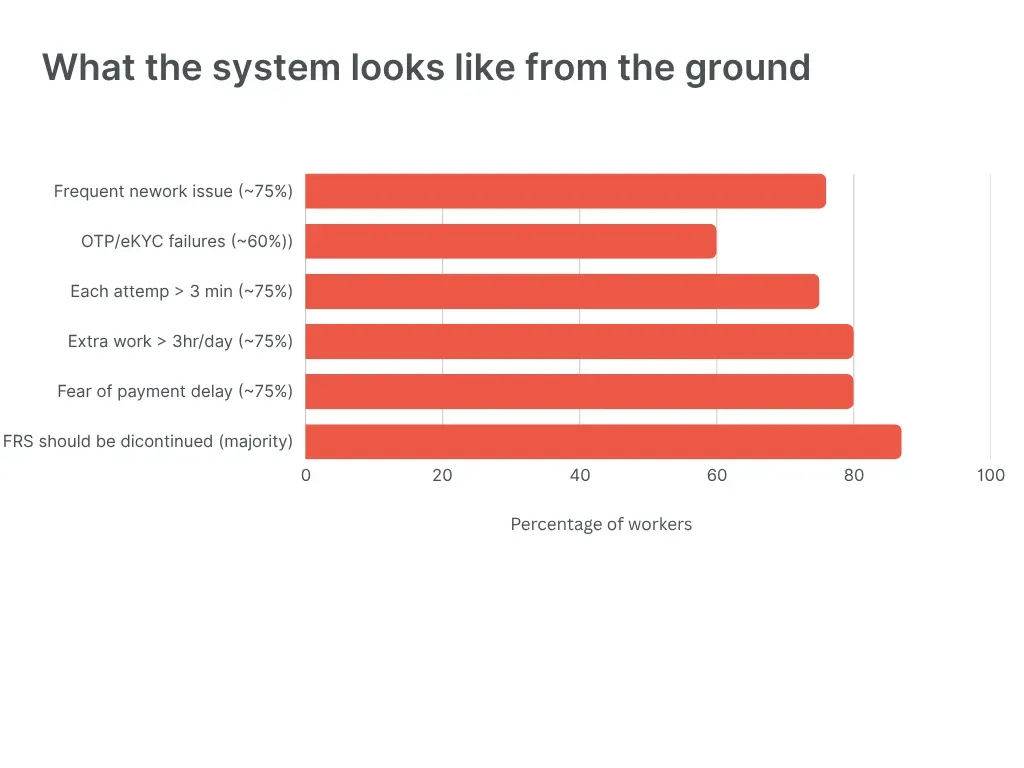
The survey received 163 responses from Anganwadi workers across multiple states. While not statistically representative of India’s entire ICDS workforce, it helped identify recurring patterns, corroborate field observations, and highlight systemic issues.
The survey was conducted digitally using Google Forms and designed in languages familiar to the workers: Kannada for Karnataka, and Hindi for Bihar and Jharkhand. It was initially circulated through workers unions in each state, who shared it via their WhatsApp groups, ahead of my field visits.
During on-the-ground reporting, I re-shared the survey in person with workers who had missed it earlier, encouraging wider participation.
The survey found three-quarters of workers reported frequent network failures during facial recognition, with each attempt taking over three minutes and adding more than three hours to workers' daily workload. A similar proportion reported facing payment cuts, while over 80% said facial recognition should be scrapped.
The findings
With the help of Anoop, we found that the Poshan Tracker operates through a largely closed, government-controlled pipeline—with several layers that remain opaque and beyond public scrutiny.
Within this system, one component relies on Google ML Kit, an AI tool designed to "detect" faces, not reliably identify them across years of physical change. The captured image is then passed to another undisclosed system that performs the actual matching.
This is where failures are frequent. The reference image, pulled from Aadhaar (India’s digital ID), is often years old, taken when many rights-holders were much younger. Changes due to age, pregnancy, or even basic conditions like lighting and camera quality lead to repeated mismatches, ultimately resulting in exclusion.
Even Google has limited visibility into how ML Kit is deployed in such systems, as the tool is freely available for developers to integrate and use in different ways.
The app also uses several third-party tools to keep it running.
It uses Sentry to track errors and crashes, which can collect information about the phone and how the app is being used. Microsoft’s App Center helps manage updates and monitor the app’s performance. Firebase, a Google service, is used for notifications and basic analytics.
Since the system is largely closed, we could not fully ascertain how data moves between the device and central servers, or what safeguards, if any, are built into the app’s functioning.
I filed Right to Information (RTI) requests and sent multiple emails to the government, seeking clarity on data handling, exclusions, and whether the system actually reduced “leakages.” I received no response.
Beyond the technology, what stood out was the human cost.
Anganwadi workers spend hours each day retrying scans and navigating app failures. Many reported adding several extra hours to their workload. They face the anger of those denied food, while also being under pressure to show 100% verification, sometimes by removing names to make records appear complete.
Failure to meet these targets can lead to cuts in their already meager honorariums.
Most workers were never trained for this level of technological intervention. Many are forced to improvise, seeking help from their children, or traveling long distances just to access stable internet to run a data-heavy app.
In effect, a system designed to streamline welfare has shifted the burden of its inefficiencies onto the workers tasked with delivering it.
Key takeaways
- Start with ground truth: Begin with people. Early field visits helped reveal that exclusion wasn’t hypothetical; it was already happening. This shaped the direction of the entire investigation.
- Pair lived experiences with technical evidence: On-the-ground reporting showed "what" was going wrong; technical analysis explained "why." Combining both made the story harder to dismiss and more structurally sound.
- Build partnerships: Collaborating with an independent researcher was key. Instead of relying on official claims, static analysis of the app helped independently verify how the system functioned. Find people through trusted networks, clearly define roles, and ensure they can translate complex findings into accessible insights.
- Use surveys to show scale: The survey wasn’t just about statistical representation, it was about spotting recurring issues across regions. It helped back up field observations with consistent patterns. Since there was no public data on this, it helped put numbers to those experiences and show that these weren’t isolated cases, but part of a larger pattern.
- Look for social strata, not just geography: The same policy does not affect everyone equally; it intensifies across social and economic divides. In Delhi, some rights-holders were willing to forgo supplementary rations to avoid the hassle of repeated authentication. But in Bihar and Jharkhand, where dependence on welfare is far greater, many persisted through repeated failures, just to remain in the system. Always track how impact shifts across contexts. What seems like inconvenience in one setting can become survival in another.