
Project
Peering Into PEPFAR’s Future
Investigating the White House's vision for the future of America's global AIDS response
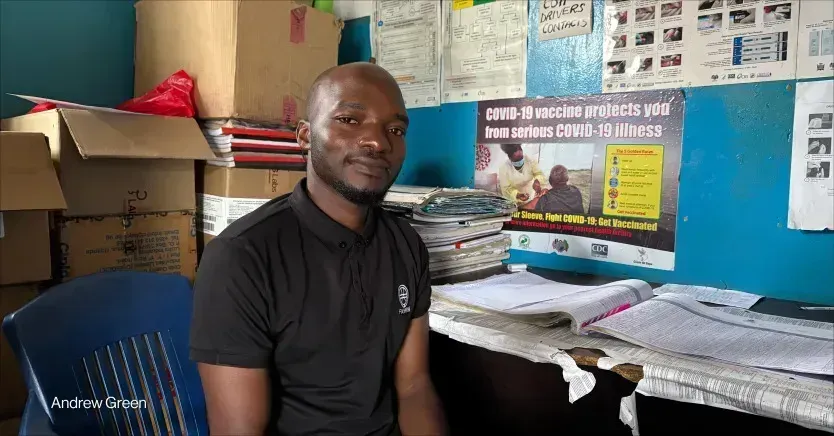
The new America First Global Health Strategy cuts off U.S. support to local organizations to fight HIV, except for faith-based organizations. But what happens to services for the communities faith groups cannot access?
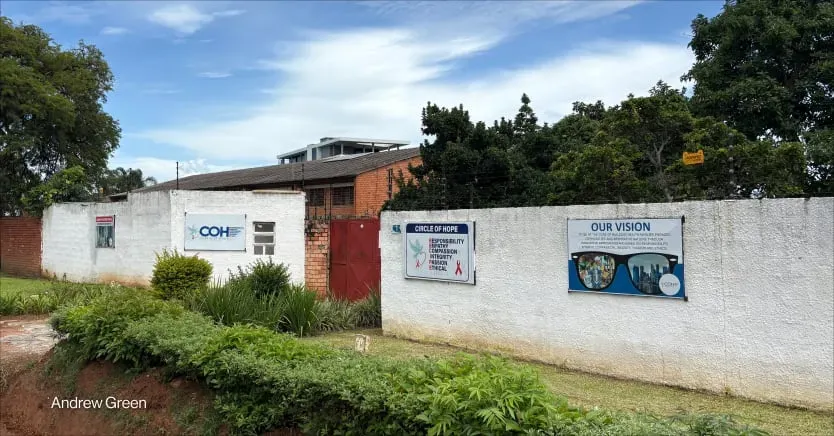
Set within a bright confusion of churches, shops, and noisy bars, it’s easy to miss Circle of Hope’s community post in George, a neighborhood in Zambia’s capital, Lusaka. The fenced blue-and-white building doesn’t register as a health center, let alone part of the Trump administration’s vision for the future of the HIV response.
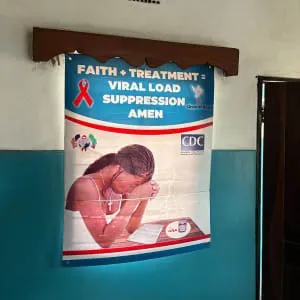
Inside, the mission is clearer. The three rooms are covered with posters that promote HIV services alongside Christianity. One reads: “Faith + Treatment = Viral Load Suppression Amen.” There is also a logo for the U.S. President’s Emergency Plan for AIDS Relief, or PEPFAR.
Along with HIV testing, treatment, and prevention, the post offers only a handful of other services, like checkups for pregnant women and young children. Circle of Hope’s priority is to make it as seamless as possible for someone shopping in the nearby market or coming home from work to drop in and quickly get tested for HIV or pick up their medication.

As a nonprofit journalism organization, we depend on your support to fund more than 170 reporting projects every year on critical global and local issues. Donate any amount today to become a Pulitzer Center Champion and receive exclusive benefits!
All of this — the nondescript exterior, the lean services, and the displays of Christian faith — are intentional. And, according to Gibstar Makangila, they are why the posts are a vital part of Zambia’s HIV response. Launched in 2018, there are now about 120 scattered across seven of the country’s 10 provinces.
“We decentralized HIV services to where people live, work, socialize, and pray,” said Makangila, Circle of Hope’s executive director, while removing “barriers and hindrances that inhibit potential beneficiaries from coming,” including concerns about being recognized entering a known HIV clinic.
Circle of Hope, a faith-based organization, or FBO, that emerged from Pentecostal Assemblies of God more than two decades ago, according to Makangila, has also made sure its posts have the blessing of local Christian leaders. “They have this trust, which no other entity, not even the governments of Africa, enjoy,” he said. “If it comes from them, the community believes in them.”
So does the Trump administration.
The America First Global Health Strategy, released in September last year, breaks with Washington’s standing model of supporting international or local organizations to provide HIV services. Instead, U.S. officials intend to channel money directly to partner governments. But citing Circle of Hope as an exemplar, the administration plans to continue leveraging FBOs that have community connections and cost-effective strategies. And U.S. officials have consulted faith leaders across multiple religions as they have negotiated bilateral funding agreements with 24 countries over the past four months.
The Trump administration’s engagement with FBOs extends a decades-long recognition of their ability to deliver HIV services to communities no other institution can access.
They do not reach everyone, though. Representatives of vulnerable groups in Zambia, including sex workers and gay men, warn of discrimination at faith-based facilities. That is why donors, particularly the United States, have supported alternative services in the past for marginalized groups, provided by civil society organizations and people from those communities.
“It is a little bit shocking that the only non-state actor that they are mentioning” in the America First strategy, aside from private players, “is the faith communities,” Gracia Violeta Ross, a program executive with the World Council of Churches, told Devex. She worries about a diminished response if only faith-based services have ongoing access to U.S. funding. “The faith communities cannot replace the communities living with HIV, cannot replace the civil society.”
In Zambia, as across much of Africa, faith-based organizations were leading the HIV response long before former U.S. President George W. Bush launched PEPFAR in 2003.
As hospitals in Zambia ran out of beds for people ill with AIDS in the mid-1980s, it was the Churches Health Association of Zambia, or CHAZ, that started sending out volunteers to people’s homes to care for them until they died, the organization’s chief executive officer, Karen Sichali-Sichinga, told Devex. When PEPFAR arrived with lifesaving treatment, CHAZ was ready to connect them with hundreds of patients in desperate need of the pills.
That exemplified the relationship that would develop between PEPFAR and FBOs: The organizations could respond to community needs and America had the resources to amplify those efforts.
Sichali-Sichinga said she underscored this history when she met a team of U.S. State Department officials late last year. She was joined by FBO leaders drawn from both the Christian and Muslim faiths.
“I think there we were honest and said, ‘Look, the government has so much on their plate,’” Sichali-Sichinga said. She also reminded them of the reach that FBOs such as CHAZ maintain through their networks of mission hospitals and clinics, which sit in some of Zambia’s most remote regions. Without funding, “you would be ignoring a critical mass and you are depriving the people who are in hard-to-reach areas of health services,” she said.
And in countries such as Zambia, where religion is widely practiced, organizations linked to faith leaders carry outsized influence. Mackson Mwale, a counselor at Circle of Hope’s George community post, told Devex this means he is rarely turned away when he knocks on someone’s door. He can use this access not just to encourage people to get tested, but to combat misinformation about HIV, particularly if it is being spread within faith communities.
“There are some other church organizations who are believing that these people can be taken to some prayers and get healed from this virus,” Mwale said. “It’s important that the church came in to make these people understand HIV cannot be healed by prayers. You need to take drugs.”
Makangila did not know in advance that Circle of Hope’s community posts would be featured in the United States’ new health strategy. But he has taken it as a validation, not just of the model, but also that their message has resonated and the U.S. remains committed to supporting the efforts of FBOs.
As the executive of the World Council of Churches’ HIV, reproductive health, and pandemics program, Ross understands the transformative role FBOs can play in combating HIV. But if the ambition is still to end AIDS by 2030, as laid out in the Sustainable Development Goals, then other groups will also need ongoing support. And the United States remains the key funder in the global HIV fight at the moment.
“The religious leaders and faith communities, they have to learn from these civil society groups, because they are leading the response in many spaces,” she said. The community-post model, for instance, was developed with the insights from networks of people living with HIV, according to Makangila.
Those same organizations have been devastated by U.S. funding cuts and now appear to be written out of the new bilateral agreements. This is not the kind of work FBOs can easily take over, even with renewed U.S. support. It involves supporting communities who do not trust faith-based groups to deliver services without discrimination.
Martin Zimba is the executive director of the Key Populations Alliance of Zambia, or KPAZ, which helps vulnerable communities, including gay men and sex workers. That includes connecting them to HIV testing and treatment facilities rooted in their communities. Before the U.S. funding cuts, he said KPAZ was active in nine of 10 Zambian provinces and had assisted 30,000 people. It is now down to only two provinces and many of its partner facilities have also closed.
Zimba said most of the people KPAZ was assisting would not seek out replacement services. With homosexual activity illegal and sex work partially criminalized in Zambia, people are afraid they might be arrested if they visit a government-run facility. And when they venture to faith-based facilities, Zimba said, “they are always hitting us back with the reformatory approach to identity, sexuality, and choice of work. So it becomes difficult to encourage someone to go there where you feel they’ll be discriminated against based on who they are or what they do.”
Both Makangila and Sichali-Sichinga dispute this characterization. They said anyone is welcome at their facilities, though they may not emphasize services for groups that are criminalized in Zambia.
“We don’t have a form where when a patient comes to the clinic they have to specify their sexual orientation,” Sichali-Sichinga said.
But putting clients in a position where they feel they must hide their identities is a kind of discrimination, Zimba said. And people who are gender-nonconforming, for instance, may find it impossible to disguise themselves, anyway.
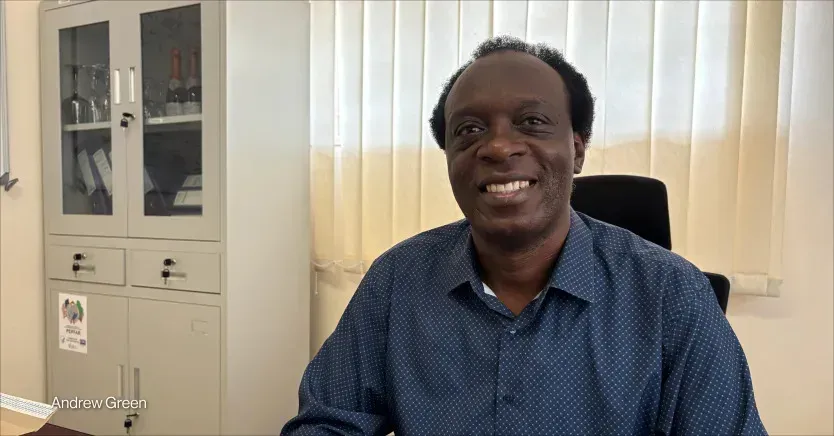
In particular, “HIV prevention really needs to be highly specialized,” said Laurel Sprague, the research director at the Williams Institute in the University of California, Los Angeles. “It needs to meet people exactly where they are and be in a space where people can speak openly about their potential risk factors.”
There are also other groups who might worry about confidentiality or encountering stigma at an FBO facility, she said, including adolescent girls and young women. That is why “we need a rich tapestry of civil society organizations in order to meet the diverse communities,” she said.
That tapestry, most observers agreed, must continue to include FBOs. They may not reach everyone, but they serve a critical constituency.
Yet, their future is also far from certain. Despite Circle of Hope’s mention in the America First Global Health Strategy and the inclusion of the religious leaders in bilateral negotiations, Washington has not actually made many explicit financial commitments.
And even if the United States does make funding available, U.S. officials have emphasized in strategy documents that they hope to draw down their engagement in the global HIV response over the next five years.
A Muslim faith leader, whose organization used to receive PEPFAR support to test people for HIV, was in the same meeting with the American leaders as Sichali-Sichinga. He asked not to be identified for fear he might lose access to any future financing, although he’s not sure it’s coming.
“Things were discussed and then the meeting ended and there hasn’t been any feedback,” he said. “It just ended there.”
Makangila said Circle of Hope would continue its work, even without U.S. government funds. The organization has already been operating on reduced support after cuts by the Trump administration. That has meant some community outreach workers, including Mwale, have not drawn a full salary in more than a year.
Makangila said there are alternative benefactors, including congregations around the world that might support Circle of Hope’s mission.
“The government gets the mandate from the people, but the faith side gets the mandate from God,” he said. “It’s our obligation to provide the services, funding or no funding.”