Pulitzer Center Update June 19, 2026
Before News of the Iran 'Memo,' 2 Films Helped Explain How Crisis Led to War
Country:


Project
'A Move'
"A Move" follows an Iranian filmmaker who stopped wearing a hijab.


Posted on Facebook June 15, 2026.
A brief “memorandum of understanding” with Iran signed by President Trump at a Versailles dinner party on June 17 is vague on details and leaves much unsaid, but what is clear is that the joint U.S.-Israel assault on Iran has left all of the warring factions in a substantially weakened position.
Trump, who went to war without congressional approval, vowed that he would accept nothing short of “unconditional surrender.” He promised regime change, an end to Iran’s nuclear program and its ballistic missile program, and the liberation of the Islamic Republic’s long-suffering people.
None of that has come to pass. Instead, Trump touts the reopening of the Strait of Hormuz, which, of course, was wide open before he went to war.
Israel, which apparently sold Trump on the idea of an attack on Iran, now finds itself with its hands tied in its forever war with Hezbollah, Iran’s proxy in Lebanon, while Prime Minister Benjamin Netanyahu navigates a strained relationship with Trump. Israel’s primary objectives in the war were regime change and the end of Iran’s nuclear program. Neither has been achieved.
That the combined firepower of the world’s mightiest military (the U.S.) and the region’s most experienced military (Israel) failed to deliver a knock-out punch to a second-tier regional adversary does not go unnoticed.
Iran’s military suffered heavy losses, but the regime survived, although the balance of power has shifted from the cautious clerics to the more hard-line Islamic Revolutionary Guard Corps, the group responsible for the brutal crackdown on domestic protesters earlier this year that resulted in tens of thousands dead.
For an inside look at how the crisis reached this point, two short films supported by the Pulitzer Center are instructive.
Iranian filmmaker Elahe Esmaili grew up in a conservative household in Mashhad, Iran’s second-largest city. In her 2024 New York Times documentary, A Move, she dissects a moment of family tension to explore how “the Iranian regime and other authoritarian leaders benefit from pitting religious and nonreligious people against each other, leading them to believe that peaceful coexistence is not possible.”
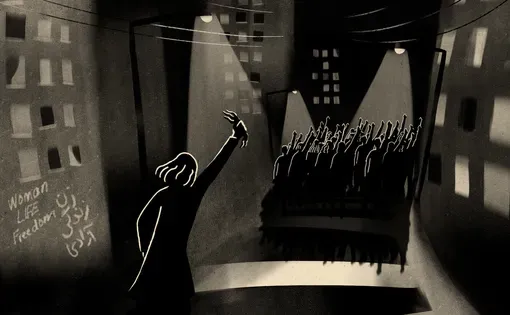
The documentary The Smallest Power was produced that same year for The New Yorker by Iranian-American filmmaker Andy Sarjahani. It follows an Iranian medical resident whose life is transformed when security police invade the intensive care unit of her hospital to arrest a fellow doctor who participated in the 2022 protests that roiled the country. The resident and her hospital colleagues stage a sit-in, blocking police from making the arrest. This dangerous gesture of protest works—the police give up and leave.
Individual gestures of this nature, multiplied by the thousands, grew into the mass protests that have provoked the regime’s panicked massacre of its own citizens.
No one can say what comes next for Iran and its 90 million inhabitants. But these two documentaries—along with countless other pieces of courageous journalism from inside Iran—are part of the movement that has brought us to this moment.
For more Pulitzer Center-supported reporting related to war and conflict, click here, and for democracy and authoritarianism, click here.
Project
'The Smallest Power'
A film provides a window into an Iranian woman’s journey as the Islamic Republic faces a...