

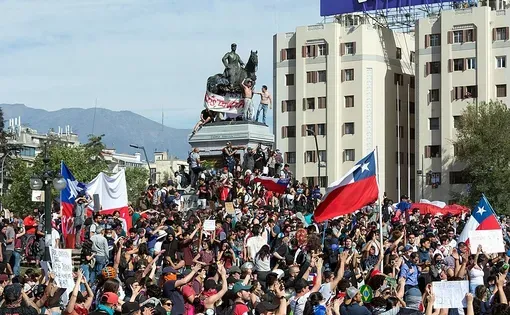
Chile’s youth are redefining activism.
I step out of the metro in Yungay, Chile, and immediately feel out of place. The street is still, edged with fences topped in barbed wire. A few people slowly pass by, their eyes flicking toward me and then away. Twice, someone taps me on the shoulder with the same warning: “Tenga cuidado con su cámara, no es el mejor aquí” ("Be careful with your camera, it is not the nicest here.") I consider turning back but my curiosity keeps me moving.
The first few blocks are tense and gray. Storefronts are shuttered, sidewalks cracked, corners quiet. Then, around a bend, a colorful mural interrupts everything. This building-length portrait shows an elderly woman gazing softly ahead. Beside her hovers a hummingbird in flight, wings outstretched as if pausing in midair.
The pairing seems improbable, yet together they feel like a message of endurance and hope. The image is painted across a wall that itself shows cracks and patches, and that contrast seems to give the mural even more force.

As a nonprofit journalism organization, we depend on your support to fund more than 170 reporting projects every year on critical global and local issues. Donate any amount today to become a Pulitzer Center Champion and receive exclusive benefits!
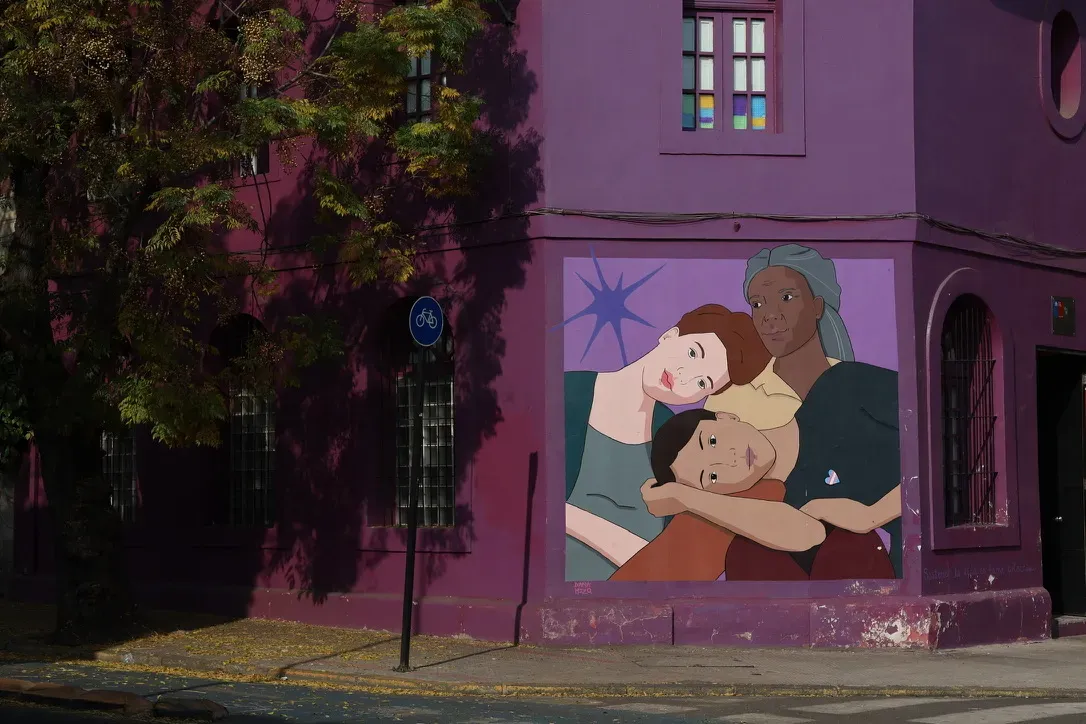
Farther down, I find another building tucked against tall trees, painted entirely in purple. The shade is so vibrant that it warms the entire block and transforms the street around it.
Covering the wall is a portrait of three women of different races. They lean into one another, heads almost touching, their bodies joined in a quiet huddle. The image is simple but powerful. In a place where caution hangs in the air, the mural insists on solidarity. It is a reminder that strength can come from connection across differences, and it makes the street feel briefly lighter.
The art is not always so comforting, though. In a particularly rough section of Yungay, where the streets are empty and windows sealed with bars, I come across a small mural painted low on a wall. It shows a bullet passing through a heart. Above it are the words “Esto no es amor” ("This is not love"). The mural is easy to overlook, yet its bluntness is unforgettable. It speaks to struggles I don't fully know, carried by people who live here every day.
As I move through the neighborhood, I begin to see that the art and the place cannot be separated. The barbed wire and the murals exist together. The cautious looks and the bright walls are part of the same story. These paintings do not sit above the neighborhood as decoration, but rather grow out of it.
When I finally return toward the metro, my sense of unease has not disappeared, but it has shifted.
Yungay left a strong impression on me, through its portraits, colors, and messages painted on walls. The streets and the murals rely on one another, and in their dialogue the character of Yungay comes alive. Even as a visitor who passed through only briefly, I could see a community using its walls to share its community, struggle, and strength with the world.