Story
 August 28, 2025
When Governments Own Tobacco Companies, Who Watches Out for Your Health?

Project
Smoking for the State
How conflicts of interest shape tobacco policies

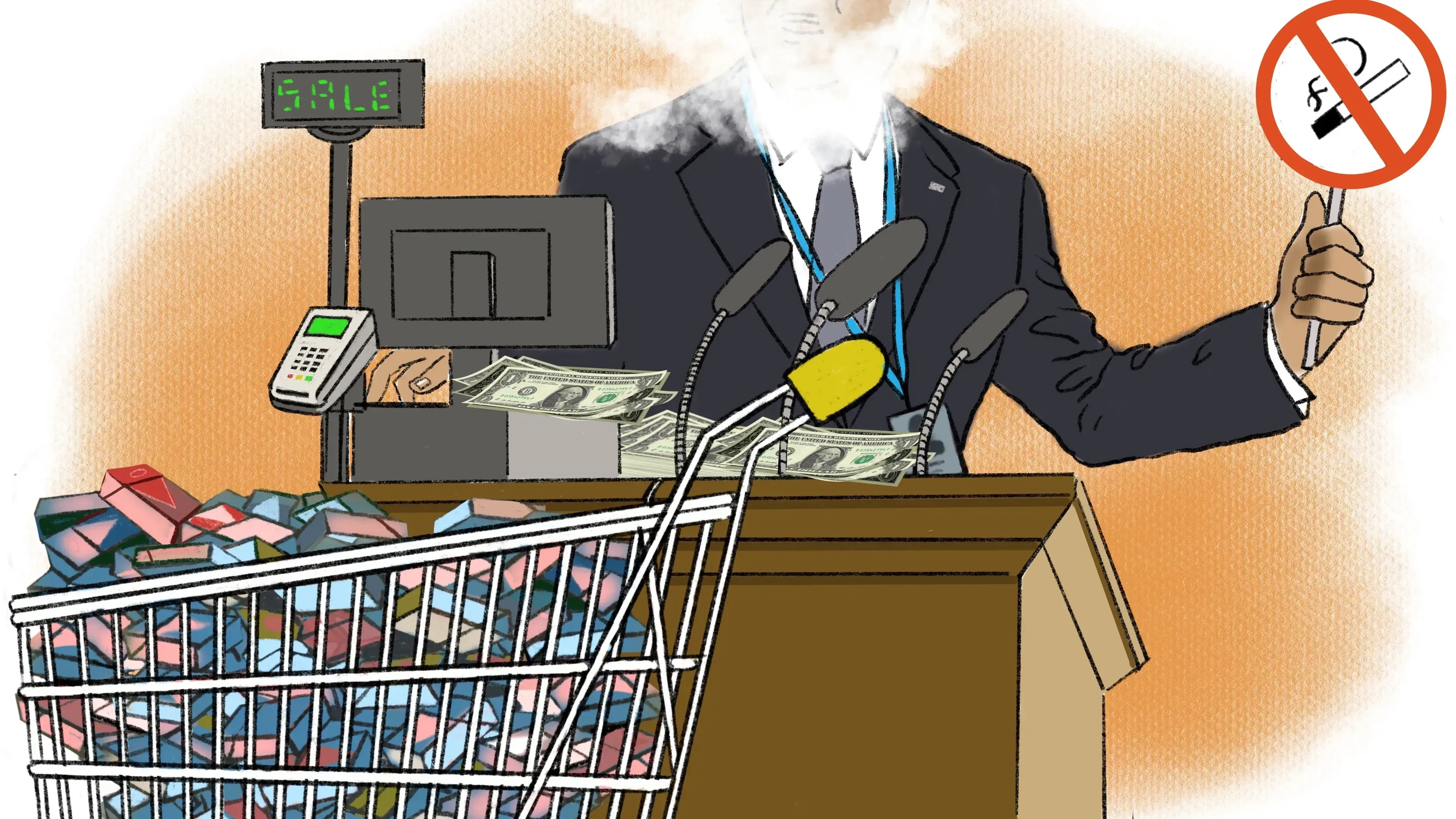
At least 17 countries have a stake in the tobacco industry, making them responsible for a product that is a leading cause of preventable death.
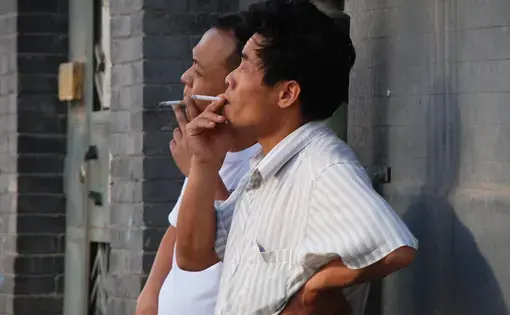
Picture three people smoking cigarettes: one sits in a cafe in Cairo, sipping tea. A second waits for a bus in the hills of Laos. A third jostles for space in a cramped smoking booth in Tokyo.
All three have something in common besides the cigarettes in their hands: The more they smoke, the more their governments profit. That’s because Laos, Egypt and Japan are among at least 17 countries, plus Taiwan, that hold stakes in tobacco companies. Together, those companies produce more than half of the world’s cigarettes.
Given that protecting public health is considered a core responsibility of government, and smoking kills more than 7 million people a year, the conflict of interest couldn’t be more stark. “What’s in the interest of state-owned tobacco industries isn’t necessarily in the interest of the country itself,” said Gary Fooks, a political sociologist at the University of Bristol in the United Kingdom.

As a nonprofit journalism organization, we depend on your support to fund more than 170 reporting projects every year on critical global and local issues. Donate any amount today to become a Pulitzer Center Champion and receive exclusive benefits!




While many countries generate revenue from excise taxes on tobacco, those taxes are designed at least in part to discourage sales. In countries with state-owned tobacco companies, however, the government has an incentive to increase sales of a product that is a leading cause of preventable death of its citizens.
And yet nearly all the countries that are in the tobacco business are parties to the World Health Organization’s Framework Convention on Tobacco Control, a landmark public health treaty finalized in 2003.
Countries that signed on to the treaty agreed to protect their public health policies from the “vested interests of the tobacco industry.” This provision stemmed from a long history of tobacco giants around the world derailing anti-smoking measures by lobbying politicians, misleading them about the dangers of their products and orchestrating astroturfing campaigns to give the appearance of grassroots opposition to anti-smoking laws.
But how are government health policies to be protected from tobacco industry influence when the government itself is in the tobacco business?
The Examination probed this question through our “Smoking for the State” series, a multi-year project focused on state-sponsored tobacco companies in China, Egypt and Laos.
Despite the scale of state-owned tobacco companies, the subject has attracted relatively little scrutiny.
“It’s remarkable how little has been written on this subject,” said Scott Hogg, a medical doctor who co-authored one of the few papers on it and is now vice chairman of Action on Smoking and Health Scotland, an anti-tobacco group.
Studies have found that privatizing state-owned cigarette companies is correlated with increased growth and efficiency of the industry. In the 1990s, cigarette consumption in several former Soviet nations boomed after their communist-era monopolies were privatized without effective tobacco control laws, according to research by the National Cancer Institute.
But cigarette companies with government ownership also benefit when their customers smoke more. Our reporting in China, Egypt and Laos, where state-owned companies dominate, found that cigarette sales in all three countries had increased from 2018 to 2023 despite declining globally. Public health advocates in those countries reported the industry was winning.
Indeed, we learned that there’s no simple takeaway when examining the relationship between government ownership of tobacco companies and health outcomes. Despite the WHO treaty, our reporting for these stories and others shows that policies are influenced by the pursuit of tobacco profits — whether by state-owned firms or the private sector.
One possible solution to end industry influence on smoking policies seems counterintuitive: Leverage state ownership to make it harder to smoke and thus decrease sales — an intriguing idea that has shown promise in reducing alcohol consumption in some countries.
Monopolizing carcinogens
State-run tobacco companies are nothing new. The Spanish crown established a tobacco monopoly in 1636. Many empires followed suit, including France, Austria, Russia, the Ottoman Empire and Imperial Japan. In many cases, monopolies were extended to colonies and territories in Africa, Asia and the Americas.
“At a time when it was difficult to tax the population, taxing a product that a large share of the population was going to use was a useful way to generate government revenues,” Hogg said.
By the early 2000s, many government-owned monopolies had been privatized and subsumed by a handful of multinational corporations, a process accelerated by the collapse of the Soviet Union.
Those that remain are a diverse group. In Japan, the government owns more than one-third of Japan Tobacco International, the world’s fourth largest cigarette maker. The company competes with market leaders Philip Morris International and British American Tobacco, selling global brands like Winston and Camel cigarettes and the Ploom heated tobacco device in about 130 countries.
In Cuba, tobacco production is a mainstay of the economy. The state runs dozens of sprawling tobacco-related companies engaged in everything from leaf processing to animal husbandry to cigar rolling.
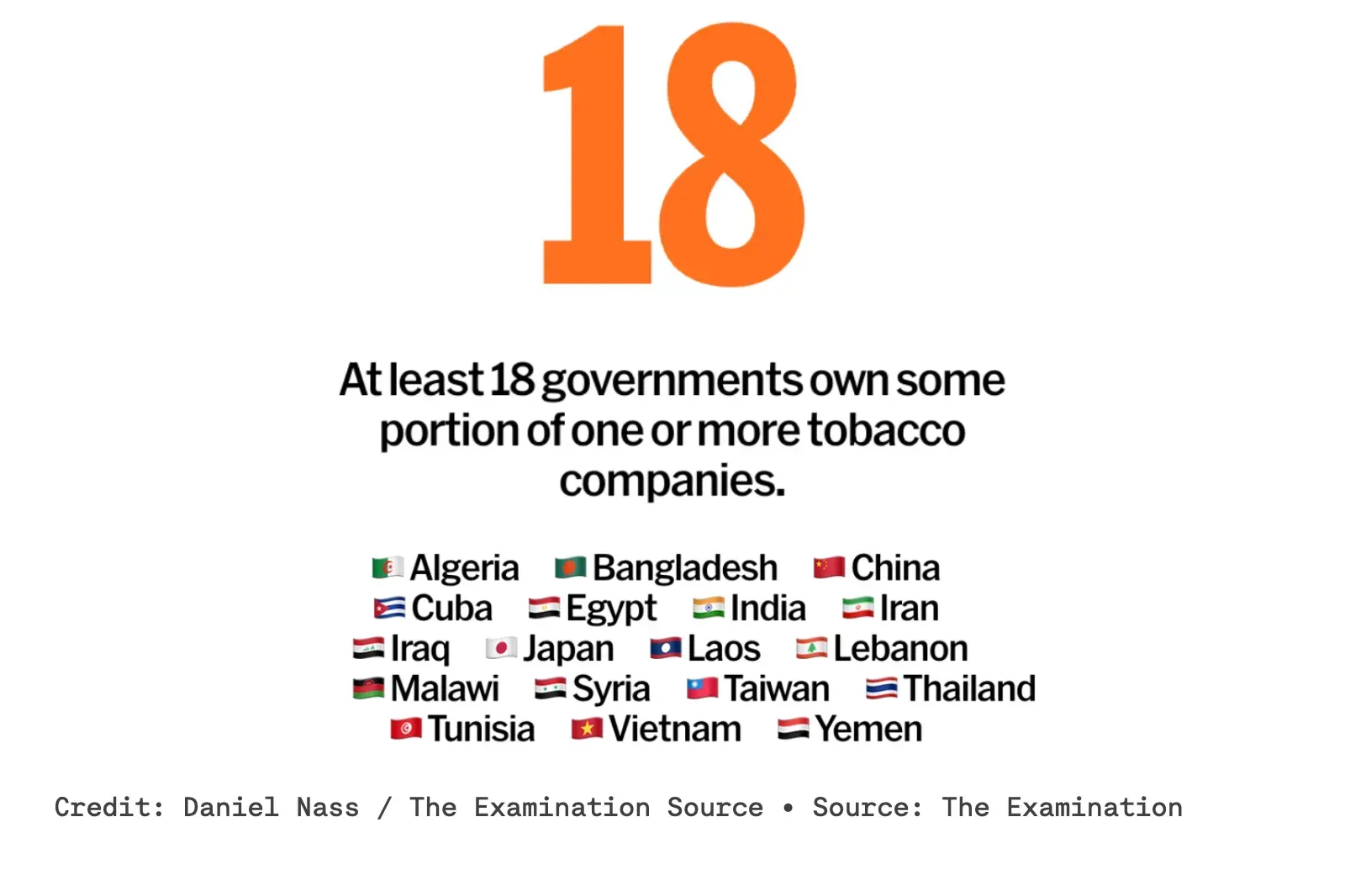
Several firms with state ownership, like those in Egypt and China, were built from the nationalization of private-sector tobacco companies. In countries such as Lebanon and Vietnam, the government owns the entire company, and tobacco provides a substantial share of government revenue. In others, like India and Algeria, the government is a minority shareholder.
When governments protect the cigarette industry
Our reporting on China, Egypt and Laos showed how state involvement in tobacco companies has shaped regulation, benefited insiders and kept prices low.
China’s massive state monopoly — it produces nearly half the world’s cigarettes — is highly successful at thwarting tobacco restrictions due to its integration into government policymaking. Its expansion into “low tar” cigarettes in recent years, a discredited marketing ploy banned in the U.S. and the European Union, is but one in a string of triumphs for the industry.
Egypt, facing an ongoing economic crisis, recently opened up its cigarette market and began selling some of the government’s stake in the former tobacco monopoly — but in a way that appears to mainly benefit Philip Morris International and a small group of politically connected insiders.
In Laos, an insolvent state monopoly was transformed by a 2001 joint venture with Imperial Brands, another Western tobacco giant. That deal did long-term harm to tobacco control efforts and secretly channeled millions of dollars to a family member of one of the country’s leaders, our investigation revealed. (Neither person responded to our questions.)
Despite high smoking rates, tobacco control efforts in those three countries are modest.
We sought comment from the governments of China, Egypt and Laos; none responded.
As for the tobacco companies, Philip Morris International declined to comment on the deals in Egypt. China Tobacco did not respond to questions. U.K.-based Imperial Brands said its investment in Laos had helped revive the country’s cigarette industry and that the company follows “all applicable compliance standards.”
Countries routinely ignore WHO guidelines
Nonbinding guidelines regarding the WHO tobacco treaty attempt to limit the effect of state ownership of these companies.
The guidelines state that governments should treat such companies like any other, with no incentives or preferential treatment. Decisions on health policies related to tobacco should be free of any influence from state-owned companies. Further, executives from state-owned tobacco companies shouldn’t be allowed to join government delegations at WHO meetings on the tobacco treaty.
Governments have certainly treated those guidelines as nonbinding. Japan’s foreign ministry has complained about higher taxes in Bangladesh that hit Japan Tobacco International. Lobbying by Lebanon’s state monopoly stalled advertising restrictions and the implementation of graphic warning labels in that country. In Laos, the government’s joint venture with Imperial Brands enjoys a range of incentives, including favorable income tax rates for executives and lower tariffs on imports of raw material.
China’s state monopoly is perhaps the most powerful. The government has routinely included three or more China Tobacco employees in its delegations to meetings about the WHO tobacco treaty. The government allowed the company to alter the treaty’s translation into Chinese in a way that weakens it. The cigarette giant has even been given a seat on the committee charged with setting tobacco control policy.
Thailand’s policies drive down sales of state-manufactured cigarettes
Thailand, however, is an outlier. The state-run Tobacco Authority of Thailand and Marlboro-maker Philip Morris International dominate the market, but it’s shrinking. Sales at TAOT, the successor to the Thailand Tobacco Monopoly, dropped by half between 2013 and 2022, according to the market research firm Euromonitor.
Helping fuel the decline: a series of stiff public health measures that raised cigarette taxes, required uniform packaging free of branding and mandated graphic warning labels.
As in Vietnam, China and other countries, current and former government officials have sat on the board of Thailand’s state-owned tobacco company. However, the company’s ability to influence health policy is limited because it is excluded from the government committee that sets tobacco control policy, according to the Southeast Asia Tobacco Control Alliance.
“Thailand is able to strengthen its tobacco control because there is political will” to adhere to the WHO treaty, the tobacco control alliance said in a 2019 report.
How state tobacco companies could put themselves out of business
While the global trend since the end of the Cold War has been for governments to privatize state cigarette makers, some in public health are discussing the idea that the public sector might return to the business as part of an “endgame” effort to wean smokers from cigarettes.
The idea is that governments could create nonprofit enterprises with a public health mandate to control the supply. Such enterprises would behave differently than China Tobacco or Lebanon’s monopoly, which have been particularly successful in maximizing cigarette sales.
Instead, the nonprofits could be modeled on the alcohol monopolies in Finland, Iceland, Norway and Sweden, which are credited with helping to keep consumption well below the European Union average. Though part of Europe’s “vodka belt,” the Nordic monopolies have slowed drinking by limiting the number of outlets, restricting retail sales hours and eliminating promotions and discounts.
Hogg acknowledged the apparent irony of a government-owned tobacco monopoly with a mandate to improve health. But he said it could work for the same reason that state-owned tobacco companies thrive in some countries.
“The argument is they have more control over the sale of an unhealthy product,” Hogg said. “If a government has control of the tobacco industry, it may be that there is some potential for it to be used for the benefit of health.”