Pulitzer Center Update January 2, 2026
When Content Creation Meets Investigative Journalism


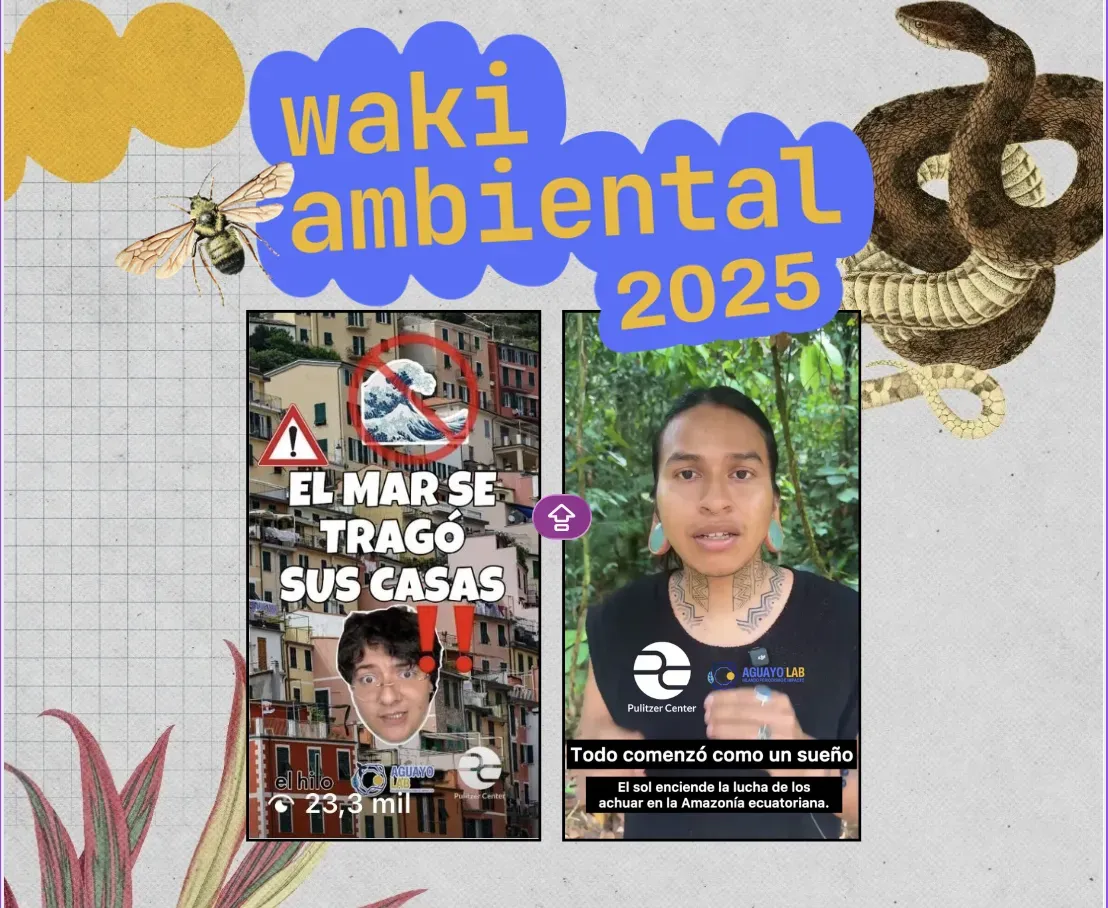
What happens when investigative journalism enters the world of social media content creation?
At first glance, it may seem like a natural alliance, two ways of telling stories, both driven by the instinct to inform. But the reality is more complex.
Journalism and content creation operate under different logics, rhythms, and expectations. Where creators rely on immediacy, emotion, and strong hooks to capture attention, journalism is grounded in verification, context, data, rigor, and careful reporting. When these worlds meet, friction is inevitable. But so is possibility.
That tension is where Waki Ambiental, a program supported by the Pulitzer Center, takes shape. Rather than smoothing over the differences between journalism and content creation, Waki Ambiental begins by acknowledging them and then asking what can be built in between.
Waki Ambiental explores how investigative reporting can travel further when it is thoughtfully re-imagined for digital platforms, without losing its rigor or ethical foundations. The initiative brings together content creators, journalists, and media organizations to create campaigns inspired by Pulitzer Center-supported investigations, while also investing in a shared learning process. Through workshops, sessions with journalists, and sustained collaboration, participants experiment with new ways of translating complex environmental reporting into formats that resonate with social media audiences.
The goal is not to turn creators into journalists, nor journalists into influencers. Instead, it is to create a common language, one that respects journalistic standards while recognizing the deep expertise creators bring.
Learning across different practices
Waki Ambiental emerged from a key question. During its first edition, the team at Aguayo Lab, the Pulitzer Center’s Latin America Outreach Program, realized it had made an important assumption: that creators already had training in journalism.
Many did not. Participants included scientists, environmental defenders, biologists, and activists, often with limited exposure to journalistic practices such as source attribution, ethical image use, or investigative workflows.
Rather than treating this as a limitation, Waki Ambiental reframed it as an opportunity. The program shifted toward training creators in the fundamentals of investigative journalism while learning from them in return about platform dynamics, audience trust, and creative experimentation. For many participants, this was the first time they worked with scripts, received editorial feedback, or directly collaborated with the journalists behind the investigations they were adapting.
From collaboration, to views, to lasting impact
These exchanges reshaped the work on both sides. Creators gained access to context, sources, and reporting materials that strengthened their content. Journalists, in turn, saw their stories reach new audiences in formats they might never have used themselves.
The results were tangible. Mexican creator Filiberto spoke about how working closely with journalist Francesc Badia i Dalmases deepened his understanding of the investigation he was adapting and enriched his creative process.
Colombian creator Sara, facing a lack of visual material for her video, collaborated with journalist Ernesto Picco, who shared archival footage and photographs that transformed the final piece.
Moi, a young creator from the Waorani Indigenous community in the Ecuadorian Amazon, cited journalistic sources for the first time during Waki Ambiental. That video became one of the most viewed on his profile, surpassing 1 million views.
Beyond metrics, what emerged was something more lasting: a shift in practice. Several creators began routinely citing sources, drawing inspiration from investigative reporting, and seeking out collaborations with journalists long after the program ended.
In a media landscape shaped by misinformation, polarization, and shrinking attention spans, these alliances matter. Investigative journalism remains the backbone of public-interest storytelling. Content creators, meanwhile, have the ability to connect, translate, and build trust with communities that traditional media often struggles to reach.
If you want to learn about our sessions, content, and metrics from this year, click here.
If you want to learn about our Waki Ambiental Network, click here.