Pulitzer Center Update October 29, 2026
What We Talk About When We Talk About AI
In San Francisco, AI billboards are a prominent feature of the landscape. They ask things like, “Are your APIs ready for AI agents?” One advises, “Stop hiring humans.” The ads seem to spread like an infection through a host body, and are no more welcome. The New York Times published a quiz where readers can test how many ads they understand, underscoring that most people find them unintelligible. Almost daily, plans emerge for a new data center somewhere in the U.S. and, for most, there’s a grassroots effort to block its development.
Amid this milieu, the Pulitzer Center partnered with UC Berkeley Graduate School of Journalism to present the “AI, Journalism, and Public Trust Symposium” on August 26, 2026. Pulitzer Center CEO Lisa Gibbs said that the organization developed their AI Spotlight Series to equip journalists across beats with skills to understand and interrogate how AI is rapidly transforming our world for better and worse.
The day began with “Reporting on AI,” a workshop for students taught by tech journalist and Pulitzer Center grantee Khari Johnson.
Johnson opened with a history lesson, defining and contextualizing the term “artificial intelligence” from its origin in the 1960s through the boom that began in 2022 with the public release of ChatGPT.
He also conveyed the scale of the boom, which eclipses the cost and pace of spending for the Apollo program that sent the first man to the moon, even when adjusted for inflation. Money and power came up during every session of the day, beginning with Johnson noting that some of the world’s wealthiest companies are driving the vision for what AI should look like in the U.S.
Johnson presented frameworks for reporting AI accountability stories ranging from environmental impacts of data centers to bias in large language models. He highlighted common mistakes reporters make. Most importantly, he said, reporters often forget that tech stories are stories about people.
“ People develop the technology,” Johnson said. People are impacted by the technology. People make the decision to deploy the technology.”
Johnson said there are many untold public interest AI stories, and he invited the journalists in the room to join the work.
Tim Lane, a Master of Journalism student at UC Berkeley, said the session helped him understand AI as technology and as a social phenomenon.
“It’s hard–living in the belly of the bubble ... to step back and contextualize it,” Lane said.
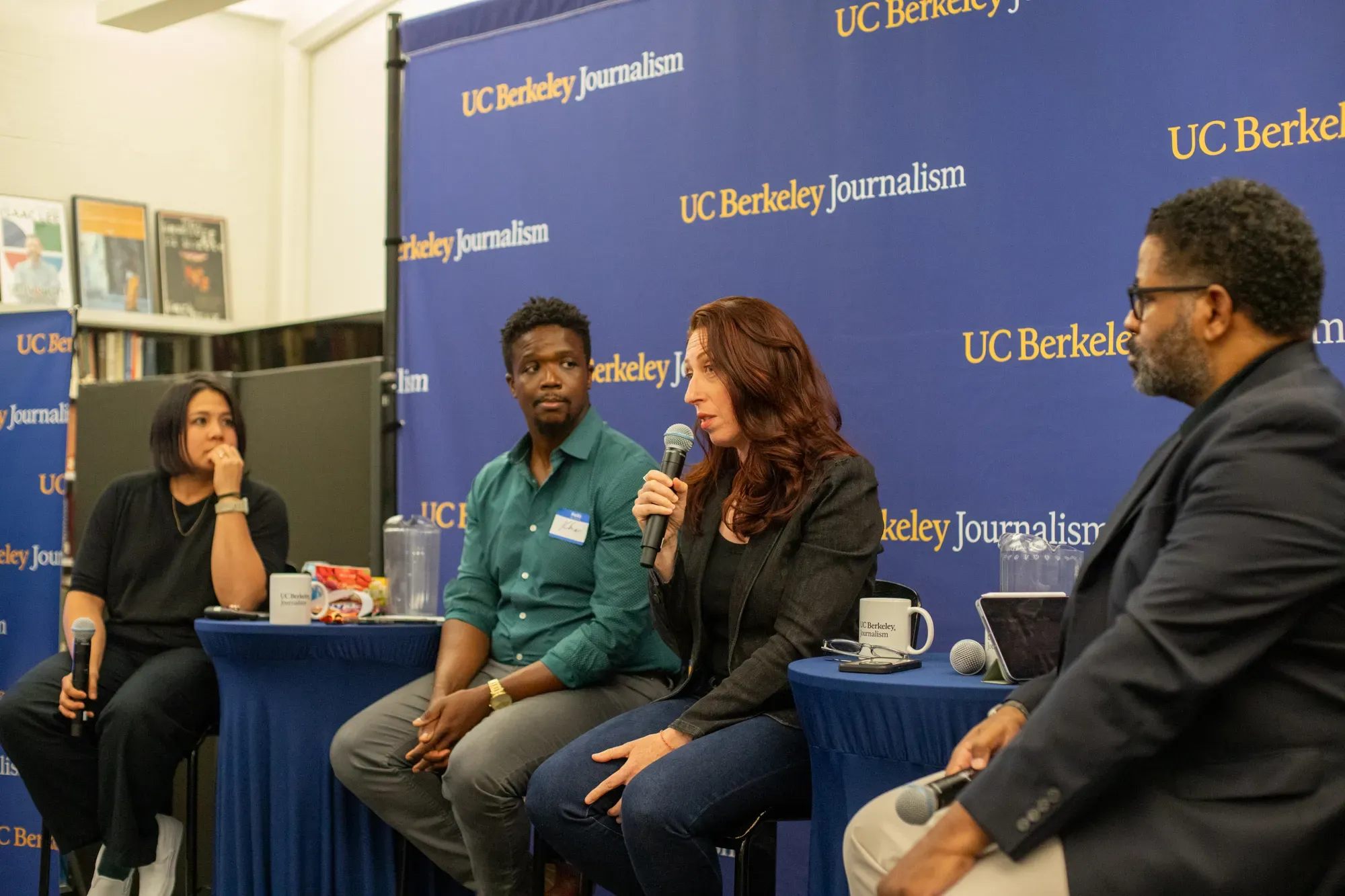
In the second session, “Reporting on AI: Ethics, Accountability, and Human Impact,” Johnson spoke on a panel with fellow Pulitzer grantees Garance Burke and Lam Thu Vo.
Vo began reporting on AI in 2016, when Russian-created misinformation and disinformation social media videos influenced the U.S. presidential election. She said for a few years, reporting on disinformation was a hot topic.
But since about 2019, Vo said, most outlets “stopped paying attention to it, but the problems have gotten worse.”
She described ‘slopfluencer’ scammers who prey upon immigrants by flooding their social media feeds with dozens of daily AI-generated videos.
Covering this information crisis pushed Vo beyond conventional reporting. She partnered with a Vietnamese community organization in Oakland to develop a workshop on navigating one’s media landscape and choosing trustworthy information sources. Vo has delivered 60 workshops in Vietnamese communities across the U.S. and is working on workshops for other immigrant populations.
Garance Burke is an investigative reporter at AP News, where she reports on AI and government accountability. She said public education drives much of her tech reporting.
Like Vo, Burke was also inspired to reach beyond her usual mode of reporting; she wrote a new chapter of the AP Stylebook to empower other journalists to report on AI. It provides a primer of definitions and sample questions to ask at press conferences with a goal of helping the public understand how technologies work and their human impacts.
The evening closed with a conversation between W. Kamau Bell and Michael Bolden, dean of the UC Berkeley Graduate School of Journalism.
As a comedian and culture critic, Bell said he feels one of his main jobs is to listen to Democracy Now! and other news outlets and think about, “How do I make this funny?”
Through humor, Bell aims to share important information with people who don’t consume news like he does. He posts about AI on his Substack and social media channels.
“Part of the work you’re doing is keeping the human cost in the conversation,” Bolden said.
Their conversation spanned how Bell navigates parenting in the age of social media, how he sees money corrupting the potential for beneficial uses of AI, and instances when generative AI tools have gotten things wrong about him personally.
Bell said back in 2023, he was featured in a Vulture story in which the magazine prompted an AI chatbot to generate a comedy routine in Bell’s style.
The routine was long, but never mentioned race, Blackness, America, or politics, he said—all topics at the heart of his work.
“ I was like, ‘Oh, AI doesn't have any Black people in there anywhere,’" Bell said.
Bolden asked Bell, “As a comedian and storyteller, what do you think a machine fundamentally fails to understand about human art and comedy?”
After a pause, Bell responded with a question. “Why would the goal be for a machine to understand?”
For Bell, the struggle of making art is part of the fun.