Pulitzer Center Update August 27, 2026
Pulitzer Center Reporting Warned of Glaciers’ Risk Before Nepal Flooding Tragedy

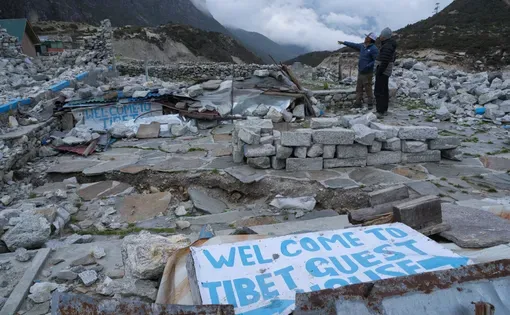
Floods are becoming increasingly common across the Himalaya as soaring temperatures are melting...

CCTV footage showed floodwaters and debris sweeping through Gyirong Port near the Nepal-China border on Wednesday, after massive flash floods struck the area. pic.twitter.com/h6scjr9UV5
— The Associated Press (@AP) August 27, 2026
The search for hundreds of people missing along the Nepal-China border after deadly flooding continued on Thursday, reports say. A glacier collapse a day earlier is being blamed for the horrific tragedy, which sent people running for their lives as floodwaters several stories high tore through Nepal.
Nearly 400 people were killed and more than 1,400 are missing, Nepal police told the Associated Press. Among the victims are scores of foreigners, including dozens of missing Americans. Hundreds have reportedly been displaced in the Himalayan region.
With shocking video of the flooding being broadcast around the world, missing victims’ families wait desperately for news. Asmita Dahal, who lives in Nepal’s capital, Kathmandu, told CNN her family is “hoping for a miracle” for her missing brother, 21-year-old Suman Dahal, who works for a tour group bringing pilgrims to Mount Kailash in Nepal. “We are worried his bus might have been swept away in the flooding, we just don’t know,” Dahal said, according to CNN.
While scientists are still looking into the cause of the flooding, CBS says, a glacier collapse likely caused the horrific flooding. As The Guardian reports, the U.S. Geological Survey said a glacial collapse registering as a magnitude 5.2 seismic event occurred near the border between Nepal and China at 8.37a.m. local time on Wednesday.
The flooding tragedy comes as Nepal, like other nations around the world, is struggling with the effects of climate change. For 20 years, the Pulitzer Center has supported coverage of all angles of the climate crisis, including reporting on warnings about events like the Nepal flooding:
- “A Dead Glacier Is a Loss. A Dying One Is a Threat”: Melting ice from the Himalayas is creating thousands of unstable lakes, a growing menace to towns and cities below, according to a report written by Jason Gulley, Raymond Zhong, and Bora Erden for The New York Times.
- "Living in the Shadow of Glaciers and Dams: A Himalayan Ticking Time-Bomb": In 2023, a glacial lake outburst flood in Sikkim, India, destroyed a dam and killed 57 people living downstream. As the government rebuilds the dam, journalists in a video report for Scroll travel to Sikkim and West Bengal to find out what it means to live in the shadow of glaciers.
- “Melting Glaciers Are Causing Billions of Dollars of Damage”: Thawing ice, from the high peaks to the poles, is producing extraordinarily expensive floods, infrastructure damage, and losses to tourism and fishing, Ocean Reporting Network Fellow Alec Luhn reports from Azerbaijan for Scientific American.
- “A Glacier-less Future?”: As global temperatures have risen, the Cordillera Blanca’s glaciers in Peru have shrunk, and towns receive diminishing flows of freshwater from glacier-fed rivers. Marco Garro and Mitra Taj show the effects in dramatic photos for ReVista.
No place on Earth seems to be spared from the climate crisis. For more Pulitzer Center-supported reporting on the environment and climate change, click here.