Pulitzer Center Update November 12, 2026
Pulitzer Center and Partners Launch AI-Powered Tool To Track Illegal Mining in Africa
Country:

What a brutal shock I had when I hovered over the satellite map of the Kambele forest in eastern Cameroon in 2021. I was investigating gold mining in the Cameroon rainforest in collaboration with Code for Africa. The satellite images showed large holes in the middle of the forest, and these holes had been expanding over the years. Plots of land once covered by forest had been transformed into artificial lakes filled with mud because of gold mining. To date, hundreds of people have died trapped in these abandoned open mine pits.
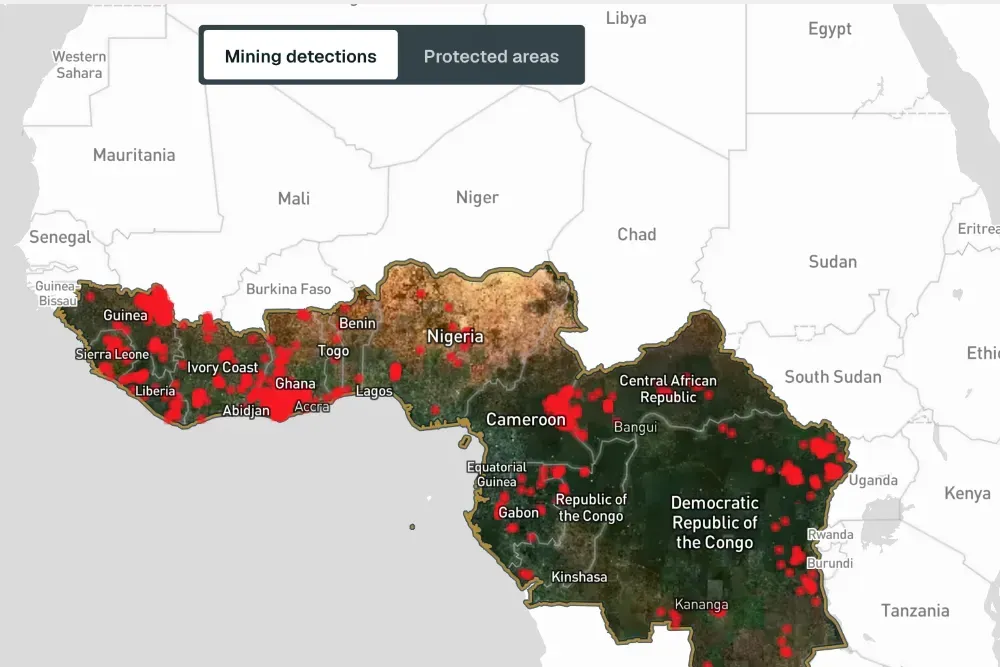
Kambele, like many territories in Africa, is suffering from the negative impacts of the rush for mineral resources extraction. You can see a snapshot of the situation by looking at the red dots on the Africa Mining Watch platform, a new AI-powered tool created by the Pulitzer Center and its partners Earth Genome and Code for Africa.
Africa Mining Watch tracks mining activities in 13 countries across West and Central Africa. It also provides users with data on the overlap between mining operations and protected areas.
The tool draws from the success of Amazon Mining Watch, the first initiative of the Pulitzer Center and Earth Genome that maps gold mining in Amazonian countries.
In recent years, the Pulitzer Center has been a key actor in exposing the damage of mining in Africa. From the Congo Basin to West Africa, the Center has supported several investigations led by African and international journalists, highlighting the impact of mining operations on the environment and local communities.
For example, the Center-supported project Ghana's Lost Forests—by journalists Ibrahim Khalilulahi Usman and Jennifer Ambolley—uncovered the alarming impact of illegal gold mining on Ghana’s vital forest ecosystems in West Africa.
Grantee Ed Davey’s project West Africa's Disappearing Rainforests reported on a similar situation, showing how Liberia’s biggest gold miner has destroyed rainforests, displaced wildlife, and poisoned waterways.
In the Congo Basin, Rainforest Investigations Network Fellow Jonas Kiriko uncovered how mines overlap with Indigenous communities’ forests in his project Mining Threatens Community Forests in the DRC. Kiriko combined field trips and satellite imagery analysis and found encroachment between mining sites and communities.
The Pulitzer Center wants to seize the opportunity offered by satellite imagery and artificial intelligence to strengthen such investigative approaches across Africa. That is why the Center is collaborating with key partners to launch Africa Mining Watch.
We saw that it was possible to use Earth Index, the technology behind Amazon Mining Watch, and replicate this model in the African context. However, we took it a step further, starting with a community of users.
In April 2026, 25 African journalists from West and Central African countries joined geospatial experts in a full-day online mapathon, a collaborative online mapping event. During the mapathon, participants used their contextual knowledge on the mining operation in Africa to train Earth Index to detect mining activities in West and Central Africa.
They also used the tool to strengthen ongoing investigations. In the project The Gold Slaves of the Sahel, grantee Abdullah Tijani used knowledge from the mapathon to track illegal mining sites in Nigeria and Niger and uncovered how illicit economies led by armed groups are fueling the gold trade and human exploitation in the Sahel. The reporting earned Tijani a 2026 Kurt Schork Award in International Journalism.
Our partner Code for Africa, the continent’s largest network of civic technology and data journalism labs, produced an Africa Mining Watch toolkit and moderated a community of users on Slack.
On November 11, 2026, the Pulitzer Center officially launched Africa Mining Watch in Nairobi, Kenya, at the African Investigative Journalism Conference. Kiriko and Tijani presented how they use Africa Mining Watch in their investigations.
Our aim is to continually update Africa Mining Watch, strengthen our community of users, and elevate mining issues to the forefront of global discussions.
Africa Mining Watch also addresses the challenges many reporters across the continent face in accessing information. I encourage African journalists to embrace this tool, using it either as a starting point for their investigations into mining or to find evidence to support sources’ claims.

Madeleine Ngeunga
Regional Editor, Africa
This message appeared in the November 13, 2026, edition of the Pulitzer Center's weekly newsletter.