Pulitzer Center Update September 4, 2026
Power and People: In Ethiopia, Pulitzer Center Journalism Leads to Conversations for Change
Country:

In Ethiopia, radio remains one of the most accessible ways for communities to access information, exchange ideas, and engage with issues affecting their daily lives. For EMMA Radio & TV Media PLC, broadcasting investigative journalism is not simply about putting a story on air. It is about creating a space where evidence can be questioned, experiences can be shared, and communities can begin imagining solutions together.
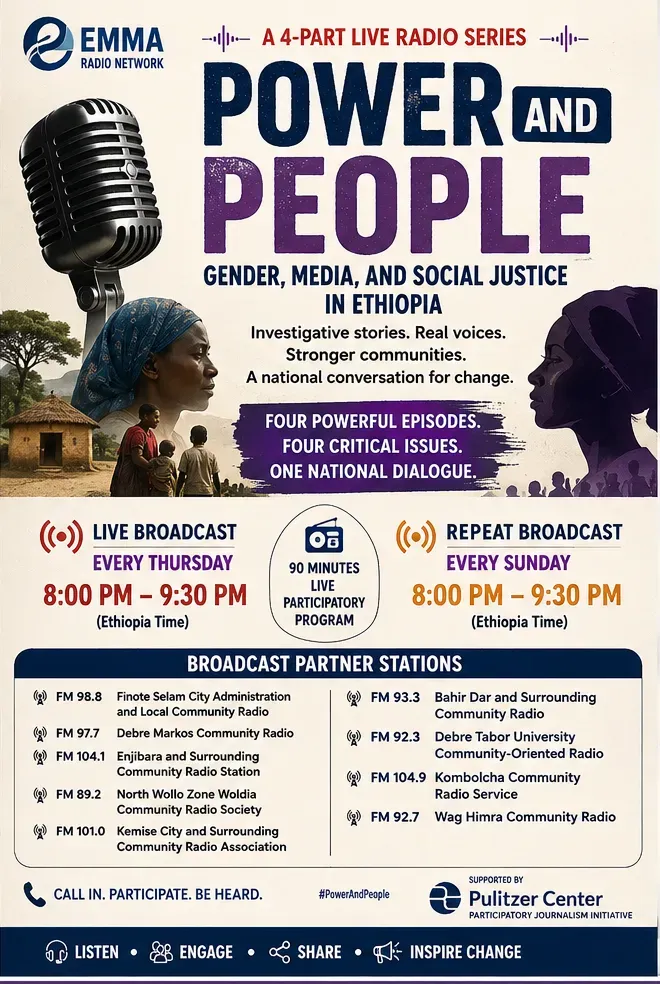
Through the Power and People: Gender, Media, and Social Justice in Ethiopia series, EMMA Radio transformed Pulitzer Center-supported investigative reporting into a participatory radio program on maternal healthcare, domestic violence, gender justice, mental health, and community accountability.
Implemented May-July 2026, the initiative brought together radio audiences, community leaders, health professionals, women’s organizations, youth, psychologists, legal practitioners, journalists, and local influencers through a combination of live radio broadcasts, digital engagement, community listening sessions, and Coffee Ceremony Listeners’ Reflection Clubs.
From investigative reporting to public dialogue
The project was implemented with support from the Pulitzer Center, which seeks to extend the impact of investigative reporting by creating opportunities for communities to interpret, discuss, and respond to the issues uncovered by journalists.
EMMA Radio built its project around three Pulitzer Center-supported investigations addressing gender and social justice in Africa:
- Taiwo Adebulu’s "Rural Women Hit Hardest by Nigeria’s Worsening Healthcare Crisis" examines the structural barriers rural women face in accessing maternal healthcare.
- Moraa Obiria’s "Nairobi to Kigali: How East African Nations Are Tackling Domestic Violence" looks into survivor support systems and responses to domestic violence across East Africa.
- Moraa Obiria’s "Shhh … My Wife Beat Me Up! When Men Endure Abuse in Silence" explores the stigma and institutional barriers faced by male survivors of domestic violence.
Rather than simply translating the investigations or reproducing them as radio stories, EMMA Radio used them as editorial foundations for Ethiopian conversations.
Key findings, testimonies, evidence, and questions from the investigations were translated into Amharic and placed alongside Ethiopian experiences. Experts and community members were then invited to examine what these stories could teach audiences about challenges within their own communities.
This approach allowed audiences to see that although the investigations originated in Nigeria, Kenya, Rwanda, and other African contexts, many of the structural questions they raised were relevant to Ethiopia as well.
Four conversations, one participatory journalism model
The initiative. a four-part radio series, addressed interconnected questions of health, gender, justice, and community participation.
"When a Mother’s Journey to Survive Takes Hours": The first program examined the barriers rural women face in accessing maternal healthcare. Drawing from Adebulu’s investigation, the program explored how distance, poor roads, shortages of healthcare workers, inadequate facilities, medicine shortages, and weak emergency referral systems can place women at risk. The Ethiopian discussion moved beyond the Nigerian context to ask what similar challenges look like in Ethiopia and how communities, health workers, and public institutions can respond. Listeners participated through telephone calls, messages, social media comments, and community discussions, sharing experiences and raising questions about maternal healthcare in their own communities.
"Behind Closed Doors": The second program examined domestic violence as a public health, human rights, and community issue. Inspired by Obiria’s reporting on responses to domestic violence in Kenya, Rwanda, and Uganda, the program brought the conversation into an Ethiopian context. Female leaders, legal professionals, social workers, community representatives, and other stakeholders discussed barriers that prevent survivors from reporting abuse, the limitations of informal mediation, and the importance of accessible legal and psychosocial support. The discussion also explored how communities can move from treating domestic violence as a private family matter toward recognizing it as an issue requiring protection, accountability, and institutional response.
"The Men Nobody Believes": The third program addressed the often-invisible experiences of male survivors of domestic abuse. Based on Obiria’s investigation into men who endure abuse in silence, the program examined how social expectations around masculinity can discourage men from reporting violence or seeking psychological support. Psychologists and other experts discussed the relationship between stigma, mental health, family conflict, and help-seeking behavior. Because of the sensitivity of the issue, EMMA Radio also used anonymous digital engagement mechanisms to give audiences safer ways to contribute without publicly identifying themselves. The approach demonstrated an important lesson for participatory journalism: The format of participation must adapt to the sensitivity of the issue being discussed.
"From Pain to Power": The final program brought together lessons from the three investigations and the conversations generated throughout the project. Rather than introducing another investigation, the program asked audiences to consider what could happen when communities move from identifying problems to developing solutions. The discussion explored community participation, gender equality, health accountability, youth engagement, media responsibility, and the role of citizens in shaping responses to social challenges. The program also provided an opportunity for listeners and community participants to reflect on the series and suggest issues for future public-interest reporting.
Turning radio listeners into participants
A defining feature of the project was its effort to move beyond conventional broadcasting. Each program incorporated opportunities for audience participation through live telephone calls, SMS, Facebook comments, Messenger, voice notes, and online discussions. This allowed audiences to respond directly to experts, share personal experiences, challenge assumptions, and propose solutions.
The project reported approximately 450,000 people reached across its broadcast and digital platforms, with 3,420 people actively engaging through interactive channels such as SMS, live phone-ins, and Telegram discussions.
A separate post-broadcast digital survey involving 1,200 respondents also indicated strong audience support for the approach. According to the project’s findings, 91% of respondents said that integrating Pulitzer Center-supported international investigations strengthened their understanding of structural challenges in their own communities, while 94% expressed a desire for the radio station to continue using cross-border investigative journalism to support local accountability.
Coffee Ceremonies become spaces for public dialogue
One of the project’s most distinctive elements was the creation of Coffee Ceremony Listeners’ Reflection Clubs. The model drew on Ethiopia’s long-standing coffee ceremony tradition as a familiar setting for community discussion, reflection, and exchange.
After broadcasts, participants gathered in community spaces to listen to program recordings, watch selected documentary material, and discuss the issues raised through the investigations. Participants included women, youth, teachers, community elders, journalists, health professionals, religious leaders, civil society representatives, and local influencers. Rather than functioning as formal training sessions, these gatherings created culturally familiar spaces where participants could discuss sensitive issues more openly.
The discussions also provided EMMA Radio with an additional feedback mechanism. Community members could identify questions that remained unanswered, describe how the issues affected their communities, and suggest areas for future programming.
In this way, the listening clubs created a feedback loop: investigative reporting → radio discussion → community reflection → audience feedback → continued programming.
Connecting communities across Ethiopia
The initiative also expanded beyond EMMA Radio’s immediate audience through collaboration with community radio partners, including stations in Bahir Dar, Debre Tabor, Finote Selam, Debre Markos, Enjibara, Woldia, Kemise, Kombolcha, and Wag Himra. This network allowed the project to extend conversations beyond Addis Ababa and reach audiences in different regional contexts.
For partner broadcasters, the project also provided an opportunity to observe how international investigative journalism could be translated, contextualized, and transformed into locally relevant public-interest programming. The approach created a model that other community radio producers could potentially adapt to their own audiences and issues.
When evidence leads to difficult conversations
The project generated several moments that demonstrated the potential of participatory journalism to challenge established assumptions.
During a community discussion in Hawassa, for example, a traditional elder reflected publicly on the limitations of treating domestic violence primarily as a family matter. The discussion encouraged participants to reconsider the role of traditional mediation when serious violence is involved and to examine how community practices can evolve to better protect survivors.
Other discussions focused on practical questions surrounding maternal healthcare, including transportation, emergency referrals, health infrastructure, and community support. These conversations illustrated the project’s broader objective: not simply to inform audiences about problems, but to create opportunities for communities to ask what should happen next.
Adapting participation to sensitive issues
The project also encountered challenges. The discussion on male survivors of domestic violence initially generated lower levels of direct call-in participation because potential contributors were concerned about stigma and public exposure. EMMA Radio responded by introducing more anonymous participation mechanisms, including digital suggestion boxes and text-based channels. This adjustment demonstrated the importance of designing participation around the realities of the audience.
For sensitive issues, traditional call-in formats may not always be sufficient. Anonymous digital tools can create safer opportunities for people to share experiences and questions that they would otherwise keep private. The experience became an important lesson for future participatory journalism programming: Meaningful participation requires not only an invitation to speak, but also an environment in which people feel safe enough to do so.
Beyond the four broadcasts
Audience interest continued beyond the flagship programs. EMMA Radio extended the initiative through additional Amharic-language discussions, community reflection programs, benchmark broadcasts, and a closing program focused on lessons learned and future community engagement.
These additional programs revisited issues raised during the main series, including community accountability, women’s leadership, youth participation, media responsibility, social justice, and citizen engagement. The extended programming demonstrated that the original broadcasts had generated questions and conversations that could not be contained within a single 90-minute program. Instead, the project evolved into an ongoing public conversation.
Conclusion
Power and People: Gender, Media, and Social Justice in Ethiopia demonstrates the potential of participatory journalism to transform investigative reporting from a finished product into an ongoing process of public engagement. By placing Pulitzer Center-supported investigations at the center of live radio discussions, community listening sessions, digital conversations, and local reflection, EMMA Radio connected cross-border investigative evidence with Ethiopian realities.